

The public story about how hospitals deal with impaired clinicians is mostly fiction.
The real system is quieter, more political, and a lot messier than anyone tells you in ethics lectures.
Let me walk you through how it actually works when a doctor or nurse shows up impaired, burned out to the point of danger, or sliding into addiction—while still treating patients.
The Official Story vs. What Really Happens
On paper, every hospital has pristine policies:
– Zero tolerance for impairment.
– Mandatory reporting.
– Immediate removal from duty if there’s any patient safety concern.
Those policies sit in binders, on shared drives, and get flashed on PowerPoint slides once a year during mandatory training.
In practice, what really happens is a negotiation between four forces:
- Protecting patients (the part everyone talks about).
- Protecting the institution from liability (the part risk management obsesses over).
- Protecting reputations of “valuable” clinicians (the unspoken priority).
- Protecting the informal culture of medicine (the “we handle our own” mentality).
That’s why you’ll see radically different responses depending on who’s impaired, how indispensable they are, and who happens to witness the problem.
A resident slurring during pre-rounds? Handled one way.
The top revenue-generating cardiologist doing the same thing? Very different playbook.
How Impairment Actually Gets Noticed
Most cases do not start with a formal report. They start with whispers.
Someone on nights notices:
– A colleague smelling of alcohol.
– Repeated narcotic “waste” discrepancies.
– Charting that makes no sense at 3 a.m.
– A surgeon whose hands shake more than usual.
– A nurse who is “always in the bathroom” and somehow missing at critical times.
At first, people rationalize. “Long call.” “Stress at home.” “Just tired.”
Because once you say the word “impaired,” you create a problem for everyone.
The sequence I’ve seen dozens of times goes like this:
Informal concern phase
Side comments in the workroom. “Have you noticed Dr X seems…off?”
No one documents anything. They’re testing the water: am I the only one seeing this?Quiet checking phase
Someone starts reviewing the charts. Looking at med administration times.
Charge nurses or chief residents compare stories. They pull pharmacy logs.
They’re trying to decide: is this just burnout or something that will be indefensible if a patient gets hurt?First soft intervention
A “friendly” meeting:
– “You seem tired, everything okay?”
– “Do you need to step away for a bit?”
– “We’re worried about you.”The purpose here is not purely altruistic. It’s also to create a record that someone noticed and “addressed concerns” before things blow up.
Only if things escalate—or there’s an acute safety event—does it move into formal territory.
What Happens When It Gets Formal
The moment someone uses certain trigger words in an email or reporting system—“impaired,” “safety event,” “near miss related to clinician behavior”—a very specific machine turns on behind the scenes.
You rarely see the full machinery as a trainee, but it looks something like this.

| Step | Description |
|---|---|
| Step 1 | Front line concern |
| Step 2 | Informal checking |
| Step 3 | Remove from duty |
| Step 4 | Monitor quietly |
| Step 5 | Notify leadership |
| Step 6 | Occupational health eval |
| Step 7 | Referral to treatment program |
| Step 8 | Performance track |
| Step 9 | Return to work with monitoring |
| Step 10 | Acute risk? |
| Step 11 | Substance or health issue? |
You might think this is all driven by ethics committees. It’s not. The primary players are:
– Department chair or service chief
– Chief medical officer or equivalent
– HR
– Risk management/legal
– Sometimes the physician health program (PHP) or equivalent
Ethics committees get involved later, if at all, and usually only when someone wants extra cover for a controversial decision.
The “Quiet Removal” Playbook
When patient safety risk looks real, there’s a go-to maneuver: the quiet removal.
No dramatic scene. No public confrontation. That’s exposure, and exposure equals liability.
Here’s the pattern:
– The clinician is pulled aside by a senior: “We’re going to have you step away from clinical duties for today while we sort this out.”
– The schedule magically changes. Patients get reassigned, surgeries “rescheduled due to unforeseen circumstances,” consults rerouted.
– Administration calls it “leave,” “rest,” or “schedule adjustment.” Nothing goes into the chart or visible to patients.
– On the backend, there’s a flurry of emails about protecting incident reports, making sure documentation doesn’t explicitly state “impairment” unless absolutely necessary.
Risk management’s nightmare is discovery in a malpractice case showing:
“We knew Dr X was impaired and let them keep practicing.”
So, bluntly, the safer legal path for the hospital is to pull someone early once concern is documented in writing. That’s when they suddenly become decisive.
Before that? A lot of deliberate looking away.
Who Gets Protected, Who Gets Sacrificed
This is where the “ethics” you’re taught parts ways with the ethics that actually govern decisions.
You will see an unwritten triage system:
– High-value attendings (major billing generators, “famous” surgeons, long-tenured figures):
They’re offered every benefit of the doubt. Issues are framed as “health concerns” or “stress.” The path is: protect, rehabilitate, keep out of the news.
– Residents and fellows:
Far more expendable. The attitude is: “We have a duty to the profession.” Translation: It’s easier to remove you than to confront a big-name attending.
– Nurses and allied staff:
Often subject to more rigid HR processes. Less political capital, more replaceable in leadership’s eyes, so policies get enforced more strictly.
I have literally heard a chair say in a closed meeting:
“We’re not losing a surgeon who brings in seven figures a year over something we can manage quietly.”
Contrast that with how a PGY-2 is treated with similar concerns: referred to the PHP early, placed on leave faster, and watched like a hawk. Partly because GME is terrified of ACGME and accreditation risk.
Is that fair? No. Is it real? Yes.
How “Impairment” Gets Reframed
For legal reasons, hospitals hate the word “impaired.” It implies they knowingly let a dangerous clinician practice.
So the language gets sanitized:
– “Concerns about fitness for duty”
– “Possible health-related performance issue”
– “Behavior inconsistent with expected professional standards”
– “Fatigue-related performance gap”
The reframing does three things:
- Protects the hospital in future lawsuits.
- Gives more room to quietly shuffle someone into monitoring/treatment.
- Makes it more psychologically palatable to colleagues who want to help but do not want to label someone an “impaired doctor.”
You’ll see notes that say, “Removed from schedule for wellness reasons” when everyone in that room knows the real story involves fentanyl, vodka, or uncontrolled bipolar.
The Physician Health Program (PHP) Funnel
For doctors, especially in the US, the PHP is the disposal and rehab system rolled into one.
Hospitals love PHPs for one reason: they’re a shield.
“This is being managed through the appropriate professional channels” is code for “we handed it off and reduced our direct liability.”
The unwritten deal looks like this:
– You “voluntarily” agree to PHP evaluation (with the full knowledge that refusing may trigger mandatory reporting to the board).
– PHP does a very thorough evaluation (often including multi-day residential assessments).
– If they diagnose a substance use disorder or mental health condition, you get a monitoring contract: random drug tests, therapy, support group attendance, work limitations.
– The hospital coordinates with PHP and only lets you back with restrictions and ongoing monitoring.
Here’s the part medical students and early trainees don’t usually hear:
– A PHP contract can quietly save your career by keeping your case out of the full disciplinary board spotlight.
– But it can also chain you to a long, intrusive monitoring process that feels punitive, even when you’re doing well.
– And if you violate the contract, the PHP can and will report you to the board, and now it’s game over territory.
Hospitals prefer this path to formal discipline because it looks compassionate and professional, while still controlling risk.
The Ethically Ugly Middle Ground: “Borderline” Cases
The toughest cases—and the ones where patient safety gets compromised most—are not the obviously drunk surgeon or the nurse stealing fentanyl.
They’re the people in the gray zone:
– The intern who is clinically depressed, on four hours of sleep, making small but accumulating errors.
– The attending whose judgment is subtly off after a concussion or while adjusting to a new psychiatric medication.
– The chronically overworked covering hospitalist juggling way too many patients and missing things they would normally catch.
These cases almost never trigger the formal impairment pathways.
Why?
Because everyone else is also exhausted and half-broken. To call one person “impaired” invites the obvious question: where’s the line? Are half the staff “unfit for duty”?
So what happens instead:
– Minor errors are corrected without formal reporting.
– Co-residents and nurses “cover” for the struggling person, often to their own detriment.
– Well-meaning supervisors chalk it up to “residency is hard,” “this rotation is brutal,” “it’ll get better next block.”
Patient safety here is protected by the goodwill and overfunctioning of everyone around the impaired or depleted clinician. Until it’s not.
And when a serious adverse event finally occurs, the institution retrospectively reconstructs a narrative that makes it look like a single, isolated lapse rather than a systemic, chronic, foreseeable risk.
Mandatory Reporting: What They Tell You vs What They Do
You’re told you have an ethical and sometimes legal duty to report impaired colleagues. The AMA Code of Ethics, hospital policies, state laws—everyone sings that chorus.
Behind closed doors, the real cultural message is more complicated:
– “Talk to them first if you can.”
– “Loop in the chief or attending rather than going directly to a formal report.”
– “Be careful what you put in writing.”
There’s a reason attendings say things like, “Let’s discuss this by phone” when you email about a colleague you’re worried about. They know email is discoverable.
Here’s the contradiction you’re living in:
– Ethically and legally, ignoring clear impairment is indefensible.
– Professionally and culturally, being “the one who reported” can brand you as disloyal, dramatic, or naive.
Good leaders try to shield reporters from blowback. Bad leaders hang them out to dry.
I’ve seen residents subtly punished with worse schedules or quietly excluded from opportunities after “creating trouble” by reporting a beloved but impaired senior physician. No one will ever say that’s why. But you feel it.
The Malpractice Shadow
Folks almost never talk openly about this to you, but malpractice risk is the real engine behind many decisions.
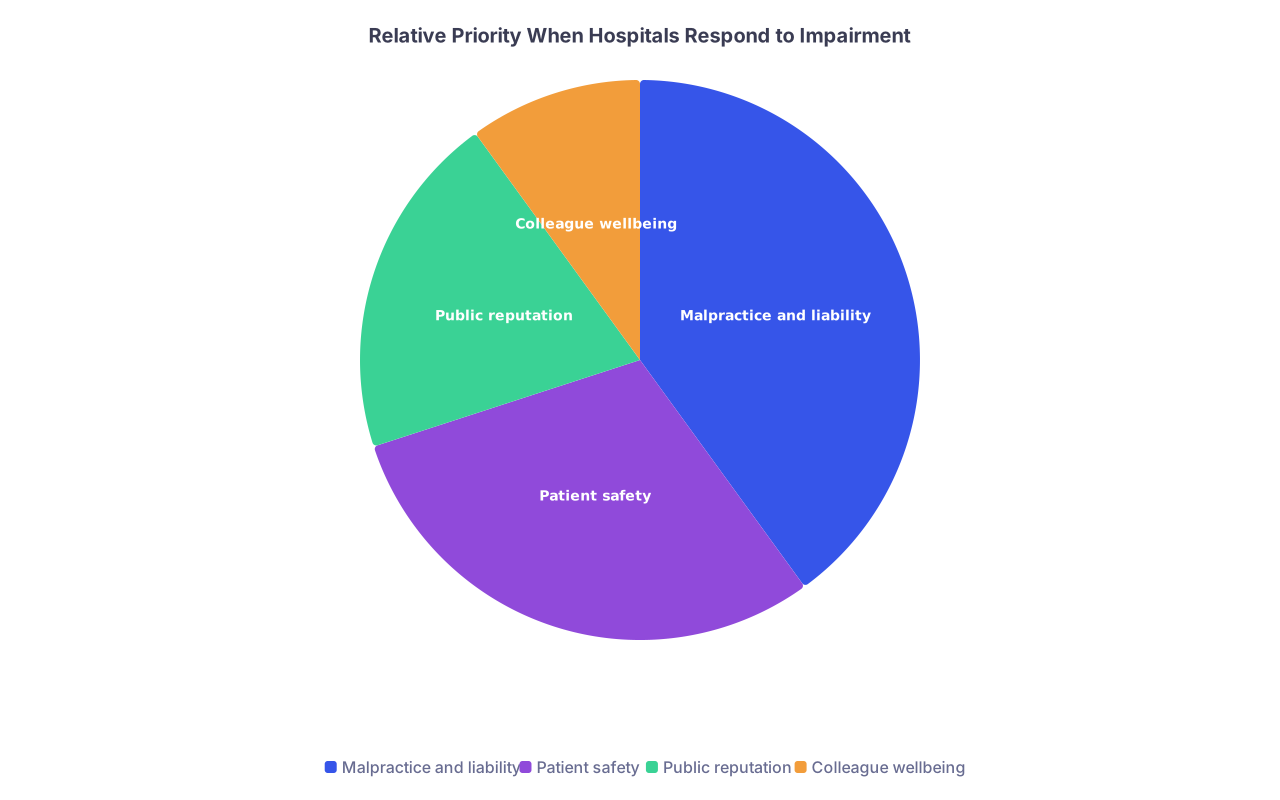
| Category | Value |
|---|---|
| Malpractice and liability | 40 |
| Patient safety | 30 |
| Public reputation | 20 |
| Colleague wellbeing | 10 |
When something goes wrong and an impaired clinician is involved, the hospital’s lawyers immediately ask:
– Did anyone know or suspect prior impairment?
– Is there any written record of concern that predates the event?
– Did we have policies, and were they followed?
– Can we demonstrate we acted promptly once we knew?
This leads to a very specific behavior pattern:
– Before a major event: everyone is careful not to document “impairment” too explicitly.
– After a major event: everyone is suddenly very interested in documenting all the “steps taken” and previous “supportive interventions.”
From a moral standpoint, it’s backwards. From a legal standpoint, it’s rational.
Protecting Yourself Ethically Without Getting Crushed
You’re stuck between your duty to patients, loyalty to colleagues, and the reality that institutions will protect themselves first.
So what should you actually do when you see a colleague who seems impaired or unsafe?
I’ll be blunt.
Do not ignore acute danger.
If someone is about to cut, prescribe, or order something while clearly impaired—step in. Directly. Even if it feels confrontational. “I’m not comfortable with this; I think we need someone else to take over.” That’s the line you can live with later.Loop in someone with positional authority early.
Chiefs, program directors, charge nurses, attending on call. You don’t need to label it “impairment”; you can frame it as, “I am concerned about safety and need help.”Be smart about documentation.
Incident reporting systems exist for a reason, and they do sometimes protect patients. But understand: once you put “impaired” in writing tied to a name, you have lit a fuse that cannot be unlit. Use that fuse when it’s truly warranted.Take your own moral distress seriously.
If you find yourself lying awake at 3 a.m. replaying a colleague’s behavior and wondering if you should have spoken up, that’s a sign. Talk to someone trustworthy with experience: a different attending, a mentor at another institution, the GME ombudsperson.Remember: silence will not protect you.
If a catastrophic event happens and it comes out that “everyone knew,” the institution will not line up to share blame. They will say: “We had policies. People were expected to report concerns.” They will throw anyone under the bus to survive.
The Quiet Personal Cost
The part nobody mentors you on: watching a colleague implode changes you.
You’ll see people you admired fall apart from addiction, depression, cognitive decline, or sheer burnout. Sometimes they come back stronger with real treatment and support. Sometimes they disappear from the schedule one day and are never mentioned again.
That erasure—the way institutions just “move on”—can feel almost as disturbing as the impairment itself.
If you’re not careful, you start hardening in the wrong ways. Becoming cynical, numb, or worse, starting to normalize impairment because “that’s just how medicine is.”
Do not romanticize working while broken. The “iron resident” myth is one of the most destructive lies in our culture. It’s not toughness; it’s negligence dressed up as heroism.
You want the insider rule? Here it is:
The best clinicians I’ve seen over long careers are the ones who set a hard line for themselves and others: if I’m not safe, I step back. If you’re not safe, I step in.
That’s the only sustainable ethic that doesn’t eventually wreck patients, colleagues, and you.

FAQs
1. Will I get in trouble for reporting an impaired colleague?
You shouldn’t. Most hospital policies explicitly forbid retaliation for good-faith reporting, and on paper you’re protected. In reality, subtle backlash can happen—socially or in how you’re treated. That’s why I tell people: document your concern through official channels when safety is at stake, but also talk with a trusted mentor or leader about the best way to raise the issue. If you ever end up in court or before a board, being the person who tried to protect patients is far safer than being the person who stayed silent.
2. How do I tell if it’s true impairment vs just burnout and fatigue?
You don’t need a DSM diagnosis to act. Focus on function and risk. Are they making unusual errors? Is their judgment noticeably off? Are they unable to complete basic tasks they normally handle? Are others independently concerned? You’re not the psychiatrist or occupational health evaluator; your job is to flag when something seems unsafe, not to label it. When in doubt, say: “Something feels off and I’m worried about safety.”
3. Can impairment be handled “quietly” and still be ethical?
Yes, sometimes. Quiet doesn’t automatically mean unethical. A clinician voluntarily seeking help, stepping away from duties, and working with a PHP or occupational health without public drama—that can be exactly the right thing. The line is crossed when “quiet” becomes “covering up known risk while the person keeps practicing in a way that endangers patients.” Protecting privacy is ethical. Hiding danger is not.
4. What if the impaired person is my supervisor or attending?
That’s the worst position to be in, and it happens more than people admit. Going directly at them is usually unsafe. Use the chain sideways or up: another attending you trust, the department vice-chair, your program director, the chief medical officer’s office, or the anonymous reporting system if there’s immediate risk. If it’s truly urgent and you’re getting stonewalled, the hospital operator can connect you to the administrator on call. Do not keep this solely on your shoulders.
5. How do I protect myself if I’m the one struggling?
First: do not wait until you’re clearly unsafe. The earlier you act, the more control you keep. Use confidential resources first—therapist, counselor, peer support, possibly your physician health program if you trust their approach. Ask about options for temporary leave or reduced duties framed as medical or personal leave, not “impairment.” And draw your own hard line: if you would be uncomfortable having a family member treated by you in your current state, you should not be treating anyone. Stepping back early is not weakness; it’s what actually preserves your license and your career long-term.
If you remember nothing else: hospitals handle colleague impairment in a way that first protects the institution, then selectively protects certain clinicians, and only consistently protects patients when someone has the spine to speak up. Your job is to be that person when it counts, and to refuse to practice when you know you’re the one who isn’t safe.


