
It’s 3:20 a.m. You’re a PGY‑2 on night float. You just admitted a crashing septic patient, signed out three pending CT scans, and you’re finally sitting down to eat something that qualifies as food mainly by temperature. Your phone buzzes with a message from a co-resident:
“Hey, did you hear? That bowel perf from last year filed a suit. They named the intern, the senior, and the night float. Check your email.”
Your stomach drops.
This is the moment everyone pretends they’re “sure will never happen to them” right up until it does. And here’s the part nobody tells you honestly in orientation: residents get named all the time. And the reasons you actually get named are not what the risk management slides claim.
Let me walk you through what really gets you dragged into a lawsuit as a resident — from the perspective of people who sit in M&M, risk committees, and yes, defense prep sessions with residents whose names are now on legal paperwork.
First: How Your Name Ends Up on That Paper
You will hear this at some point: “Don’t worry, they always just sue everyone. Your name doesn’t really matter.” That’s half true, and dangerously comforting.
Here’s how it really happens behind the scenes.
How plaintiff attorneys decide who to name
Most plaintiff firms work like this. They get a call: “My mom died at [Your Hospital].” They order the medical records. A paralegal or nurse consultant sits down with a 2,000-page chart, a highlighter, and a spreadsheet.
They go line by line through the chart and log:
- Every provider who wrote a note
- Every provider who entered an order
- Every provider listed in the H&P, consult, or operative reports
Then they ask two questions:
- Who touched the patient in the time window where things went wrong?
- Whose name appears close to the alleged bad outcome?
Those names go on the initial complaint. That includes attendings. But also residents. And sometimes students.
They are not reading your note thinking, “This resident seems nice and reflective.” They’re thinking, “Is this a person I can say failed to meet the standard of care?” If your name is there in a pivotal 12–24 hour window, you’re likely on the list.
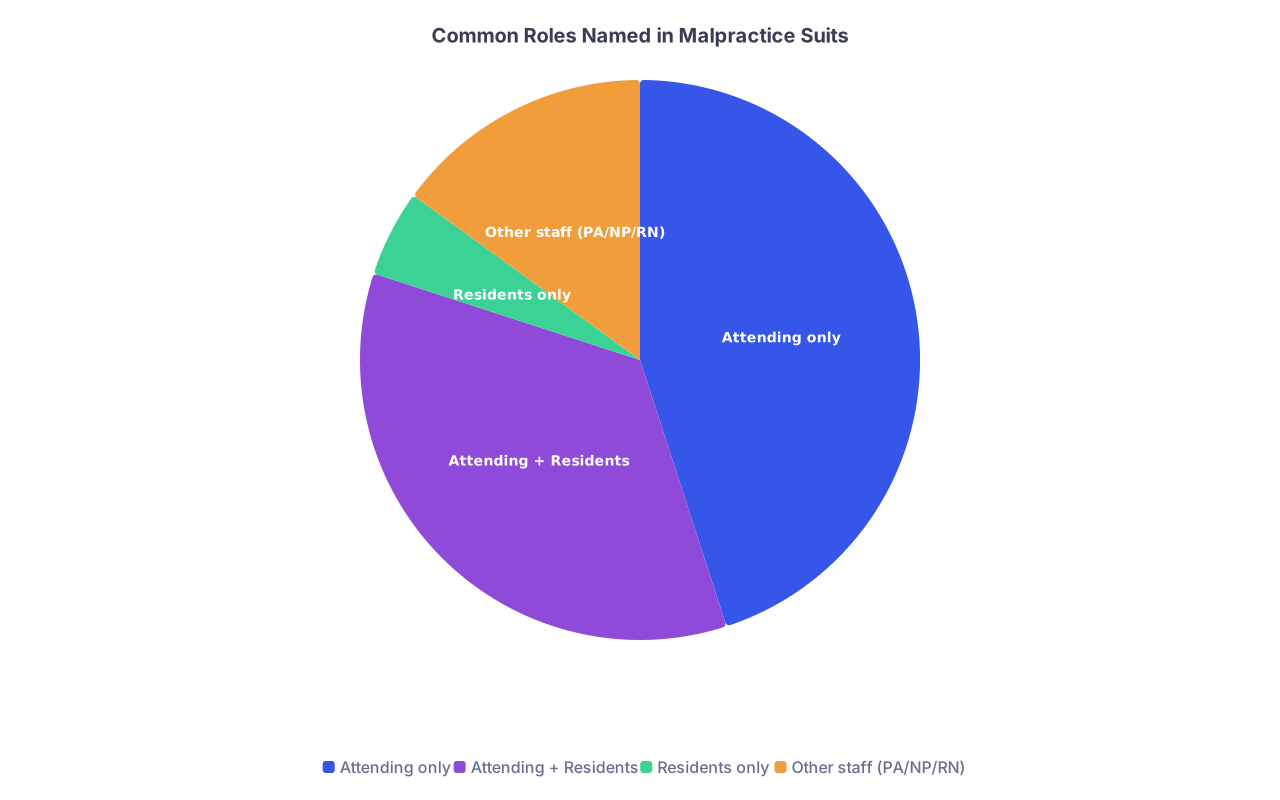
| Category | Value |
|---|---|
| Attending only | 45 |
| Attending + Residents | 35 |
| Residents only | 5 |
| Other staff (PA/NP/RN) | 15 |
The surprise for many residents? A decent chunk of cases name residents explicitly. Especially at academic centers where attendings co-sign but residents drive the care minute-to-minute.
Now let’s get specific. Because there are patterns. I’ve seen the same fact patterns over and over in risk review.
The Real Triggers: What Actually Gets You Named
I’ll cut the fluff. These are the things that most commonly land a resident on the lawsuit caption.
1. Sloppy or arrogant documentation in a bad outcome
You can do an okay job clinically and still destroy yourself with your note.
The lawyers are hunting for phrases they can weaponize. And residents give them ammunition constantly.
These lines, directly pulled from resident notes in litigated cases, come up over and over:
- “Patient refusing care. Educated extensively.” (With zero details what was actually said.)
- “Likely anxiety. Low suspicion for serious pathology.” (In the chest pain patient who later had an MI.)
- “No acute distress.” (Documented about a hypoxic patient on 4 liters nasal cannula, sat 89%.)
In a deposition, plaintiff counsel will put your note on a screen and go line by line:
- “Doctor, you wrote ‘likely anxiety.’ What cardiac workup did you exclude before deciding this was anxiety?”
- “You documented ‘educated extensively.’ What exactly did you say? What alternatives did you offer? What risks did you explain?”
If you can’t answer, it looks like you were hand-waving and covering yourself, not actually thinking. That makes you an attractive defendant.
The documentation sins that get residents named:
- Overconfidence: “Stable for discharge” with minimal workup, weak vitals, or concerning complaints.
- Template abuse: Complete ROS marked “negative” on a septic, obtunded, or minimally interactive patient.
- Retroactive CYA: Obvious backfilled notes after a bad outcome, with language that doesn’t match the actual time stamps of orders and vitals.
You want the ugly truth? Risk management people sit in rooms with plaintiff attorneys and watch them tear residents apart over phrases that were clearly there “to sound good” instead of to reflect reality.
2. Ignoring nurses and consultants (and it’s documented)
Residents get named a lot when there is a documented pattern of someone else seeing the danger and the resident being the blocker.
The chart usually looks like this:
- 02:10 – RN note: “Patient increasingly short of breath, BP 88/54, MD notified.”
- 02:25 – RN note: “MD aware, no new orders.”
- 04:05 – Rapid response called.
- 04:20 – Code Blue.
Guess whose name gets circled in red highlighter by the plaintiff attorney?
When nurses chart “MD notified,” that’s not a casual thing. It’s an evidentiary landmine. If your only response was a verbal “we’ll watch it,” and you didn’t document your reasoning, you are extremely exposed.
Same with consultants.
Example from a real case:
Surgery resident: “No indication for emergent surgery at this time; will follow.”
Medicine resident: “Surgery to evaluate in AM, stable for ward.”
Patient perforates six hours later.
The plaintiff argument writes itself: Two doctors, two notes, one avoidable delay.
You get named not just for the decision, but for the disconnect.
3. Delayed escalation or refusal to call for help
Program directors almost universally say the same thing behind closed doors: “If they’d just called their attending, we might not be in this mess.”
Here’s the quiet truth. Most attendings would rather be awakened at 2 a.m. for something that turns out to be nothing than deposed at 2 p.m. three years later about a resident who “didn’t think it was a big deal.”
Patterns that scream “resident liability” to lawyers:
- A long stretch of concerning vitals with no attending note, no ICU consult, no senior involvement.
- Pages or messages to you documented by nursing, with no subsequent orders or documentation of your assessment.
- Transfer to ICU hours later with an attending asking, “Why wasn’t I called sooner?” documented in some version in the note.
You know who gets named when there’s a gap between “problem started” and “attending involved”? The person who was supposed to bridge that gap. That’s you.
The Situations Where Residents Are Prime Targets
Some clinical scenarios are landmines for residents. Because residents carry the front-line responsibility, while attendings are more insulated by “supervision” language.
Let’s be direct.
1. Night float and cross-cover disasters
Night float charts are candy for plaintiff attorneys.
Why? Because they often show:
- Limited familiarity with the patient
- Brief or absent documentation
- Decisions made quickly by tired, overextended residents
Picture this common setup:
- Day team admits a borderline sick patient. They’re “okay” but could go either way.
- Night float gets paged at 2 a.m. about borderline vitals, pain, or dyspnea. Adjusts pain meds, fluids, maybe orders a lactate.
- Bad event happens at 4 a.m. The only MD name in the chart from 7 p.m. to 7 a.m. is yours.
Do you think the plaintiff attorney is going to skip the only physician whose documented actions are in the pre-collapse window? Absolutely not.
You want a cruel secret? In more than one internal review I’ve seen, attendings have essentially thrown the night float under the bus in their own deposition prep: “I wasn’t called; I didn’t know. Had I been informed of X, I’d have done Y.”
Fair or not, night float is where residents get exposed.
2. ED discharges that bounce back dead or maimed
Emergency department discharges are lawsuit factories. The resident is frequently the one who did the bulk of the exam, wrote the H&P, and presented.
The combination that gets you named is simple:
- High-risk complaint (chest pain, SOB, neuro deficits, abdominal pain in older patient, testicular pain, vaginal bleeding in pregnancy).
- Minimal workup or incomplete documentation of your thinking.
- Bad outcome within 24–72 hours.
Cases I’ve personally seen:
- 29-year-old with chest pain, labeled anxiety, given Ativan, discharged. LAD lesion. Arrest at home.
- Young woman with SOB, PERC “negative” on the note, but heart rate 110–115 the whole time and oral contraceptives not mentioned. Massive PE days later.
- Pediatric head injury, no documented neuro exam worth anything, DC’d with “head injury instructions.” Comes back with subdural.
The plaintiff attorney will say: “The resident missed it. The attending just trusted the resident.” You’re a named defendant. The attending might be too, but you’re not invisible.
3. Surgical and procedural complications where you “took the first pass”
This one hurts because it’s tied to the whole point of residency: you need to learn by doing.
But. When a complication occurs, the question becomes: who actually did the maneuver that led to the injury?
- Central line placement → pneumothorax, carotid puncture, air embolism.
- Intubation → dental injury, anoxic brain injury.
- Lap chole → common bile duct injury when you were the one holding the clip applier.
- Ortho pinning → neurovascular compromise.
If the op note or procedure note lists you as the “primary operator under supervision” and the complication is arguably technique-related, plaintiff counsel will absolutely name you.
And attendings will sometimes defend themselves by saying versions of: “I was present but allowed the resident to perform the procedure; their technique deviated from my usual standard.”
Translation: you’re now the technical scapegoat.
The Stuff That Doesn’t Usually Get You Named (But Everyone Fears)
You should understand the flip side too. There are things residents obsess about that rarely get them specifically targeted.
1. Every single missed lab or marginal delay
Not every delay in ordering a troponin or repeating a CBC leads to liability, much less specifically for the resident. Lawsuits aren’t about perfection. They’re about “clear deviation from standard of care that caused harm.”
Most borderline timing issues get absorbed into “system failure,” “busy ED,” or “global care issues.” You may be on the suit, but you’re not the focal point. The hospital usually shoulders most of that, legally and financially.
2. Being the least-senior name on a long team list
Plaintiff attorneys are not eager to take a full trial hinging entirely on the decisions of a PGY‑1 when three attendings and a hospital system are more lucrative targets. You might get named for leverage, then quietly dismissed later in settlement negotiations.
Does it suck for your stress level? Yes. Does it always mean your individual practice was “horrible”? No.
What Actually Protects You (That No One Spells Out Honestly)
No, I’m not going to tell you that “good communication” and “always doing your best” will save you. I’ve seen very good residents get named.
But there are concrete habits — and mindsets — that change your risk profile dramatically.
1. Thoughtful documentation, not theatrical documentation
The point of your note is not to impress another resident or pad your billing. It’s to show what you thought, what you did, what you considered, and why.
You protect yourself when your note answers the questions a lawyer will eventually ask.
If you discharge chest pain, your note should read like this:
- Why you thought it wasn’t ACS, PE, dissection.
- What objective data supported that: serial EKGs, troponins, risk scores, imaging, normal vitals over time.
- What you told the patient: specific warnings and reasons to return.
Write so that if someone reads only your note three years from now, it sounds like a rational human thought process, not a template with buzzwords.
Bad: “Low suspicion for ACS. Likely musculoskeletal.”
Better: “Atypical chest pain (sharp, reproducible with palpation, no exertional component), normal EKG x2, negative troponins x2 over 6 hours, HEART score 2. Discussed very small but non-zero risk of missed ACS, patient prefers discharge with close follow-up and explicit return precautions.”
That’s the difference between “you blew this off” and “you made a defensible clinical judgment.”
2. Documenting escalation and shared decisions
If you’re uneasy, and you tell your attending, but you don’t document that… you’re exposed.
One of the strongest protective sentences a resident can write — when it’s true — is:
“Case discussed with Dr. [Attending], who agrees with plan for [X].”
Psychologically and legally, this shifts some of the perceived weight. You weren’t unsupervised freelancing. You brought in the responsible physician.
Same with patients refusing care:
“Discussed with patient the risks of leaving / refusing CT head, including but not limited to bleed, brain injury, disability, death. Patient verbalizes understanding and continues to refuse. Deemed to have capacity. Offered admission and observation; patient declines. Encouraged immediate return for worsening symptoms.”
That’s a real refusal discussion. “Educated extensively” with no content is how you get shredded.
3. When in doubt, call early, not late
I’ve watched malpractice defense attorneys prepare residents for deposition. They all say a version of this: “Your best friend is an early call that’s documented.”
Program culture sometimes punishes “weak” residents who call too often. Ignore that noise. Quietly observe who actually gets in trouble long-term: the ones who couldn’t tell the difference between a mild concern and a disaster in slow motion.
If a nurse is clearly worried, if your gut says “this feels bad,” if the vitals are persistent and trending wrong — call your senior or attending, and then write it down that you did.
4. Understand your name is a data point, not your worth
Being named in a suit feels like a moral indictment. It isn’t. You’re being pulled into a system where your name is mostly a strategic lever.
You need to know this:
- Many residents get dropped before trial.
- Many cases settle with residents nominally “included” but not paying a dime themselves.
- Your institution and malpractice carrier expect residents to be named sometimes.
Yes, it’s stressful. No, it does not mean you’re a bad doctor by default. But it is a wake-up call to tighten your habits.
| Behavior | Effect on Being Named |
|---|---|
| Not documenting escalation to attending | Increases risk significantly |
| Dismissing RN concerns without note | High-risk pattern |
| Using vague phrases like "educated extensively" | Increases vulnerability |
| Early, documented consults | Decreases resident focus in suit |
| Clear risk–benefit and return-precaution notes | Protective |

| Step | Description |
|---|---|
| Step 1 | Patient with concerning change |
| Step 2 | No escalation |
| Step 3 | Bad outcome |
| Step 4 | Resident named in suit |
| Step 5 | Call senior or attending |
| Step 6 | Shared decision documented |
| Step 7 | Lower individual liability |
| Step 8 | Document stable exam and plan |
| Step 9 | Defensible care if reviewed |
| Step 10 | RN calls resident |
| Step 11 | Still worried? |
What Happens After You’re Named (The Part No One Preps You For)
Let me strip the drama away and tell you mechanically what will likely happen if your name ends up on a complaint.
- You get notified by risk management or GME, not by surprise from a random lawyer. Usually via email and then a meeting.
- The hospital’s malpractice carrier assigns you defense counsel. You are not expected to find your own unless there’s a conflict.
- They will sit you down, go through the chart, and ask: “What actually happened that day?” This is where your documentation either saves you or exposes you.
- If your care is within a defendable range, their goal is to include you in the global defense, not hang you out separately. If you freelanced recklessly, they may distance the institution from your choices. Yes, that happens.
- Most of the time, this drags for years and either settles or gets dropped without ever seeing a jury. Your personal financial ruin nightmare scenario is extremely rare as a trainee, especially with institutional coverage.
You’re not powerless. You can:
- Be honest with your defense attorney.
- Avoid editing memories to match what you wish you had done; they have the chart.
- Use it as a brutal, unwanted but real education about where your practice is fragile.

What You Should Start Doing Tomorrow
If you want the short, actionable version — the things I’d tell my own resident if I were blunt over coffee:
- Stop writing dramatic, vague phrases. Write your actual thinking.
- Treat “RN very concerned” as an alarm bell, not background noise.
- Call your attending more, not less, when things feel wrong. Then chart that call.
- For any high-risk discharge, imagine you’re explaining your decision to a jury five years from now. If your note wouldn’t convince them, fix it now.
- When you screw up (you will), debrief quietly with someone you trust and change something about your process. Not your self-worth — your process.