
The way most hospitals run malpractice training is a waste of your time.
You get a canned slideshow, someone from Risk Management reads policy bullets, people check email in the back. You sign the attendance sheet, learn nothing, and quietly hope you never get sued.
You can do better than that.
You’re not going to redesign your institution’s program, but you can turn your first malpractice training session into something that actually changes how you practice. That requires planning before you walk into the room, intentional behavior during the session, and concrete action after you sign out.
Let’s walk this in order.
2–4 Weeks Before the Session: Set Yourself Up
At this point you should stop treating “malpractice training” like a calendar nuisance and start treating it like a high-yield skills lab.
Week −4 to −3: Get Oriented
You’re a month out. That’s enough time to show up prepared instead of passive.
Find out what type of session it is.
- Is it:
- Generic institutional orientation?
- Specialty-specific risk management?
- Simulation (e.g., disclosure role-play)?
- Email or message:
- “Hi, I’m scheduled for the malpractice training on [date]. Is there an agenda or outline so I can prepare questions ahead of time?”
- Is it:
Clarify who’s leading it.
- Risk management nurse?
- Hospital attorney?
- Outside malpractice defense lawyer?
- Senior clinician with horror stories?
- This matters. Lawyers answer different questions than a QI nurse. Plan accordingly.
Pull your policies.
- Track down:
- Incident reporting policy
- Disclosure of adverse events policy
- Social media / documentation policy
- Skim. Do not memorize. Just know what exists and where it lives on the intranet.
- Track down:
At this point your goal is simple: know the terrain so you can ask specific questions instead of vague, nervous ones.
Week −3 to −2: Collect Real Cases
Generic hypotheticals are useless. Real cases are gold.
Think through the last year of your training or practice. Write down 3–5 situations:
- “EKG slightly abnormal, discharged, came back with STEMI.”
- “Order placed on wrong patient but caught before med given.”
- “Family claimed we ‘never told’ them about a serious risk, though we did.”
- “Resident wrote a note that threw a colleague under the bus.”
For each case, jot:
- What actually happened (3–4 sentences)
- What documentation looked like (or failed to look like)
- What you still wonder:
- “If this went to court, what part of this chart would crush us?”
- “Was our disclosure conversation legally sufficient?”
Turn these into 1–2 sharp questions each:
- “If a near-miss is caught before reaching the patient, how should that be documented, and is it discoverable?”
- “When multiple teams are involved in a bad outcome, who is supposed to disclose to the family?”
You are building your own “case file” to interrogate during the session.
Week −2 to −1: Learn the Basics So the Session Is Advanced
If you walk into your first malpractice training not knowing the fundamentals, the whole session becomes a vocabulary lesson. That’s a waste.
This week you get just enough background to ask non-obvious questions.
Know the four malpractice elements. You should be able to say these without thinking:
- Duty – you had a clinical relationship
- Breach – you deviated from the standard of care
- Causation – that breach caused harm
- Damages – there was actual, compensable harm
Understand what actually gets litigated. People don’t sue over honest mistakes they understand. They sue when:
- They’re angry and feel dismissed
- The story does not make sense
- The documentation looks sloppy or dishonest
- Communication was fragmented and defensive
Skim a short primer.
- One chapter or a reliable online summary on:
- Informed consent law in your region
- Documentation pitfalls (late entries, copy-paste, blame-shifting)
- Apology laws (what you can say without it being used against you)
- One chapter or a reliable online summary on:
You’re not trying to become an attorney. You’re trying to raise the floor so the training doesn’t waste time on things you could have Googled.
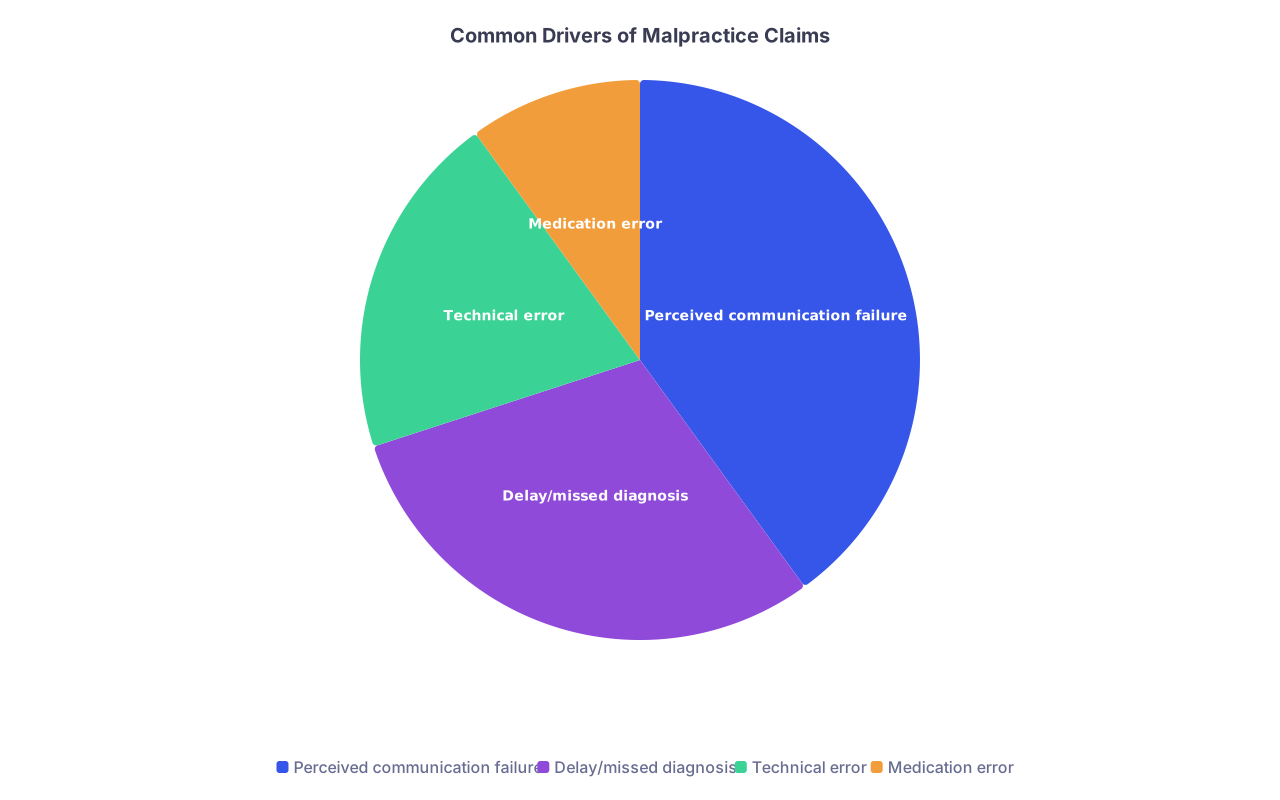
| Category | Value |
|---|---|
| Perceived communication failure | 40 |
| Delay/missed diagnosis | 30 |
| Technical error | 20 |
| Medication error | 10 |
At this point you should be able to describe, in 60 seconds, how a routine case becomes a lawsuit. If you can’t, fix that this week.
1 Week Before: Build Your Personal Agenda
You are not going to this thing to “attend.” You’re going with a checklist.
7 Days Out: Identify Your Gaps
Ask yourself, brutally:
- Which situations make you most anxious?
- Telling a family someone died?
- Signing out a borderline patient?
- Managing angry families?
- Being the junior person when an attending is cutting corners?
Write down 3 “I’m honestly scared I’ll screw this up” scenarios.
Then convert each into an objective:
- “By the end of this training, I want to know exactly how to document a bad outcome when multiple teams are involved.”
- “I want a script for starting a disclosure conversation after a med error.”
- “I want to know what happens internally after an incident report is filed.”
5–3 Days Out: Draft Your Questions
You’re close enough to the date now that the calendar reminder is pinging you. Time to get concrete.
Create a one-page note (physical or digital) with 3 sections:
Documentation
- “What phrases in the chart make defense lawyers groan?”
- “How do they view copy-forward?”
- “Is documenting ‘family upset and threatening to sue’ wise or dumb?”
Communication & Disclosure
- “Who should be in the room for a serious adverse event disclosure?”
- “What words are legally protected under state apology laws here?”
- “Where’s the line between ‘being honest’ and making an admission of fault?”
Process
- “What exactly triggers a root cause analysis here?”
- “If I report a near-miss involving a senior, what protection do I have?”
- “How often do trainees get named personally in lawsuits at this hospital?”
You might not get to all of these. That’s fine. Having them ready matters.
Day Before: Logistics and Mindset
At this point you should treat this like an OR day or an exam, not like mandatory HR fluff.
Block the time mentally.
- Plan to:
- Arrive early
- Sit near the front
- Stay after to ask 1–2 private questions
- Plan to:
Gather your materials.
- Your one-page note with:
- Cases you collected
- Questions you drafted
- Pen. Notebook. Not your phone’s Notes app. (You will end up on Instagram. Don’t lie to yourself.)
- Your one-page note with:
Pick your focus. Decide on one theme you will prioritize:
- Documentation
- Disclosure
- Dealing with complaints
- Protecting yourself as a trainee
If the session goes sideways or time is short, you know what you’re going to push on.
Day Of: Turning a Boring Lecture into a Live Fire Drill
This is where most people zone out. You will not.
Before the Session Starts
Show up 5–10 minutes early. Yes, really.
- Sit where you can make eye contact with the speaker.
- Introduce yourself quickly:
- “Hi, I’m [Name], new [intern/PA/NP/attending] on [service]. I’ve been looking forward to some practical guidance on documentation.”
That one sentence does two things:
- Puts your name in their brain (useful if you need help later).
- Signals that you’re here for practical advice, not theory.
During the Presentation: What to Watch For
At this point you should shift into “pattern capture” mode. You’re looking for habits you can actually change Monday morning.
1. Build a Personal “Do / Don’t” List in Real Time
Create two columns in your notebook:
I will start doing:
- Specific documentation phrases
- Specific communication steps
- Checklists or brief tools
I will stop doing:
- “Per family, they were never told…” blame notes
- Vague CYA phrases (“Patient appears stable” with no vitals)
- Copy-pasting entire prior notes
Whenever the speaker says:
- “Plaintiff attorneys love this line in the chart…”
- “What killed us in that case was…”
- “If you change one habit, let it be…”
Write it down under the right column.
2. Ask High-Yield Questions at the Right Time
Do not be the person derailing the session with, “So what if the patient is 17 years and 11 months old and divorced but pregnant…” Keep it useful.
Good timing:
- After a case example
- During Q&A
- During breaks
Good question styles:
- “In our ICU we often… Is there a better way to document that?”
- “In real life, when X happens, everyone is angry and rushed. What’s the minimum we must do to be defensible?”
Bad question styles:
- “What if…” edge cases no one actually faces
- “Is it true that…” urban legend probing
Use one of your pre-written questions early. Once you’ve spoken once, it’s easier to speak again.
If There’s a Simulation or Role-Play
A lot of people roll their eyes here. That’s a mistake. This is the only safe space you’ll get to practice screwing up these conversations.
At this point you should:
Volunteer early.
- Getting called on last, when everyone’s tired, is worse.
Practice your real words. Use the exact phrases you think you’d say on the wards:
- “We did everything we could.”
- “This was a rare complication.”
- “I’m sorry this happened.”
Then ask the facilitator:
- “How would a plaintiff lawyer hear that sentence?”
- “What wording would you prefer I use here?”
- Write down 2–3 go-to scripts.
Example:
- Opening a bad-news discussion after an error:
- “I’m so sorry. Something happened during your care that we did not intend, and I want to explain clearly what we know so far and what we’re doing now.”
- When you don’t know yet:
- “We’re still actively reviewing all of the details. I don’t want to give you incomplete information, but I promise we will come back to you as we learn more.”
- Opening a bad-news discussion after an error:
Those scripts should go into your pocket notebook or phone today.

Immediately After: Convert Notes to Behavior
The session ends, everyone bolts for coffee. This is where most of the value evaporates. Not for you.
Within 30 Minutes
At this point you should not be back on service yet if you can help it. Find a quiet corner.
- Rewrite your notes into 3 concrete habits.
Force yourself to pick:
- One documentation change
- One communication change
- One process/systems change
Example:
- Documentation:
- “I will stop writing ‘patient non-compliant’ and instead document specific behaviors and context.”
- Communication:
- “Before every consent, I’ll explicitly say: ‘Tell me in your own words what you understand we’re planning to do and what worries you most.’”
- Process:
- “Any time something feels like a near-miss, I will file an incident report and tell the senior explicitly, even if it feels awkward.”
- Put them where you’ll see them.
- Write them on an index card taped inside your locker.
- Add them as a recurring reminder on your phone for 30 days at 7am.
Yes, it feels corny. No, you won’t remember them otherwise.
Later That Day: Debrief with a Peer
Grab a co-resident, fellow, or colleague who also attended.
Ask:
- “What’s one thing you’re going to do differently after that session?”
- “Did any of the examples scare you into changing something?”
Share your three habits. You’ve just created mild social accountability.
Bonus move:
- Agree to check in one week later about whether you actually did any of this.
1–4 Weeks After: Integrate into Daily Practice
Malpractice risk is not lowered by what you hear. It’s lowered by what you rehearse.
At this point you should start wiring the training into your habits.
Week +1: One-Day Micro Audit
Pick a single call shift or clinic day and run a quiet “malpractice lens” over it.
During that day, for every patient ask yourself:
- “If this went badly and I got deposed, would today’s note help me or hurt me?”
- “Does this family actually understand the plan, or did they just nod?”
Make quick marks in your notebook:
- “Note too vague”
- “Consent conversation rushed”
- “Angry family – followed up vs ignored”
End of the day, pick one pattern you didn’t like and adjust.
| Case # | Documentation Risk | Communication Risk | Follow-up Needed |
|---|---|---|---|
| 1 | Vague assessment | None | Clarify tomorrow |
| 2 | Copy-forward heavy | Moderate | Re-discuss plan |
| 3 | Adequate | High | Call family |
| 4 | Adequate | Low | None |
Week +2: Practice Your Scripts on Real Patients
By two weeks out, you should have used at least one of your new scripts in real life.
Examples to deliberately practice:
- Clarifying understanding during consent:
- “What are you most worried about with this procedure or treatment?”
- After something unexpected but not catastrophic:
- “This wasn’t the result we wanted for you, and I want to walk through what happened and what we’re doing now.”
If it feels awkward, that means you’re doing it consciously. That’s good.
Week +3–4: Follow Up with Risk Management (Optional but Powerful)
Now you’ve lived with the training for a bit. Real questions have surfaced.
At this point you should send a short follow-up email to the presenter or risk management team:
- “After your session on [date], I started changing how I document X and disclose Y. A few situations came up that I’d love your take on. Could we schedule a 15-minute call or can I email you specifics?”
Come with:
- 2 anonymized real cases
- Specific questions:
- “Did I over-document?”
- “Was that apology wording safe?”
- “Should I have filed an incident report?”
This is how you quietly build your own advisory board.

3–6 Months Later: Level Up Beyond the Basics
If your first malpractice training was even halfway decent and you followed this timeline, you’re now ahead of most of your peers. Do not stop here.
Month 3: Do a “Worst-Case Scenario” Drill
At this point you should have at least one scary complication or close call fresh in your mind.
Sit down for 30–45 minutes and walk through:
Pick one real case (de-identified):
- Significant harm, or could have been
Ask yourself:
- “If this patient sued, what parts of the record help me?”
- “What parts hurt me?”
- “What would a plaintiff’s lawyer say in closing argument from this chart?”
Rewrite one note (for yourself, not the record) the way you wish you had written it. Study the differences.
This is uncomfortably honest work. That’s the point.
Month 6: Teach One Concept to Someone More Junior
Nothing cements learning like teaching.
At this point you should be able to:
- Explain the difference between:
- Documenting what happened vs. speculating about why someone else messed up
- Coach a junior on:
- How to avoid blame-y language in the chart
- How to start a disclosure conversation
Do it informally:
- On rounds when a complication comes up
- During student teaching
- At sign-out: “Here’s how I’d word this in the note so it doesn’t bite you later.”
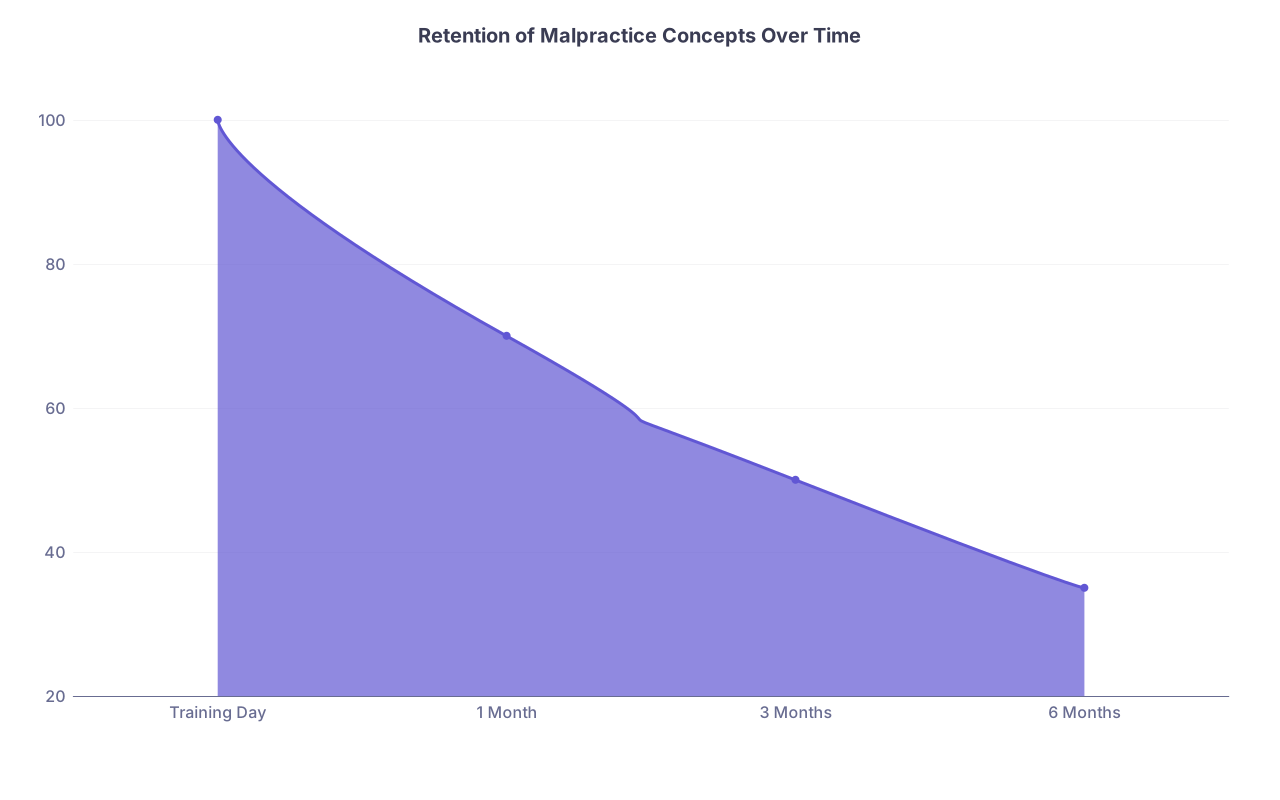
| Category | Value |
|---|---|
| Training Day | 100 |
| 1 Month | 70 |
| 3 Months | 50 |
| 6 Months | 35 |
Then reinforce:
- Review your three original habits
- Decide if they’ve become automatic or if you’re drifting back
Long-Term: Keep a Running “Risk Lessons” Log
This is for the few who actually want to get excellent at this instead of “good enough.”
At this point you should:
- Create a simple document called “Risk Lessons – [Your Name].”
- Every time:
- A bad outcome happens
- You feel uneasy about the care
- You hear a malpractice story in conference
Add:
- 2–3 bullets:
- What went wrong clinically
- What went wrong communication/documentation-wise
- What you will do differently next time

Review it quarterly. That becomes your personal malpractice curriculum. Custom-built from your real career.
Key Takeaways
- Treat your first malpractice training session like a skills lab, not a checkbox: prepare cases, questions, and personal goals 1–2 weeks beforehand.
- During the session, actively harvest concrete “start doing / stop doing” behaviors, and walk out with 2–3 specific changes to your documentation and communication.
- Over the following weeks and months, deliberately practice scripts, audit your own notes, and build a running “risk lessons” log so the training actually reshapes how you practice—not just how you sign attendance sheets.