

The bravest people in a hospital are not the ones who rush to a code. They’re the ones who voluntarily report their own mistakes.
Let me tell you what actually happens behind the sterile policy manuals and “just culture” posters on the wall. Because the politics of reporting errors and near misses are very real, and if you do not understand them early in your training, you’ll either get burned or quietly learn to keep your mouth shut. Both are bad outcomes—for you and for patients.
The Public Story vs. The Back Room Reality
On paper, every hospital and residency program loves error reporting. They’ll show you slides in orientation:
- “See something, say something.”
- “We learn from mistakes, not punish them.”
- “Near misses are gifts.”
That’s the public story. The part we tell Joint Commission, CMS, and applicants on interview day.
The back room reality is messier.
When a serious error or near miss happens, four forces immediately kick in:
- Risk management starts thinking about liability and discovery.
- Administration starts thinking about public reporting, reputational damage, and pay-for-performance metrics.
- Program leadership starts thinking about ACGME citations, board pass rates, and “resident quality.”
- Frontline clinicians start thinking: “Am I going to get thrown under the bus for this?”
Those forces shape what gets reported, who gets blamed, and what actually changes. Not the EHR report form. Not the policy binder. The politics.
Let me walk you through how this actually plays out in real hospitals.
How Incident Reporting Really Works (Not the Way They Teach It)
Every hospital has some version of an electronic incident/error reporting system. You’ll be told it’s for “quality improvement, not punishment.” That’s… selectively true.
Here’s the part nobody tells you explicitly: your report goes through a political filter long before it becomes “systems learning.”

| Step | Description |
|---|---|
| Step 1 | Clinician submits report |
| Step 2 | Unit manager reviews |
| Step 3 | Risk management notified |
| Step 4 | Quality nurse review |
| Step 5 | Legal and admin huddle |
| Step 6 | QI committee |
| Step 7 | Targeted response |
| Step 8 | Education or policy change |
| Step 9 | Serious harm or high liability? |
The path through that diagram depends on three things:
- Harm level – Actual injury vs. near miss vs. inconvenience.
- Litigation risk – Could a reasonable lawyer smell money here?
- Who’s involved – Attending vs. resident vs. nurse vs. “VIP” patient.
Example from a real residency program
At a large academic center, a PGY-2 miss-read a potassium of 2.4 at 4 a.m. as 4.2, didn’t replete, went back to bed. The patient coded at 7 a.m. from an arrhythmia, survived but with a prolonged ICU course.
What should happen in the ideal world? Transparent reporting. Root cause analysis. Process change around lab notification and resident fatigue.
What actually happened?
- The nurse informally told the chief: “I’m not putting this in the system unless you say so; I don’t want the resident destroyed.”
- The chief and attending quietly documented “rapid clinical deterioration” in the note.
- No incident report. No case conference. No system learning.
- The resident privately carried the guilt for months.
Why? Because that program had recently been dinged by the ACGME for “inadequate supervision” and had had two high‑profile malpractice cases. Leadership was terrified another documented error involving a resident would be discoverable and damage them in future litigation and accreditation reviews.
That’s how culture dies. One “we’re going to handle this quietly” at a time.
Who Gets Blamed (and Who Gets Protected)
Here’s something you learn fast when you sit on a hospital quality committee or as a program director: accountability is not evenly distributed.
| Role | Typical Risk of Being Blamed | Typical Institutional Protection |
|---|---|---|
| Medical student | Low (officially) but high emotional | Moderate, informal shielding |
| Resident | High | Variable by specialty/program |
| Attending | Lower than residents | High, especially high-RVU stars |
| Nurse | High for documentation/process | Moderate, strong union in some places |
| Hospital administration | Almost never directly blamed | Very high |
Now, let me strip away the sugar coating.
Residents and fellows: easy scapegoats
You are the perfect target:
- You write most of the notes.
- You put in many of the orders.
- You are transient—gone in 3–7 years.
- You do not bring in big RVUs.
- You are terrified of failing or being reported to your board.
So when something goes badly wrong, the quiet conversation in some closed offices is not, “How did our system fail?” It’s, “How do we make this about an individual learner’s deficit instead of a structural problem that will cost millions to fix?”
I have sat in M&M prep meetings where the first question was, “Can we frame this as a documentation/communication issue by the intern so it doesn’t become a ‘system failure’ problem?” Not because the leaders are evil. Because systems failures trigger regulatory scrutiny, capital expenses, and possible public reporting. Blaming a trainee is cheaper.
Attending physicians: selectively protected
Not all attendings are equal in this game.
A high-volume interventional cardiologist who brings in seven figures of revenue gets more institutional cushioning than a hospitalist who started last year. That’s just reality.
If a superstar surgeon and a PGY‑2 both had their hands in a case that went badly, watch the language:
- For the surgeon: “Unavoidable complication,” “extremely complex anatomy.”
- For the resident: “Poor situational awareness,” “failure to escalate concerns,” “needed more direct supervision.”
Does this always happen? No. But often enough that residents trade these stories like war stories. You already know this from the way people talk in workrooms.
Nurses: different but parallel politics
Nurses live in their own version of this. Charge nurses and managers are very aware of staffing ratios, unsafe assignments, and policy violations. Many will protect their staff by “not writing up” every deviation because they know administration will treat each incident as an individual failure rather than a staffing or resource issue.
So you’ll see this pattern: nurses write up each other for “behavior” or egregious things but underreport chronic understaffing errors that would implicate admin decisions.
You, as a resident, are moving through that ecology whether you realize it or not.
Near Misses: The Most Important Events No One Wants to Touch
Near misses are the most politically sensitive category. Why? Because they reveal system weaknesses without the buffering excuse of “well, the patient was really sick anyway.”
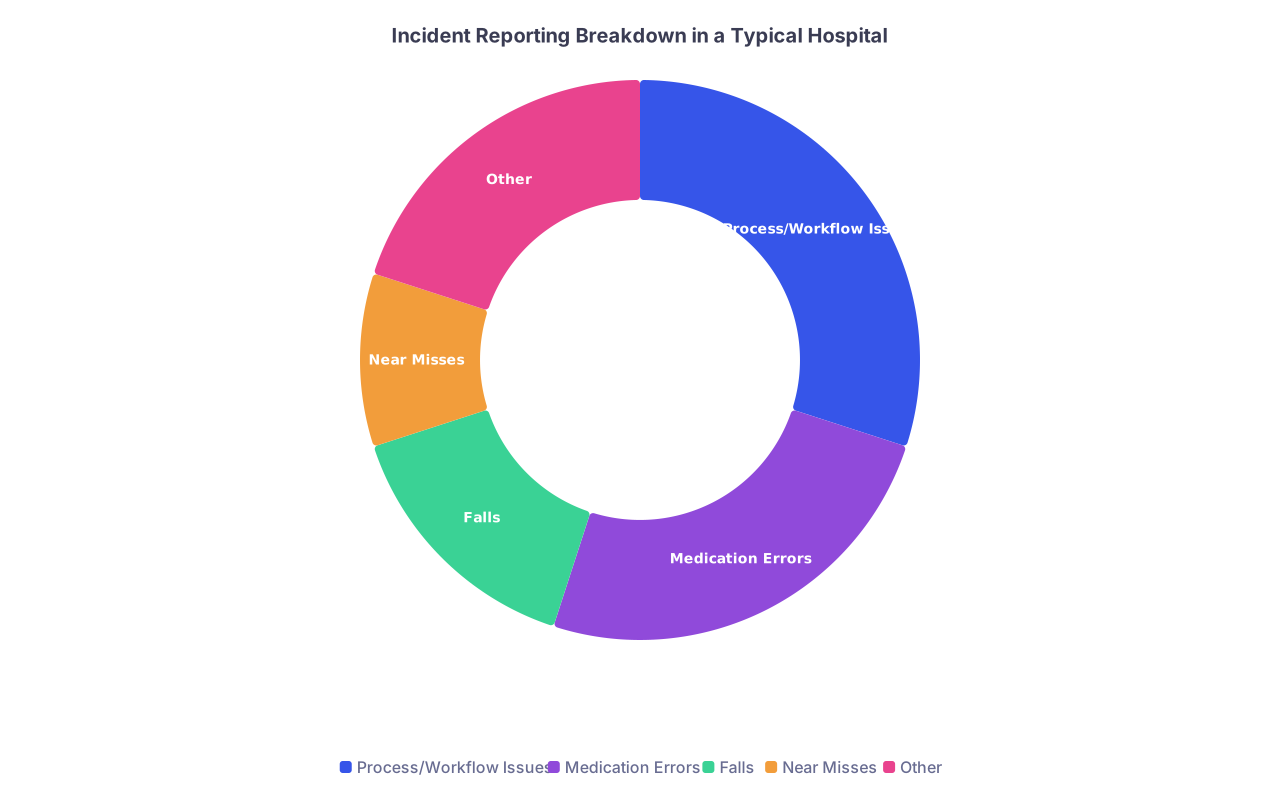
| Category | Value |
|---|---|
| Process/Workflow Issues | 30 |
| Medication Errors | 25 |
| Falls | 15 |
| Near Misses | 10 |
| Other | 20 |
The “near misses” slice is small. Not because they’re rare. Because they are underreported.
Three unspoken reasons:
- No clear harm, so no immediate pressure to act – Administrators prioritize reportable harm metrics.
- People fear exposing system landmines that would require expensive fixes.
- Clinicians internalize the message: “If it didn’t hurt anyone, just fix it and move on.”
Example that I’ve seen multiple times: High-risk chemotherapy ordered with the wrong dose, caught by pharmacy at verification. In theory, this is the perfect near miss to report and study. In practice, it becomes an annoyed phone call, a corrected order, some eye-rolling about the EHR, and then… silence.
When you, as a trainee, try to report those events, you may get subtle pushback:
- “Are you sure you want your name on that report?”
- “We’ll just handle it on the unit level.”
- “Don’t make trouble; pharmacy already fixed it.”
That’s the political message: keep the lid on.
How Programs Quietly Track “Problem Residents” Using Errors
Here’s the part they absolutely do not tell you in orientation.
Many residency programs maintain informal lists, spreadsheets, or mental shortlists of “residents of concern.” And error reports—especially those tied to patient harm or repeated near misses—become one of the key data streams feeding that list.
Notice what I said: informal. Not an official “you are on probation” letter. Not something you can appeal. A quiet classification that colors how every future incident involving you is interpreted.
You’ll see it in patterns:
- Your name starts coming up in CCC (Clinical Competency Committee) meetings more frequently.
- Every small slip you make suddenly becomes “another data point.”
- You get pulled into “coaching” or “professionalism” meetings couched as “support.”
Are some residents genuinely unsafe? Yes. Occasionally you see someone who should not be in independent practice yet and needs serious intervention.
But I’ve also seen residents branded as “error-prone” largely because they were the only ones honest enough to consistently report their own mistakes, while their peers quietly buried similar events.
Programs rarely differentiate between:
- Residents who cause errors and hide them.
- Residents who cause errors and report them.
- Residents who work in higher-risk settings and therefore naturally have more reports attached to their name.
From the outside, the dashboard just shows: “Number of incidents involving Dr. X this year.”
That’s the dirty secret.
Legal, Ethical, and Emotional Crossfire
Let’s layer in law and ethics, because the conflict is brutal.
You’re taught four things in parallel:
- Ethically, you must be honest, disclose errors, and participate in improvement.
- Legally, you should avoid creating discoverable documents that can be used against you in court.
- Professionally, you must protect patient privacy and institutional reputation.
- Psychologically, you need to preserve your own sanity and not drown in guilt.
Those four do not align neatly.
The legal trap
Some hospitals have strong “peer review privilege” protections. Incident reports, M&M discussions, QI documents are (in theory) protected from legal discovery.
Others… not so much. And even in protected settings, plaintiffs’ attorneys can still get:
- Your progress notes.
- Your order history.
- Your in-basket messages.
- Your emails.
Risk management knows this. That’s why, after a serious error, you may get very pointed coaching:
- “Don’t speculate in your note.”
- “Stick to objective facts.”
- “Do not use language like ‘error’ or ‘mistake’ in the chart.”
Ethically? Transparency feels right. Legally? Your future malpractice defense attorney wants minimal ammo for the other side. You’re caught in the middle.
The emotional cost of honesty
Residents who report their errors and near misses honestly often develop what’s now called “second victim syndrome.” Guilt, shame, hypervigilance, intrusive memories.
I’ve had residents in my office saying things like:
- “I will never write another safety report again. It just got me in trouble.”
- “I was more traumatized by the committee grilling than by the actual event.”
- “I tried to do the right thing and got labeled as unsafe.”
That’s how you build a culture where people lie by omission. Not because they’re bad people. Because the system punishes honesty more obviously than it punishes silence.
How to Report Safely Without Being Naive
Now, I’m not going to tell you to stop reporting. That would be cowardly and wrong. Good clinicians own their errors and try to fix the system.
But I will tell you how smart residents and early attendings handle this in the real world.
Step 1: Know your institution’s terrain
Not all places are the same. Three red flags that you’re in a politically toxic environment:
- M&Ms are always about individual blame, never about system factors.
- Attendings openly say, “Don’t put that in writing.”
- Nurses and residents both tell you, “We don’t report things here; it just gets ugly.”
If you’re in a place like that, you need to be more strategic. Still ethical, still honest—just less trusting.
Step 2: Separate three things in your mind
You need to mentally separate:
- Clinical documentation (the chart).
- Formal institutional reporting (incident report systems).
- Protected educational/peer review spaces (M&M, debriefs, supervision).
Each has different audiences and legal exposures.
In the chart, focus on accurate, objective description and appropriate follow‑up. Avoid self-flagellating narratives like, “I failed to recognize…” that add nothing medically and may be misused later.
In incident reports, be detailed about the sequence of events and contributing factors, but keep it professional, not emotional. Avoid speculation.
In M&M or debriefs, this is where you can really unpack your thought process, your emotions, the cognitive errors, the cultural issues. That’s where the actual ethical and educational work gets done—if your institution is using those forums correctly.
Step 3: Never be the only one holding the bag
If something serious happens, do not carry it alone.
Loop in:
- Your senior or chief.
- The attending of record.
- The charge nurse.
- If serious harm occurred, risk management—through the official channels.
Put bluntly: you do not want to be the only name associated with the recognition, reporting, and response to a major event. Shared ownership is safer—for patients and for you.
Step 4: Use near-miss reporting as a form of quiet self-protection
Here’s an underused tactic the savvy residents figure out.
If you consistently report near misses that you catch and fix yourself, over time you’re building a pattern of:
- Situational awareness.
- Proactive safety behavior.
- Willingness to improve.
So if one day something gets through and causes harm, the record doesn’t only show “errors around Dr. X.” It also shows years of “Dr. X identified and prevented multiple safety issues.”
Program directors absolutely look at that pattern when they’re deciding whether you’re a careless danger or a conscientious clinician who had a bad day in a bad system.
Just do not gloat or editorialize in those reports. Describe the hazard, the catch, and what you think would prevent it in the future.
Step 5: Learn to speak the language of systems, not self-indictment
When you describe events, think like a quality officer, not like a confessional.
Compare:
- “I failed to check the renal function before ordering contrast and caused AKI.”
- “Contrast was ordered before the most recent creatinine resulted; there was no automated alert or hard stop to prevent this. The most recent creatinine (returned later) showed significantly impaired renal function. Patient developed AKI likely related to contrast.”
One sounds like a personal flogging. The other recognizes the individual error but also points directly at a system design flaw: a process that allows high-risk orders without relevant labs.
You’re not dodging responsibility. You’re putting it in context. That’s ethically honest and politically smarter.
What Good Programs Actually Do Differently
There are places that get this right, or at least try hard.
Signs you’re in a healthier culture:
- M&M is protected, blame-light, and focused on cognitive and system errors, not public humiliation.
- Attendings model error admission and show you their own incident reports.
- Safety reports lead to visible, concrete changes: new order sets, staffing changes, process redesign.
- Residents who report errors are not derailed; they’re supported and mentored.
In one internal medicine program I know, a resident mis‑dosed heparin, causing a GI bleed. Serious, real harm. The resident self-reported, was transparent with the patient, and participated in the root cause analysis.
What did the program do?
- Used the case as a systems-focused M&M: confusing dosing interface, no weight-based check, unclear nursing protocol.
- The resident helped design a new anticoagulation order set.
- A faculty mentor met with the resident monthly for six months to debrief emotionally and review anticoagulation cases.
That resident still matched into a competitive cardiology fellowship. Because the letters said, essentially: “This person faced a serious error, behaved with integrity, and turned it into growth and system improvement.”
That’s the other possible story. And it starts with leadership deciding not to weaponize error reports.


