

The belief that “residents can’t be personally sued” is not just wrong. It’s dangerously wrong.
You can be sued. Personally. Name on the complaint, served at the hospital, dragged through the process. I’ve seen PGY‑1s blindsided because someone told them, “Don’t worry, the hospital covers everything.”
That’s not how this works.
You don’t need to live in fear, but you do need to replace myths with actual legal basics. Once you understand the structure—who can be sued, who pays, when you’re exposed—you can stop relying on hallway folklore and start acting like a professional who understands the risk.
Let’s dismantle the biggest lies.
Myth #1: “Residents can’t be sued individually—only the hospital gets named”
Flatly false.
In a malpractice lawsuit, plaintiffs can (and regularly do) name:
- The hospital
- The attending physician
- The resident(s) involved
- The clinic or group practice
- Sometimes nurses, techs, or midlevels
There is no legal shield that says “if PGY‑2, do not name as defendant.”
Plaintiff lawyers pull the chart. They identify everyone who touched the case in a meaningful way. Then they name almost all of them. Why? Strategy: more pockets, more leverage, more pressure to settle.
Do all of those people ultimately pay? Usually not. But that’s a different issue. We’re talking about being sued, not about who cuts the final check.
You can absolutely be listed as:
“John Smith, M.D., individually and as an employee/agent of XYZ Medical Center.”
Even as a PGY‑1.
The doctrine that confuses everyone: respondeat superior
Here’s where the myth starts. Under “respondeat superior” (Latin for “let the master answer”), an employer is held liable for the negligent acts of its employees acting within the scope of employment.
Translated to your world:
- Resident acts in the course of their hospital duties
- Resident is negligent → patient harmed
- Hospital (and often faculty group) can be held liable for that negligence
So residents hear, “The hospital’s on the hook, not you.” That’s incomplete at best.
What’s more accurate:
- You can be sued and named individually.
- Your employer is usually vicariously liable for you.
- Their insurance often defends and pays on your behalf—if you’re acting within the scope of your duties and under supervision as required.
So yes, the hospital often pays. But you’re still in the lawsuit.
Myth #2: “If the hospital covers me, I don’t need to care about malpractice insurance”
That’s like saying, “My landlord has building insurance, so my stuff is safe in a fire.”
Some protection? Sure. Complete protection? No.
Hospitals and residency programs usually provide professional liability coverage for your clinical work for that employer. But there are cracks people pretend don’t exist.
Let’s be concrete.
Common gaps where residents get exposed
Moonlighting outside the residency’s insurance
- Internal moonlighting might be covered.
- External moonlighting (urgent care, telemedicine, small EDs, locums-style shifts) often requires your own policy.
- I’ve seen residents sign moonlighting contracts that say, in tiny legalese, “Physician shall maintain their own malpractice coverage.” Most never read it carefully.
Work outside the scope of your role
- Supervising without proper credentialing
- Performing procedures you weren’t privileged or trained for
- Signing things you shouldn’t (like attending-only sections)
When you step outside the job description, insurers start asking whether they’re truly obligated to cover you.
Post-residency tail coverage
- Many policies are claims-made, not occurrence-based.
- Translation: if a claim is filed after you leave, you may need “tail” coverage to be protected. Residents almost never learn this until they’re signing an attending contract and someone mentions “tail” like it’s a normal word.
Volunteer work / global health trips
- Free clinic? Mission trip? Camp doctor?
- Sometimes covered by the sponsoring organization. Sometimes not.
- “Good Samaritan” laws are narrower than people think and don’t reliably cover organized clinical work.
| Scenario | Usually Covered By Program | Often NOT Covered |
|---|---|---|
| Regular inpatient duties | Yes | No |
| Internal moonlighting | Maybe | Maybe |
| External moonlighting | No | Yes |
| Volunteer free clinic | Maybe | Maybe |
| Global health mission trip | Maybe | Yes |
If you don’t know exactly what your program’s policy says, you’re guessing. And guessing is a terrible risk management strategy.
Myth #3: “Malpractice insurance means I’m safe no matter what I do”
Insurance is not a magic absolution card. It’s a contract with conditions.
Here’s what most residents never get told explicitly:
- Insurers can reserve rights or deny coverage when you:
- Commit intentional misconduct
- Falsify or alter the medical record
- Practice while under the influence
- Perform acts clearly outside your privileges or licensure
Your protection is strongest when:
- You’re acting within your training and program rules
- You document honestly (including your mistakes)
- You respond appropriately when something goes wrong
Trying to “fix” the record after the fact—late entries disguised as contemporaneous notes, deleting comments, backdating orders—is one of the fastest ways to turn a defensible case into a disaster. Juries hate it. Insurers hate it more.
I’ve seen cases that were medically marginal but legally winnable… until someone got “creative” with the chart. Then it’s game over.
Myth #4: “Residents rarely get named; plaintiff attorneys focus on attendings”
Also wrong.
Plaintiff lawyers like:
- Clear targets with decision-making responsibility
- Deep pockets (hospital, practice groups, insurers)
- Anyone whose name appears in critical parts of the chart
Residents write the majority of the day-to-day documentation. Progress notes. Admission H&Ps. Cross-cover notes. Orders. Procedure notes. Discharge summaries.
If your name is on:
- The admission where sepsis was missed
- The progress note ignoring a worsening neuro exam
- The cross-cover note brushing off crushing chest pain
You’re a natural target.
Residents are particularly vulnerable in:
- ED evaluations where disposition decisions are made
- ICU settings with evolving organ failure and bad documentation
- Obstetrics (delayed C-section, fetal distress not acted on)
- Surgery (post-op complications, missed serial exams, compartment syndrome)
Let me underline something: being named does not mean you personally pay. But it does mean:
- You’re involved in discovery
- You give a deposition
- You may sit in court while experts dissect your every decision and note
- You carry that stress for years—while still doing 70–80 hour weeks
So no, “they’ll only go after the attending” is not a comforting or accurate assumption.
Myth #5: “If I just follow orders, I can’t be liable”
Obedience isn’t a defense. You’re not a scribe. You’re a licensed physician in training.
Legally, you have an independent duty to your patient to practice within the standard of care that reasonably applies to someone in your position. Notice the phrasing: in your position, not “as good as a 30-year attending.” Courts do understand training levels. But they don’t give you a free pass for blindly following bad orders.
Scenarios where residents get nailed:
- You recognize that a plan is unsafe (e.g., discharging clear ACS risk) but you do it anyway because the team wants beds.
- You see an attending ignore clearly abnormal vital signs or labs, and you document “patient stable” because you don’t want conflict.
- You perform a procedure you’re not comfortable with and don’t call for help, then document as though everything was fine.
“Attending told me to” is evidence; it’s not a shield. Juries and boards expect you to:
- Speak up about dangerous plans
- Escalate concerns
- Call another attending if your supervisor is truly unresponsive in an emergency
Does that create political risk? Sometimes. But pretending you’re just following orders is a legal liability, not just a moral failure.
Myth #6: “Good Samaritan laws mean I’m fine if I’m helping”
This one is wildly misunderstood, especially by residents who dabble in volunteer work or find themselves in off-duty situations.
Good Samaritan laws vary by state, but commonly:
- Apply to uncompensated, emergency aid provided in good faith
- Are aimed at scene-of-accident type situations
- Often exclude acts of gross negligence or willful misconduct
- Do not clearly cover structured clinics, shifts, or pre-arranged roles
If you’re staffing a free clinic every Wednesday night as “the doctor on duty,” plaintiffs can argue this is organized care, not spontaneous emergency aid. Your state’s Good Samaritan law may or may not apply. Many don’t.
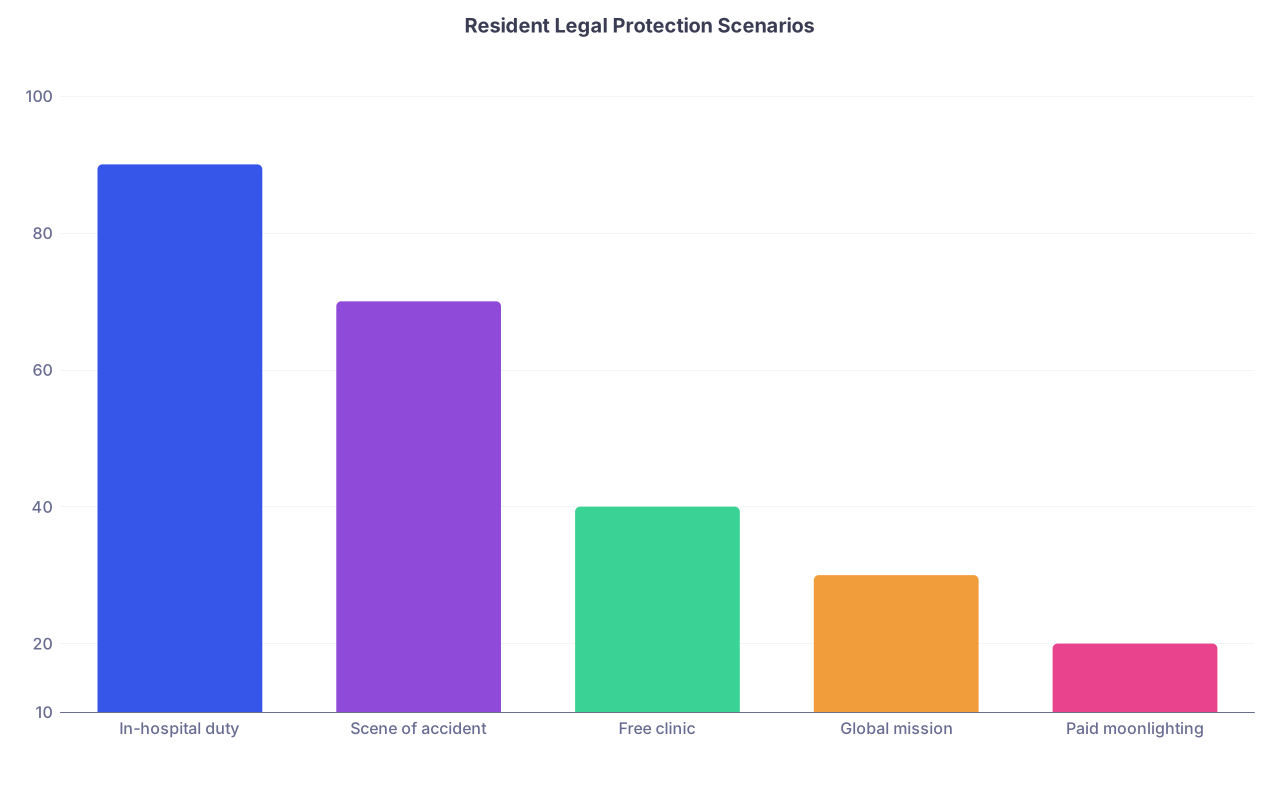
| Category | Value |
|---|---|
| In-hospital duty | 90 |
| Scene of accident | 70 |
| Free clinic | 40 |
| Global mission | 30 |
| Paid moonlighting | 20 |
(Those numbers aren’t literal percentages. Think of them as a rough “likelihood your existing program coverage is rock-solid.” In-hospital highest. Moonlighting and missions lowest, unless properly insured.)
Bottom line: never assume “Good Samaritan” is a universal force field. It’s a narrow statute, not a philosophical principle.
Myth #7: “If something bad happens, my best move is to say as little as possible and avoid admitting fault”
This is where ethics and law collide—and residents get whiplash.
Here’s what’s actually true:
- You should not speculate about legal causes or blame in the chart.
- You should definitely document the medical facts, your reasoning, and the plan.
- Many states now have “apology laws” that make expressions of sympathy or regret inadmissible as evidence of liability.
So the old-school “never say you’re sorry; you’ll get sued” advice is outdated and ethically weak.
Ethically, you have duties to:
- Disclose significant adverse events to patients/families
- Be honest about what is known and not known
- Participate in institutional review and quality processes
Legally, your best move is:
- Stick to facts, not accusations, in the record
- Avoid defensive charting (“family is litigious,” “patient is noncompliant”)
- Get risk management and GME involved early after a major event
- Don’t alter prior documentation—ever
What really burns physicians in court isn’t saying “I’m sorry this happened.” It’s the combination of bad care, sloppy documentation, and clear attempts to cover tracks.
Practical Reality: How this affects your career
Let’s talk about two long-term issues residents don’t connect to malpractice risk.
1. Credentialing and privileging
Every hospital and health system you work for in the future will ask:
- Have you ever been named in a malpractice suit?
- Outcome? Settlement? Judgment?
- Any board complaints? Disciplinary actions?
You will answer these questions for decades. Under penalty of perjury in some cases. That doesn’t mean a lawsuit ruins your career, but lying about it absolutely can.
Most credentialers understand residents get swept into broader cases. A single naming, especially with a defensible record, doesn’t blacklist you. What worries them more:
- Patterns—multiple suits with similar issues
- Dishonesty in application materials
- Serious board actions, license restrictions, or DEA troubles
2. Board and licensure issues
Boards don’t generally punish people for being named in a case alone. They act when they see:
- Repeated lapses in professionalism or impairment
- Clear incompetence, especially if unremediated
- Dishonest behavior: falsifying documents, lying to investigators, misrepresenting training or credentials
Again, the myth that “malpractice = career death” is overblown. What destroys careers faster is a mix of arrogance and dishonesty layered on top of clinical mistakes.
So what should a rational resident actually do?
Let me cut through the noise. If you want to act like an adult professional instead of a passenger, do the following:
Get and read your coverage details.
From GME or risk management: policy type (claims-made vs occurrence), limits, what’s covered, what’s not, moonlighting rules, tail coverage.Clarify moonlighting coverage in writing.
If you’re moonlighting, either:- Get a rider/letter showing you’re covered, or
- Buy your own policy and know the limits and tail requirements.
Stay in your lane—professionally and legally.
Don’t do procedures you’re not trained or privileged to do. Don’t act as attending when you’re not. Don’t sign things as if you’re faculty.Treat documentation as future testimony.
Chart as if you’ll have to explain it to a jury in 6 years. Because you might. Clear reasoning. Objective descriptions. Minimal editorializing.Ask for help early—clinically and legally.
Call your attending. Then if there’s a bad outcome, call your chief and risk management. Silence and delay rarely help.Don’t let fear of lawsuits paralyze you.
The solution isn’t defensive paralysis. It’s being competent, honest, and proactive inside a system that’s admittedly hostile and messy.

| Step | Description |
|---|---|
| Step 1 | Adverse event occurs |
| Step 2 | Stabilize patient |
| Step 3 | Notify attending |
| Step 4 | Notify chief or program |
| Step 5 | Contact risk management |
| Step 6 | Fact based documentation |
| Step 7 | Participate in review |

The real myth: “Legal stuff is for later, when I’m an attending”
You’re already practicing medicine. Your name is already on orders and notes. You’re already generating legal risk every single call night.
You don’t need to become a malpractice lawyer. But you do need baseline literacy:
- You can be sued personally as a resident.
- Institutional coverage helps a lot but has limits and conditions.
- Your day-to-day choices—what you do, what you document, what you sign—shape how exposed you are.
Strip away the folklore and it boils down to three things:
- You are legally visible, not invisible.
- Your protection is real but conditional.
- Honest, thoughtful practice plus basic legal awareness is your best defense.


