

Does Defensive Medicine Actually Prevent Lawsuits? Data and Nuance
What if most of the extra tests and consults you order “to cover yourself” are not protecting you at all—and might even increase your legal risk?
That’s the uncomfortable reality when you stop listening to hallway folklore and start looking at data.
Let me be blunt: “Defensive medicine” is one of the most overused, poorly defined, and badly misunderstood concepts in medicine. Residents swear by it. Attendings complain about it. Politicians blame it for the entire US healthcare budget. And lawyers? They quietly smile and let doctors keep believing the wrong things.
Let’s tear this apart.
What Are We Calling “Defensive Medicine,” Really?
On rounds, when someone orders a CT “just in case, so we don’t get sued,” everyone knows what that means. But the literature distinguishes two flavors, and the difference matters.
| Type | Description |
|---|---|
| Positive defensive medicine | Doing *more* (extra tests, consults, admissions) mainly to reduce perceived legal risk |
| Negative defensive medicine | Doing *less* (avoiding high-risk patients/procedures) mainly to reduce perceived legal risk |
| Non-defensive care | Actions primarily aimed at patient benefit, evidence-based, not driven by lawsuit fear |
Positive defensive medicine is what most people complain about: CTs for low-risk headaches, echo for every murmur, admitting “for observation” because discharge feels scary.
Negative defensive medicine is uglier and quieter: surgeons not operating on high-risk older adults, OBs dropping VBACs entirely, EDs transferring anything remotely risky.
Here’s the key myth:
Myth: If I practice defensive medicine, I’m less likely to get sued.
That belief is so deeply baked into medical culture that people rarely question it. But courts, juries, and malpractice carriers don’t actually reward “more stuff.” They reward good care and good documentation. Those are not the same thing.
What the Data Actually Shows About Lawsuits and “More Testing”
Start with this: most malpractice suits are not about “you didn’t order enough tests.” They’re about missed diagnoses, delays in treatment, poor communication, and bad outcomes with bad documentation.
Let’s look at some actual evidence rather than vibes.
1. High-utilization ≠ low-risk of suit
Studies across multiple specialties show a consistent pattern: physicians who order more tests and spend more money per patient are not reliably less likely to be sued.
One widely cited JAMA Internal Medicine study looking at Florida physicians found something subtle: in some areas, higher spending was weakly associated with lower lawsuit rates. People seized on that and said, “See? Defensive medicine works!”
But here’s the catch: the study didn’t show that the tests themselves were protective. It showed association, not causation. High spenders may differ in other ways: more thorough documentation, better patient communication, more time per patient, different patient mix. The data can’t tell you the mechanism.
And crucially: even in that study, the absolute differences in suit rates were small. You’d be insane to justify millions of dollars in extra imaging based on that sort of weak association.
2. Malpractice claims rarely hinge on “you didn’t do a CT on everyone”
Look at the granular analyses from malpractice insurers and the CRICO/Harvard malpractice database. Patterns jump out in high-risk areas like:
- Missed myocardial infarction
- Missed stroke
- Delayed cancer diagnosis
- OB catastrophes
- Surgical/ICU complications
The legal arguments usually revolve around:
- Failure to take or act on a proper history
- Failure to perform a targeted exam
- Failure to follow up abnormal tests
- Failure to escalate or reassess when the patient worsened
- Failure to communicate risks, options, and follow-up clearly
Lawyers do not stand up in court and say, “The standard of care is 100% CT rate for any dizziness, and this doctor only CT’d 60% of them.” They say, “This patient had red-flag symptoms, and the physician did not respond as a reasonable physician would.”
That’s not “do more of everything.” That’s “do the right thorough things, for the right patient, then document your reasoning.”
3. Overtesting can backfire—legally
Here’s what physicians often ignore: over-testing creates new risk.
Every test is a minefield:
- Incidentalomas you then fail to follow up
- False positives that lead to harm (unnecessary biopsy, surgery, contrast nephropathy)
- Conflicting results that you don’t reconcile or discuss
- Documentation gaps (abnormal result, no documented plan)
I’ve seen this more than once: a radiology report with “recommend clinical correlation and repeat imaging in 3–6 months if clinically indicated” quietly ignored. Three years later, the patient shows up with metastatic disease. Plaintiff attorney pulls the old scan and the report.
At trial, the defense can’t say, “We were being defensive by ordering many scans.” The question becomes: “You ordered the scan. You saw—or should have seen—the abnormality. Why did nothing happen afterward?”
Over-ordering without a system to follow through is not protective. It is a liability factory.
The Real Levers: Communication, Documentation, and Actual Quality
The malpractice literature is boringly consistent on what really drives lawsuits. It’s not your “CT threshold.” It’s how you think, how you talk, and how you chart.
Communication: massively underrated, legally powerful
Patients rarely sue because “the doctor missed something that anyone could have missed—but they were clear, compassionate, and honest about uncertainty.” They sue when they feel:
- Dismissed (“they brushed me off”)
- Confused (“no one explained what was going on”)
- Betrayed (“they hid something or lied”)
You can discharge a low-risk chest pain patient without a CT angiogram and still be relatively safe if you:
- Explain your reasoning in plain language
- Discuss uncertainty honestly: “No test is perfect; here’s what to watch for”
- Give clear, specific return precautions
- Document that conversation
The same clinical decision, but without that conversation and without notes? Far more dangerous.
Documentation: your actual shield
Law is retroactive storytelling. The chart is the script. If it isn’t in there, you didn’t think it, you didn’t do it, you didn’t say it.
Defensive medicine that matters looks more like this:
- “DDx for abdominal pain includes appendicitis, SBO, biliary colic, etc. At this time, low suspicion for appendicitis because X, Y, Z.”
- “Discussed risks/benefits of CT abdomen including radiation; patient prefers to defer imaging today, agrees to return if worsening.”
- “Shared decision-making: low-risk Wells score, D-dimer negative. Discussed that PE can never be ruled out with 100% certainty. Patient understands, agrees with outpatient management.”
Notice what’s happening. You’re not ordering every test “just in case.” You’re making a rational choice, showing your work, and documenting the conversation. That’s far more legally robust than throwing tests at the problem.
But What About “Standard of Care” and the Fear of Being Second-Guessed?
Here’s where the mythology really takes over.
Doctors imagine a jury saying, “If there was any chance* of a bad outcome, the doctor should have done everything.” That is not how “standard of care” works in most jurisdictions.
Standard of care is usually defined as what a reasonable physician would do in similar circumstances. Not the most aggressive physician on Earth. Not the “sued three times so now he CTs everyone” physician.
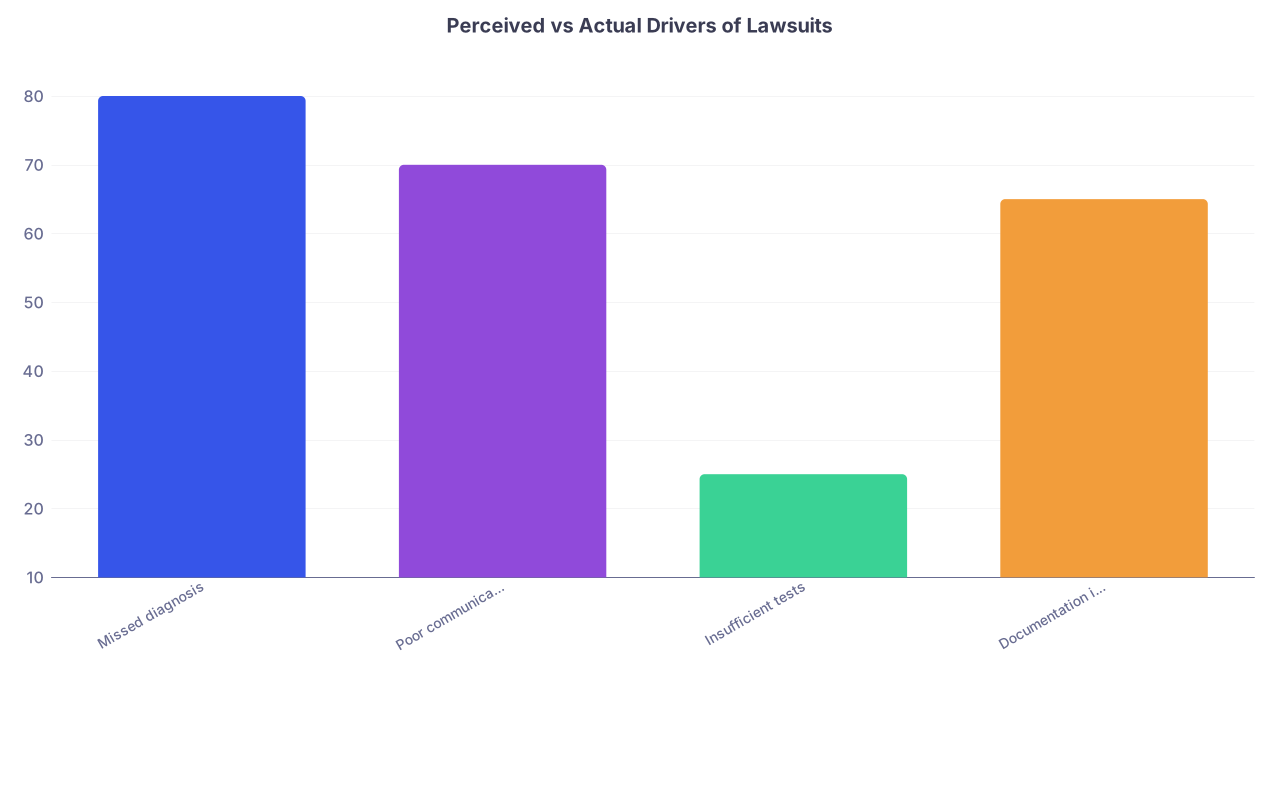
| Category | Value |
|---|---|
| Missed diagnosis | 80 |
| Poor communication | 70 |
| Insufficient tests | 25 |
| Documentation issues | 65 |
Physicians assume “insufficient tests” is the main problem. Actual case reviews show: missed diagnosis and poor communication—often tied to inadequate documentation—dominate.
So if you want to be smart, stop asking, “What extra test will a lawyer think I should have ordered?” and start asking, “What would a reasonable colleague say if they read this chart two years from now, without me in the room to explain?”
That mental shift is where defensive medicine starts to get sane.
The Psychological Trap: Fear, Availability Bias, and War Stories
A lot of defensive medicine isn’t rational risk management; it’s fear conditioning.
You don’t remember the 500 chest pains that did fine without a CT. You remember the one “normal” young patient who came back with a dissection, and the attending who said, “This is the kind of thing that gets you sued.”
Or you hear a story in M&M: “We didn’t order the CT, the patient crashed, now there’s a claim pending.” The implicit lesson isn’t, “Be thoughtful.” It’s, “Scan everyone so this never happens to you.”
This is availability bias on steroids. Catastrophic outliers dominate your decision-making. You then retrofit a legal rationale for what is really fear-driven overuse.
The data tells a different story:
- Most patients with bad outcomes never sue.
- Of those who sue, many cases are dropped or resolved without payment.
- Many suits arise from care that met technical standards but failed on communication and empathy.
And here’s the darker twist: when you order a mountain of tests, you create more abnormal results, more complex conversations, more points of failure. That complexity doesn’t necessarily lower your legal exposure. It changes the shape of it.
Negative Defensive Medicine: Ethically Worse, Legally Not That Safe Either
Everyone focuses on positive defensive medicine (“over testing”). Negative defensive medicine is quieter but ethically nastier.
Examples you’ve probably heard or seen:
- “I don’t take ASA class 4 patients anymore; too risky.”
- “No more VBACs. I only do repeat sections. I’m not going to be the one on the stand.”
- “Transfer the borderline ICU patient instead of admitting. Let someone else own it.”
From a pure risk perspective, this sometimes makes sense individually. But zoom out and it’s ugly: high-risk patients lose access to care, shifts become skewed, the sickest people get bounced around.
Legally, this isn’t a bulletproof move anyway. Dumping, abandonment, refusal of indicated care—these all have their own legal theories attached. EMTALA exists for a reason. So does the concept of “duty to treat.”
Your license is not a get-out-of-jail-free card for refusing to engage with hard problems.
What Actually Works as “Legally Smart” Practice
If you want to practice in a way that’s both ethical and realistically protective, reframe defensive medicine entirely. Less “order everything,” more “think clearly, communicate well, document like a professional.”
Think of it as high-yield risk management:
Know the true red flags cold.
For your specialty, know which presentations and misses are lawsuit magnets: sudden neuro deficits, chest pain, pediatric fever with lethargy, post-op day 5 belly pain, vaginal bleeding in pregnancy. Defensive medicine here isn’t “test everyone.” It’s “never blow off these cases; slow down and be thorough.”Document your clinical reasoning, not just your actions.
“CT negative” is not a defense. “Clinical suspicion for SAH low due to X, Y, Z; risks of CT/LP discussed; shared decision made to forego further testing” is much closer.Use shared decision-making explicitly.
Courts and juries respond well to evidence that:- You informed the patient of options and risks.
- You respected their preferences.
- You gave explicit return instructions.
That’s ethically correct and legally strategic.
Build systems to catch follow-up failures.
Most doctors underestimate how many malpractice cases start with: “Abnormal result—no documented follow-up.” If you insist on ordering lots of tests, you must insist on robust follow-up infrastructure.Invest in communication skills as seriously as procedural skills.
A 3-minute genuine, clear conversation about uncertainty and follow-up is often more protective than an extra lab panel.
Here’s the contrast in a simple snapshot:
| Approach | Overt Defensive Medicine | Smart Risk Management |
|---|---|---|
| Goal | Avoid blame by doing "everything" | Provide reasonable, documented, patient-centered care |
| Tests | Broad, untargeted panels | Targeted to differential and risk level |
| Communication | Often minimal, "we'll run some tests" | Transparent about uncertainty and options |
| Documentation | Focus on what was ordered | Focus on why choices were made |
| Legal risk | Shifts/creates new vulnerabilities | Aligns with standard of care and jury expectations |

| Step | Description |
|---|---|
| Step 1 | Patient presents |
| Step 2 | Assess risk and red flags |
| Step 3 | Thorough workup and consult |
| Step 4 | Targeted testing or no testing |
| Step 5 | Explain findings and plan |
| Step 6 | Shared decision making |
| Step 7 | Clear return precautions |
| Step 8 | Document reasoning and discussion |
| Step 9 | High risk? |
The Bottom Line: Does Defensive Medicine Prevent Lawsuits?
If by “defensive medicine” you mean “ordering more tests and consults primarily out of legal fear,” then:
- It does not reliably prevent lawsuits.
- It creates new legal and ethical problems.
- It wastes resources, harms patients, and erodes your own clinical judgment.
If by “defensive medicine” you mean:
- Thoughtful awareness of high-risk scenarios,
- Clear, documented reasoning,
- Honest communication about uncertainty,
- Shared decision-making with patients,
then yes, that kind of “defensiveness” actually is protective—because it’s just good medicine plus good documentation.
So the next time you feel that itch to order “just one more test so I don’t get sued,” pause. Ask yourself:
- Is this test likely to change management?
- Am I ordering this because of evidence, or because of fear?
- Would I be better protected—not to mention more ethical—by having a transparent conversation and documenting my thinking instead?
You do not need to practice bad medicine to avoid court.
You need to practice clear, rational, documented medicine—and stop confusing “more” with “safer.”
Key points:
- Simply doing more tests and procedures does not reliably reduce malpractice risk; it often just shifts the risk to follow-up failures and incidental harm.
- Communication, clinical reasoning, and documentation drive legal outcomes far more than raw test volume—this is where real “defensive” practice should live.
- Ethically and legally smart care is not maximalist; it’s targeted, transparent, and accountable.


