

The belief that you’re “legally required to treat every patient” is wrong. EMTALA does not say that, never said that, and pretending it does is how people end up burned out, confused, and occasionally in front of a hospital attorney.
You are not a universal treatment vending machine. You are part of a system with very specific legal triggers and very specific ethical obligations. Those are not the same thing.
Let’s separate myth from statute.
What EMTALA Actually Says (Not What People Repeat on Rounds)
EMTALA is a federal anti-dumping law. It’s not a universal right-to-care law. Congress passed it in 1986 because hospitals were literally sending unstable, uninsured patients down the road to die somewhere else.
The core of EMTALA boils down to three obligations that apply to Medicare-participating hospitals with emergency departments (which is almost all of them):
- Provide an appropriate medical screening exam (MSE) to any person who comes to the ED and requests examination or treatment for a medical condition.
- If an emergency medical condition (EMC) exists, provide stabilizing treatment within the hospital’s capability and capacity.
- Only transfer an unstable patient if certain strict requirements are met (benefit outweighs risk, appropriate receiving facility, proper documentation, etc.).
Notice what’s missing: “You must treat everything forever,” “You must accept every transfer,” and “Individual physicians everywhere are legally required to treat every single person who appears in front of them.”
That’s not EMTALA. That’s folklore.
To be concrete, here’s how EMTALA’s main obligations shake out in real life:
| Topic | What EMTALA Actually Requires |
|---|---|
| Who is covered | Hospitals with EDs that take Medicare |
| Trigger for duty | Person comes to ED & requests exam/treatment |
| Required first step | Appropriate medical screening exam (MSE) |
| If EMC exists | Stabilize within capability/capacity or transfer |
| Transfer of unstable patients | Only if benefits > risks and receiving facility agrees |
That’s the skeleton. Everything else is commentary, policy, or someone’s risk-averse rumor.
Myth 1: “EMTALA Means I’m Required to Treat Every Patient”
No. EMTALA is mainly a hospital obligation, not a general personal obligation that follows you around like a shadow.
Here’s the more precise version:
If you’re the on-duty emergency physician (or on-call specialist) at an EMTALA-covered hospital, then when the hospital’s EMTALA duty is triggered, you may be part of how the hospital fulfills it. If you simply refuse to participate in that process for non-clinical reasons (e.g., “I don’t like uninsured patients”), yes, you and the hospital can both get in real trouble.
But that’s very different from “you must treat every patient in every setting.”
Scenarios where EMTALA does not apply the way people think:
- You’re a dermatologist in clinic. A walk-in with no appointment says they “need to be seen right now.” There’s no ED, no hospital campus ED triage. EMTALA isn’t the governing law here.
- You’re an off-duty physician grocery shopping. Someone collapses. That’s about Good Samaritan laws, state duty-to-rescue rules, and your ethics. Not EMTALA.
- You’re on a telehealth shift seeing scheduled video visits. EMTALA isn’t triggered by a scheduled Zoom visit from someone sitting at home.
Meanwhile, EMTALA does bite hard when these conditions line up:
- The person is on hospital property/ED (or certain hospital-controlled areas)
- They request examination or treatment
- The hospital participates in Medicare
Then: no financial pre-screening, no “we don’t see your insurance here,” no dumping the patient onto the sidewalk because they’re homeless.
The entity on the line is the hospital. Physicians are implicated when they become part of the hospital’s response—commonly on-call surgeons who decline to come in for an unstable patient, or ED docs who send someone out without a real screening exam.
Myth 2: “You Have to Keep Treating Forever Once You Start”
Also wrong.
EMTALA isn’t a lifetime membership card. It’s about screening and stabilization of emergencies.
Once the patient is:
- Stabilized, or
- Appropriately admitted as an inpatient
the EMTALA obligation mostly ends. From there, you’re in the land of normal malpractice, professional standards, and hospital policies. Not EMTALA penalties.
The legal bar for “stabilized” is often misunderstood. It doesn’t mean “100% healthy.” It means no material deterioration is likely during or as a result of discharge or transfer, within reasonable medical judgment.
So yes, the person with a non-STEMI can be “stabilized” enough for transfer to a facility that can do cath. The patient with appendicitis can be transferred if you can’t provide surgery and a receiving hospital agrees, and the benefits outweigh the risks.
What you can’t do under EMTALA is:
- Realize they’re unstable and uninsured
- Shove them in an ambulance to go somewhere else just to avoid costs
- Or dump them to the street or a shelter while unstable
Here’s the trend that gives away the real game: CMS data show that EMTALA enforcement overwhelmingly targets failures to do an MSE, failures to stabilize, and illegal transfers of unstable patients—especially in vulnerable populations.
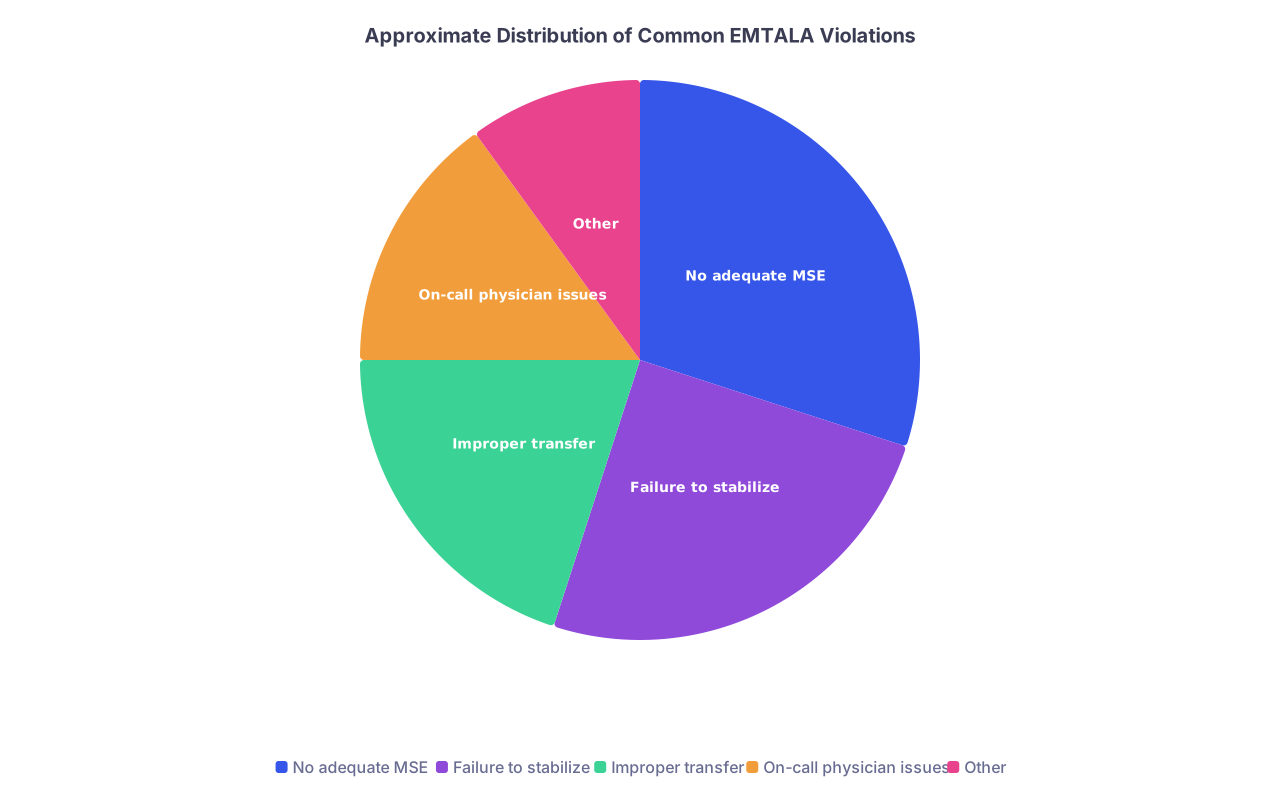
| Category | Value |
|---|---|
| No adequate MSE | 30 |
| Failure to stabilize | 25 |
| Improper transfer | 20 |
| On-call physician issues | 15 |
| Other | 10 |
The system isn’t watching you because you discharged a stable, annoying frequent flier with thorough documentation. It’s watching for emergency “problem patients” being offloaded once they become expensive or inconvenient.
Myth 3: “You Must Provide Every Possible Service the Patient Asks For”
No again. EMTALA is anchored to emergency medical conditions and the hospital’s capabilities and capacity.
You’re required to:
- Perform an appropriate screening exam (which can be triage-level in some cases, but not a sham)
- Stabilize an actual EMC within what your hospital can reasonably do
- Arrange transfer if you can’t stabilize and a higher-level facility is available and accepts
You’re not required to:
- Do an MRI at 2 a.m. because a stable patient “wants to be sure”
- Admit a clearly stable patient who refuses all outpatient follow-up options
- Provide elective, non-emergent procedures under the banner of EMTALA
- Prescribe controlled substances in the ED because “my doctor closed and you have to give me something”
A real example I’ve seen multiple times: a stable patient with chronic back pain demands an MRI “right now” and threatens to “report you for EMTALA” if you don’t order it. That threat is legally empty. Your duty under EMTALA was satisfied by an appropriate MSE and addressing any emergent condition (e.g., cauda equina warning signs, infection, fracture). Stable radiculopathy with no red flags does not turn the ED into an outpatient imaging center on demand.
Ethically, you still need to manage their pain reasonably, treat them with respect, and offer appropriate follow-up. But that’s ethics and good practice, not EMTALA handcuffs.
Myth 4: “If There’s No Bed, You Still Have to Take Them”
Capacity matters. EMTALA doesn’t require the impossible.
Hospitals can and do go on diversion or claim lack of capacity for certain services. However, the government gets suspicious when a hospital is miraculously “at capacity” every time the incoming patient is uninsured, has Medicaid, or is otherwise financially radioactive.
Here’s the nuance:
- If you have ICU beds, the right specialists, and equipment, it’s very hard to argue you lack capacity.
- If your last ICU bed was literally filled 10 minutes ago and there’s no physical or staffed space, you can legitimately say you lack capacity for an ICU-level transfer.
- “We technically have space but don’t want this complex, uninsured train wreck” is where EMTALA violations breed.
On the flip side, not every hospital is supposed to take every kind of patient. A critical access hospital without neurosurgery simply isn’t obligated to do a craniotomy. Their job is to stabilize as much as possible, then transfer appropriately.
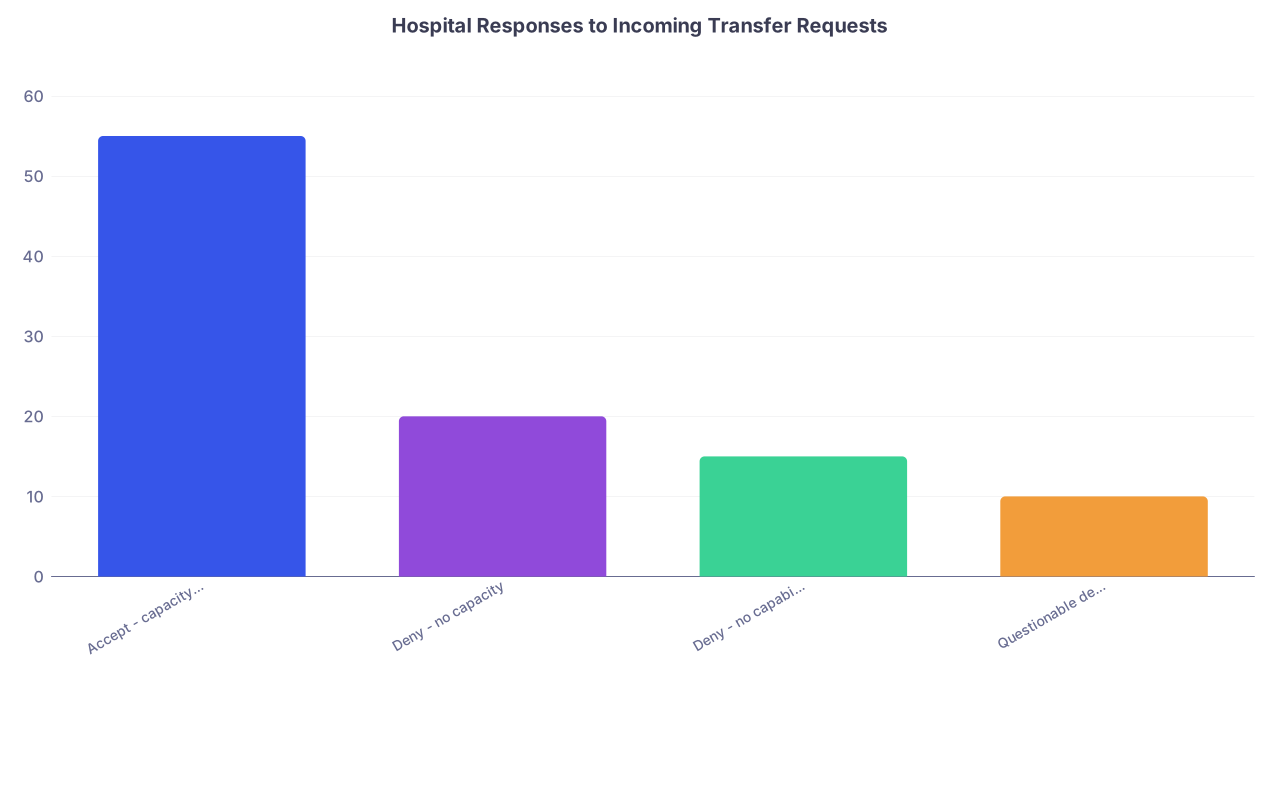
| Category | Value |
|---|---|
| Accept - capacity & capability | 55 |
| Deny - no capacity | 20 |
| Deny - no capability | 15 |
| Questionable denial | 10 |
That last category—“questionable denial”—is where regulators live. Your job as the physician is to be honest in your assessment of capability and capacity, and to document rational, clinical reasons for acceptance or refusal.
Myth 5: “Private Patients Only / We Don’t Take Your Insurance” Applies in the ED
This one is flatly illegal in the EMTALA context.
EMTALA does not care about:
- Insurance status
- Citizenship
- Ability to pay
- Whether they’re “our patient”
At the point someone comes to the ED requesting care, you don’t get to send them away at triage because “we’re out-of-network for you” or “we’re a private hospital.”
In practice, I’ve seen front-desk staff or even security guards say exactly those things to patients with visible homelessness or mental illness. That’s textbook EMTALA trouble.
Once they hit the ED and request care:
- You do an MSE
- You identify or rule out an EMC
- You stabilize if present
- Only then does “your insurance vs our system” start to matter for disposition and follow-up
Hospitals that forget this and let financial gatekeeping creep into triage get hammered in EMTALA investigations.
What About Ethical Duties That Go Beyond EMTALA?
Now the uncomfortable part: ethics is broader than the statute.
You probably do feel some obligation beyond “what I can get sued or fined for.” Good. You should. But mixing ethics and EMTALA in your head is how both get distorted.
Ethically:
- You don’t walk away from a crashing patient because they yelled at you or smell like alcohol.
- You don’t withhold necessary acute treatment as punishment for being noncompliant.
- You don’t cherry-pick “clean, insured, grateful” patients when you’re on call.
Legally under EMTALA, your duty is narrower and more defined:
- Emergency context
- Screening
- Stabilization
- Proper transfer
A lot of residents confuse the two and think, “If I discharge this person, I might be breaking EMTALA.” In reality, you’re probably worried about clinical judgment, malpractice risk, and professional conscience—not EMTALA.
Here’s how I mentally separate them:
| Aspect | EMTALA Focus | Ethical/Professional Focus |
|---|---|---|
| Scope | ED / hospital emergency care | All patient interactions |
| Trigger | Request for exam/treatment | Any encounter |
| Main duty | Screen, stabilize, transfer properly | Act in patient’s best interests |
| Enforcement | Federal investigation, fines, CMS | Boards, malpractice, reputation |
| Time frame | Emergency episode | Longitudinal, career-long |
You need both frameworks. But you need to know which is which.
Common Situations: What EMTALA Actually Means for You
Let’s run through some everyday scenarios people routinely misunderstand.
Scenario 1: “He Just Wants a Work Note”
Patient walks in to the ED: “I need a work note; I feel fine.” You still owe an MSE. That does not mean labs and CTs. It means a focused, appropriate exam to confirm no emergency condition.
Document symptoms, vitals, focused history and exam. If no EMC, you’re done for EMTALA. Whether you give the note is a separate policy/ethics issue.
Scenario 2: “She Refuses Everything”
Patient with an EMC, fully capable of decision-making, declines treatment. Legally, you’ve got to:
- Explain risks, benefits, and alternatives
- Document refusal and capacity
- Offer what they will accept (e.g., pain control, follow-up info)
You can’t force treatment under EMTALA just because there’s an emergency. Autonomy still exists. EMTALA doesn’t override consent law.
Scenario 3: “Out of Control Psych Patient, No Psych Beds”
You still owe an MSE and stabilization, which for behavioral health can include meds and safe containment. You are not required to conjure a bed that doesn’t exist.
Regulators care that you tried: calls to other facilities, proper documentation of lack of beds, ongoing safety measures. They don’t require magic.
How EMTALA Fits Into Your Development as a Physician
If you’re early in training, here’s the blunt truth: most of what you’ve heard about EMTALA is either incomplete or wrong, often weaponized as “we have to do X or we’ll be in EMTALA trouble” when someone just doesn’t want to argue with administration.
Your job is to internalize a simple decision process for ED encounters:

| Step | Description |
|---|---|
| Step 1 | Patient arrives & requests care |
| Step 2 | Medical screening exam |
| Step 3 | Discharge with instructions |
| Step 4 | Stabilize within capability |
| Step 5 | Continue care / Admit / Discharge when stable |
| Step 6 | Arrange appropriate transfer |
| Step 7 | Emergency medical condition? |
| Step 8 | Can hospital stabilize? |
If you keep that mental flowchart in your head, you’re ahead of half the practicing physicians I’ve met.
And if you’re in a non-ED setting—clinic, telehealth, elective OR—stop invoking EMTALA as a boogeyman. It does not apply there the way people throw it around.
The Bottom Line
Three takeaways and you’re done:
- EMTALA is about emergency screening, stabilization, and safe transfer at Medicare-participating hospitals—not a universal “you must treat every human for everything” rule.
- Once a patient is appropriately screened and stabilized (or admitted), EMTALA largely steps aside; ethics, malpractice, and good medicine take over.
- You’re not required to do the impossible or the elective; you are required to avoid dumping unstable, unwanted, or uninsured patients under the guise of “no capacity” or “not our patient.”
Know the law. Know your ethics. Stop letting myths control your practice.


