

10–20% of malpractice claims are won by plaintiffs even when the chart looks “good enough.”
So no, “If it’s not documented, it didn’t happen” is not some magic legal truth. It’s a slogan. And like most slogans in medicine, it’s a half‑truth that’s been repeated so often people stopped asking if it’s actually correct.
Let me be blunt: over‑documentation is wasting your time, burning you out, and not protecting you nearly as much as you think. And sometimes, the absence of documentation is ethically and legally safer than a bloated, copy‑pasted mess.
Let’s tear this thing apart properly.
Where “If It’s Not Documented, It Didn’t Happen” Actually Came From
The phrase didn’t come from a court ruling. It came from risk‑management seminars and compliance trainings.
Law and ethics are more nuanced.
Courts and regulators usually care about three main things:
- What actually happened (facts, memories, other records, witnesses)
- Whether what happened met the standard of care
- Whether the documentation helps or hurts understanding that
Documentation is evidence, not reality. It’s powerful evidence, but it isn’t the only thing that exists. Judges say this explicitly:
- U.S. courts have repeatedly allowed clinicians to testify about care they provided, even when it wasn’t charted, and juries can accept that testimony.
- In negligence cases, the record is often incomplete. That does not automatically equal malpractice. It just raises questions.
A more honest version of the slogan would be:
“If it’s not documented, it’s harder to prove it happened, and that might hurt you.”
Clunky. Not catchy. But more accurate.
What the Data Actually Shows About Documentation and Lawsuits
Here’s the part that gets ignored in those fear‑mongering lectures: the research.
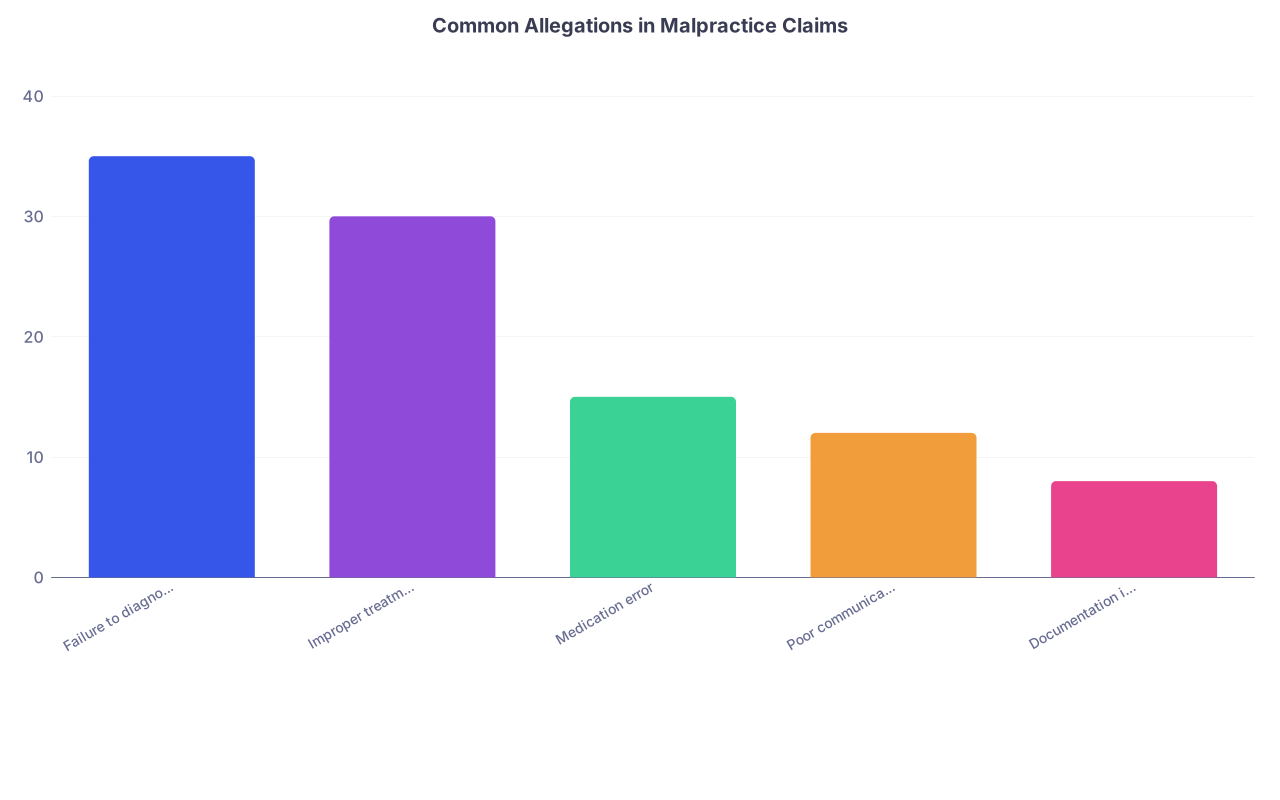
| Category | Value |
|---|---|
| Failure to diagnose | 35 |
| Improper treatment | 30 |
| Medication error | 15 |
| Poor communication | 12 |
| Documentation issues | 8 |
Look at closed‑claim analyses from big malpractice insurers and risk‑management groups:
- The top causes of claims: failure to diagnose, delayed diagnosis, poor clinical judgment, poor communication.
- Documentation problems show up as contributing factors, but they’re rarely the central allegation by themselves.
When documentation is central, it’s usually because of things like:
- Critical elements missing (no neuro exam in a suspected stroke)
- Contradictions (ROS “negative” but HPI describes classic red‑flag symptoms)
- Copy‑paste errors (chart says “no distress” while the nurse writes “patient crying in severe pain”)
Notice the pattern: it’s not the missing fluff that causes trouble. It’s missing or conflicting clinically relevant info.
So the blind “document everything” reflex is not backed by evidence. Document the right things is what the data supports.
Myth vs Reality: What Courts Actually Do With Missing Documentation
Let’s walk through the situations where people love to quote the myth.
1. “If you didn’t document you counseled the patient, the court will assume you didn’t.”
Not exactly.
Courts look at:
- Your testimony
- The patient’s testimony
- Typical practice patterns
- Any corroborating evidence (brochures, consent forms, witnesses, clinic policies)
If you say, under oath, “I always discuss X risks for this surgery, and I remember having that counseling conversation with this patient,” the jury can believe you. Or not. They don’t treat the note as a sacred, infallible object.
Is a clear note about counseling helpful? Absolutely.
Is its absence fatal? No.
2. “No note = automatic loss in a malpractice case.”
False.
I’ve seen cases where the documentation was thin but the expert testimony was strong, the care was clearly within standard, and the defense won. Conversely, I’ve seen cases with pristine notes and the defense still lost because the clinical decisions were indefensible.
The chart is one piece in a bigger puzzle. The idea that it’s the only thing that matters is just lazy thinking.
3. “Regulators only care what’s written.”
They care what’s written and what can be reasonably inferred from patterns, logs, orders, and witness statements.
- EHR timestamps
- Order histories
- Nursing notes
- Device data (monitor logs, infusion pump records)
All of those speak, even when your progress note is brief.
When “If It’s Not Documented, It Didn’t Happen” Becomes Ethically Dangerous
Here’s the part your compliance module conveniently skips: that slogan, taken literally, can push you toward ethically sketchy behavior.
1. It nudges people toward creative “reconstruction”
You’ve probably heard someone say, “Well, you must have done a full neuro exam, just document it now” after the fact.
That’s falsification.
Not “documentation optimization.” Not “filling in the gaps.”
Falsification.
And if the record gets audited (or the EHR log shows you completed a 12‑point ROS at 03:17 in 8 seconds), you look worse than if you’d just admitted: “I did a focused exam and didn’t document every element.”
Ethically, the right move is:
“I don’t remember doing that part, and it’s not in my note, so I can’t claim I did it.”
There’s a big difference between reasonable inference (“I didn’t list every normal heart sound, but I clearly noted ‘no murmur’”) and fantasy charting.
2. It encourages harmful over‑sharing
The myth also fuels another problem: people dump way too much into the chart under the banner of “defensive documentation.”
That includes:
- Speculation about diagnoses the patient will never see explained
- Snarky comments about “drug‑seeking behavior”
- Emotional reactions written as clinical fact
Those notes can poison the therapeutic relationship, stigmatize patients, and cause direct harm—especially now that patients can read almost everything through portals.
Ethically, you do not have to document every unfiltered thought just to “protect yourself.” In fact, doing so can hurt care and may backfire legally.
3. It wastes time that should go to patients
Let’s be clear: ER and ICU docs spending extra 30–60 minutes per shift artificially inflating notes “for legal protection” is not benign. That time comes from somewhere. Usually sleep, teaching, or patient interaction.
Massive, bloated notes increased with EHRs. Burnout climbed right alongside them. That’s not a coincidence.
The Standard of Care Is Not “Write a Novel”
The law cares about whether your care met the standard, not whether your note reads like a peer‑reviewed article.
Standard of care = what a reasonable, similarly trained clinician would do in that situation.
Documentation supports that by:
- Showing your clinical reasoning
- Recording major findings and decisions
- Demonstrating that you warned about key risks and alternatives
But there’s no legal requirement to:
- Document a 14‑point ROS on every visit
- Copy forward the entire exam from yesterday
- Record every single negative in the universe
In fact, in many malpractice cases, copied and bloated documentation is used against clinicians.
| Pattern | Legal/Ethical Impact |
|---|---|
| Focused, relevant notes | Supports good care |
| Copy-paste of old findings | Undermines credibility |
| Inconsistent entries | Raises doubt and suspicion |
| Clear risk/benefit counseling | Strong defensive value |
| Snide or biased language | Ethically and legally risky |
You don’t win cases because the chart is long. You win because it’s honest, coherent, and clinically sensible.
When Memory and Testimony Still Count
Another reason the slogan is misleading: it erases the role of human memory and routine practice.
Courts allow something called “habit evidence” or “customary practice.” If you always:
- Use a specific checklist for a procedure
- Always counsel on certain risks for a certain med
- Always order pregnancy tests before certain imaging
You can testify about that pattern even if a given visit note is bare‑bones. Juries can weigh that.
Does this rescue you from every gap? Of course not. If something is truly critical or unusual, it should be in the chart. But the idea that everything not written becomes legally nonexistent is fantasy.
A better mental model:
The chart is the backbone of your story. Your memory and pattern of practice are supporting muscles, not forbidden extras.
The Real Ethically Defensible Approach to Documentation
So what should you actually do, ethically and practically?
Think of documentation as serving three masters: the patient, the clinical team, and the legal/regulatory environment. In that order.
The ethically solid approach looks like this:
First, serve patient care.
Ask: “If someone reads this tomorrow—or if I do, half‑asleep—will they understand what’s going on and what I was thinking?”
That means: key findings, relevant negatives, clear plan, and reasoning for important decisions.Second, respect the patient as a person.
Assume they might read every word. Because many now do.
That means no eye‑rolling phrases, no character judgments dressed up as diagnoses, no gratuitous details that don’t help care.Third, protect yourself honestly.
Document critical counseling, discussions of alternatives, clear refusals.
Don’t invent, don’t pad, don’t retro‑fit reality to make yourself look better.
That aligns with ethics and with the law far better than the myth.
When Less Documentation Is Actually Safer
Here’s the curveball: sometimes, more documentation is legally and ethically worse.
Concrete examples:
- Copy‑pasting normal exams for a patient who is clearly deteriorating makes you look blind or dishonest.
- Dropping a half‑baked differential diagnosis list can confuse future clinicians or terrify the patient reading it, without changing management.
- Writing subjective hostility toward a patient (“manipulative”, “noncompliant”) can bias everyone else and destroy trust.
I’ve watched plaintiff attorneys point to screens of repeated “no distress” notes while the vitals show tachycardia, escalating oxygen, and increasing pain meds. The problem wasn’t “not enough documentation.” It was too much bad documentation.
How to Reframe the Myth Without Getting Sued
You do not have to choose between defensive chart novels and legal suicide. The smart middle ground is:
- “If it’s important, it should be documented.”
- “If I cannot honestly say I did it, I will not document it.”
- “My note should reflect real thinking, not billing targets.”
- “I assume the patient and a jury might read this, and I’m okay with that.”
For personal development as a clinician, that last one is huge. It forces you to ask: “Would I be comfortable explaining this note—every word of it—aloud in front of the patient and their family?”
If the answer is no, the problem is not under‑documentation. It’s your documentation culture.
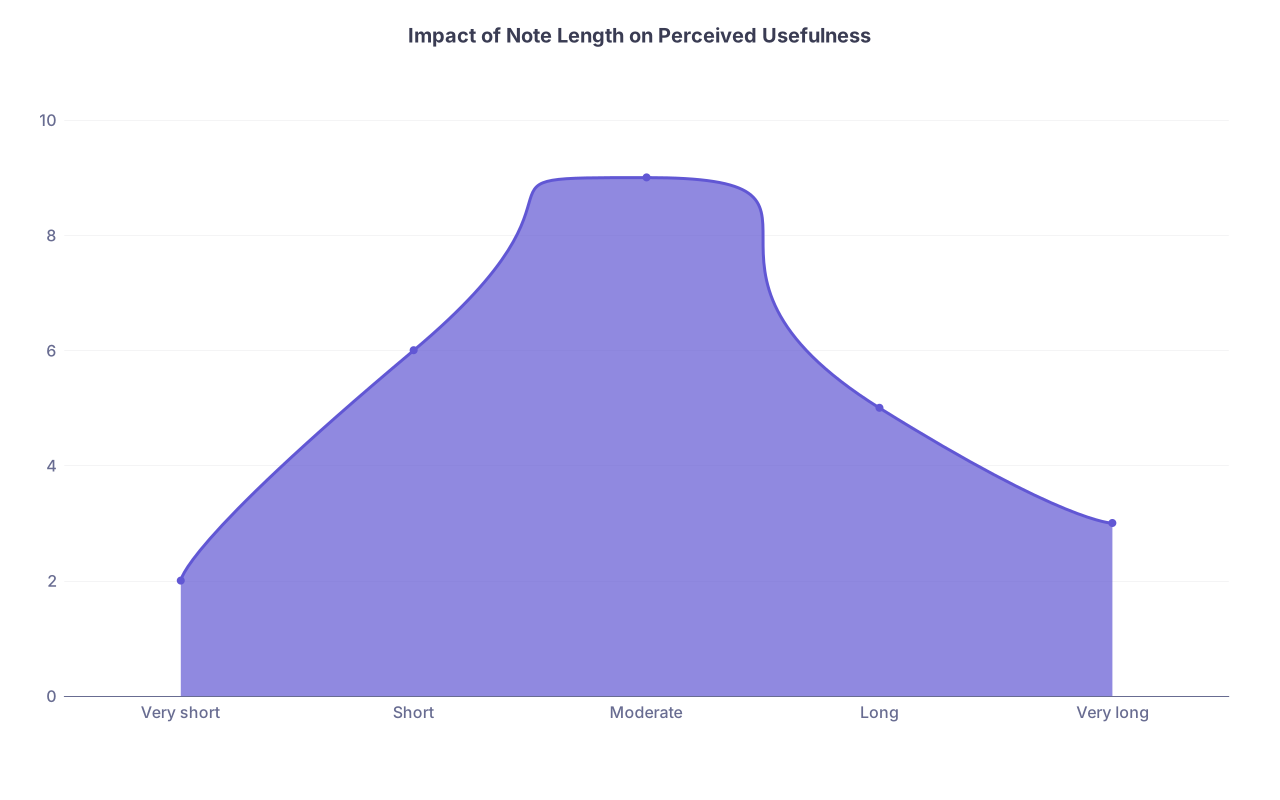
| Category | Value |
|---|---|
| Very short | 2 |
| Short | 6 |
| Moderate | 9 |
| Long | 5 |
| Very long | 3 |
Notice how clinicians consistently rate “moderate, focused notes” as most useful in usability studies. Extremely long notes are regarded as almost as useless as ultra‑brief ones. That should tell you something about where your effort should go.
A Simple Mental Checklist Before You Sign
You don’t need a 40‑item template. Just run through this in your head:
- Does this note tell the story of why I did what I did?
- Are the big risks, options, or refusals documented when they matter?
- Is anything here exaggerated, assumed, or back‑filled from memory without support?
- Would I be fine with the patient reading this sentence?
If you can say yes, yes, no, yes—you’re in a far better ethical and legal position than the person who documented a page of fluff just to hit billing and “cover themselves.”
FAQ (5 Questions)
1. Can I testify that I did something if it’s not in the chart?
Yes. You can testify based on your memory and usual practice. The court can accept that. But the absence of documentation may make your testimony less persuasive, especially for critical steps like informed consent or high‑risk decisions.
2. Is it ever okay to edit a note after the fact?
Yes, with transparency. Most EHRs time‑stamp edits. Adding an addendum like “On review, I would add that…” is fine. Quietly changing the original to pretend you documented something earlier is risky and unethical.
3. What absolutely must be documented for legal and ethical safety?
Key findings, your working diagnosis, major differentials in high‑risk or unclear cases, big decisions with reasoning, critical test results, and important counseling or refusal of recommended care. Not every normal lung exam for the 15th time.
4. Do insurance or billing rules change what I ethically should document?
Billing requirements push you toward more detail than clinically needed. Ethically, you should never fabricate or exaggerate for billing. Where there’s a tension, clinical truth wins. If a payer wants a scripted ROS that doesn’t reflect reality, that’s their problem, not your license’s.
5. How do I push back on attendings or administrators who insist on “document everything”?
Use their own language: risk, efficiency, safety. Show that bloated notes hide key data, increase errors, and don’t clearly reduce claims. Offer an alternative: “Let’s standardize what must be captured for risk and let the rest be clinically driven.” Some will resist. But that’s how culture starts to shift.
Key points: The phrase “If it’s not documented, it didn’t happen” is not a legal truth; it’s an oversimplified teaching tool. Missing documentation makes things harder, not impossible—while dishonest or bloated documentation can actively harm you and your patients. The ethical sweet spot is focused, honest, clinically driven notes that you’d be comfortable defending—in court and in front of the patient.


