

Last winter, a second-year resident on our service walked out of a family meeting looking like she’d been hit by a truck. The family had demanded “everything” for an 89‑year‑old in multi‑organ failure. She’d said no, gently and correctly. They’d called her heartless. Then she came to the workroom and whispered the question that tells me someone is still early in their training: “What are the attendings really thinking when we push back like that?”
Let me answer that the way attendings actually talk when the door closes and the chart is still open on the screen.
The First Thing Attendings Notice: Your Spine
Every attending I know is judging one thing first in these situations: do you have a spine, and can you use it without setting the place on fire?
We watch how you handle that first clear conflict between family demands and medical judgment like it’s a stress test.
You think we’re obsessing over your exact phrasing: “I recommended against intubation because…” vs “I do not think intubation is appropriate because…”. We’re not. We’re asking ourselves:
- Did you cave because you were uncomfortable?
- Did you stonewall because you were scared of conflict?
- Or did you stay in the pocket, hold the ethical line, and still treat that family like human beings?
Here’s the ugly truth no one puts in the professionalism handbook: many attendings are more disturbed by spineless acquiescence than by an awkward, slightly clumsy refusal.
If a family demands:
“You will put my father on a ventilator and do everything. He’s a fighter.”
and the chart screams end-stage dementia, metastatic cancer, repeated hospitalizations, and the patient’s own prior statement that he never wanted to be a “vegetable”—and you say:
“Okay, if that’s what you want. We can do that,”
we are not impressed. We’re worried. Deeply. That is not compassion; that’s abandonment dressed up as “being family-centered.”
When you instead say:
“I understand how hard this is. Based on what we’re seeing and what he told us he wanted, starting a ventilator now would not help him recover and would likely cause suffering. I don’t recommend that, and I won’t order it… but I’m here to talk about what we can do,”
you’ve just done something most PGY-2s are terrified to do: you’ve refused a demand that conflicts with the patient’s interests and values.
Behind the closed door afterward, the conversation usually sounds like:
“She actually held the line. Good. We can teach the rest.”
We can fix your phrasing. We can polish your empathy. We cannot teach backbone to someone who refuses to take a position.
What We’re Quietly Scoring In Our Heads
No one tells you this during orientation, but attendings run a silent checklist when you refuse a family’s demand. It’s not written anywhere. It determines whether we call you “strong” or “a problem” in evaluation meetings.
Here’s the real rubric.
| Dimension | What Impresses Attendings |
|---|---|
| Ethical clarity | Clear stance grounded in patient’s best interests |
| Communication | Direct, calm, no jargon, no argumentative tone |
| Emotional regulation | Composed under anger, tears, or threats |
| Team awareness | Loops in attending, nursing, palliative, chaplain |
| Documentation | Specific, defensible, shows thought process |
You refuse a demand. What do we look for?
1. Ethical clarity
Did you anchor yourself in the patient, not “policy,” not “the hospital,” not “what we usually do”?
We love hearing things like:
- “Given his condition and what he told us, CPR would not help him recover and would most likely cause harm.”
- “We won’t offer treatments that we believe will not benefit him and may cause suffering.”
We do not love:
- “The hospital doesn’t allow us to do that.”
- “We’re not allowed to give more pain meds.”
- “It’s against policy.”
That tells me you don’t understand that your job is to be the patient’s advocate, not a policy-parrot or a risk manager in a white coat.
2. Communication skill
We watch every word you choose when the family pushes back.
If the family says, “You’re killing him!” and your voice goes flat and you retreat into technical language, we notice.
Attendings talk like this later:
“He technically said the right thing, but he sounded like he was reading from UpToDate. You can’t do that when people are grieving in real time.”
We’re not expecting poetry. We’re expecting you to sound like a human being.
3. Emotional regulation under heat
This is the part nobody trains you for properly.
A daughter stands up, finger in your face, and says, “If he dies, it’s on you.” Your heart rate spikes. Your ears ring. Your instinct is to either fight or escape.
You stay seated. You keep your voice level. You say:
“I hear how scared and angry you are. I don’t want your father to die. But I also won’t do procedures that will not help him and could hurt him.”
In the workroom later, the attending won’t say, “She had excellent emotional regulation.” They’ll say:
“She didn’t flinch. She kept her cool. She’s solid.”
That’s code for: I can trust this person at 3 a.m. when I’m not in-house.
4. Team awareness
If you decide to have that whole battle alone at the bedside with no page to your attending, no heads-up to nursing, no consult to palliative—yeah, we notice.
A resident who says to the family:
“This is a big decision and a hard moment. I’d like to bring my attending and possibly our palliative care colleagues into this conversation so we can support you better,”
is a resident who understands hierarchy exists for a reason. We’re here to absorb some of the blast. Use us.
5. Documentation
This is not optional. This is your shield.
We look for notes that actually say what happened:
“Family requested CPR and intubation in event of arrest. Explained prognosis (multi-organ failure, refractory shock), likelihood of non-beneficial CPR, and high probability of suffering without meaningful recovery. Recommended DNR/DNI consistent with patient’s previously expressed wishes (see ACP note 2/2023). Family tearful, requested time to discuss. Will revisit; attending Dr. X present for conversation.”
That is the kind of note that makes risk management relax and makes me think, “This person gets it.”
A vague “Goals of care discussed with family” is worthless. It does not protect anyone. And it makes us wonder what really happened in that room.
What We Think But Rarely Say Out Loud
Let’s go into the stuff that never appears in the workshop slides.
1. We know when a family is asking for “everything” because no one has been honest
Half the time families demand futile interventions because every clinician before you has dodged the truth.
They’ve heard “He’s very sick,” “We’re doing everything we can,” “He’s not out of the woods.” What they have not heard is: “He is dying. Not ‘might die.’ Is dying.”
So when you’re the first one to say no—to CPR, to ECMO, to another ICU transfer—you inherit all the pent-up shock and betrayal that rightly belongs to the last five people who rounded on that patient and refused to use the word “dying.”
I’ve sat in rooms after those meetings and said to residents flat out:
“They’re furious with you because you told them the truth. But we set you up by not preparing them. That’s on us.”
If you’re wondering what your attending is really thinking after one of those blow-ups: sometimes it’s guilt. We know we should have been in that room with you two days ago setting expectations.
2. Sometimes we think the demand is about their guilt, not your decision
When a son who hasn’t visited in years shows up at the eleventh hour and screams that we must do “everything,” everybody on the team notices. The nurses, the social worker, the attending. Especially the attending.
We will talk about it privately:
“He’s not actually asking for care. He’s begging us to erase ten years of absence.”
You refusing those demands is not you being “cold.” It is you refusing to convert medical care into a guilt-erasure ritual. We know that. We see the dynamic. We do not want you performing torture to make someone feel better about disappearing for a decade.
3. We can tell if you’re refusing out of moral clarity or out of exhaustion
Here’s the part that might sting.
I’ve seen residents, post-call, exhausted and burnt out, shut down a family’s demand not because it’s ethically wrong but because they’re simply done.
Family asks for another family meeting, wants to see the imaging, wants more explanation. There’s still some gray space. And the resident says, clipped and irritated, “No, we’re not doing that,” without actually addressing concerns.
Afterward, attendings will say:
“He’s not wrong medically. But that ‘no’ came from burnout, not from ethics.”
We’re sympathetic. We’ve been that tired. But we also know who can be safely left alone with a complex family, and who we have to hover over because their fuse is too short.
So if you feel yourself refusing because you just can’t bear another conversation, you need to pull us in. That’s part of professionalism too.
The Legal Reality We Actually Worry About
You’ll hear attendings say, “We’re not required to provide non-beneficial treatment,” but you probably haven’t seen what that looks like in our heads.
Contrary to what med students think, the biggest legal risk is not refusing to do an inappropriate intervention. The bigger risk, long-term, is doing something wildly out of step with standard of care because a family shouted loudest.
We know where the lines are, institutionally and legally:
- You are not obligated to provide treatments that have no reasonable chance of achieving a physiologic effect or that only prolong dying and suffering.
- You are obligated to explain, clearly, why you’re refusing; to offer alternatives; and to escalate to your attending.
- You are obligated to document your rationale in a way another clinician and a lawyer could both understand.
Behind the scenes, when a family is making wild demands, some attendings are already mentally looping in risk management:
“If this escalates, I need a clear record that we recommended against X, explained why, offered palliative options, and declined to do something outside standard practice.”
So yes, when you refuse a family demand and you do it thoughtfully, we are actually relieved. You’re aligning with what the hospital’s lawyers and ethics committee quietly want you to do: practice good medicine, not defensive torture.
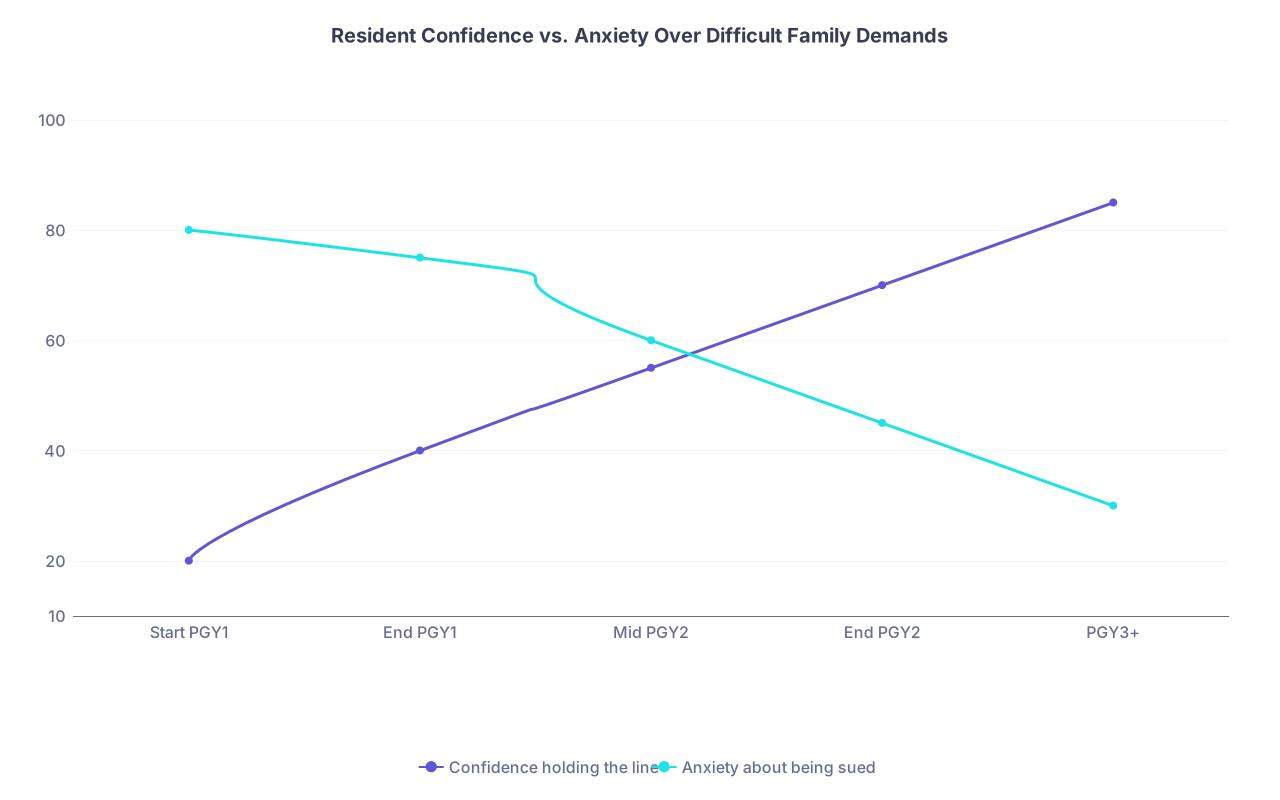
Here’s how that legal/emotional tension usually looks over time:
| Category | Confidence holding the line | Anxiety about [being sued](https://residencyadvisor.com/resources/medical-ethics-law/what-actually-gets-you-named-in-a-lawsuit-during-residency) |
|---|---|---|
| Start PGY1 | 20 | 80 |
| End PGY1 | 40 | 75 |
| Mid PGY2 | 55 | 60 |
| End PGY2 | 70 | 45 |
| PGY3+ | 85 | 30 |
Confidence goes up as you see that carefully refusing inappropriate care doesn’t end in lawsuits every time. Anxiety drops when you realize what actually protects you is clarity and documentation, not reflexive “yes” to every demand.
When You Go Too Far: How Attendings React
Let’s be honest. Residents sometimes overshoot.
You learn the phrase “medically inappropriate.” You feel the righteousness of not doing harm. You get burned once by a family meltdown. And then suddenly every borderline request becomes “non-beneficial,” and you’re saying “no” faster than you should.
Example I’ve seen:
Family: “Can we have one more day to see if he wakes up? My brother is flying in.”
Resident (tired, frustrated): “There’s no point. We need to extubate now. Waiting is not appropriate.”
Technically? Maybe still defensible. Humanly? Tone-deaf.
Behind the scenes, an attending will say:
“He’s right about prognosis. But he slammed the door instead of walking them to it.”
Here’s what we’re thinking in those cases:
- You’re starting to use “futility” as a shield to avoid hard, slow conversations.
- You’ve internalized the ethical rules but not the art.
- We need to pull you back toward nuance before you become “that doctor” everyone dreads calling.
We’re not angry. We’re wary. And we’re going to start watching your family meetings more closely, not less.
What “Strong But Fair” Actually Looks Like
The residents who get quietly labeled as “excellent with families” are not the ones who always agree. They’re the ones who can do all of this in the same conversation:
- Tell a family their demand will not be met
- Acknowledge and validate their emotion without giving in
- Stand clearly on the side of the patient’s values and best interests
- Offer real alternatives instead of a bare “no”
Picture this scenario.
Family: “If his heart stops you must do CPR. That’s what good doctors do. That’s what we want.”
You:
“I hear how much you want him to stay with you. A lot of families feel that way.
Given his heart failure, kidney failure, and how weak he is, CPR would almost certainly break his ribs, put him in the ICU on machines, and still not bring him back in any meaningful way. It would likely cause him pain in his last moments.
Because of that, I won’t recommend or perform CPR.
What I can do is make sure that if his heart stops, he’s not in pain, not struggling for breath, and that you’re here with him, not in a waiting room. Can we talk about what matters most to you in those moments?”
That’s a refusal. But it’s a refusal that carries the family somewhere instead of leaving them on the curb.
When I hear a resident give that kind of answer, my internal monologue is simple:
“Good. They’re going to be fine.”
How To Recover When It Goes Badly
You will blow one of these conversations. Everyone does. You’ll say too much, or too little, or your voice will crack, or you’ll lose your temper internally and then freeze.
What do attendings think when that happens?
We’re not judging the failure; we’re judging what you do next.
If you come to me and say:
“That went badly. I think I said the right medical thing but I did not handle their emotion well. Can you come with me the next time we talk to them and also tell me what I could do differently?”
I will gladly invest the time. Because that tells me you’re coachable and self-aware.
If instead you say:
“The family is crazy. They’re impossible. They just don’t get it,”
and that’s the end of your analysis? Now we’ve got a problem. Because you’re externalizing everything. You’re not seeing your part in a conversation that went off the rails.
What you do after a failed refusal conversation tells me more about your future as an attending than how that one conversation went.
The Part You Don’t See: How Attendings Protect You
Let me pull back the curtain on one last thing: what happens after you refuse a demand and the family escalates.
You go home. You’re replaying the conversation in your head, half-convinced you’ll be fired or sued. Meanwhile, upstairs, this is what’s happening:
- Your attending calls risk management and walks them through the note you wrote.
- They frame your actions as appropriate, thoughtful, and in line with standard of care.
- They take full responsibility in that call. It’s “our recommendation,” not “the resident’s.”
- If needed, an ethics consult is dropped in not to undermine you, but to formally validate the stance you took.
I’ve been in those calls. The attendings who care about their residents do not throw them under the bus. They lean heavily on “We, as a team, recommended against X because…”
Your job is to give us something to defend: clear reasoning, documented conversations, and a refusal that was about the patient, not your burnout. If you do that, most attendings will go to bat for you harder than you realize.
FAQs
1. What if my attending seems to cave to a family’s demands I think are wrong?
It happens. Some attendings practice more defensively or conflict-avoidantly than they admit. You’re allowed to say, privately and respectfully: “I’m struggling with this plan because it feels non-beneficial. Can you walk me through your reasoning?” You’ll learn one of three things: you missed a nuance; they’re making a pragmatic compromise; or yes, they’re caving. Note it, learn from it—but don’t let a single attending’s avoidance rewrite your own ethical compass.
2. Can I ever say “the team” or “the hospital” instead of “I” when refusing?
You can say “we” to emphasize that you’re not a lone zealot. But hiding behind “policy” or “the hospital won’t let us” is weak and obvious. Families sense it. Use “I” when you’re stating medical judgment: “I do not recommend… I will not order…” and “we” when framing consensus: “We as a team believe this would not help him.”
3. Should I involve ethics or palliative care early when I anticipate conflict?
Yes, and attendings like that kind of foresight. Calling ethics is not an admission of failure; it’s a sign you recognize complexity. Same for palliative: the best residents loop them in before the fourth screaming match, not after. It signals maturity and an understanding that these conversations are a team sport.
4. How do I emotionally cope after a brutal family confrontation?
Attendings actually expect you to be rattled. Use your co-residents, your attending, maybe even your program leadership. Say out loud what you’re carrying. Debrief: what was ethically clear, what was gray, what personally hurt. If every time you hold the line you go home drowning in guilt, you’ll either burn out or go soft and start saying yes to everything. Neither is sustainable. Processing this is part of becoming the kind of physician who can do the right thing and still sleep at night.
You’re going to face more of these moments, not fewer, as you move up. The good news is that you don’t have to guess what we really think when you say no. Now you know. The next time you walk into that room and close the door, you’re a step closer to being the attending on the other side of it.


