
The way program directors judge you when you push back on an unsafe discharge is not what you think. You are not being evaluated on whether you “won the argument.” You’re being graded on how dangerous you are—to the patient, to the institution, and to the team.
Let me walk you through what really runs through their heads when you speak up, stall, or outright refuse to go along with a discharge that smells wrong.
The Unspoken Rule: Safety Is Sacred… In Theory
On paper, every residency and hospital screams the same line: “Patient safety is our top priority.” The posters are everywhere. Quality improvement. High reliability. Just culture. Blah blah.
Behind closed doors, the real equation is quieter and more ruthless:
Does this resident’s behavior increase or decrease my risk of:
- A bad outcome
- A complaint or lawsuit
- A reportable event or public embarrassment
- A dysfunctional team
That’s it. That’s the calculus.
When you push back on a discharge plan that feels unsafe—frail COPD patient going home on home oxygen with no family, new insulin start for someone who can’t read labels, psych patient “contracting for safety” with no actual follow-up—they’re judging three things immediately:
- Are you right about the safety concern?
- Are you escalating it the right way?
- Are you someone I can trust when things get hot?
If you think this is about moral purity, you’ll get eaten alive. It’s about risk, perception, and how you handle conflict under pressure.
What PDs and Attendings Really Look For When You Push Back
There are four archetypes we use in our heads when we talk about residents who challenge discharge plans. Trust me, this is almost word-for-word from faculty meetings.
| Archetype | How You’re Perceived |
|---|---|
| The Canary | Early-warning, valuable |
| The Hero | Right but exhausting |
| The Problem Child | Dangerous to team |
| The Ghost | Never pushes back |
The Canary
This is the resident who quietly says, “I’m not comfortable with this discharge; something’s off,” and they’re usually right.
They bring specific concerns, relevant data, and realistic alternatives. They document. They escalate when needed but do not perform.
Program directors love Canaries. They see you as:
- A safety net
- A potential chief resident
- Someone who prevents lawsuits before Risk even hears about them
You can disagree, push back, and even stall a discharge as a Canary, and the commentary about you in the CCC meeting is: “She catches things early; she’s a little anxious maybe, but she saves us.”
The Hero
The Hero is often clinically correct, ethically solid, and deeply invested in doing the right thing. The problem? They’re high-friction.
They argue. They dig in. They make everything a moral battlefield. They’re the ones saying, “If we send her home I’m going to lose sleep over this,” loudly, in the middle of a crowded hallway.
Directors see Heroes as:
- Ethically serious
- Smart
- Emotionally draining
You do not get fired for being a Hero. But you get labeled. “Strong advocate but needs to work on diplomacy,” “can escalate quickly,” “does not always pick their battles.”
That label will follow you into letters of recommendation.
The Problem Child
This is who you do not want to be.
The Problem Child uses “safety” as a blunt weapon to cover inefficiency, poor planning, or avoidance. They block discharges without a plan, scream liability instead of thinking solutions, and CC five people on every email the moment they feel the slightest pushback.
Program directors see them as:
- High risk to morale
- High risk for complaints and HR drama
- Unreliable under pressure
Even if they occasionally catch something real, the global story becomes: “They cry wolf constantly. I don’t trust their judgment. I’m exhausted.”
That’s how your otherwise valid safety concerns get dismissed next time.
The Ghost
The Ghost never pushes back. They discharge everyone, no matter how sketchy it seems. They’re efficient, their list is always clean, the board is happy.
Until something goes really wrong.
Then, in the morbidity and mortality discussion, their name gets followed by: “Why didn’t anyone speak up? The red flags were there.”
PDs are quietly afraid of Ghosts. You look good on the surface—no “attitude,” no conflict—but you’re a medicolegal landmine. They don’t trust you to protect the program when something feels off.
What Actually Happens When You Push Back
Let’s talk through a real-world scenario that I’ve seen versions of at multiple programs.
The Setup
PGY-2 on medicine. Friday afternoon. Hospital is at 98% capacity. There’s a “discharge push” email from hospital leadership. Attending is on their third week straight on service and looks fried.
Your patient: 72-year-old living alone, recent heart failure exacerbation, still a little dyspneic at rest, multiple med changes, new diuretic, borderline creatinine.
Attending: “He looks okay. Let’s get him out. We can’t keep him forever.”
You: “I’m not comfortable sending him home today.”
The moment you say that, a few things happen that no one narrates out loud.
The Attending’s Internal Checklist
Whether they admit it or not, they run this mental checklist on you in seconds:
- Are you prepared or just reacting emotionally?
- What’s your specific concern?
- Do you have a concrete, reasonable alternative plan?
- How have you handled conflict with me before?
- How is this going to look if there’s a bad outcome and this chart is scrutinized?
If your pushback sounds like: “This feels wrong,” “I’m nervous,” “I just don’t like it,” you look unstructured. That’s how you slide toward Hero/Problem Child territory.
If it sounds like:
“His weight is up 2 kg from admission, he’s still needing 2L at rest, and he hasn’t demonstrated understanding of his med changes. I’m concerned he’ll bounce back this weekend. Can we keep him one more day with a focused plan—strict I/Os, PT/OT, case management to confirm home support, and a follow-up in HF clinic early next week?”
Now you sound like a Canary.
The Back-Channel Conversation
You walk out of the room after the encounter. What happens behind your back?
- The attending may message the chief or PD informally: “Your PGY-2 on Blue is very cautious, advocates for patients.” Or: “They’re obstructive and not practical.”
- On Monday, in the workroom, someone will say: “Did you hear about that discharge kerfuffle on Friday?” Your name will come up.
- At the next Clinical Competency Committee meeting, your “Professionalism” and “Systems-based practice” milestones will get colored by this story.
Everyone pretends those milestones are about abstract competencies. They’re not. They’re about specific moments like this, re-told in shorthand.
The Three Things That Matter Most to PDs in These Situations
Strip away all the fluff. Program directors are judging you on three core axes when you challenge a discharge:
- Insight – Do you actually understand the clinical, social, and systems context?
- Tact – Can you challenge without tearing the team apart or embarrassing people?
- Documentation and Follow-through – Do your actions match your words, and does the chart tell a coherent story?
1. Insight
If you’re going to push back on safety, you’d better show that you’ve done your homework.
That means:
- You know the patient’s baseline function, home situation, and literacy.
- You’ve already talked to the nurse, case manager, maybe PT/OT.
- You’ve checked follow-up options and can articulate them.
- You understand that “the perfect, risk-free discharge” does not exist.
Residents who say “unsafe” but don’t know the home environment or don’t even know if there’s a PCP come across as unserious. Emotionally driven but unprepared.
That’s when PDs label you as a Problem Child: big talk, shallow work.
2. Tact
This is where most well-meaning residents get crushed.
You can be absolutely right clinically and still lose the room by how you say it. A few ways people shoot themselves in the foot:
- Calling things “negligent” or “malpractice” in front of others.
- Raising your voice or getting visibly angry.
- Challenging an attending aggressively in front of the entire team or the patient.
- Saying, “If this goes badly, that’s on you,” or anything implying blame.
I’ve seen residents torpedo their reputations in under 60 seconds with one poorly controlled outburst over a discharge.
The politically smart version is more like:
“Given his readmissions this month and how tenuous his social situation is, I’m worried this might be too early. I’m happy to help problem-solve alternatives—could we loop in case management again or explore a short SNF stay?”
Same content. Different vibe. You sound like someone who wants to solve a problem, not win a fight.
3. Documentation and Follow-through
Here’s what PDs and risk management actually notice long-term: what’s in the chart, and what you did after the disagreement.
Residents who are taken seriously usually:
- Document the state of the patient, the discussions, and the plan clearly.
- Offer alternatives and execute them (ordered PT, called social work, arranged follow-up).
- Communicate with the patient and family about the plan and document that conversation.
- Don’t weaponize the note (“Attending insisted on unsafe discharge” – terrible idea).
If things ever go sideways and a case gets reviewed, this is what saves you and makes the PD say in a room full of lawyers and administrators: “This trainee used good judgment and did what they could in the system they had.”
That matters. A lot.
Legal and Ethical Reality: What You’re Actually Responsible For
You’re not a bystander. Legally and ethically, you’re part of the decision, even if you’re “just” the resident.
The Ethical Core
The ethical tension is simple:
- Autonomy: The patient has the right to leave, even if you’re uneasy.
- Beneficence/nonmaleficence: You’re supposed to act in their best interest and prevent harm.
- Justice: The system does not have infinite beds. Others need care too.
Pretending this is purely an individual morality problem is naive. You’re functioning in scarcity. Your PD knows it. So do you.
The question becomes: Did you make a good-faith effort to minimize foreseeable harm within realistic system constraints?
The Legal Picture (Simplified, but Real)
Here’s the part no one says explicitly to residents: yes, your name in that chart matters if an adverse event ends up in front of hospital counsel.
If something bad happens after discharge, reviewers look for:
- Was there clear evidence the patient was unstable or lacked capacity?
- Were warning signs ignored?
- Were reasonable steps taken to arrange follow-up, home services, education?
- Did anyone document dissenting views or concerns, and how were they handled?
If your attitude was “not my problem, attending signed it,” you’re exposed. Maybe not personally in a courtroom, but in your PD’s mind. They need residents who won’t sleepwalk through obvious danger.
How to Push Back So PDs Respect You, Not Fear You
Let me be blunt: you must learn how to disagree like a future attending. That’s the test.
Step 1: Get Specific Before You Speak
Before you say “I’m not comfortable,” you should be able to answer:
- What exactly is unsafe? Vital signs, mental status, mobility, support, understanding, follow-up?
- What objective data or concrete facts support your concern?
- What’s your proposed alternative, and is it realistic for this system?
If all you have is a vague feeling, fine—start there internally. But by the time you challenge the plan, you need more than vibes.
Step 2: Start Soft, Not Explosive
Try something like:
“I have some safety concerns about sending him home today. Can I run them by you?”
You’re asking for a moment of attention, not declaring war. You’ll be shocked how often a tired attending will actually listen if you frame it this way.
Then be structured:
“Here’s what’s bothering me:
– He’s still needing X support.
– He hasn’t demonstrated Y ability.
– We don’t yet have Z in place.
If we can address those today, I’d feel better about him leaving. Otherwise, I’d suggest staying until we can line them up.”
That’s how Chiefs talk. That’s how faculty talk to each other.
Step 3: Use the System, Not Just Emotion
If you really hit a wall:
- Loop in case management or social work with a clear question: “From your perspective, is this discharge safe given X?”
- Ask for a brief huddle: you, attending, nurse, case manager.
- If you’re still uneasy, talk to your senior or chief quietly and ask for advice on how to proceed.
What PDs hate is the resident who bypasses all of this and fires off a scorched-earth email to Risk, the DIO, and half the hospital. That’s how you become a Problem Child overnight.
Step 4: Document Wisely
Your note should:
- Describe the patient’s actual status honestly.
- Outline social situation and supports or lack thereof.
- Document that the plan was discussed with the patient/family, and what they understood.
- Avoid dramatic language or accusations. Just facts.
If you raised a concern that led to additional evaluations or interventions (PT, psych, case management), document that too. It shows you acted, not just complained.
How This Shows Up in Your Evaluation File
Let’s be very clear: these episodes get remembered. They get written into your story.
In Clinical Competency Committee discussions, you’ll hear phrases like:
- “Always speaks up about concerns and does it appropriately.” (That’s a future chief)
- “Tends to catastrophize and slow down discharges; needs better judgment.” (Borderline Hero/Problem Child)
- “Goes with the flow, doesn’t advocate much, I’m not sure I trust their instincts yet.” (The Ghost label)
Program directors are constantly asking:
If I put this person in charge of nights as a senior, will they protect patients, protect the program, and not turn my phone into a war zone?
How you handle discharge disagreements answers that question loudly.
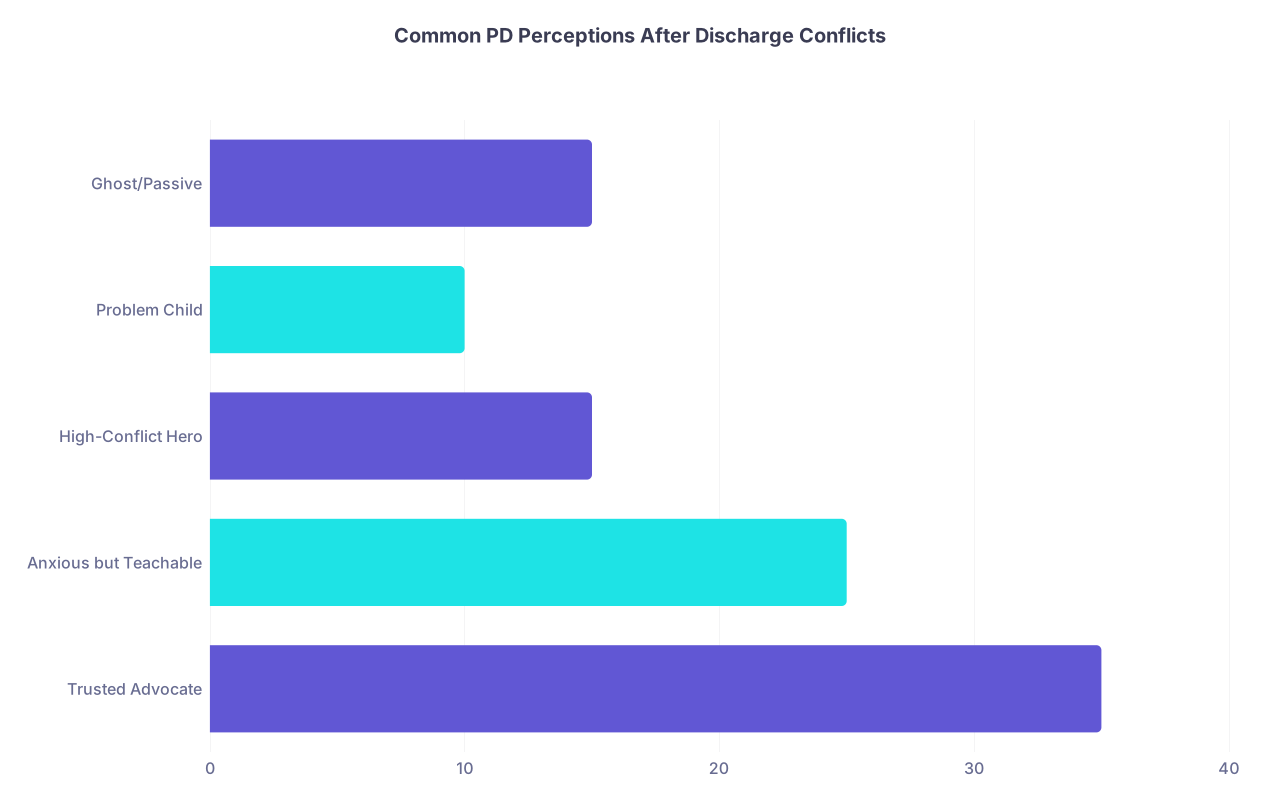
| Category | Value |
|---|---|
| Trusted Advocate | 35 |
| Anxious but Teachable | 25 |
| High-Conflict Hero | 15 |
| Problem Child | 10 |
| Ghost/Passive | 15 |
Building Your “Ethical Spine” Without Getting Crushed
You’re not there just to keep the hospital humming. You’re there to practice ethical medicine.
You need an ethical spine. But you also need political intelligence. One without the other is how people get burned out or quietly sidelined.
So, the internal rule set I give my residents looks like this:
- If a discharge feels slightly off: clarify, plan better, document.
- If it feels pretty risky: push back respectfully with specific concerns and alternatives.
- If it feels truly dangerous or grossly unethical: escalate firmly—senior, chief, PD if needed—and accept that this may be one of those career-defining moments.
And if you’re ever in that last category—where you’d genuinely not sleep at night if you went along—then yes, you say the hard thing:
“I’m not comfortable being the one to discharge this patient under these conditions. If you’d like to document the decision yourself, I’ll make sure the rest of the plan is carried out, but I can’t sign off on this as-is.”
That’s rare. That’s a nuclear option. But when it’s used sparingly, PDs actually respect it. Because they know: in a real disaster, you won’t fold.

| Step | Description |
|---|---|
| Step 1 | Feel Uncomfortable About Discharge |
| Step 2 | Gather Objective Data |
| Step 3 | Clarify Home and Support Situation |
| Step 4 | Formulate Alternative Plan |
| Step 5 | Proceed With Documented Plan |
| Step 6 | Discuss With Attending Calmly |
| Step 7 | Adjust Plan and Document |
| Step 8 | Consult Senior or Chief |
| Step 9 | Document Discussion and Follow Plan |
| Step 10 | Escalate to PD or Risk Through Proper Channels |
| Step 11 | Still Unsafe? |
| Step 12 | Attending Agrees? |
| Step 13 | High Risk or Ethical Breach? |
FAQ (Exactly 4)
1. Will pushing back on an unsafe discharge hurt my evaluations?
It can, if you do it carelessly. If your pushback is specific, solution-oriented, and documented, most PDs see it as a strength. If it’s emotional, vague, or accusatory, it gets framed as a “professionalism” or “teamwork” issue. Same instinct, very different outcome.
2. What if my attending is clearly wrong and won’t listen?
First, get your facts tight. Then involve your senior or chief and ask for advice rather than launching a crusade. If the situation is truly high-risk or ethically gross, you escalate—PD, risk, or ethics—using calm, written communication when possible. Do not threaten or grandstand in front of the team.
3. Can I write in the note that I disagreed with the discharge?
You shouldn’t turn the chart into a battleground. Document the clinical facts, the consultations, and that “the discharge plan was discussed with the team and attending” rather than editorializing. If you feel the need to record significant ethical concern, that’s a sign this should have gone through senior/PD/ethics channels already.
4. How do I avoid being seen as either “difficult” or “passive”?
Pick your battles, be precise, and always bring an alternative. Do not block a discharge without a realistic plan B. At the same time, don’t let your desire to be “easy to work with” silence you when the risk is obvious. The residents PDs trust the most are the ones who speak up thoughtfully, not constantly, and then do the work to make the safer plan actually happen.
Key takeaways:
You’re being judged less on whether you agree or disagree, and more on how you think, how you communicate, and how you document when the discharge feels unsafe. Become the Canary: specific, prepared, tactful, and persistent. That’s how you protect patients—and your career—at the same time.