

Last winter, on a crowded medicine service, a resident cornered me outside a family meeting room and whispered, “We’re calling ethics because the son won’t let us withdraw care, but… everyone agrees this is futile. What actually happens in an ethics consult? Are they going to overrule the family?”
You’re told ethics is about principles, justice, autonomy. On the wards, it looks a lot more like damage control, politics, and risk management wrapped in moral language. Let me walk you through what really happens behind those “Ethics Consult Requested” notes you see in the chart.
Why Ethics Gets Called – The Real Reasons, Not the Textbook Ones
The chart will say something noble like: “Ethics consult requested to assist with goals of care discussion and conflict resolution.” That’s the varnish.
Here’s what usually drives an ethics consult in real life:
- The team is stuck and scared of liability.
- There’s a conflict that might explode – between family and team, or between services.
- An attending wants cover for a decision that might upset someone (often “We think we should stop aggressive care”).
- Administration is nervous. Risk management has quietly nudged, “Maybe involve ethics.”
And a fifth, quieter reason: a resident or nurse is morally distressed and someone with power actually listened.
No one writes: “Consulting ethics because the ICU folks think this is a waste of resources and the family is living in denial,” but that’s the subtext in a large portion of cases. Ethics consults are often the institutional way of saying: “We need a referee and a witness.”
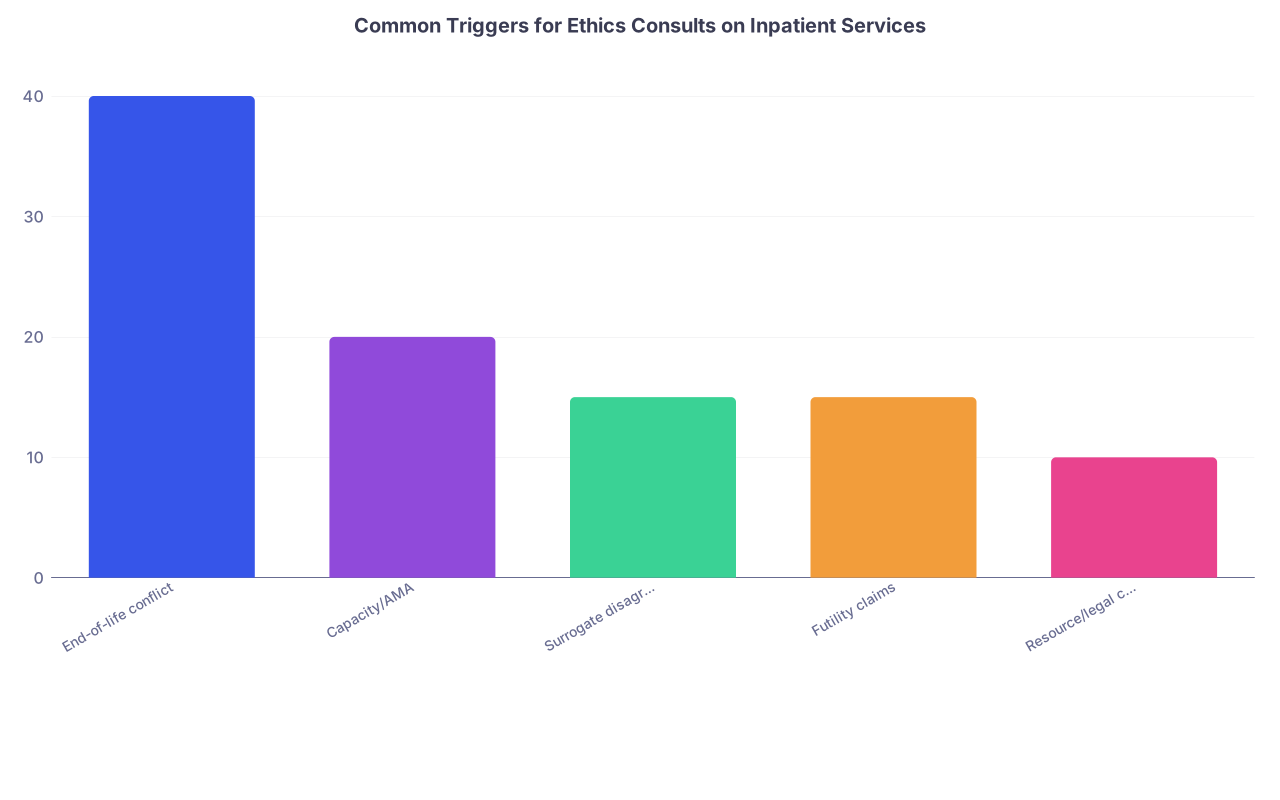
| Category | Value |
|---|---|
| End-of-life conflict | 40 |
| Capacity/AMA | 20 |
| Surrogate disagreement | 15 |
| Futility claims | 15 |
| Resource/legal concerns | 10 |
I’ve sat in ethics committee meetings where the first question wasn’t, “What’s the right thing for this patient?” It was, “How hot is this going to get? Who’s angry? Who might sue?” If you understand that lens, the rest of what you see on rounds will make a lot more sense.
Step One: The Quiet Pre-Consult – Who Really Calls and What They Say
You imagine some formal mechanism, right? An order placed, consult pager buzzes, ethics professor appears like a wise owl. Not quite.
What typically happens:
A senior resident vents to an attending:
“Family keeps demanding everything, but he’s been in multi-organ failure for three weeks. This feels wrong. We need ethics.”
Or a nurse says to the charge nurse:
“We’re torturing this patient. I’m not comfortable. Can we call ethics?”
Or risk management emails the attending:
“Given the family’s threats to call the media, we recommend involving ethics to support the team.”
Then there’s a pre-consult conversation. This is rarely charted. It’s a phone call or hallway chat between the attending (or chief resident) and the ethics consultant, something like:
- “Off the record, we think this is medically futile.”
- “The son is insisting we continue dialysis and pressors. The rest of the family seems resigned.”
- “We’re all burned out on this case.”
The consultant is listening for three things:
- Is this truly an ethical dilemma, or just bad communication and system failure?
- Is there clear risk (legal, PR, safety)?
- Is there already a “desired” outcome the team wants them to validate?
That third one is the part no one tells you. A lot of ethics consults are requests for moral backing: “Please tell us that what we want to do is ethically justifiable.”
Only after that informal vetting do you see the formal consult note appear in the EMR, dressed up in neutral language.
Step Two: The Ethics Consultant’s Recon Mission
Once the consult is “official,” the ethics consultant rarely marches straight into a family meeting. First, they do reconnaissance. That’s the part you, as a student or junior resident, often only half-see.
They will:
Read a lot of chart. Not just the latest notes — they scroll way back. Old goals-of-care notes, primary care clinic notes, prior advance directives buried in media tab, palliative notes you forgot were there. They’re looking for patient values, patterns, inconsistencies.
Talk to the bedside nurses. This is where you hear the truth:
- “The daughter is more realistic; the son is driving the ‘everything’ talk.”
- “He told me last week he wouldn’t want to live like this, but he says something different when the whole family is in the room.”
- “The team keeps changing the message every day – no wonder the family is confused.”
Probe the team, and they’re not just asking for facts. They’re assessing moral temperature:
- “If it were you, what would you do?” (Watch people tense.)
- “Who on the family side seems to understand the big picture?”
- “What are you most worried will happen if we don’t call ethics?”
What they’re really mapping is: Who has power. Who’s conflict-avoidant. Who will blow up. Where the unspoken consensus lies.
The smartest ethics consultants do not jump in and “decide things.” They frame, clarify, rephrase. And they watch how each side responds. It’s as much anthropology as it is philosophy.
Step Three: The Family Meeting – Orchestrated, Not Spontaneous
You’ll get an email or hear on rounds: “Ethics will join the 2 pm family meeting.”
You think: “Great, someone will finally tell us what to do.”
No. What’s actually happening is choreography.
Before the meeting, there’s often a quick pre-huddle in a side room or at the nurses’ station. It might last 2 minutes. Pay attention; this is where the script forms.
It usually sounds like:
- “Dr. S will present the medical situation.”
- “I’ll help clarify the options and maybe reflect back what I’m hearing from the family,” says the ethics consultant.
- “Let’s avoid words like ‘futile’ initially; talk about ‘non-beneficial’ and ‘no chance of meaningful recovery.’”
That’s deliberate. Language is tactical.

| Step | Description |
|---|---|
| Step 1 | Team Concern |
| Step 2 | Informal Call to Ethics |
| Step 3 | Chart and Staff Review |
| Step 4 | Pre huddle with Team |
| Step 5 | Family Meeting |
| Step 6 | Ethics Recommendation Note |
| Step 7 | Team Decision and Follow through |
During the meeting itself, watch the ethics consultant’s moves:
They do not start with, “Here’s what we think you should do.”
Instead, they reconstruct:
- Ask the team to state, clearly and without hedging, the prognosis and realistic options. This is often the first time the family hears a blunt, consistent message.
- Ask the family what they understand so far. They’ll sit through long, wandering narratives because embedded in those are the patient’s actual values and family dynamics.
- Translate conflict into “values language” instead of accusation language.
- “It sounds like for you, honoring your father means fighting as long as there is any chance.”
- “For you, honoring him means avoiding suffering he would not have wanted.”
You’ll see tears, anger, silence. All normal. The consultant’s job is to pull those threads together into something coherent enough that a path forward can be justified – ethically and chart-wise.
The dirty secret: in many cases, the ethics consultant already knows which way this is going (continue treatment vs. limit treatment) before the meeting starts. The meeting is about getting everyone to a place where that outcome doesn’t fracture the relationship completely.
Step Four: The Note – What’s Really Being Documented
After the fireworks, you’ll see an “Ethics Consult Note” appear. Residents skim it for the recommendation line, but you should read how it’s built. It’s a piece of institutional armor.
A good ethics note will:
- Lay out a calm, almost sterile summary of the clinical facts. Stable, neutral tone.
- Document what the patient previously said or wrote about their values. Even vague statements like, “Patient told family he never wanted to be kept alive on machines with no chance of meaningful recovery.” That line is gold.
- Describe the conflict in value-neutral terms:
- “There is conflict among surrogate decision makers regarding the relative importance of prolonging biological life versus minimizing suffering in the setting of extremely poor prognosis.”
Then come the key paragraphs. The justification.
They will anchor the recommendation in:
- Respect for the patient’s prior expressed wishes (autonomy).
- Professional integrity and the boundaries of what clinicians are obligated to provide.
- Sometimes, justice or resource considerations, but this is usually softer and between the lines.
The last section is the one attendings really care about:
- “It is ethically permissible to …”
- “The team is not ethically obligated to provide …”
- “We recommend that the medical team consider a time-limited trial / transition to comfort-focused care / respecting the patient’s informed refusal…”
That wording is deliberate. “Ethically permissible” is code for: you can do this, and if someone later scrutinizes the record, your decision was within accepted standards. It doesn’t force anyone, but it gives cover.
When Ethics Actually Says “No” to the Team
People imagine ethics swoops in to block families. In reality, some of the most charged moments are when ethics pushes back on the physicians.
A few patterns:
1. The “Futility” Power Grab
The team says, “We want ethics to back us in unilaterally stopping dialysis. This is futile.”
The consultant asks: “Is it physiologically working?”
“Yes, his labs improve. But he’ll never go home.”
Translation: not futility, just a terrible prognosis and long-term dependency.
Ethics may say, in more polished terms:
You’re not at a place where you can stop life-sustaining treatment without some degree of surrogate agreement or a much clearer prior refusal from the patient. Calling this “futile” is ethically sloppy.
You’ll see attendings bristle at that. They want a green light to withdraw. Ethics won’t always give it.
2. The Coerced AMA
You’ll see a team eager to have a “difficult” patient leave against medical advice. Ethics gets involved because someone questions capacity.
Ethics might decide: yes, capacity is intact. But then they’ll quietly ask the team,
“Have you actually given realistic options? Or did you frame it as ‘leave or we’ll call security’?”
They might write a note that essentially says:
The patient has capacity. The team should offer a safe discharge plan rather than leverage fear or threats.
Clinically inconvenient. Ethically correct.
3. Quiet Criticism of Mixed Messages
In some consults, the ethics note is a mirror held up to the team:
- “We recommend that all members of the care team provide a consistent message regarding prognosis and treatment options in order to minimize confusion among family members.”
That sentence is a polite way of saying: You’ve been all over the place, and you’re part of the problem.
I’ve seen residents read that and mutter, “Ouch.” Good. You learn.
How This Feels on Rounds (And How to Not Look Lost)
On rounds, what you experience is the sanitized version:
- “Ethics has recommended that it’s ethically permissible to transition to comfort-focused care given the patient’s previously expressed wishes…”
- Or: “Ethics felt we should offer a time-limited trial of dialysis while we reassess.”
You see a bullet point. The 72 hours of calls, emotions, and politics behind it? Hidden.
Here’s how to not be dead weight in these situations.
1. Recognize when a case is heading toward ethics territory
You do not need to be an ethics genius. You just need to recognize patterns:
- Prognosis is poor and everyone is exhausted and angry.
- There are multiple decision makers disagreeing.
- The patient’s previously stated wishes do not match what’s happening now.
- Nurses are whispering, “This feels wrong.”
Say to your senior: “This might be a good case to involve ethics or palliative earlier.” You’ll sound more seasoned than half the interns.
2. Stop using lazy language
On rounds, listen to how people talk:
- “The family is unreasonable.”
- “They won’t accept reality.”
- “We’re torturing the patient.”
Those are emotional signals, not ethical analysis.
Train yourself to phrase it like an ethics person would:
- “There’s a conflict between the family’s stated goals and the likely outcome of continued treatment.”
- “We lack a clear understanding of the patient’s authentic preferences in this situation.”
You don’t do this to sound fancy. You do it to move the conversation from venting to actual problem-solving.
3. Learn to summarize the ethics piece efficiently
As a student or resident, when you present after an ethics consult, do not mumble, “Ethics saw them; they recommended comfort care.” Superficial and wrong.
Say something like:
“Ethics met with the team and family yesterday. Their assessment is that, given prior statements from the patient about not wanting prolonged life support without meaningful recovery, and the current prognosis, it is ethically permissible and consistent with the patient’s values to focus on comfort-oriented care. They recommended we clarify with the family that they’re not obligated to continue treatments that only prolong dying.”
That’s one paragraph. But it shows you understood the logic, not just the bottom line.
What Ethics Consults Do to You Over Time
Here’s the part nobody addresses. Watching these cases shapes your own moral habits.
You’ll see:
- Attendings who always want to avoid conflict and outsource the hard conversation to ethics.
- Attendings who use ethics as a weapon: “We’ll call ethics and show the family they’re wrong.”
- Ethics consultants who are brilliant, humane, and humble. And a few who enjoy the power a little too much.
You need to decide:
- What kind of clinician you’ll be when a patient’s daughter looks at you and says, “What would you do if this was your mom?”
- Whether you’re going to hide behind “ethics said it’s permissible” or own the decision you’re participating in.
The students who mature fastest in ethics-heavy rotations are the ones who:
- Volunteer to sit in on the hard family meetings instead of “catching up on notes.”
- Ask ethics consultants after the meeting, “Can you explain how you got from X to Y?”
- Reflect on the cases, not just the lab values. Write them down. You’ll be astonished how often similar patterns repeat in your career.

The Legal Shadow You Don’t See But Should Understand
You’re in the “Medical Ethics and Law” bucket, so let’s rip off one more veil.
Most hospital ethics committees and consultants are keenly aware of case law and local statutes, even if they don’t parade it around. They know:
- In many jurisdictions, surrogates are obligated to follow substituted judgment (what the patient would have wanted), not just “what I want for them.”
- Courts are very reluctant to force physicians to provide truly non-beneficial, physiologically futile treatment – but hate seeing sloppy documentation and inconsistent communication.
- States differ wildly on who’s the default surrogate when there’s no health care proxy.
So when ethics insists on:
- Detailed documentation of prior statements.
- Clear capacity assessments.
- Naming a primary decision maker when the family is diffuse.
They’re not just being pedantic. They’re building a defensible record in case this hits a courtroom or the news.
You don’t need to be a lawyer. But you should understand: an ethics note is as much a legal artifact as it is a moral one. When you contribute, you’re part of that record.
How to Use Ethics on Rounds Without Outsourcing Your Conscience
Here’s the real “insider” point: The best clinicians don’t use ethics consults as moral outsourcing. They use them as amplification.
What that looks like:
- You wrestle with the case first. Quietly, honestly.
- You form a view: “Given what we know, this is what I think respects the patient while respecting our role as clinicians.”
- You invite ethics in not to tell you what to think, but to test your reasoning, help with communication, and make sure the institutional machinery aligns with the patient’s values.
Then, even when an ugly case inevitably lands on your service, you’re not just another bystander waiting for a committee to decide. You’re a professional with your own ethical spine, using institutional ethics as a tool, not a crutch.
Years from now, you won’t remember the exact words of any particular ethics note. You’ll remember the faces in those family meetings, and whether you felt you showed up as the kind of physician you’d want for yourself.


