

You’re on overnight call. ICU. It’s 2:15 a.m. The patient lacks decision-making capacity, is on vasopressors, vented, and the chart has zero documented advance directive. At the bedside: the patient’s spouse, quietly saying, “He told me he never wanted to live like this.” On speakerphone: the adult son, yelling, “You better do everything. He’s a fighter.” And now everyone turns to you.
If you get this wrong, it won’t just feel bad. It can become an ethics consult, a complaint to the board, or a lawsuit with your name on it. The worst part? Most of the big mistakes in these situations are totally preventable if you know what to watch for.
Let’s make sure you don’t become the cautionary tale people mention in ethics rounds.
1. Mistake: Treating “Family” and “Surrogate” as the Same Thing
This one causes chaos.
You walk into a room, three relatives are there, everyone is talking, and you think, “The family wants X.” That sentence should already be a red flag in your head. The law doesn’t care what “the family” wants. It cares who the surrogate decision-maker is, and what the patient would have wanted.
Here’s where people screw up:
- They take a group consensus as binding.
- They listen to the loudest or most emotional relative instead of the legally authorized surrogate.
- They assume “oldest child” or “the one who lives closest” is automatically in charge.
In most jurisdictions, there’s a statutory hierarchy for surrogate decision-makers when there’s no written health care proxy. It usually looks something like this (details vary by state/country):
| Priority | Surrogate Type |
|---|---|
| 1 | Court-appointed guardian |
| 2 | Health care proxy/agent |
| 3 | Spouse or domestic partner |
| 4 | Adult children |
| 5 | Parents |
| 6 | Adult siblings |
The mistake is acting like all of these people are equal. They are not.
If the spouse is the legally recognized surrogate and the adult children disagree, you must not default to “compromise” care just because it feels peaceful. Your obligation is to respect the legal surrogate and the patient’s values, not to make everyone equally happy.
How to avoid this:
- Very early in the encounter, ask clearly: “Who is the legally designated decision-maker for [name]’s medical care?”
- Check the chart for:
- Health care proxy / power of attorney for health care
- Any guardianship papers
- Prior documentation from previous hospitalizations
- If there’s no documentation, identify the surrogate according to your state or institutional policy. Don’t invent your own hierarchy.
And document that conversation. Specifically. “Spouse is primary surrogate per state hierarchy; two adult children disagree but do not override spouse’s authority.”
If you skip this, you’re building decisions on legal quicksand.
2. Mistake: Ignoring the Patient’s Voice Because They’re Unconscious Now
The patient may be unresponsive today, but that doesn’t mean their voice disappeared.
Where people go wrong:
- They accept the surrogate’s current preference even when it contradicts what the patient clearly said before.
- They treat a surrogate’s “I changed my mind” as if it changes the patient’s values, not just the surrogate’s comfort level.
- They stop looking for prior statements or documents once they find a surrogate.
This is backwards. Ethically and legally, in many systems, the hierarchy is:
- Patient’s current competent wishes
- Patient’s prior competent wishes (advance directives, written or clearly documented)
- Patient’s known values and preferences inferred from conversations and behavior
- Best interests standard when 1–3 are truly not knowable
The surrogate is supposed to help you discover and apply 1–3. Not replace them.
I’ve seen this play out ugly: patient with a clear POLST (or MOLST) saying “DNR / DNI / comfort measures only.” Spouse panics in the ICU when things get bad and says, “Ignore that. Do everything.” Some clinicians cave in the moment. That’s not protecting the patient. That’s avoiding a hard conversation.
What you should do instead:
- Actively search for:
- Advance directives
- Prior notes about goals of care
- Old discharge summaries mentioning code status or wishes
- Ask specific questions:
- “When your father was healthy, did he ever talk about situations like being on a ventilator long-term?”
- “Has he ever said what he fears most about serious illness or being kept alive by machines?”
- Distinguish between:
- “What do you want us to do?” (bad question)
- “What do you think he would want us to do in this situation?” (better question)
And when you have clear prior wishes, do not let them be quietly overridden because the surrogate is uncomfortable with them now. That’s one of the core ethical errors.
3. Mistake: Confusing Surrogate’s Emotions with Surrogate’s Authority
You will meet the distraught daughter sobbing next to the bed saying, “I can’t let him go.” You’ll also meet the detached son who hasn’t visited in 10 years but now demands full code and ECMO. Both will try to push you to act based on their feelings.
Here’s the trap: you start tailoring medical care to soothe the surrogate’s grief, guilt, or fear, rather than to respect the patient’s values and medical realities.
You see this when:
- Clinicians agree to “one more round of everything” purely to satisfy a surrogate, despite medical futility.
- A surrogate’s unresolved family conflict drives decisions (“He doesn’t deserve to die yet after what he did to us”).
- Team members say, “Well, the family is not ready,” as if that alone should delay ethically indicated transitions to comfort-focused care.
Let me be very direct: you are not ethically obligated to provide non-beneficial or harmful treatment to manage a surrogate’s emotions. You are obligated to communicate clearly, support them, and respect the patient’s interests.
Practical ways to stay out of this mess:
- Separate empathy from agreement. You can say:
“I can see this is incredibly painful. I wish we were in a different situation. But based on what he told you he wanted, and where the illness is now, continuing these treatments would not be what he asked for.” - Bring in palliative care or ethics early when you see intense emotional conflict dictating unreasonable demands.
- Document the difference between:
- Surrogate’s stated emotions (“I feel guilty stopping care”)
- Patient’s prior expressed values (“He said no machines, no nursing home, no long-term life support”)
This isn’t cold. It’s actually the only way to protect the patient from getting dragged through treatments they never would have accepted.
4. Mistake: Failing to Clarify the Decision Standard (Substituted Judgment vs Best Interests)
This is one most trainees never have explained clearly, then get grilled on in ethics sessions later.
There are two main standards surrogates are supposed to use:
- Substituted judgment – “What would the patient choose, if they could decide right now, based on their values and prior statements?”
- Best interests – “What option best promotes the patient’s overall well-being when their wishes are truly unknown?”
People screw up by:
- Letting surrogates say, “Well, I could never live like this, so don’t do X,” when the patient previously said they would accept aggressive measures. That’s the surrogate projecting, not substituted judgment.
- Sliding straight to “best interests” because nobody bothered to ask detailed questions about the patient’s life, fears, religion, or values.
- Treating “I’m not ready to lose him” as a best interests argument for the patient. It’s not. That’s about the surrogate’s interests.
Ask directly:
“When you think about what she would say if she were sitting here, what do you think she would tell us to do?”
If the surrogate answers with, “I don’t know what she would want,” then and only then are you really in best interests territory.
And when you’re there, you do not just ask, “What do you want?” You help them think through:
- Patient’s likely experience (burdens vs potential benefits)
- Chance of meaningful recovery
- Known personality traits: risk-taker vs avoidant, religious frameworks, prior comments about quality of life
If you let surrogates operate in a vague, unnamed standard, you set yourself up for wildly inconsistent, emotionally driven choices. Label the standard in your own mind and in your documentation.
5. Mistake: Not Documenting Conflicts and Reasoning in Detail
If there’s a conflict between surrogates, or between surrogates and the medical team, and your note says, “Discussed with family, agreed on plan,” you’re asking to get burned.
I’ve seen complaints where the chart is so vague it looks like nobody took conflict seriously, even when the clinician remembers hours of discussion.
Bare-minimum documentation in high-conflict surrogate cases should include:
- Who was present (by name and relationship), who was on phone/video, who refused to participate
- Who the legally recognized surrogate is, and how you determined that
- What different parties wanted, in plain language
(“Son requested full code and all life-sustaining treatments. Spouse stated patient had repeatedly expressed he did not want prolonged life support or CPR in this situation.”) - Any known prior statements or documents from the patient
- Your ethical and medical reasoning for the plan chosen
- If applicable, that ethics, palliative care, or risk management were consulted
Think of it this way: if an external reviewer reads your note a year later with no other context, will they see that you:
- Knew who the surrogate was
- Centered the patient’s known or probable wishes
- Reasoned through the medical realities
- Did not just let the loudest voice win
If the answer is no, your documentation is too thin.
6. Mistake: Delaying Ethics or Legal Help Until the Situation Is Explosive
Too many clinicians wait until the family is screaming in the hallway and threatening to call the media before they involve ethics or legal. By then, everyone’s positions are entrenched, and your options shrink.
Common early warning signs you’re already in trouble:
- Two or more potential surrogates with obviously conflicting agendas: ex-spouse vs current partner, estranged child vs longtime caregiver.
- Repeated statements like, “We’ll sue if you don’t do everything,” OR “We’ll sue if you don’t let him go peacefully.”
- A surrogate expressing clear inability to follow the patient’s wishes: “I know he said DNR, but I just can’t do that.”
Don’t be a hero trying to solo-manage all of this.
Get help early:
- Ethics consult for:
- Conflicting surrogate accounts of patient’s wishes
- Unreasonable or potentially harmful surrogate demands
- Disagreements within the team about what’s right
- Legal/risk management for:
- Questionable validity of documents (multiple POAs, old vs new)
- Possible need for court intervention or temporary guardianship
- Threats of litigation, especially when you may need to withhold non-beneficial treatments despite surrogate insistence
There’s a nasty pattern you must avoid: the physician who tries to appease everyone for days instead of escalating, only to end up with prolonged, non-beneficial treatment and a furious family claiming nobody gave them honest information.
7. Mistake: Treating “Conflicting Wishes” as a Problem to Negotiate, Not Clarify
When you hear “the family is conflicted,” it’s tempting to become a mediator. That’s fine up to a point. But this isn’t a divorce settlement. This is about a patient’s rights and interests.
Here’s the subtle but dangerous mistake: you let the conflict sit at the level of “who wins,” instead of drilling down into what the conflict is actually about.
You’ll see things like:
- One relative saying “do everything” because to them, “everything” just means “don’t abandon him.”
- Another saying “comfort care only” because they think “doing everything” always implies suffering, not that it can include high-quality symptom treatment.
- Family thinking DNR means “no treatment at all.”
Your job is not to negotiate a middle number between 0 and 100. It’s to clarify misunderstandings, correct misinformation, and then ground the decision in the patient’s values plus the medical reality.
Use questions that expose the real issue:
- “When you say ‘do everything,’ what specific treatments are you imagining? Ventilator? CPR? Dialysis? Surgery?”
- “What do you think he would say about being in a long-term facility, unable to interact or recognize you?”
- “What worries you most about changing the focus of care from cure to comfort?”
Once you clarify, a lot of “conflicts” turn out to be people agreeing on values but using different language.
And if after correction and clarification there’s still a fundamental conflict tied to past family wounds, money, or control? That’s not something you “solve” with one more hour at the bedside alone. That’s ethics, social work, sometimes legal territory.
8. Mistake: Over- or Under-Protecting Yourself Legally
Two opposite but equally bad patterns:
The over-defensive clinician:
- Orders everything the most aggressive family member wants
- Keeps patient on futile therapies “to avoid being sued”
- Refuses to discuss prognosis frankly because bad news feels legally dangerous
The reckless minimalist:
- Ignores clear legal surrogate hierarchy
- Disregards existing advance directives as “old” without process
- Makes unilateral decisions without documenting or engaging support services
Both approaches are mistakes.
Here’s the reality: you are usually on strongest legal and ethical footing when you:
- Follow the applicable law or policy on surrogate identification
- Ground decisions in:
- Known patient wishes or values
- Clinically reasonable options (not “anything imaginable”)
- Communicate clearly with the surrogate about prognosis and options
- Document the above with actual specifics
You are not legally obligated in most jurisdictions to provide treatments that are medically non-beneficial or outside the standard of care just because a surrogate demands them. But if you’re going to withhold or withdraw them against surrogate objection, you’d better have:
- Clear documentation of futility or harm
- Support from the care team
- Ideally an ethics consult
- Legal/risk sign-off if your institution expects it
The lazy legal move is, “Family wants it, so we do it.” The careful legal move is aligning with patient-centered, evidence-based practice, and showing in the record that you did exactly that.
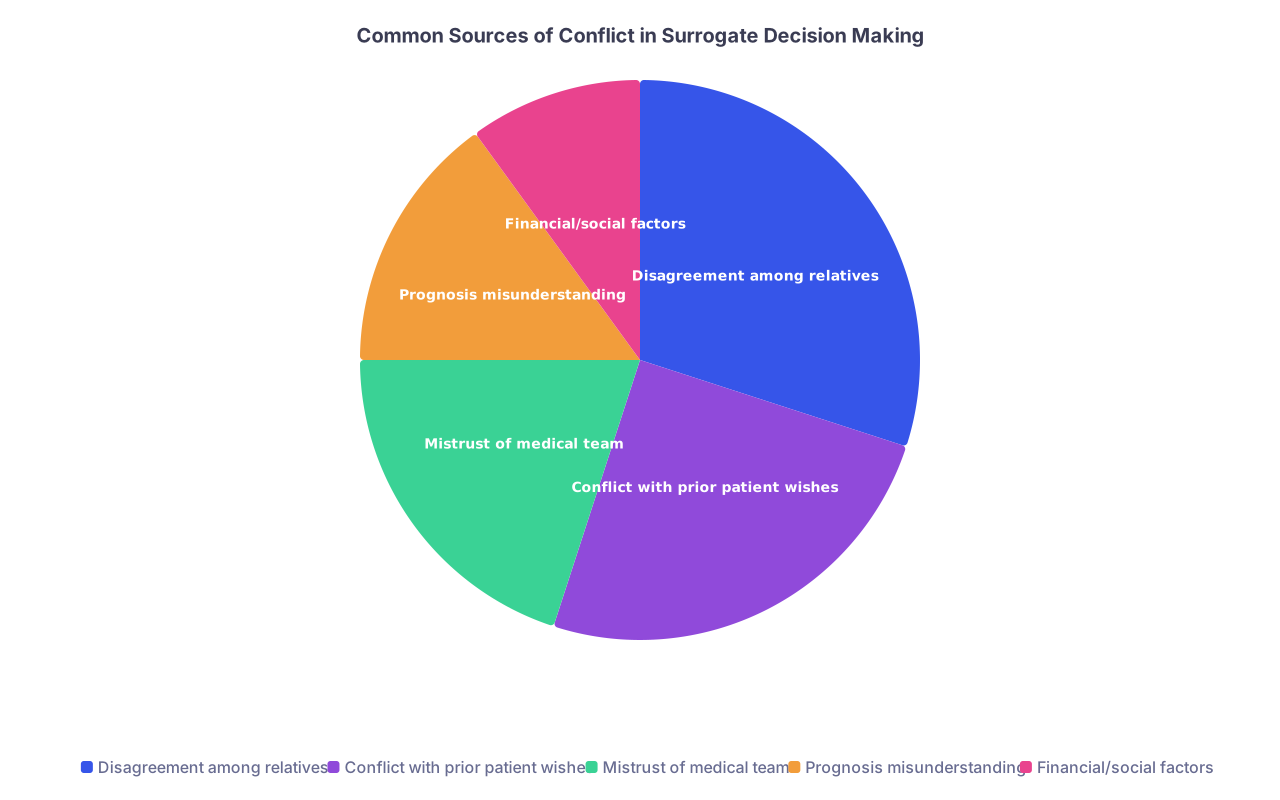
| Category | Value |
|---|---|
| Disagreement among relatives | 30 |
| Conflict with prior patient wishes | 25 |
| Mistrust of medical team | 20 |
| Prognosis misunderstanding | 15 |
| Financial/social factors | 10 |
9. Mistake: Leaving Trainees or Night Float Alone in High-Risk Conflicts
If you’re a trainee, you already know this one. The 3 a.m. family “meeting” that’s just you and six angry relatives because no one else picked up their phone.
And if you’re an attending, this is the part you may not want to hear: abandoning junior staff in these situations is not just bad mentoring, it’s ethically irresponsible. These are exactly the kinds of decisions that should not be made solely by the least experienced person in the room.
For trainees: do not let yourself be cornered into making final, irreversible decisions in a chaotic surrogate conflict scenario, alone.
You can:
- Clarify medical facts and immediate safety decisions
- Defer major shifts in code status or long-term goals of care to daytime with full team present, unless there’s clear documentation already
- Say explicitly:
“This is an important decision. I’m going to make sure the full team, including the attending and possibly ethics, are involved when we finalize this.”
For attendings and seniors: if your trainee calls you from a mess like this and you say, “Just handle it,” you’re part of the problem. These are precisely the cases where experience matters—for framing options, setting boundaries, and tolerating anger without collapsing into “do everything.”

| Step | Description |
|---|---|
| Step 1 | Identify conflict |
| Step 2 | Stabilize patient |
| Step 3 | Clarify surrogate status |
| Step 4 | Clarify patient wishes |
| Step 5 | Involve attending |
| Step 6 | Ethics or palliative consult |
| Step 7 | Contact legal/risk |
| Step 8 | Document plan |
| Step 9 | Medical emergency? |
| Step 10 | Conflict persists? |
| Step 11 | Legal risk? |
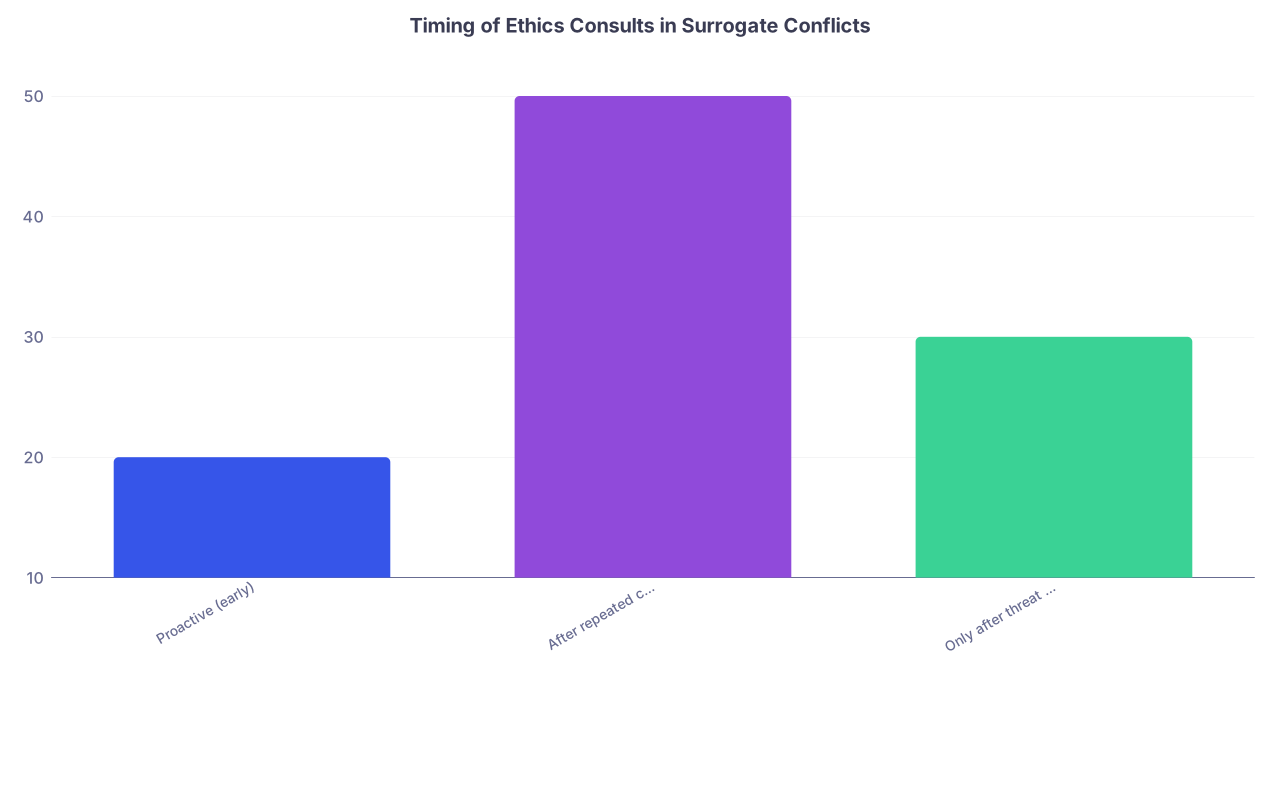
| Category | Value |
|---|---|
| Proactive (early) | 20 |
| After repeated conflicts | 50 |
| Only after threat of lawsuit | 30 |

10. Mistake: Never Talking About This Until You’re In It
Biggest meta-error? Treating surrogate conflicts as rare, freak events instead of standard practice challenges you should prepare for.
They are not rare. They’re common. And predictable.
If you want to avoid being blindsided:
- Read your institution’s policy on surrogate decision-making. Yes, the actual policy.
- Learn your jurisdiction’s default surrogate hierarchy and how to handle disputes.
- Practice phrases for hard conversations:
- “I hear that you want us to do everything. Let me explain what ‘everything’ means medically, and what it would look like for him.”
- “Our responsibility is to follow what she would have wanted, not what any of us might want for ourselves.”
- “Continuing these treatments will not help him recover or improve his comfort. At this point, they may only prolong dying.”
If you wait until the room is full of crying relatives and an angry consultant to start figuring out what substituted judgment means, you’re already behind.

FAQ (Exactly 4 Questions)
1. What if the legally recognized surrogate is making decisions that clearly go against the patient’s documented wishes?
You’re not obligated to follow surrogate instructions that contradict valid, clear patient directives. Your anchor is the patient’s autonomous choices. In that situation, you should: verify the document’s validity, explain to the surrogate that your duty is to honor the patient’s prior wishes, involve ethics for support, and document the discrepancy and your reasoning. If conflict escalates, bring in legal/risk management early.
2. How do I handle it when multiple adult children all claim to be “in charge” and disagree?
You don’t let the loudest or most insistent person win. Identify whether there’s a named health care proxy or agent; if so, that’s your point person. If not, follow your state/institution’s surrogate hierarchy, which normally treats a group of adult children collectively. Then you either seek a group consensus or, if that fails, involve ethics and possibly the courts if decisions are urgent and stalemated. Throughout, anchor decisions in what the patient would have wanted, not in who shouts the most.
3. Am I legally required to provide every treatment a surrogate demands if the patient’s wishes are unknown?
Generally no. You’re required to offer treatments that are medically appropriate and within the standard of care. You’re not required to provide futile, harmful, or non-standard interventions just because a surrogate insists. If you’re going to decline a demanded treatment, you must explain why medically, offer ethically and clinically appropriate alternatives, and document thoroughly. In high-risk situations, involve ethics and legal before drawing a firm line.
4. What if there’s no clear surrogate and no known wishes, and a decision has to be made urgently?
In a true emergency with no surrogate and no known wishes, you treat based on implied consent and best interests: what a reasonable person would likely want in that situation. Stabilize the patient, document the absence of a surrogate and the urgent nature of the decision, and actively work to identify appropriate decision-makers once the crisis passes. If the patient remains incapacitated and still has no surrogate, your institution may need to seek a court-appointed guardian; get ethics and legal involved sooner rather than later.
Two things to carry out of this:
- Don’t confuse “family” noise with legally grounded, patient-centered surrogate decisions. Find the right surrogate, find the patient’s voice, and write it all down.
- When conflict shows up, your job isn’t to keep everyone happy. It’s to protect the patient, stay within the law and ethics, and get help early instead of waiting for the explosion.


