

What exactly do you say in the first 60 seconds after realizing you made (or may have made) a medical error—without making your legal situation much worse?
Most clinicians get this wrong. Sometimes badly wrong. And they usually do it with the best intentions.
Let me be blunt: the first things out of your mouth after a medical error can either preserve your ability to practice—or hand a plaintiff’s attorney their opening statement.
This is not about “being slick” or “covering yourself.” It is about:
- Not lying
- Not abandoning the patient
- Not casually creating liability where it might not even exist
All while staying ethically decent and legally sane.
Below are the phrases that create liability, why they are dangerous, and what to say instead.
1. The Most Dangerous Sentence You Can Say
The single worst reflex phrase after a bad outcome:
“This is all my fault.”
Do not say this. Ever. Not to the patient. Not to the family. Not to the nurse. Not to your co-intern in the hallway.
Why this creates massive liability:
It is a legal admission, not just emotional comfort.
That one sentence:- Collapses complex causation into your “fault”
- Can be quoted in depositions years later
- May be taken out of context, without the nuance
You do not know the full picture yet.
You have:- Incomplete data
- Adrenaline clouding your judgment
- No full review of chart, meds, protocols, equipment, staffing
But you have just declared yourself the sole cause.
You are prejudging the standard of care.
Saying “my fault” implies:- You breached the standard of care
- Your action (or inaction) caused the harm
- No systems or shared responsibility involved
All before any investigation. That is gold for a plaintiff.
Better alternative:
“Something went wrong, and we are working urgently to understand exactly what happened and to care for you / your loved one. I am very sorry for what you are going through.”
- Expresses concern.
- Acknowledges that there was a problem.
- Does not pre-assign legal blame before you even know if an error occurred.
Make this your new reflex. Anything but “It’s all my fault.”
2. “I Made a Huge Mistake” vs. “Something Unexpected Happened”
Next liability trap: the dramatic confession.
“I made a huge mistake.”
Here is the problem:
“Mistake” is a loaded word.
In legal and regulatory language, “mistake” is often interpreted as:- Deviation from standard of care
- Human error, not just bad outcome
- Preventable harm
You just handed the narrative over for them to define.
You might be wrong about it being a “mistake.”
Post-op bleed?
Medical error? Or known complication? Or coagulopathy? Or device failure?You are allowed to be upset. You are not required to label the event a “mistake” in the moment.
Families will repeat that exact word.
I have heard it:- “The doctor told us they made a huge mistake.”
- “They said it was their mistake.”
Those sentences resonate in front of juries.
Better wording:
“There has been an unexpected complication / an unexpected outcome. We are working to understand exactly what happened and to respond appropriately.”
Then, if a true error is confirmed later, in a structured disclosure process (often with risk management present), you can give a clear explanation with accurate language.
Do not self-diagnose your legal exposure in the heat of the moment.
3. Apologies: The Wrong and Right Way to Say “I’m Sorry”
Here is where well-meaning clinicians get burned. They confuse:
- Ethical apology
with - Legal confession
The problematic version:
“I’m so sorry, this happened because I screwed up.”
Why this is dangerous:
You linked sorrow to personal negligence.
“I’m sorry” is one thing.
“I’m sorry because I screwed up” is quite another.Some states protect expressions of sympathy, not admissions.
Many jurisdictions have “apology laws” that make pure sympathy (“I’m sorry this happened”) non-admissible.
They rarely protect “I made an error” or “this is my fault.”Families often hear only the causal part.
They will forget the nuance and remember:- “The doctor told us they screwed up.”
- “They admitted it right away.”
Ethically appropriate and safer apology:
“I am very sorry that you’ve had this outcome. I know this is frightening and painful. We are going to be honest with you about what we learn as we review what happened.”
This:
- Shows compassion
- Commits to transparency
- Does not make premature, inaccurate legal admissions
You are not a robot. You should not act like one. But you must not casually confess to negligence without facts.
4. The Casual Speculation That Will Haunt You
One of the worst things you can do after an error (or even just a bad outcome) is to guess out loud about causes.
Things like:
- “The nurse must have missed the change in vitals.”
- “It was probably the anesthesia.”
- “Maybe the lab mis-labeled the sample.”
- “The night team must not have checked.”
- “It is probably that the CT tech delayed the scan.”
Those sentences feel like harmless brainstorming. They are not.
Why speculative blame is dangerous:
You may be flat-out wrong.
And now someone else is unfairly implicated.
Congratulations, you just helped create litigation against your colleagues and possibly the institution—based on your uninformed guess.It looks like a blame-shift.
In court, your speculation becomes:- Evidence of finger-pointing
- Proof of systemic breakdowns
- A narrative of dysfunction in the care team
You destroy team credibility.
Families notice and remember intra-team conflict.
“The doctor said the nurse missed it” is a powerful, ugly line in a complaint.
What to say instead, when asked “How did this happen?” before full review:
“We do not yet have all the facts. There are several possibilities, and we are doing a thorough review to understand exactly what happened. When we have more clarity, we will discuss this with you.”
That is honest.
That is accurate.
And it does not turn your speculations into permanent legal landmines.
5. The Temptation to Minimize, Distract, or Lie
Another serious category: things you say to downplay the event. That is how cover-ups start.
Phrases that will come back to crush you:
- “This is not a big deal.”
- “Complications like this just happen.”
- “Everything was done correctly,” when you already suspect otherwise.
- “Nothing went wrong,” when a clear deviation occurred.
- “There was nothing we could have done,” said reflexively.
Why this is not just unethical but dangerous:
When documentation / investigation contradicts your words, you look dishonest.
And dishonest physicians are exactly who juries love to punish.Minimization destroys trust.
Families are not stupid. If their loved one is in the ICU intubated, “this is not a big deal” sounds like gaslighting.Lies become the story, not the error.
Many lawsuits are driven not just by harm, but by:- Perceived cover-up
- Evasion
- Disrespect
Your attempt to “smooth it over” can create the lawsuit that might otherwise never be filed.
Safer, honest alternative:
“This is serious. We are going to be transparent with you as we understand exactly what happened. Right now, our focus is on [stabilizing / treating / monitoring] your loved one, and we will keep you updated frequently.”
You can acknowledge seriousness without guessing cause or confessing negligence.
6. Email, Text, and Charting: The Hidden Phrases That Destroy You
What you say in the hallway is one thing. What you write in the chart, in email, or in a text thread is something else entirely.
I have seen residents write in the chart:
- “I messed this up.”
- “This was completely my fault.”
- “I should have ordered the CT earlier. My mistake.”
That may feel “honest” or even “humble.” Legally, it is reckless.
Worse in group chats or email:
- “We definitely screwed this case up.”
- “This will be a huge lawsuit.”
- “Let’s all say we told the family risks of X.”
- “We need to change the note so it looks better.”
Those last two cross from unwise into career-ending. That is how you get:
- Spoliation of evidence
- Allegations of fraud
- Sanctions from licensing boards
Legal conclusions
Do not write:- “This was malpractice.”
- “This was negligence.”
- “This was a preventable error caused by my mistake.”
Speculation about blame
Do not write:- “Nursing missed multiple vitals.”
- “ED physician failed to recognize sepsis.”
Unless you are writing in a formal, protected QA/peer-review setting (and even then, be precise and factual).
Emotionally loaded self-flagellation
Chart is for:- Objective facts
- Clinical reasoning
- Plan
Not for your emotional processing.
Better way to document:
- Describe what occurred, factually:
- Times
- Vital signs
- Orders
- Responses
- Conversations (who, what was discussed)
- If an error is identified and institutional policy supports disclosure in the chart, use neutral, clear language:
- “The [medication / test / imaging] was not performed as intended. This has been disclosed to the patient/family. Risk management notified.”
Consult risk management or your attending before documenting anything that looks like a confession.
7. Comparing “What Not to Say” vs “Safer Alternatives”
Here is the contrast clearly laid out.
| Risky Phrase | Safer Alternative |
|---|---|
| "This is all my fault." | "Something went wrong, and we are working to understand exactly what happened." |
| "I made a huge mistake." | "There has been an unexpected complication / outcome." |
| "I screwed up your care." | "I am very sorry for what you are experiencing. We are reviewing what happened carefully." |
| "The nurse/other doctor missed it." | "We are reviewing the entire course of care to understand what happened." |
| "Nothing went wrong; this just happens." | "This is a known risk, but we take it very seriously and will keep you updated." |
Print this table in your brain. Especially for your first years in practice.
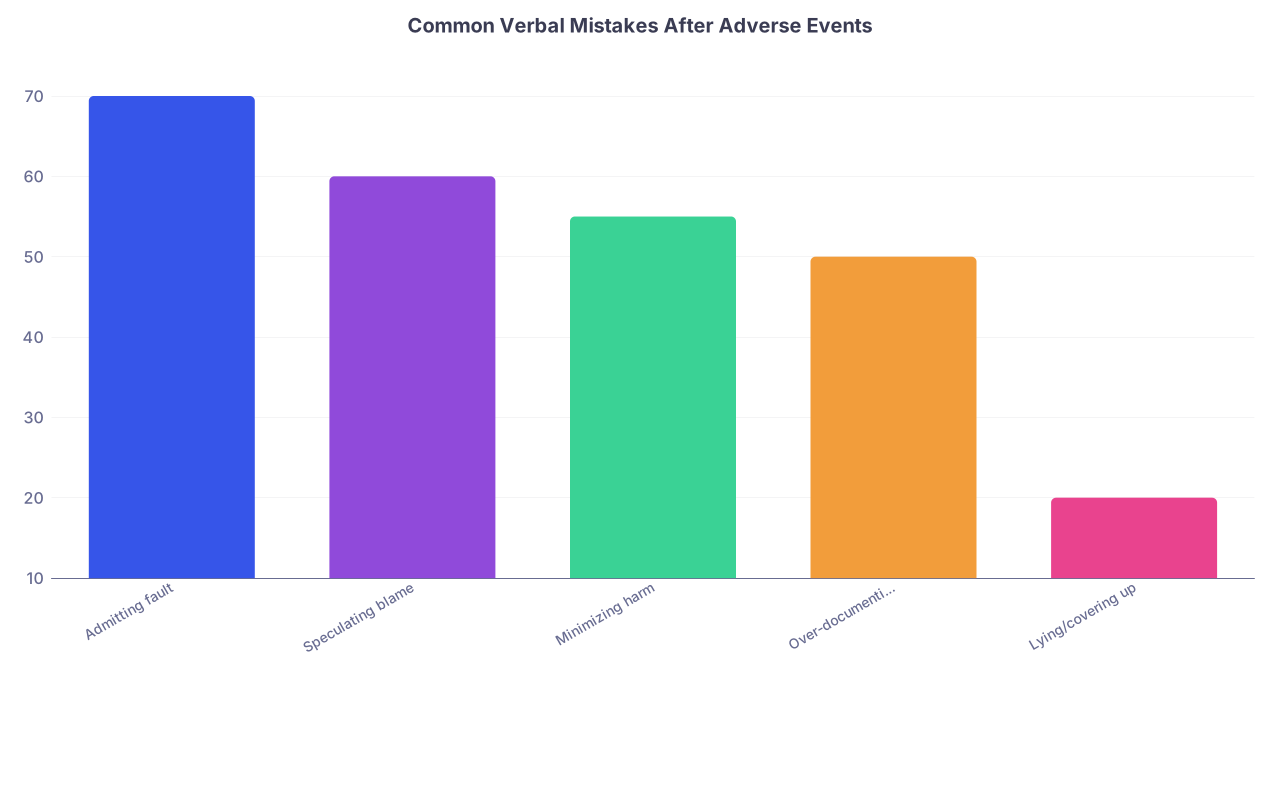
| Category | Value |
|---|---|
| Admitting fault | 70 |
| Speculating blame | 60 |
| Minimizing harm | 55 |
| Over-documenting guilt | 50 |
| Lying/covering up | 20 |
8. What To Say First (So You Don’t Panic Into a Bad Sentence)
You need a default script for the first minutes after you recognize a serious adverse event or possible error. Without one, you will improvise—and that is how you end up saying “This is all my fault” at 3 a.m. in an ICU waiting room.
Here is a basic structure you can use and adapt.
With the patient/family, early phase
- Acknowledge seriousness and presence
“I know this is very frightening and unexpected. I am here, and our team is working on [stabilizing / treating / evaluating] right now.”
- Commit to honesty without speculating
“There has been an unexpected complication/outcome. We are working to understand exactly what happened.”
- Express empathy without confessing negligence
“I am very sorry that you and your family are going through this.”
- Set expectation of updates
“As we learn more, we will talk with you again and explain what we know.”
That is it. No blame. No self-indictment. No lies.

| Step | Description |
|---|---|
| Step 1 | Recognize possible error |
| Step 2 | Stabilize patient |
| Step 3 | Notify senior/attending |
| Step 4 | Notify risk management per policy |
| Step 5 | Speak with patient/family |
| Step 6 | Use neutral, honest language |
| Step 7 | Document facts objectively |
9. Involving Risk Management and Following Policy (Without Looking Like a Robot)
Another mistake: delaying notification because you “don’t want to make it a big deal.”
By the time you think “This could be a lawsuit,” you are already late.
Common harmful phrases said to colleagues:
- “Let’s not get risk involved yet.”
- “We can just fix the note.”
- “Don’t mention this in the chart.”
Those are career-risk sentences. They sound like concealment. Because they are.
Better internal approach:
- Early call to attending: “We had X outcome. I am concerned this may represent an error or system issue. I think we should loop in risk management.”
- Early call to risk (if you are the attending / allowed): “We had X adverse event. I am not yet sure if this is a straightforward complication or possible error. We need guidance on disclosure and documentation.”
You are not “ratting yourself out.” You are:
- Creating a structured, protected review
- Getting help with communication
- Protecting the patient’s right to know and your right to a fair process
10. Ethics vs. Law: Do Not Use One to Excuse Ignorance of the Other
You will hear two stupid extremes in the hospital:
“Just do whatever legal says; ethics are secondary.”
Wrong. That is how you end up technically protected but morally bankrupt.“Just be totally transparent and confess everything; the truth will protect you.”
Also wrong. The truth is often complicated. The legal system is not kind to naive oversharing.
You need both:
- Ethical obligation: honesty, respect, non-deception, accountability.
- Legal wisdom: avoid premature, inaccurate admissions; avoid speculation; avoid creating misleading documentation.
The line is not that fuzzy:
Bad:
“I screwed this up and caused your loved one’s death. This is all my fault.”
Better and still ethical:
“Your loved one experienced a serious, unexpected outcome. We are very sorry. We are doing a thorough review of the care provided. When we know exactly what happened, we will discuss it with you clearly. We will not hide anything we learn.”
The second is honest, respectful, and legally sane.
11. Three Rules To Drill Into Your Brain
If you remember nothing else, remember this:
Do not label yourself the sole cause.
No “all my fault,” “I ruined everything,” “I killed your loved one” in the moment.Do not guess causes out loud.
“Probably the nurse,” “probably anesthesia,” “probably the lab” are stories, not facts.Do not lie or minimize.
No “nothing went wrong” when something clearly did. No “not a big deal” when someone is on a ventilator.
Stay factual, stay human, and involve the people whose job is to protect both the patient and you.
FAQ (4 Questions)
1. Is it ever appropriate to explicitly say “I made an error” to a patient or family?
Yes, but not impulsively and not alone. Once the event has been reviewed (often via morbidity and mortality, peer review, or risk management), and it is clear that a true error occurred, many institutions have formal disclosure policies. In that setting, you may explicitly acknowledge that an error happened, what it was, and what is being done to address it and prevent recurrence. That conversation should be:
- Fact-based
- Planned, not improvised
- Often done with support (risk management, another physician, sometimes legal)
The mistake is doing this confession-style in the first emotional minutes with incomplete information.
2. If my institution encourages “full transparency,” should I still avoid phrases like “this is all my fault”?
Yes. Transparency does not require self-condemnation or sloppy language. You can be fully transparent about:
- What happened
- What is known vs. unknown
- The steps being taken to investigate
without making inaccurate legal admissions or emotional exaggerations. “All my fault” is rarely literally true and almost never helpful. Transparency demands accuracy, not melodrama.
3. Can saying “I’m sorry” ever be used against me in court?
It depends on jurisdiction and wording. Many places have “apology laws” that protect pure expressions of sympathy (e.g., “I am sorry this happened to you”). Those protections often do not extend to admissions of fault (e.g., “I’m sorry, I made a mistake and caused this”). Because the line is narrow and varies by state or country, the safer approach is to:
- Freely express empathy and sorrow
- Avoid coupling that with statements that explicitly assign negligence or fault
Know your institution’s and region’s specific guidelines.
4. What should I do if I already said something like “It’s my fault” in the heat of the moment?
Do not try to erase or rewrite it. That compounds the problem. Instead:
- Document the factual sequence of events carefully and objectively.
- Notify your attending and risk management, explaining exactly what you said and in what context.
- In any later conversation with the patient or family, focus on clarity: “When I spoke earlier, I was very distressed about the situation. We are in the process of carefully reviewing everything that happened so we can give you a precise and accurate explanation.”
The priority now is to be truthful, stop adding new problematic statements, and let your institutional support team guide the next steps.
Key Takeaways
- Do not impulsively admit “fault” or “mistake” before you understand what actually happened.
- Do express empathy, seriousness, and commitment to honest follow-up—without speculating or blaming.
- Involve seniors and risk management early; do not improvise solo confessions that create more liability than they resolve.


