

The belief that refusing treatment makes a patient automatically incompetent is wrong. Clinically wrong, ethically wrong, and legally wrong.
It’s also one of the most persistent myths I see among trainees and even seasoned clinicians. Someone declines a clearly beneficial intervention—CT head after trauma, dialysis, antipsychotics, chemo—and you hear it in the workroom: “They must lack capacity.” Or, even worse: “Well, if they refuse that, they can’t be competent, so we can just override.”
That’s not how any of this works.
Let’s dismantle this properly.
What Competence Actually Means (And Why Refusal ≠ Incompetence)
First problem: people mix up “I disagree with this decision” with “this person can’t make a decision.”
Legally and ethically, decision-making capacity (clinical term) and competence (legal term) hinge on a set of abilities, not on the content of the decision. Courts and major ethics bodies are annoyingly consistent on this.
Most modern standards boil capacity down to four abilities:
- Understand relevant information
- Appreciate the situation and its likely consequences
- Reason about options in a consistent way
- Communicate a choice
A patient can do all four and still say “no” to a life-saving intervention. That’s allowed. That’s autonomy.
You are not the “right answer” police. You are the process referee.
Contrast two patients refusing chemo:
Patient A: “I understand this chemo could extend my life by maybe a year, but the side effects—vomiting, fatigue, frequent hospital trips—are not what I want. I’d rather have a shorter life with better quality, at home, even if it means dying sooner.”
Patient B: “Chemo will let me live forever. But I’m refusing because the nurses are part of a government plot and my neighbor told me I’ll turn invisible if I get it.”
Same outcome—refusal of therapy. Completely different capacity analysis.
Patient A: has capacity. Understands, appreciates, reasons, communicates.
Patient B: likely lacks capacity on multiple prongs—doesn’t appreciate reality, reasons from delusional premises.
The myth flips this on its head: “Bad decision = no capacity.”
Actual standard: “Impaired abilities = no capacity,” decision content is just a clue.
What the Law Actually Says (Not What People Assume It Says)
The law is brutally clear on this, both in common law and statute across many jurisdictions.
Courts have repeatedly stated variants of: a patient with capacity has a right to refuse treatment, even if that refusal is irrational, unwise, or leads to death.
You can find this pattern in:
- U.S. cases like Cruzan v. Director, Missouri Dept. of Health (right to refuse life-sustaining treatment, through surrogates, when previously expressed)
- Re C (Adult: Refusal of Medical Treatment) in the UK: a man with schizophrenia was ruled competent to refuse amputation, despite his psychiatric diagnosis
- Re B (Adult: Refusal of Medical Treatment): a paralyzed woman with full mental capacity refused ventilation; court upheld her right to have the ventilator withdrawn
- Similar standards embedded in provincial acts like Ontario’s Health Care Consent Act, and national frameworks in places like Australia and New Zealand
Notice the pattern: serious illness, high stakes, sometimes psychiatric comorbidity—and courts still uphold refusal if those four abilities are intact.
Let’s put this bluntly:
If you think “refusal = incompetence,” you’re more paternalistic than most high courts. That’s not a good look.
Data: Most Refusals Are Not About Incompetence
When you actually look at the data, treatment refusal is much more about values, trust, and communication than about incapacity.
We have numbers on this.
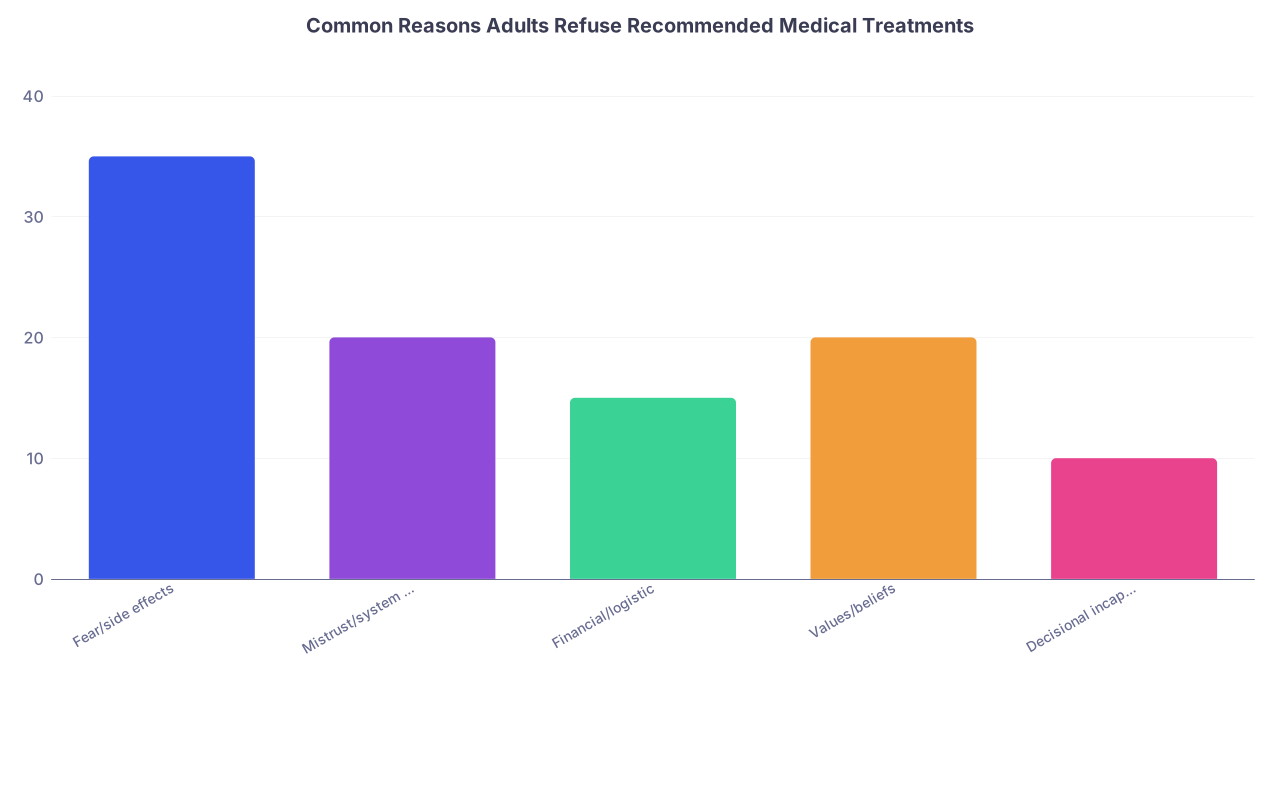
| Category | Value |
|---|---|
| Fear/side effects | 35 |
| Mistrust/system concerns | 20 |
| Financial/logistic | 15 |
| Values/beliefs | 20 |
| Decisional incapacity | 10 |
These percentages vary between studies, but the general pattern holds across settings: emergency departments, oncology, psychiatry, even ICU.
Rough picture:
- A big chunk refuse because they’re afraid—of pain, of side effects, of disability.
- Another chunk because they don’t trust you or the system.
- Some because they simply can’t afford it or can’t handle the logistics.
- Some because their values are different: religious beliefs, quality-of-life priorities, views on disability.
- A minority actually lack capacity in a legally meaningful way.
Yet clinicians routinely jump from “this choice makes no sense to me” to “they’re incompetent.” That’s not data-based. That’s ego-based.
Capacity Is Decision-Specific, Not All-Or-Nothing
Another common error: once someone is “incompetent,” they’re incompetent for everything. Also wrong.
Capacity is:
- Task-specific
- Time-specific
- Context-specific
A patient with moderate dementia might:
- Lack capacity to manage complex finances
- Still have capacity to refuse a minor procedure
- Temporarily lose capacity in the middle of a delirious episode
- Regain it after hydration and orientation
You don’t get to slap “incapacitated” in the chart and call it a day forever.
| Scenario | Likely Capacity Status |
|---|---|
| Choosing what to eat for lunch in early dementia | Likely has capacity |
| Signing a complex estate planning document | Likely lacks capacity |
| Consenting to simple blood draw when mildly intoxicated | Often has capacity |
| Refusing high-risk surgery during septic delirium | Likely lacks capacity |
| Refusing CPR when fully oriented with terminal cancer | Likely has capacity |
When a competent patient refuses dialysis, they might still want pain control. When someone lacks capacity to consent to risky surgery during acute psychosis, they might fully understand and choose their daily meds.
Capacity isn’t a switch; it’s a dimmer.
The Four Abilities: How to Actually Assess Capacity (Not Guess)
Here’s where I see the worst shortcuts. “They seem confused.” “She’s depressed.” “He’s homeless and says no to everything.” None of that is a capacity assessment.
Walk through the abilities. Briefly, but explicitly.
Understanding
Can the patient describe—in their own words—the nature of the problem, the proposed intervention, and major risks/benefits/alternatives?Appreciation
Do they grasp that this information applies to them, here, now?
Example: “If I don’t get this surgery, I might die soon. I get that. I just don’t want it.”Reasoning
Can they compare options and explain why they prefer one? Logic does not have to be medically sophisticated; it just has to be internally coherent and reality-based.Expression of a choice
Can they communicate a stable choice? Not flipping every five minutes, not so disorganized they can’t give a clear answer.
This can take 5–10 minutes when you get good at it.
And yes, you should actually document those elements.
What you should not do is equate:
- Disagreement with you
- Lower education
- Cultural differences
- Unfamiliar risk calculus
- Distrust of the hospital
with incapacity.
Those are separate problems: communication, health literacy, structural harm, lived experience. Hard, but different.
Refusing “Obvious” Care Is Allowed. That’s the Whole Point of Autonomy.
There’s a particular discomfort when a patient refuses something “obviously” life-saving:
- STEMI patient refusing cath lab
- Jehovah’s Witness refusing transfusion
- Elderly patient refusing CPR/intubation
- Diabetic refusing insulin
- Competent oncology patient stopping chemo to go home and die
The emotional temptation is to protect them from themselves.
Ethically and legally, that’s shaky ground.
Autonomy means: you get to make choices others think are terrible, as long as you have the relevant capacity. Medicine is not a benevolent dictatorship where anyone who steps out of line is demoted to “incompetent.”
Consider a very common hospital scene: an 85-year-old with severe heart failure and recurrent admissions says, “No more ICU, no CPR, I’d rather die peacefully at home.”
Resident reaction I’ve heard verbatim: “She must be depressed; no one would choose that.”
Translation: “No one who thinks differently from me can be competent.”
That’s not clinical judgment. That’s arrogance dressed as concern.
You can—indeed, you must—screen for depression, clarify misunderstandings, correct distorted risk estimates. But when she says, after all that, “I understand and I still say no,” the correct response isn’t to manufacture incapacity. It’s to respect the choice.
When Refusal Does Signal Possible Incapacity
Now the other side. Sometimes refusal really does flag a problem with capacity; just not automatically, and not always.
Red flags that might trigger a capacity evaluation:
Refusal based on obvious delusions or hallucinations
(“The IV is filled with demons,” “The CT scanner is a portal to hell.”)Refusal in the context of acute delirium, sepsis, or intoxication
Dramatically inconsistent or wildly fluctuating choices within short intervals
Profound cognitive impairment where patient cannot recall key facts 30 seconds later
Clear evidence they plain do not understand the basic facts, even after repeated, simple explanations
But here’s the key: those are triggers for a structured assessment, not carte blanche to override. Too many teams skip from “this looks weird” straight to “no capacity”; they fill in the middle with vibes instead of analysis.
Surrogates Are Not a Shortcut Around Capacity
Another lazy move: label someone “incompetent” just to get to the more agreeable surrogate.
You’ve seen this:
- The patient is awake, oriented, and says no to surgery.
- The family says yes and wants “everything done.”
- The team sides with the family, quietly questioning the patient’s “judgment.”
Unless the patient truly lacks capacity by those four standards, the family’s wishes are legally irrelevant. Surrogates step in only when the patient lacks capacity or has delegated certain decisions in advance directives.
Otherwise, the competent patient is the decision-maker. Period.
What happens in the real world? People reverse it: family preferences dominate, and the patient is sidelined via vague chart phrases like “questionable capacity” with no actual assessment documented.
From an ethics standpoint, that’s not just sloppy. That’s coercive.
How to Push Back on the Myth in Real Time
You’re going to hear this myth on rounds. In consults. In family meetings.
Here’s how you can quietly challenge it without starting a war:
When someone says, “If they refuse, that proves they lack capacity,” respond with:
“Capacity is about the process, not the conclusion. Have we checked understanding, appreciation, reasoning, and choice?”When refusal triggers panic, ask:
“What exactly makes you think they lack capacity? Is it delusions? Memory? Inconsistency? Or just that you don’t like the choice?”When someone wants to default to the family:
“The patient is conscious and communicating. Let’s document a capacity assessment before we bypass them.”When a patient refuses, focus on exploration:
“Tell me what worries you most about this treatment.”
Nine times out of ten, what surfaces is fear, mistrust, past trauma—not incapacity.
And yes, document like a lawyer is going to read it. Because one might.
Visualizing the Decision Path: Refusal vs Incompetence

| Step | Description |
|---|---|
| Step 1 | Patient refuses treatment |
| Step 2 | Clarify reasons and understanding |
| Step 3 | Has capacity - Respect decision |
| Step 4 | Perform structured capacity assessment |
| Step 5 | Involve surrogate or legal pathway |
| Step 6 | Understands, appreciates, reasons, communicates? |
| Step 7 | Lacks capacity? |
This is the part people skip: from A straight to G. Which is exactly how autonomy gets quietly throttled.
The Bottom Line
Strip away the myths and the emotional noise, and you’re left with three blunt truths:
Refusing treatment—even life-saving treatment—does not automatically make a patient incompetent. Capacity is about abilities (understand, appreciate, reason, choose), not about agreeing with you.
Most treatment refusals come from fear, values, mistrust, or bad communication, not from decisional incapacity. Your job is to clarify, explore, and inform—not to pathologize every “no.”
Capacity is specific, assessable, and documentable. If you’re using “they must lack capacity” as shorthand for “I hate this decision,” you’re not protecting patients; you’re undermining their rights.
If you want to practice ethically in modern medicine, you have to get comfortable with this: competent adults are allowed to make what you think are terrible medical choices. That’s not a bug in the system. That is the system.


