

The idea that “doctor knows best” died with paternalistic medicine is a comforting fiction. The data say otherwise: that instinct is still quietly steering your choices, even when you swear you’re a “shared decision-making” champion.
Let’s drag that into the light.
The Myth Of The Post‑Paternalistic Era
Medical schools tell a polished story: we used to be paternalistic, now we’re collaborative. Old days: white-haired surgeon barking orders. New days: “What matters to you?” and decision aids with colorful charts.
Reality is grimmer and more subtle.
Look at what patients actually report. In large surveys from the US and Europe over the last decade, anywhere from 60–80% of patients say their doctors “mostly” or “entirely” decided treatment plans for them. That’s not shared decision-making. That’s rebranded paternalism with a consent form on top.
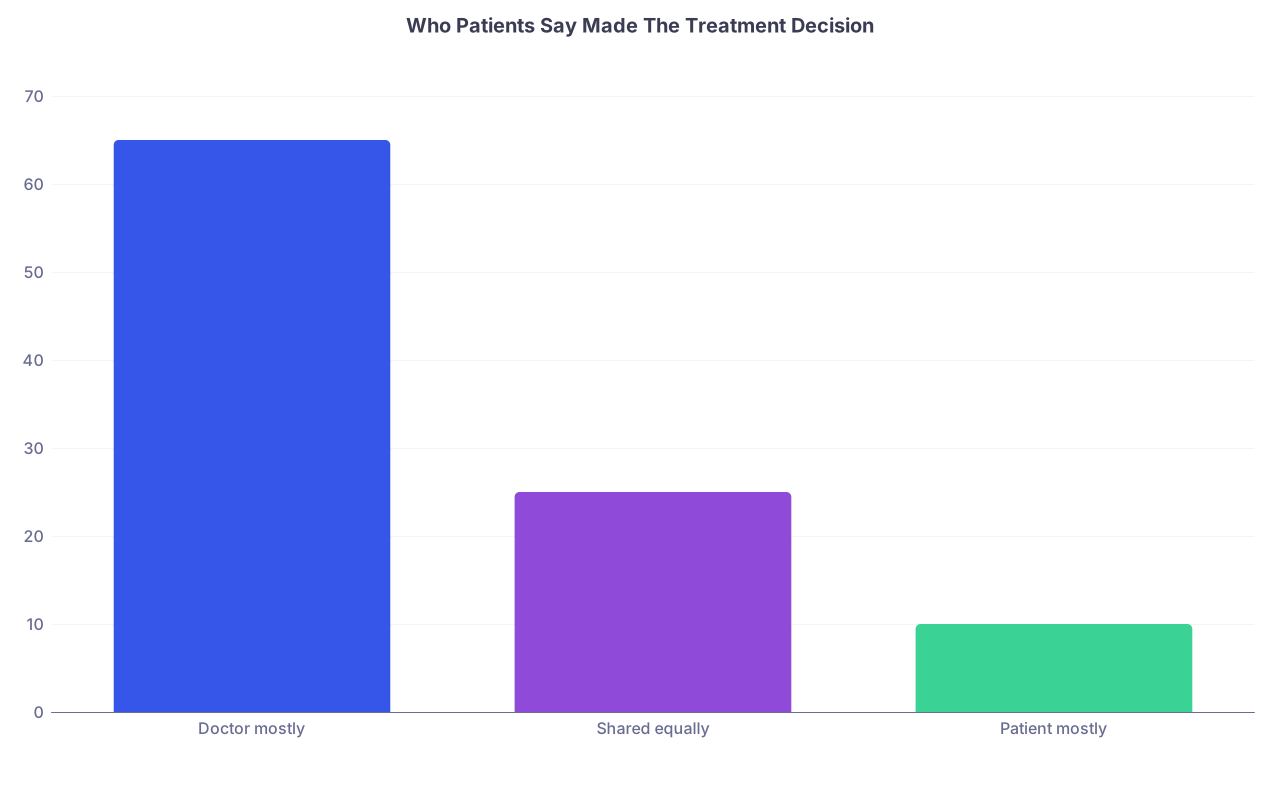
| Category | Value |
|---|---|
| Doctor mostly | 65 |
| Shared equally | 25 |
| Patient mostly | 10 |
Clinicians tell a different story when asked. Self-report from physicians? They “involve patients” 80–90% of the time. When researchers record actual visits and code them objectively, the rate of true shared decision making plummets. Often into the single digits.
So two myths right out of the gate:
“We left ‘doctor knows best’ behind.”
No, we just stopped saying the quiet parts out loud.“Patients today are empowered and informed.”
Some are. Most are overwhelmed, time-pressured, and primed to defer.
The ethical problem isn’t simply authority. It’s unexamined authority. The old slogan is still driving the car; you’ve just hung an “autonomy” air freshener from the mirror to make it smell better.
How Authority Quietly Steers Decisions (Even When You Think It Doesn’t)
You do not need to say, “I know best, just do what I say” to shape a decision entirely. Three subtle levers do it for you: framing, default bias, and social pressure.
Framing: The Script You Don’t Hear Yourself Saying
Let me be blunt: the way you phrase options can override any “choice” you pretend to provide.
Examples I’ve actually heard on wards and in clinic:
- “We can just try watchful waiting, or we can go ahead and treat this aggressively.”
- “Most patients don’t really want to deal with the side effects of surgery.”
- “If it were my mother, I’d absolutely do the chemo.”
Patients hear the adjectives, not the abstract principle of autonomy. Behavioral economics has been screaming about this for decades. Risk framed as survival vs. mortality changes choices dramatically, even when the numbers are identical.

You think you’re neutrally “explaining risks and benefits.” You’re not. You’re constructing a recommendation-shaped tunnel and inviting the patient to walk down it.
Ethically, that’s still “doctor knows best.” It’s just disguised as information delivery.
Defaults: The Silent Yes
The most powerful phrase in modern medicine is not “do this.” It’s “this is what we usually do.”
Default options drive behavior in everything from organ donation rates to retirement savings. Medicine is no exception. When you present a “standard of care,” you’re creating a default. Patients must actively push against it to choose otherwise.
In ethics seminars, people love the idea of “equipoise,” of presenting options as genuinely open. At 4:30 p.m. on clinic day when you’re behind by six patients, you love defaults. So you say things like:
- “The normal next step is…”
- “The guideline-recommended treatment is…”
- “We routinely start with…”
Those phrases are not neutral. They are authority signals. They say, indirectly: “You’d be foolish to deviate from this.”
That is paternalism by inertia.
Social Pressure: The White Coat In The Room
Then there’s the body language and micro-pressure that nobody wants to admit.
You stand. Patient sits. You speak 80% of the words. You glance at the clock. You interrupt after 11 seconds (yes, that’s around the historical median from actual recordings). They pick up the hierarchy like static electricity.
Studies consistently show that when patients feel rushed, intimidated, or worried about being “difficult”, they default to agreement. They nod along even when they don’t understand. They rarely say, “I’m not sure that’s right for me.” They just sign.
Is that “informed consent”? On paper, yes. Ethically, it’s still very close to “doctor knows best; I’ll just go along.”
Where The Law Pretends This Is Solved (And Where It Isn’t)
Lawyers like tidy frameworks. Ethicists like four-box models. The mess of real encounters doesn’t fit.
Let’s talk about the legal structure that’s supposed to counter “doctor knows best”: informed consent.
Two Standards That Quietly Favor The Doctor
There are two main legal standards for informed consent:
- Professional standard: disclose what a “reasonable physician” would disclose.
- Patient-centered standard: disclose what a “reasonable patient” would want to know.
Sounds good on slides. In practice, even the patient-centered standard is filtered through physician judgment. Who decides what a “reasonable patient” wants to know? The doctor. The same person whose training, incentives, and fears are already pushing toward certain choices.
Let’s be honest: courts rarely scrutinize the nuance of your conversation. They look for documentation. Box checked? Signature present? You’re usually fine.
So yes, legally, the system has moved away from naked paternalism. Ethically, the bar is low. You can comply with informed consent law and still be deciding for the patient 90% of the time via framing, defaults, and structure.
| Aspect | Legal Requirement | Ethical Reality |
|---|---|---|
| Information disclosed | Minimal reasonable amount | Highly variable, often filtered |
| Patient understanding | Rarely verified | Frequently superficial |
| Documentation | Central to defense | Often treated as the goal |
| Patient voluntariness | Presumed if signature | Heavily shaped by power dynamic |
The law has carved out space for autonomy. It has not forced you to actually fill that space with genuine, patient-driven decisions.
Shared Decision-Making Tools: Used, Misused, Or Ignored
Hospitals love rolling out decision aids to prove they’re “patient-centered.” PDF booklets, online modules, interactive videos.
Evidence shows that good decision aids can reduce decisional conflict and improve knowledge. They really can shift power. But here’s the catch: they only work when they’re used as tools for actual choice, not as props.
I’ve watched clinicians hand a 20-page booklet to a patient with, “This explains the options, but really, I recommend X.” Translation: “Skim this if you like, but the real answer is my answer.” That’s not shared decision-making. That’s paternalism with extra paperwork.
So even our attempts to cure “doctor knows best” are often quietly colonized by it.
Why You Keep Slipping Back Into “Doctor Knows Best”
This isn’t just about bad habits or “old-school” attendings. There are structural forces that push even well-meaning clinicians back into the paternalism groove.
Time Pressure Is An Ethical Force
You cannot separate ethics from workflow. When you have 15 minutes to diagnose, explain, negotiate, and document, you will reach for shortcuts. The fastest shortcut is: decide for the patient and label it as recommendation.
“Doctor knows best” is time-efficient. Autonomy is not.
Ethics committees love to preach about honoring values. Administrators love visit quotas. Guess which one shapes behavior more on a random Tuesday?
Risk Aversion Masquerading As Wisdom
Malpractice fear is another driver. If you offer a range of options and the patient chooses one that goes badly, you worry you’ll be blamed for not steering harder toward the guideline. So you steer.
You overstate benefits. You downplay uncertainties. You emphasize the “standard.” All of that feels like being responsible. It’s also a quiet way of saying: “Look, I know best, do the safe thing, so we’re both protected.”
Ethically, that’s you prioritizing your risk profile over the patient’s value profile. And your white coat gives that priority enormous weight.
Identity: The Need To Be The One Who Knows
There’s also ego. And identity. Medicine tends to attract and then reinforce people who see themselves as problem solvers, experts, fixers.
“Doctor knows best” isn’t just a phrase; it’s a psychological safety blanket. Letting go of it feels like letting go of competence itself. What are you if not the person who knows what should be done?
So even when you say “what do you think?”, you may be fishing for agreement, not genuinely open to deviation. Patients can usually tell.
What The Data Actually Show Patients Want
The standard excuse for subtle paternalism is, “But many patients want the doctor to decide.” There’s some truth there, but it’s weaponized half the time.
When you look closely at surveys, a more accurate statement is: many patients want to share decisions but lean on the doctor for guidance, especially in high-stress scenarios or complex illness. That’s not carte blanche for unilateral authority.
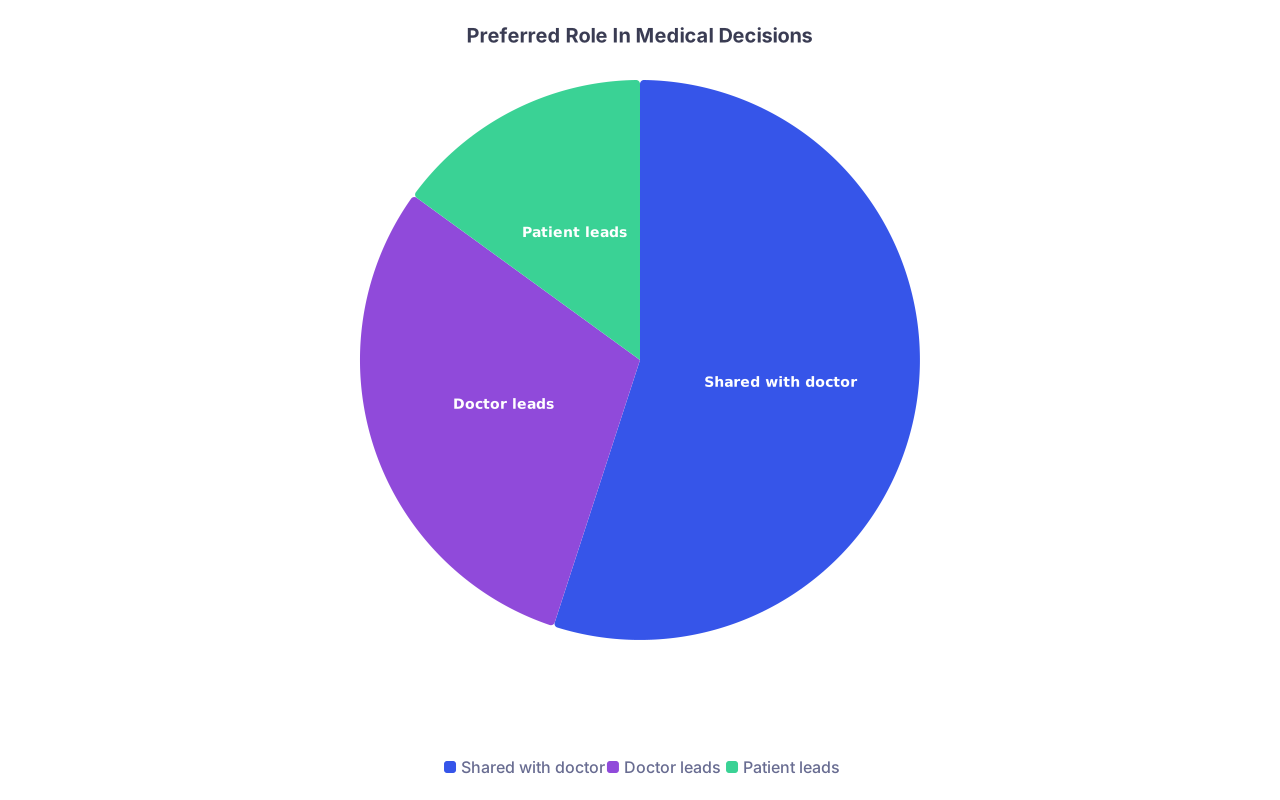
| Category | Value |
|---|---|
| Shared with doctor | 55 |
| Doctor leads | 30 |
| Patient leads | 15 |
“Shared with doctor” is the plurality preference in most modern studies. The problem is that clinicians often translate that as “I decide, they consent.” That’s not what the word shared means.
Patients generally want:
- A clear recommendation.
- Honest disclosure of uncertainty and tradeoffs.
- Real permission to say no or choose differently—without being punished, shamed, or rushed.
They don’t want an abdication: “You decide, it’s your body.” They also don’t want a performance of inclusion where every path leads back to what you’ve already decided.
That middle ground—recommendation plus reversible authority—is harder. It requires tolerating choices you disagree with.
If You Actually Want To Stop Doing “Doctor Knows Best” On Autopilot
You’re not going to dismantle structural paternalism in one clinic block. But you can stop lying to yourself about how much of it is still yours.
Three concrete shifts that change behavior more than any ethics lecture:
Separate recommendation from choice explicitly.
Say both parts out loud:- “Clinically, I lean toward surgery because of X and Y.”
- “But that’s based on my weighting of risks. If you’d rather prioritize avoiding surgery even if it means a higher chance of recurrence, that’s a reasonable choice, and we can plan around that.”
Make refusal and deviation socially safe.
Don’t just say, “You can say no.” Rehearse it for them:- “Some people in your situation decide this is too invasive and prefer to manage symptoms instead. If after thinking it over you feel that way, just tell me, ‘I’d rather not do that,’ and we’ll work with it.”
Check understanding with skin in the game.
Not “Do you understand?” They’ll say yes. Try:- “If you had to explain to your partner tonight what we’re choosing between, what would you say?”
Then shut up and listen. If what comes back doesn’t match what you thought you communicated, that’s on you, not their “noncompliance.”
- “If you had to explain to your partner tonight what we’re choosing between, what would you say?”
None of this is exotic. It just runs counter to the very old, very comfortable script that “once I’ve recommended, the right answer is obvious.”
That script is “doctor knows best,” and it’s still quietly directing the scene.
The Bottom Line
Three points, stripped of the polite padding:
The old paternalism did not disappear; it mutated. Framing, defaults, time pressure, and hierarchy let “doctor knows best” shape most decisions while everyone recites autonomy slogans.
Law and policy have raised the floor with informed consent and decision aids, but they haven’t forced genuine shared authority. You can check every legal box and still be deciding for your patients.
If you actually care about medical ethics—beyond compliance—you have to deliberately create space for patients to meaningfully disagree with you. Otherwise, “doctor knows best” is still in charge; it’s just whispering instead of shouting.


