

The way most trainees use “capacity” and “competence” is legally sloppy and clinically dangerous.
Let me break this down specifically, because this is one of those topics where I have watched smart residents get burned on exam questions, in family meetings, and in court affidavits.
1. The Core Distinction You Keep Blurring
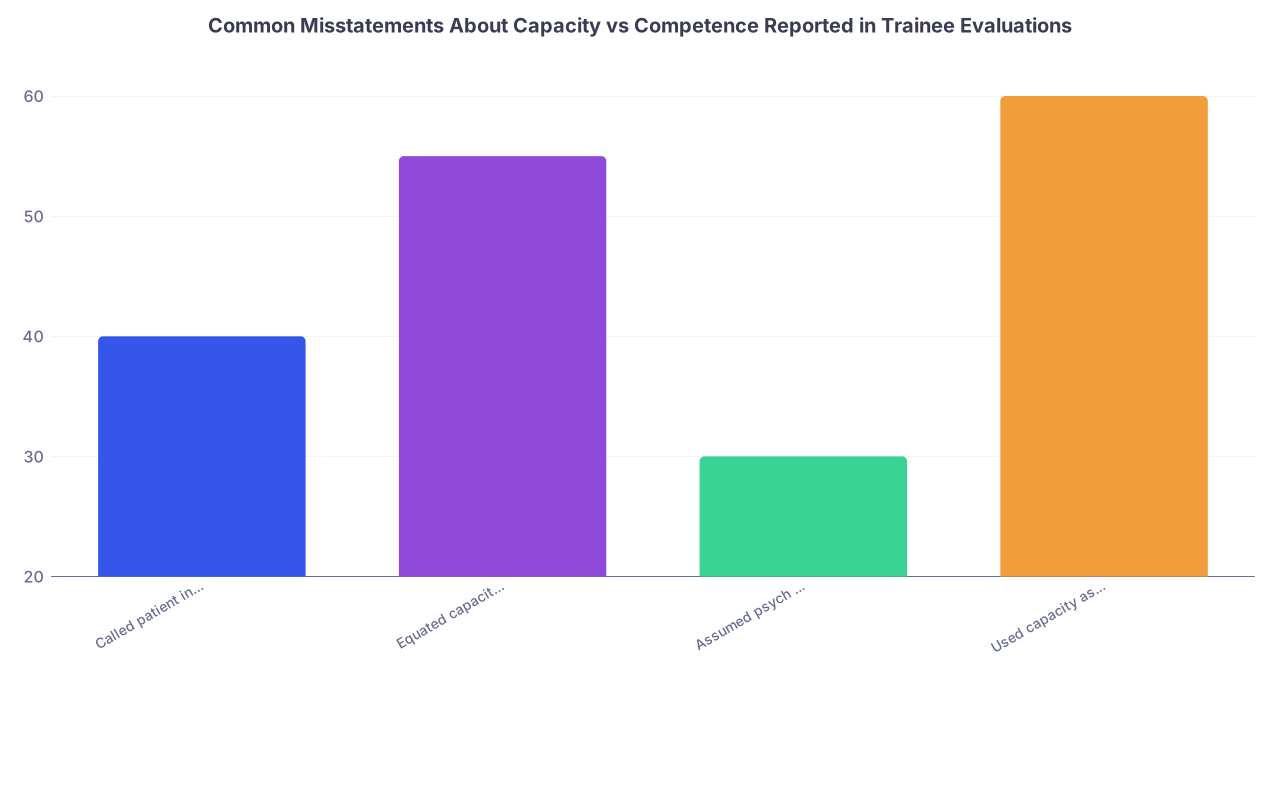
| Category | Value |
|---|---|
| Called patient incompetent | 40 |
| Equated capacity with Mini-Mental score | 55 |
| Assumed psych admission removes capacity | 30 |
| Used capacity as all-or-nothing label | 60 |
The blunt truth:
- Capacity is clinical, dynamic, decision‑specific.
- Competence is legal, global, status‑based.
I have heard interns say on rounds: “He’s incompetent, he cannot sign consent.” That single sentence tells me they do not understand the landscape.
Here is the precise breakdown:
Capacity
- Assessed by: clinicians (any physician, often supported by psychiatry, geriatrics, ethics).
- Scope: particular decision at a particular time – “Does this patient have capacity to consent to this surgery now?”
- Nature: fluid; can change over hours or days; can vary by complexity of decision.
- Standard: ability to understand, appreciate, reason, and communicate a choice regarding the specific decision.
Competence
- Determined by: a court (or legally authorized tribunal), not by you, not by your attending, not by the on‑call psychiatrist.
- Scope: broad legal status, usually across domains (financial, personal, medical) as specified in jurisdiction.
- Nature: relatively stable until legally modified.
- Impact: triggers appointment/activation of a legal guardian or conservator, with long‑term consequences.
You, as a trainee, almost never determine “competence.” You assess capacity and you describe your assessment so that others (including courts) may later rely on it.
If your note says, “Pt incompetent,” you have already stepped outside your lane. That will show up on OSCEs, exams, and possibly in legal discovery. Use the right word.
| Feature | Capacity (Clinical) | Competence (Legal) |
|---|---|---|
| Who decides? | Clinician | Judge / court |
| Scope | Specific decision, specific time | Global or domain‑wide |
| Changeability | Fluctuates with condition/context | Changed only by legal process |
| Documentation word | "Lacks decision-making capacity" | "Declared legally incompetent" |
| Typical trigger | Bedside concern about a decision | Petition, hearing, legal evidence |
Memorize that table. It saves you from half the “capacity vs competence” errors I see in trainee documentation.
2. The Four Abilities: What Capacity Actually Means Clinically
Most trainees have heard “understand, appreciate, reason, communicate,” but they test it like a checkbox, not like an assessment.
The best operational model is Appelbaum & Grisso’s four abilities. You must be able to elicit and document each:
Understanding
Can the patient state, in their own words:- What the condition is (to a reasonable degree)
- What the proposed intervention is
- The major risks, benefits, and reasonable alternatives (including no treatment)
“Yes doc, the stent will unclog my heart pipe and if we do not do it I could die” passes.
“They’re putting electricity in my blood to read my thoughts” does not.Appreciation
This is the most commonly missed piece.
The question is: does the patient recognize that the information applies to them?Examples:
- Patient with psychosis who can parrot, “Schizophrenia is an illness that can cause hallucinations,” but insists “I do not have that, you are trying to poison me” → understands but does not appreciate.
- Patient with COPD who can say, “People with my illness can die from stopping oxygen,” but adds, “I am different; God told me I will not die regardless,” and truly relies on that belief to refuse → appreciation is questionable and requires careful analysis.
Reasoning
Can the patient compare options and give a logically coherent explanation, even if you disagree with their values?“I know surgery gives me a 60% chance of surviving one more year, but I would rather go home and die with my family” is adequate reasoning.
“I am refusing surgery because the nurse put fluoride in the IV to control my mind” is impaired reasoning grounded in delusion.Ability to Express a Choice
This is the simplest but frequently forgotten. The patient must:- Be able to communicate a stable choice (verbally, in writing, via assistive device)
- The choice should be consistent enough over the relevant timeframe to act on it
Severe aphasia, advanced dementia with rapidly shifting answers, or severe delirium may block this ability.
You do not need perfection in all four domains. Capacity is a clinical judgment: Are deficits severe enough, in this context, to render the patient unable to make this particular decision?
That “in this context” clause is not fluff; it is where almost all fine‑grain mistakes occur.
3. Capacity is Decision‑Specific and Risk‑Sensitive

| Step | Description |
|---|---|
| Step 1 | Identify Decision |
| Step 2 | Assess Understanding |
| Step 3 | Assess Appreciation |
| Step 4 | Assess Reasoning |
| Step 5 | Assess Ability to Express Choice |
| Step 6 | Respect Decision |
| Step 7 | Identify Surrogate or Legal Route |
| Step 8 | All abilities adequate for this risk? |
One of the most pervasive trainee errors is treating capacity as an all‑or‑nothing trait. As if a person either “has capacity” or “does not have capacity,” universally, for everything.
That is not how any serious court or ethics body sees it.
Two key principles:
Decision‑Specific
A patient may:- Have capacity to choose what to eat for dinner.
- Lack capacity to consent to complex, high‑risk neurosurgery.
On the same day. With the same cognitive baseline.
Classic case:
- 82‑year‑old with moderate Alzheimer’s:
- Easily demonstrates understanding and appreciation to choose between SNF A and SNF B.
- Cannot grasp the long‑term financial consequences of different annuity products. → May have capacity for simple medical choices, but a court might still appoint a financial conservator.
Risk‑Sensitive (Sliding Scale)
The higher the risk and irreversibility of the decision, the higher the threshold of capacity we demand.Acceptable reasoning for:
- Choosing between oral vs IV antibiotics (low risk, reversible) can be quite minimal.
- Refusing life‑saving dialysis (high risk, potentially irreversible) needs more robust understanding, appreciation, and reasoning.
This is where I see residents get uncomfortable and vague. They sense that refusing a high‑benefit, low‑risk intervention must mean “lack of capacity.” That is wrong.
Refusing a clearly beneficial treatment does not automatically imply incapacity. The question is not “Is the decision reasonable?” It is “Is the patient capable of making an unreasonable decision?”
You can have a patient say:
“I know the surgery is likely to cure me. I understand I might die without it. But I have lived a long life and I am not willing to go through an ICU stay and rehab.”
That might be a bad choice clinically. Ethically and legally, if the abilities are intact, you must respect it.
4. Common Misconceptions Trainees Keep Repeating
Let me dismantle a few myths I hear every month.
Myth 1: “He is on a psychiatric hold, so he has no capacity for anything.”
Wrong. A 72‑hour hold for danger to self/others does not globally erase decision‑making capacity.
Capacity for:
- Consenting to antipsychotics
- Refusing a voluntary group session
- Consenting to an unrelated surgery
must all be assessed separately.
I have watched trainees tell a restrained, psychotic patient, “You do not have capacity for medical decisions,” as a blanket statement. That is inaccurate. They might lack capacity for some decisions, but retain enough capacity for others.
Myth 2: “Low MMSE / MoCA = no capacity”
Cognitive screens are data points, not verdicts.
- An MMSE of 15 strongly suggests severe impairment, but you still must map it to the four abilities and the specific decision.
- A highly educated person with mild dementia might score 24 but be unable to appreciate risks for a complex procedure.
Courts and ethics committees are skeptical of capacity determinations founded solely on a screening score.
Myth 3: “If family says patient always wanted X, we can ignore current choice”
This is an autonomy train wreck.
- Advance directives and prior statements matter when the patient lacks capacity.
- When the patient has capacity now, their current informed wishes override what they supposedly wanted 5 years ago.
I have seen residents cling to old POLST forms to avoid talking with a decisional patient who has changed their mind. That is lazy medicine and ethically indefensible.
Myth 4: “If patient agrees with us, no need to assess capacity”
Agreement is not proof of capacity. A delirious patient can agree to anything.
You assess capacity especially when there is:
- High‑risk decision
- Fluctuating mental status
- Concern that the patient does not actually grasp what is happening
If all you document is “Patient agreeable,” you have not done an assessment; you have documented convenience.
5. How to Actually Do a Bedside Capacity Assessment

Here is a concrete, efficient structure you can run in 5–10 minutes and then chart properly.
Step 1: Define the Decision Precisely
Vague: “Does this patient have capacity?”
Better: “Does this patient have capacity to refuse emergent coronary angiography recommended for NSTEMI?”
Your assessment is meaningless if you do not anchor it to a specific decision and timeframe.
Step 2: Optimize Conditions
- Treat obvious contributors: pain, hypoxia, hypotension, hypoglycemia.
- Reduce distractions: television off, family interruptions minimized.
- Use interpreter services if needed; language is not capacity.
- Consider timing: wait until sedatives have worn off if possible.
Step 3: Use Targeted Questions for Each Ability
You do not need a script, but you do need examples.
Understanding
- “Can you tell me what is going on with your health right now?”
- “What is the treatment that we are recommending?”
- “What are the main risks and benefits as you understand them?”
Appreciation
- “How do you think this illness affects you personally?”
- “What do you think is likely to happen if we do not do this procedure?”
- “Do you believe you have [condition]?” (watch for delusional denial)
Reasoning
- “What options do you see for yourself right now?”
- “Can you tell me why you prefer that option?”
- “What might be the downside of the choice you are making?”
Expressing a Choice
- “Given everything we have discussed, what do you want to do?”
- “Is that your final decision, or do you feel unsure?”
- check consistency across the conversation or visits.
You are not administering a test. You are probing: Is there a coherent, reality‑based, values‑consistent decision‑making process?
Step 4: Weigh Impairments Against the Risk of the Decision
You might find:
- Mild difficulty recalling some statistics, but strong grasp of big‑picture risks → likely still adequate for many decisions.
- Significant delusional system driving refusal of life‑saving care → likely inadequate.
Document your reasoning, not just your conclusion.
6. Documentation: How to Stop Writing Legally Useless Notes

Most capacity notes from trainees are a single line:
“Patient lacks capacity to refuse surgery.”
That will not defend you in a lawsuit, will not satisfy an ethics consult, and will not help a court appoint a guardian.
You need three pieces:
Context
- Decision at stake.
- Relevant medical facts (risk, urgency, alternatives).
- Why a capacity assessment was triggered (e.g., unexpected refusal, fluctuating mental status).
Content of the Assessment
- Short quotes or paraphrases that demonstrate each of the four abilities (or deficits).
- Mental status findings relevant to decision‑making (delusions, delirium, severe anxiety, aphasia).
Conclusion and Plan
- Clear statement: “In my judgment, Mr. X lacks decision‑making capacity to [decision] at this time because…”
- Next steps: surrogate decision‑maker invoked, ethics consult, possible court petition, plan to reassess if condition changes.
Example of a strong, concise note:
“Mr. A is a 68‑year‑old with septic shock and acute kidney injury. Decision at issue: consent for emergent dialysis.
Understanding: When asked, he stated, ‘My kidneys are shutting down and you want to clean my blood with a machine.’ He was unable to describe any potential risks or alternatives despite repeated explanations.
Appreciation: He persistently stated, ‘There is nothing wrong with my kidneys; this is all a mistake,’ and stated, ‘I will go home tomorrow,’ despite explanation that without dialysis he is likely to die.
Reasoning: When asked why he refused dialysis, he replied, ‘I do not need it because they filled the room with poison gas,’ indicating fixed persecutory delusion.
Choice: He expressed refusal of dialysis multiple times but in the context of the above impairments.
In my judgment, due to his lack of appreciation of his condition and delusional reasoning, he lacks decision‑making capacity to refuse emergent dialysis tonight. I spoke with his designated health care proxy (wife), who consents to dialysis on his behalf. We will reassess his capacity as his mental status improves.”
That is defendable. That shows you know what you are doing.
7. Competence: When It Actually Matters for You
You will not be the one declaring someone “incompetent.” But you must know what it looks like when that status exists, because it changes:
- Who can consent
- Who can access records
- Who can refuse discharge plans
Key scenarios:
Existing court‑appointed guardian / conservator
- Check the court order or chart: what domains? Medical? Financial? Both?
- If a guardian has authority for medical decisions, you still perform capacity assessments, but the legal final say may rest with the guardian.
Requesting a court evaluation
- Usually triggered by chronic incapacity (advanced dementia, severe intellectual disability, profound brain injury).
- You are asked to provide supporting documentation: history of impaired decision‑making, cognitive evaluations, attempts at supported decision‑making, risk of harm.
Distinguishing “incapacity” from “incompetence” in notes
- Use language like: “Patient currently lacks medical decision‑making capacity for [decision]. A formal evaluation for legal competence and possible guardianship has been requested from [court / legal department].”
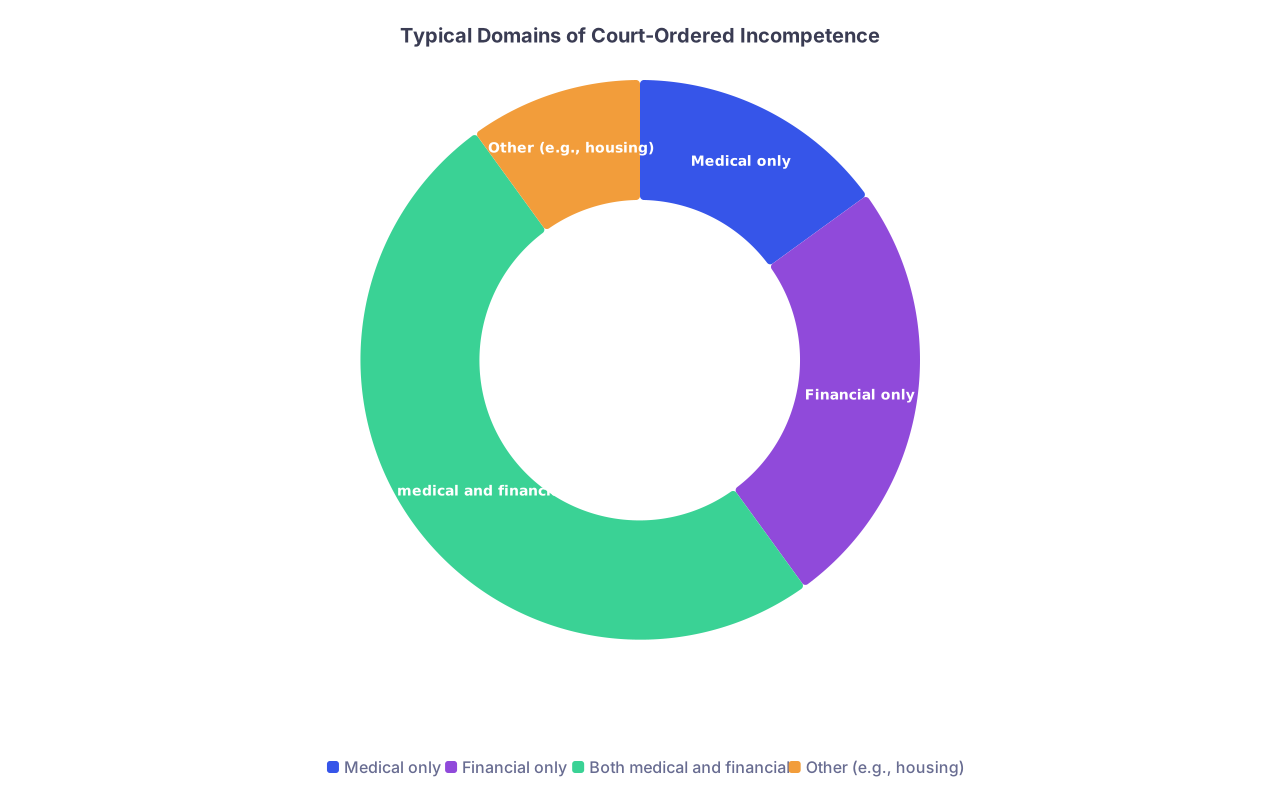
| Category | Value |
|---|---|
| Medical only | 15 |
| Financial only | 25 |
| Both medical and financial | 50 |
| Other (e.g., housing) | 10 |
Courts move slowly; clinical decisions move fast. That is why clinicians own capacity and courts own competence.
8. Substituted Judgment vs Best Interests: How Capacity Failure Cascades
Once you conclude that a patient lacks capacity for a decision, you do not magically get to do what you think is best. You switch ethical frameworks.
Two major standards:
Substituted Judgment
- Ask: “What would this patient choose, if they had capacity, based on their known values and prior statements?”
- Use:
- Advance directives
- Old conversations documented in charts
- Statements from family/friends who knew the patient well (“He always said he never wanted to live on machines.”)
Best Interests
- Used when there is insufficient data about patient’s values.
- Ask: “Given general values (relief of suffering, preservation of function, etc.), what option promotes this particular patient’s welfare?”
Your job is to guide surrogates through those frameworks. Not to demand that they agree with you, but to clarify what standard they are using.
Capacity errors upstream lead to surrogate chaos downstream. I have seen families torn apart because a sloppy early capacity note allowed one child to dominate decisions for weeks before anyone realized the patient was actually quite capable when delirium resolved.
9. Capacity in Special Contexts Trainees Mismanage

Let me run through a few high‑risk contexts where the nuance really matters.
A. Refusal of Life‑Saving Treatment
Classic exam and real‑world scenario:
Conscious patient refuses blood transfusion, surgery, or intubation.
Fine‑grain points:
- You must rigorously assess capacity; courts have supported competent refusals of life‑sustaining care even when the outcome is death.
- Do not label someone as lacking capacity simply because they value religious beliefs, fear of suffering, or autonomy over survival.
- If capacity is intact, you respect the refusal, document in detail, and offer palliative options.
B. Patients With Substance Use
Patients intoxicated or withdrawing are often reflexively labeled as “no capacity.” That is sloppy.
Ask:
- Is the intoxication actually impairing understanding/appreciation right now?
- For minor decisions, a mildly intoxicated patient may still have adequate capacity.
- For high‑risk decisions (leaving AMA while hypoxic), you may require a much clearer level of mentation.
Never rely solely on a blood alcohol number. Map it to actual abilities.
C. Minors and Emancipated Youth
Legally, minors often cannot consent on their own, though there are exceptions (emancipated minors, specific categories like reproductive health in some jurisdictions).
Capacity still matters because:
- A 17‑year‑old with good decision‑making abilities should be involved in assent and discussion, even when parents give formal consent.
- Courts sometimes consider mature minor doctrines; your capacity assessment can be relevant.
Here, capacity is ethical; legal competence is constrained by age statutes.
10. How This Shows Up on Exams and OSCEs
Let me save you some points.
Common patterns on exams:
Question stem: delirious patient refusing CT scan after trauma. Ask: “What is the best next step?”
- Correct: Assess decision‑making capacity more formally; if lacking, proceed under emergency exception or with surrogate.
- Incorrect: Call patient incompetent; ignore their refusal with no documentation.
Question: “Which of the following is true about decision‑making capacity?”
- Correct options will say things like:
- “It is decision‑specific and may fluctuate.”
- “It can be assessed by any physician familiar with the patient.”
- Wrong options will claim:
- “It can be determined only by a court.”
- “It is present when the patient agrees with treatment.”
- Correct options will say things like:
OSCE: actor refusing procedure; you are being observed for:
- Clarifying the decision and risks.
- Exploring understanding/appreciation.
- Avoiding judgmental language or power plays.
- Concluding with a clear statement and plan.
If you just shout the definition of autonomy and call psych, you will not pass.
11. Pulling It Together: Practical Habits That Separate Grown‑Up Clinicians from Nervous Trainees
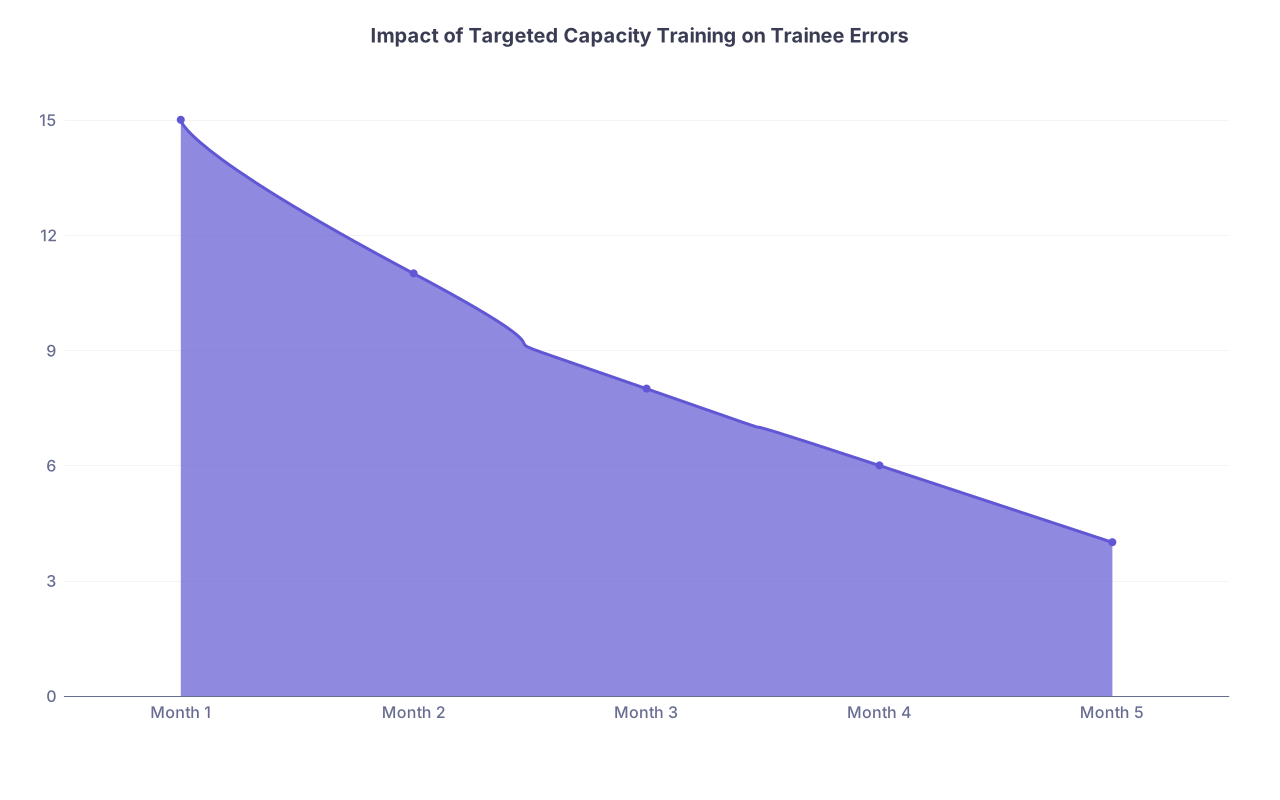
| Category | Value |
|---|---|
| Month 1 | 15 |
| Month 2 | 11 |
| Month 3 | 8 |
| Month 4 | 6 |
| Month 5 | 4 |
There are three habits that immediately elevate your practice.
Always Name the Decision
Start every capacity note and conversation with: “The decision at issue is…”
That single phrase forces specificity and prevents globalized nonsense like “patient has no capacity.”Use the Four‑Abilities Framework in Real Time
Stop relying on vibes.
As you talk, mentally tag what you are hearing:- “That showed understanding.”
- “That is a failure of appreciation driven by delusion.”
- “That is weak reasoning but maybe good enough for this low‑risk choice.”
Respect Strange Choices When Capacity is Intact
You are not the patient’s life coach.
If they can understand, appreciate, reason, and choose, and you have documented it, your job is to advise, not to override.
Key points to walk away with:
- Capacity is a clinical, decision‑specific, risk‑sensitive judgment assessed by you; competence is a legal status decided by courts. Stop mixing the words.
- Use the four abilities—understanding, appreciation, reasoning, and communication—and anchor them to the specific decision and risk profile; then document your reasoning, not just your conclusion.
- Strange or high‑stakes refusals do not automatically mean incapacity. Your role is to distinguish bad decisions from incapable decisions and to act accordingly, with clear, defensible notes.


