

The claim that “withholding and withdrawing life support are ethically identical” is too simplistic – and sometimes dangerously so.
Let me break this down specifically, because this is one of those topics where slogans have replaced thinking. You have probably heard the line in rounds or ethics lectures: “Ethically, withholding and withdrawing are the same.” That sentence is doing too much work, and hiding too many real-world landmines.
The deeper truth is more nuanced:
- At the level of core ethical principles, the professional consensus does treat them as equivalent.
- At the level of law, documentation, family perception, and your own psychology, the distinction still matters. A lot.
- And if you ignore those differences, you increase the risk of conflict, complaint, and moral injury – to yourself and to families.
1. The Textbook View: Why Bioethics Calls Them “Equivalent”
Let us start with the orthodoxy, because you need to know the standard answer before you can critique it intelligently.
Core ethical argument
The classic bioethics position (Beauchamp & Childress, major society guidelines, etc.) goes roughly like this:
- A patient (or valid surrogate) has the right to refuse any medical intervention, even if refusal leads to death.
- There is no moral difference between:
- Not starting a treatment the patient does not want (withholding), and
- Stopping a treatment the patient no longer wants (withdrawing).
The focus is on patient autonomy and the moral status of the treatment, not the timing. A ventilator is a ventilator, whether you never connect it or disconnect it after three days. Death is attributed, in this framework, to the underlying disease, not to the act of withdrawing.
So on rounds, this gets compressed to: “Withholding and withdrawing are ethically the same.”
You will see this formalized in major guidelines:
| Organization | Core Position Summary |
|---|---|
| AMA Code of Medical Ethics | No ethical distinction between withholding and withdrawing life-sustaining treatment |
| European Society of Intensive Care Medicine | Withholding and withdrawing are ethically equivalent when based on patient wishes and best interests |
| ATS (American Thoracic Society) | Supports both withholding and withdrawal as appropriate limits of treatment |
| UK GMC Guidance | Life-prolonging treatments may be withheld or withdrawn on same ethical and legal grounds |
| Canadian Critical Care Society | No hierarchy between withholding and withdrawing; both are permitted |
The stated reasons for this “equivalence” view:
- Consistency in honoring autonomy: Patients often only realize after trying a treatment that they do not want to continue. You must allow a “trial” without trapping them.
- Avoiding perverse incentives: If withdrawing feels morally worse, clinicians may be reluctant to start treatments, even when a trial would be reasonable.
- Avoiding magical thinking about timing: The moment you connect a ventilator does not transform it into something sacred that can never be stopped.
Philosophically elegant. Neat. Clean.
Now let us talk about the mess.
2. The Real ICU: Why It Does Not Feel the Same
Walk into any ICU or oncology ward. Ask people genuinely, not in front of an ethics committee:
- “Are you more comfortable not starting the ventilator, or turning it off after 5 days?”
- “Which order is harder to write: ‘Do not intubate’ or ‘Extubate and transition to comfort measures only’?”
You already know the answer. Withdrawing feels heavier. More personal. Closer to “killing.”
Psychological and emotional asymmetry
Here is the reality I have seen play out again and again:
Withholding:
- Framed as “letting nature take its course.”
- Often documented as “allow natural death” or “DNR/DNI.”
- Emotional narrative: We are not escalating because it will not help.
Withdrawing:
- Feels like an “action” rather than an “omission.”
- Staff talk differently: “We are pulling the plug,” “We are turning off the machine.”
- Emotional narrative: We are the ones causing the moment of death.
The end result? Moral distress. Nurses and junior doctors especially describe withdrawal as the moment they feel most complicit in causing death, even when they intellectually accept the ethics lecture.
Family dynamics mirror this:
- Many families will accept “We will not escalate further” long before they accept “We will now remove this support.”
- I have watched family meetings where everyone nods at “no CPR, no dialysis, no new pressors,” but the entire room changes when someone says, “And that means we will stop the ventilator on Tuesday at 10:00.”
So in the real-world psychological landscape, they are not experienced as the same.
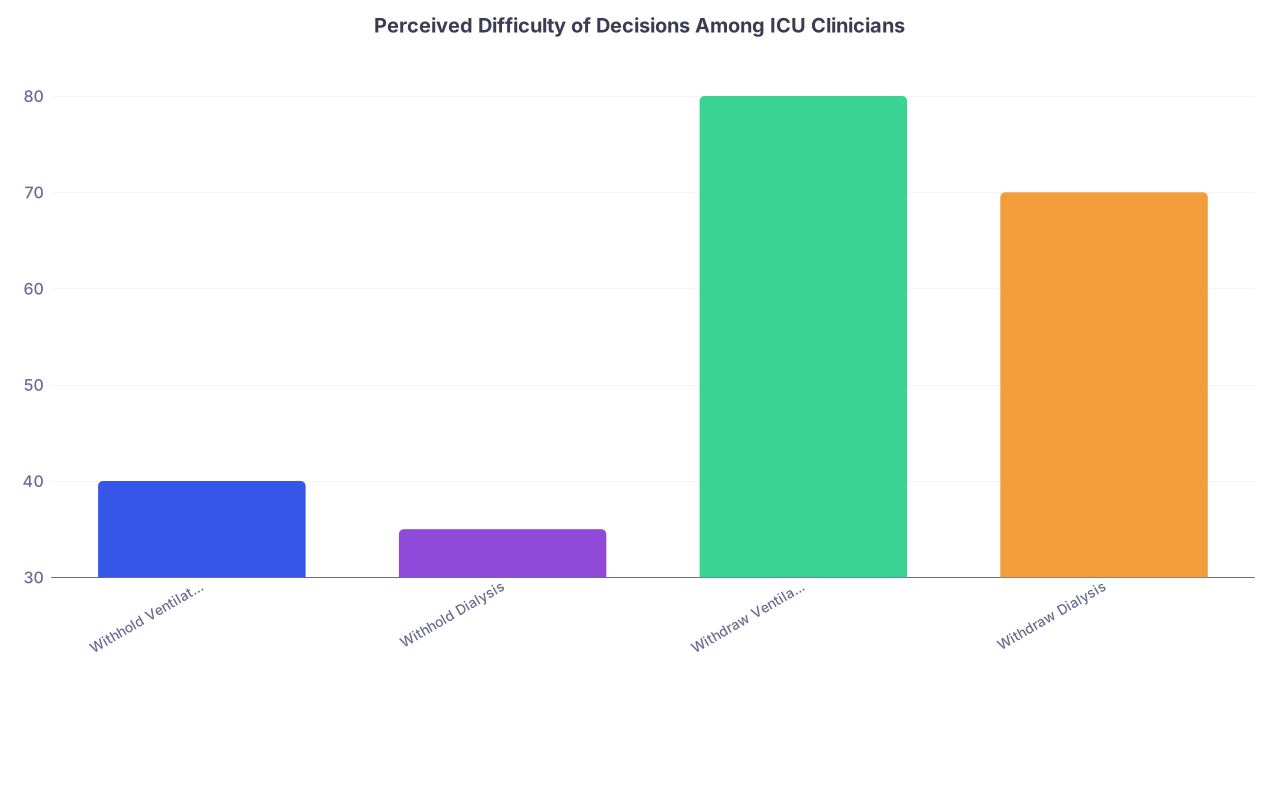
| Category | Value |
|---|---|
| Withhold Ventilation | 40 |
| Withhold Dialysis | 35 |
| Withdraw Ventilation | 80 |
| Withdraw Dialysis | 70 |
You can quote equivalence all day. It will not erase the emotional asymmetry.
Language as a marker of difference
Listen to how teams talk. You will hear phrases like:
- “We are comfortable with a DNR, but the family is not ready to talk about withdrawing yet.”
- “We will shift to a time-limited trial. If it is futile, we can withdraw.”
- “He would not want to be kept alive like this, but ‘turning off the machine’ is too much for them right now.”
Those are not accidental word choices. They mark a felt moral difference, even if the policy says otherwise.
The bottom line: Ethically “equivalent” does not mean psychologically, emotionally, or socially identical. Pretending otherwise is a fast route to mistrust and burnout.
3. Legal Reality: Subtle but Important Distinctions
Now to law. This is where people get sloppy. They say “The law treats them the same.” Often, that is roughly true in modern Western jurisdictions, but you cannot assume it blindly.
Common legal principles
Most contemporary legal frameworks in North America and Western Europe accept:
- A competent patient can refuse any treatment, even if refusal is life-ending.
- Surrogate decision-makers can decline or request discontinuation of life-sustaining treatments, based on:
- Substituted judgment (what the patient would have wanted), or
- Best interest standards when wishes are unknown.
But law is not written in the language of ethics seminars. Courts obsess over:
- Timing.
- Documentation.
- Who said what, when.
- Whether there was a clear change in prognosis or consent.
And those factors look very different in withholding versus withdrawing cases.
Where legal risk actually shows up
You rarely see lawsuits about withholding treatments when:
- The patient is DNR/DNI.
- There is clear documentation of informed refusal.
- Multiple consultants agree on futility.
But you certainly do see high-profile conflicts around withdrawing:
- Withdrawal of ventilators in children against parental objections.
- Removing feeding tubes in patients in persistent vegetative states.
- Stopping dialysis or ECMO when the team considers it futile but the family doesn’t.
Why? Because withdrawal offers a concrete moment to contest. A time and act that can be framed (often inaccurately) as “the decision that killed them.”
Courts then scrutinize:
- Was there a change in prognosis that justified withdrawal?
- Was consent clearly obtained or appropriately overridden?
- Were institutional policies followed to the letter?
The equivalence slogan does not protect you from poor documentation.

| Step | Description |
|---|---|
| Step 1 | Life support in place |
| Step 2 | Ongoing treatment |
| Step 3 | Lower legal risk |
| Step 4 | Higher scrutiny |
| Step 5 | Check consent and documentation |
| Step 6 | Defensible decision |
| Step 7 | Increased legal exposure |
| Step 8 | Continue or change plan |
| Step 9 | Policy followed |
The law might recognize that withholding and withdrawing rest on the same right to refuse treatment. But the forensic story about what happened will often hinge on the timing and act of withdrawal.
So yes: The distinction still matters to lawyers, judges, and risk management.
4. Causation, Intent, and the Euthanasia Red Line
Another reason this distinction is not trivial: It sits uncomfortably close to euthanasia and physician-assisted dying. And almost every jurisdiction wants a bright legal line between:
- Permissible withdrawal of life-sustaining treatment, and
- Impermissible active killing.
Who or what “causes” death?
Ethically, the standard narrative is:
- In withholding or withdrawing life support, the underlying disease causes death.
- In euthanasia, the clinician’s action (e.g., lethal injection) causes death.
But try explaining that to a family when you turn off the ventilator and the patient dies within minutes. The temporal link is brutal.
The distinctions that actually matter here:
Object of the act
- Withdrawing: Stopping a medical intervention that is no longer wanted or indicated.
- Euthanasia: Administering something whose purpose is to kill.
Intent
- Withdrawing: Intends to stop burdensome or unwanted intervention; foresees but does not intend death as such.
- Euthanasia: Intends death as the primary goal.
Means
- Withdrawing: Removal of an external support; no new lethal agent given.
- Euthanasia: Positive act introducing a lethal means.
All of this is why, for example, sedating and extubating is legally acceptable in many jurisdictions when managed under palliative sedation guidelines, but administering a barbiturate overdose with the explicit purpose “to end life now” crosses into prohibited territory.
The line is fragile. If you blur withholding/withdrawing in your own mind, you can also unintentionally blur the protective line separating withdrawal from euthanasia.
So again: the distinction matters.
5. Cultural, Religious, and Family Perceptions
This is where ignoring the distinction frankly becomes arrogant.
You might think ethically sophisticated people accept equivalence. Many religious traditions and cultural frameworks do not.
Common patterns I have seen
Some religious traditions:
- Accept non-initiation of extraordinary measures (like not starting ventilation).
- View active disconnection of an established life support as morally problematic, especially if the patient is still “alive” in a visible sense (heartbeat, warmth, some brainstem reflexes).
Many families:
- Say things like: “We are okay with no more interventions, but we cannot be the ones to pull the plug.”
- Use language of “killing” only in relation to withdrawal, never withholding.
The ethical equivalence soundbite does not persuade these families. It often alienates them. They experience you as steamrolling their moral intuitions with abstract theory.
You need the distinction for communication strategy:
- Framing a plan as “no further escalation, allow natural death” is often acceptable earlier.
- Proposing withdrawal requires more groundwork, time, and often involvement of spiritual care, ethics, and senior clinicians.
Ignoring these differences leads directly to protracted conflict and fractured trust.

6. Where the Distinction Changes Clinical Decisions
Let me be concrete. Here is where the difference between withholding and withdrawing actually alters what you do.
1. Time-limited trials of life support
You cannot offer a time-limited trial of ventilation, ECMO, or dialysis unless you firmly believe that withdrawal later is ethically permissible and psychologically bearable.
If you internalize that withdrawing is morally or emotionally taboo, you will face two bad options:
- Never start a trial, even when there is genuine uncertainty and a chance of recovery.
- Start, then feel trapped when it fails, leading to ongoing non-beneficial treatment.
Recognizing that withdrawal is allowed but heavier lets you:
- Structure the trial clearly: “We will ventilate for 5 days and reassess with these markers.”
- Prepare the family from day 1 that discontinuation is possible.
- Document criteria for continuation vs withdrawal.
But pretending “it is just the same” can trivialize how careful you need to be in planning and documenting those trials.
2. DNR orders vs withdrawing ongoing treatments
A common pattern on the wards:
- Step 1: DNR/DNI (withholding future CPR/intubation).
- Step 2: No new pressors, no escalation to ICU (withholding escalation).
- Step 3: Possibly, later, withdrawal of current supports (pressors, BiPAP, inotropes, dialysis).
Each step is ethically linked, but clinically and emotionally distinct.
You plan differently for:
- An elderly patient with sepsis where the team agrees on “no ICU, no intubation” from the start.
vs - A 40-year-old on ventilator and high-dose catecholamines where you need to confront whether to turn off those infusions after two weeks of no improvement.
Your documentation, family meetings, and interdisciplinary communication must acknowledge the rising stakes as you move from withholding to withdrawal. A single monolithic “they’re the same” mindset is not operationally useful.
3. Escalation and de-escalation culture
ICU culture often has this unspoken rule: Escalation is easy, de-escalation is hard.
- Starting pressors at 2 a.m.? Routine.
- Stopping them when MAP is decent but the big picture is grim? Suddenly there are ethics consults, extra family meetings, moral distress.
You cannot fix that by chanting equivalence. You fix it by:
- Explicit teaching on how to conduct withdrawal ethically and compassionately.
- Standardized protocols for withdrawal, including symptom management and communication steps.
- Normalizing discussions about stopping treatments in daily rounds, not just starting them.
That requires recognizing withdrawal as its own distinct challenge.
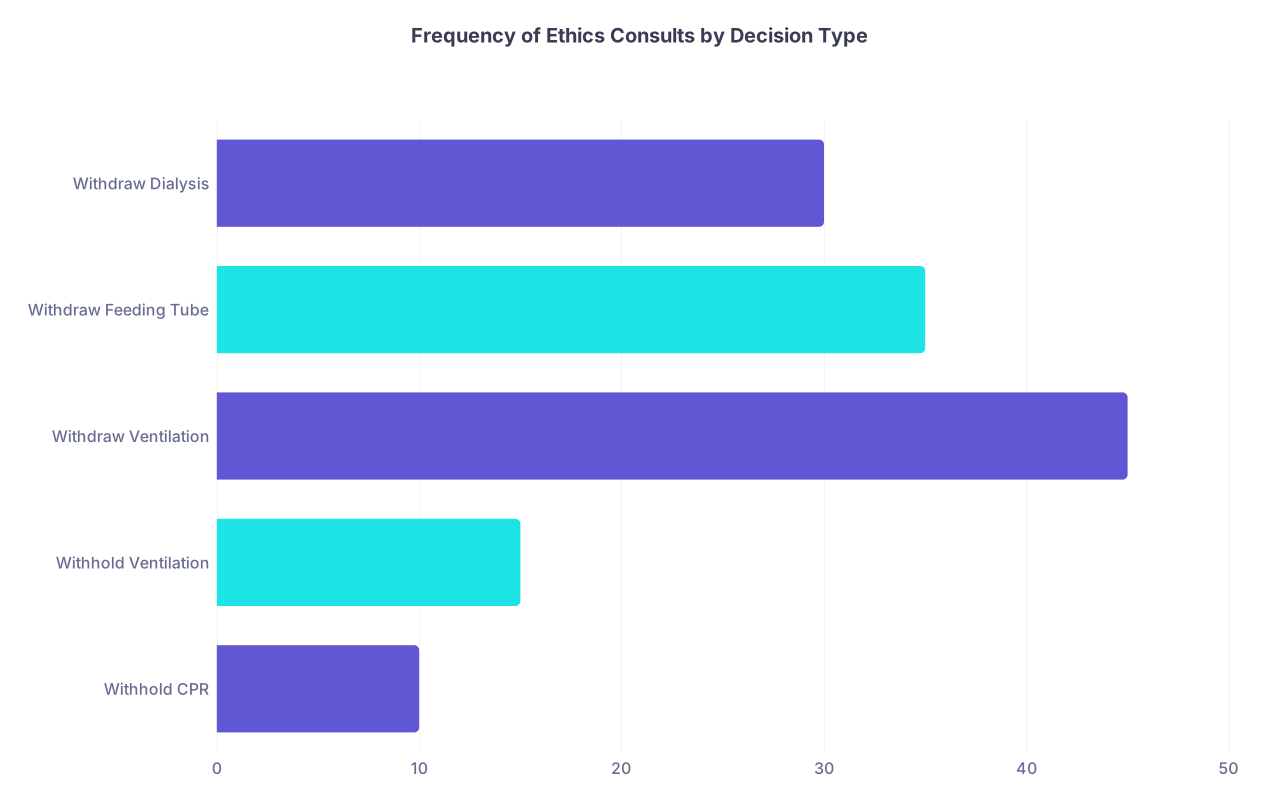
| Category | Value |
|---|---|
| Withhold CPR | 10 |
| Withhold Ventilation | 15 |
| Withdraw Ventilation | 45 |
| Withdraw Feeding Tube | 35 |
| Withdraw Dialysis | 30 |
Notice where the spikes are. Where withdrawal is involved.
7. How to Talk About This Honestly with Patients, Families, and Yourself
Let me give you a practical script, because this is where people get tongue-tied.
When explaining equivalence without sounding dismissive
You might say:
- “There are two ways we sometimes limit treatment. One is not starting new machines or interventions that will not help. The other is, after a trial, stopping a machine that is only prolonging dying.”
- “From a medical ethics and legal perspective, both are accepted ways to respect what your mother would have wanted and to avoid burdens that no longer help her.”
Then acknowledge the difference they feel:
- “I know that stopping something already in place feels very different than not starting it. Many families feel that way. We will go slowly, explain every step, and make sure you are supported in this.”
When talking to trainees
Drop the slogan and give them the real picture:
- “Conceptually, yes, we treat withholding and withdrawing as morally on the same footing. In practice, you will find withdrawing is harder – on you, on nurses, and on families.”
- “So we plan more carefully, involve senior staff, and document more thoroughly when we withdraw ongoing life support.”
- “Do not offer a time-limited trial of ECMO unless you are personally prepared to help lead the conversation when it is time to stop.”
When talking to yourself
You are allowed to find withdrawal hard. That does not make you ethically weak. It makes you human.
But you cannot hide behind emotional discomfort to indefinitely prolong non-beneficial treatment. That simply shifts the burden from you onto the patient and their family.
So your internal monologue needs to be something like:
- “Withdrawing this ventilator support is ethically justifiable because it no longer benefits the patient and is against their known wishes.”
- “My discomfort is about being the proximate cause of the moment of death, not about the wrongness of the act.”
- “I need support from colleagues and a clear plan for symptom control and communication.”

8. Where I Land: The Distinction You Cannot Ignore
So here is the position I am willing to state plainly:
- At the level of fundamental ethical permissibility, withholding and withdrawing life support should be treated as equivalent. There is no coherent ethical framework that allows one and bans the other without generating serious contradictions and harm.
- At every other level that matters in real practice – psychology, law, communication, family perception, moral injury, and institutional risk – the distinction absolutely still matters.
If you are serious about being an ethically competent clinician, you need to hold both ideas at once:
- Do not create a moral taboo around withdrawal that traps patients on futile life support.
- Do not pretend that withdrawal is “nothing special” and can be managed like any other order.
Respect the equivalence of underlying principles. Respect the non-equivalence of lived experience.
FAQ (exactly 6 questions)
1. Is withdrawing life support ever considered euthanasia or assisted suicide?
Properly performed, no. Withdrawing life support is stopping a medical intervention that is no longer wanted or beneficial, allowing the underlying disease to cause death. Euthanasia or assisted suicide involve actively giving a lethal agent with the intent to cause death. If your documentation, intent, and medications are clearly oriented to symptom relief and respecting refusal of treatment, you are not practicing euthanasia.
2. Do I need different consent for withdrawing versus withholding treatment?
Legally, both rest on the same principles of informed consent and refusal. Practically, withdrawal gets more scrutiny, so your consent process should be more explicit: document the prognosis, the discussion of alternatives, confirmation that the patient or surrogate understands that stopping support will likely lead to death, and any disagreement within the team or family. Withholding often occurs earlier and feels more intuitive; withdrawal demands more deliberate, recorded conversations.
3. How should I document a decision to withdraw life support to minimize legal risk?
You should record: the patient’s diagnosis and prognosis; prior stated wishes (advance directives, previous conversations); surrogate identity and capacity; details of discussions (dates, participants, what was explained, and the decision reached); the specific treatments to be withdrawn; the plan for comfort measures and symptom control; and any consultations (ethics, palliative care, second opinions). Ambiguous, one-line entries like “family wants to pull plug” are professionally and legally indefensible.
4. What if the family wants to continue life support but the team believes it is futile?
This is where the withholding/withdrawing distinction becomes central in conflict. You need a structured process: clear medical explanation of prognosis; discussion over multiple meetings; involvement of senior clinicians, palliative care, and often spiritual care; and early ethics consultation. Many institutions have futility or non-beneficial treatment policies that, after due process, allow stopping life support even over objection, but those decisions are high stakes and must be tightly aligned with institutional policy and local law.
5. Are there cultural or religious groups that accept withholding but not withdrawing?
Yes. Some faith traditions and cultural communities explicitly allow non-initiation of extraordinary measures but regard active withdrawal of ongoing support as morally problematic, particularly when the patient retains heartbeat and some biological function. You cannot bulldoze these concerns with “ethics says they’re the same.” Instead, you need nuanced dialogue, often involving chaplains or community leaders, and sometimes graduated approaches (e.g., no new interventions, then weaning rather than abrupt discontinuation).
6. How can trainees build comfort with withdrawing life support without becoming desensitized?
Start by observing well-run withdrawal processes led by experienced clinicians, with attention to both technical and communication aspects. Seek debriefing after emotionally difficult cases. Read institutional guidelines and relevant legal/ethical standards. Reflect explicitly on intent and causation to avoid internal confusion with euthanasia. Most importantly, balance exposure with reflection: neither avoid participation (which breeds fear and ignorance) nor rush through it mechanically (which breeds cynicism). Structured teaching plus honest emotional processing is the only sustainable path.


