
What actually happens if you think your attending is wrong about a patient’s plan… and then something bad happens? Are you legally on the hook because you didn’t fight harder? Or worse—because you spoke up?
Let me say the scary part first: yes, you can be named in a lawsuit as a trainee. Residents, interns, even students can end up on those complaint lists. I’ve seen it. It’s awful.
But here’s the part nobody tells you when you’re spiraling at 1 a.m. post-call: disagreeing respectfully with your attending, documenting appropriately, and then following the final team plan is not what usually gets people in legal trouble.
The real danger? Staying silent when you clearly know something is unsafe, and then having zero proof you ever thought otherwise.
Let’s unpack this like an actual human who lies awake thinking: “What if I get sued before I even finish residency?”
How the Law Actually Sees You as a Trainee
You probably imagine some judge saying: “You were just following orders? Too bad. Guilty.”
That’s not how this works.
Legally, a few principles matter a lot:
Standard of care is role-specific.
You’re not held to the same independent decision-making standard as a board-certified attending. A PGY-1 isn’t expected to override a 30-year cardiologist on complex management. But you are expected to:- recognize obvious red flags,
- escalate appropriately, and
- not do blatantly dangerous stuff just because someone told you to.
Supervising physicians carry primary responsibility.
In most systems, attendings are legally responsible for supervising you. Hospitals and attendings know that. That’s why every policy manual is full of “supervision” rules.You can still be named in a lawsuit.
Being named doesn’t equal being found liable. Lawyers cast a wide net. I’ve seen med students named who never even wrote an order. They were eventually dropped from the case, but they still went through months of anxiety.
So no, you’re usually not legally punished just for disagreeing with your attending’s plan. If anything, your attempts to advocate for the patient, documented appropriately, actually help defend you.
The law cares less about “Were you perfectly right?” and more about “Did you act reasonably for your role and training?”
The Nightmare Scenario in Your Head vs What Actually Happens
Let’s look at the worst-case storyline you’re probably running:
You: “Uh, I’m not sure this discharge is safe. The patient looks worse than this morning.”
Attending: “They’re fine. We’re short beds. Discharge them.”
You (thinking): If I push back more, they’ll hate me. If I don’t, and something happens, I’ll get sued. Great, can’t wait.
Patient goes home, comes back coded, family sues everyone with a pulse.
What happens legally?
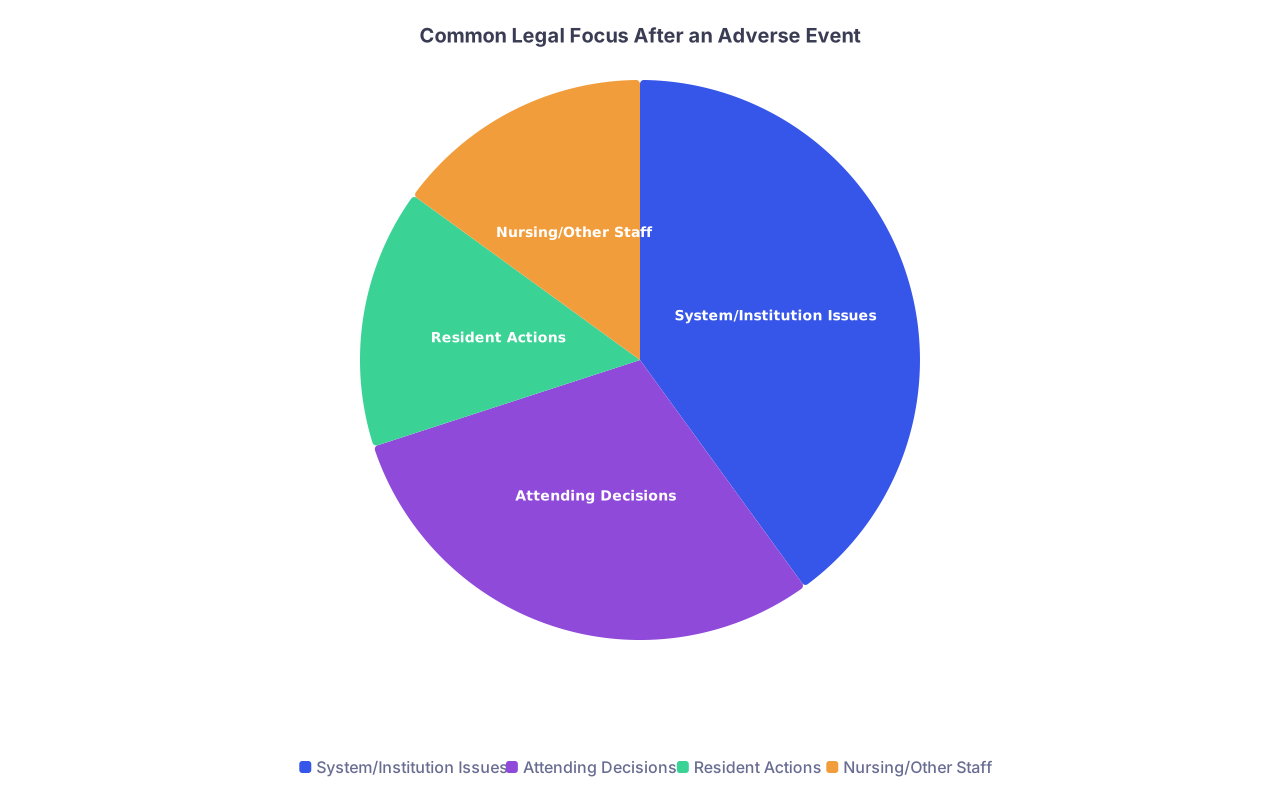
| Category | Value |
|---|---|
| System/Institution Issues | 40 |
| Attending Decisions | 30 |
| Resident Actions | 15 |
| Nursing/Other Staff | 15 |
In that kind of investigation, people ask:
- Did the attending exercise reasonable judgment?
- Did the system (hospital) have safe discharge processes?
- Did the resident recognize a problem and escalate?
- Is there any documentation of concern, vitals, notes, or calls?
If there’s even a brief note like: “Discussed ongoing SOB and borderline O2 sat with attending Dr. X at 15:30; plan to proceed with discharge with close outpatient follow-up and return precautions,” that’s evidence you:
- noticed the issue
- brought it to the attending
- recorded that the final decision came from them
That’s not bulletproof armor, but it’s a hell of a lot better than silence.
Silence on the record looks like agreement.
Can You Be Punished Legally for Disagreeing?
This is the anxiety core, right? “If I say I disagree, can I get in legal trouble for not going along?”
Short answer: No, disagreeing itself is not the legal problem. The issue is what you actually do and whether it’s reasonable.
You’re not punished legally for saying:
- “I’m uncomfortable with this dose.”
- “I think we need imaging before discharge.”
- “I’m not trained to perform that procedure alone.”
You could be at risk if:
- You carry out an order you know is patently unsafe and way outside norms.
- You act independently in a way that far exceeds your training and goes badly.
- You ignore clear patient deterioration and don’t escalate because you “didn’t want to bother” your attending.
Law cares about actions and omissions, not egos and hierarchy drama.
The professional repercussions (bad evals, being labeled “difficult”) are what most of us actually fear. But the legal system? It’s not punishing you for asking, “Are we sure?”
When You Think the Attending Is Wrong: A Practical Ladder
Here’s the part you actually need: what to do in the moment so you’re protecting your patient and not destroying your own future.

| Step | Description |
|---|---|
| Step 1 | Notice Concern |
| Step 2 | Clarify Facts |
| Step 3 | Ask Attending a Focused Question |
| Step 4 | Accept and Learn |
| Step 5 | Restate Concern Clearly |
| Step 6 | Escalate or Use Chain of Command |
| Step 7 | Document Objectively |
| Step 8 | Still Unsafe? |
| Step 9 | Still Unsafe? |
Step 1: Get very clear on why you disagree
Vague worry like “This feels bad” is hard to advocate for. Concrete is better:
- “Their lactate doubled.”
- “They’re on 4L O2 now; this morning they were on room air.”
- “They can’t repeat back discharge instructions; I’m worried about capacity/safety.”
Write it down for yourself if you have to. It helps you talk without rambling.
Step 2: Ask a focused, non-accusatory question
You are not there to cross-examine your attending like a hostile witness. Try things like:
- “Can you walk me through your thinking on discharging them today? I’m worried about X and Y.”
- “I’m a little concerned about their trend in vitals. Is there something you’re seeing that reassures you?”
- “I don’t fully understand why we’re not anticoagulating here—could you explain the rationale?”
Most attendings will respond to curiosity way better than, “I think you’re wrong.”

Step 3: If you still think it’s unsafe, state your concern clearly
No hedging. This is the part that feels terrifying.
Example:
- “I hear what you’re saying, but I’m still honestly worried this discharge might not be safe because of X, Y, Z.”
- “I just want to say clearly that I’m uncomfortable with this plan, given their current status.”
You’re not overturning the decision. You’re putting your concern on record with a human being who has power.
Step 4: Decide whether this is a “live with it” vs “must escalate” situation
Not every disagreement justifies going over someone’s head. You’ll burn trust and look unhinged if you escalate every time you disagree about a beta blocker dose.
Times to seriously consider escalating beyond the attending:
- You believe the plan poses a significant, immediate risk of serious harm.
- The attending is dismissing objective red flags (crashing vitals, acute neuro changes, etc.).
- You’ve clearly stated your concern, and they’re still deciding something you view as dangerous.
Escalation might look like:
- Calling a different on-call attending (ICU, surgery, etc.) for another opinion.
- Using the hospital’s “chain of command” policy (yes, this is a real thing).
- In extreme cases, using ethics consults or risk management.
Is this socially risky? Absolutely. But if you’re at “I’d lose sleep if I let this slide,” you have to at least consider it.
Step 5: Document like someone’s going to read it in a courtroom… without throwing anyone under the bus
What you don’t do:
“Attending refused to listen, dangerous discharge ordered.”
What you do write is neutral, factual, and specific:
- “Patient reporting increased SOB compared with morning. O2 sat 90–92% on 4L NC (baseline RA). Lung exam with new crackles at bases. Expressed concern to Dr Smith; plan per Dr Smith: proceed with discharge with close PCP follow-up and strict return precautions reviewed with patient.”
That says:
- Here’s what I saw.
- Here’s who I told.
- Here’s who made the decision.
No drama. No adjectives. Just facts.
Where Trainees Really Get Legally Exposed
The patterns I’ve seen over and over in stories and risk management debriefs:
Failure to escalate obvious deterioration
Example: resident doesn’t call the attending overnight because “they’ll yell at me,” patient crashes, and there’s zero documentation of any concern.Doing something clearly outside scope because the attending “trusted you”
Example: intern independently performs a procedure they’re absolutely not credentialed for, bad complication, no attending anywhere near it.Changing the attending’s plan quietly without telling them
Example: attending says, “No CT for now.” Resident orders CT anyway, contrast reaction, then chart shows mixed instructions and confusion.Terrible or nonexistent documentation
If it’s not written, it basically didn’t happen. That includes you recognizing an issue and calling someone.
| Risky Behavior | Safer Alternative |
|---|---|
| Not calling attending overnight due to fear | Call anyway, document discussion briefly |
| Quietly changing plan without telling attending | Propose change, get buy-in, then document |
| Performing advanced procedure alone | Ask for supervision or decline if unsafe |
| Vague notes like 'patient stable' | Concrete vitals, exam, and rationale |
Emotional Fallout: Fear of Retaliation vs Fear of Lawsuits
Let’s be honest: you’re not just thinking about judges and malpractice premiums. You’re thinking:
- “What if this attending tanks my eval?”
- “What if they blacklist me from a letter of recommendation?”
- “What if I’m known as ‘that resident’ who escalated over an attending?”
This is the awful bind: protecting a patient versus protecting your career.
Here’s the uncomfortable truth:
Long term, your reputation is actually better if you’re the person who calmly advocates, documents clearly, and doesn’t lose your mind emotionally, even when you disagree.
The people who get quietly labeled as unsafe are the ones who:
- miss obvious deterioration,
- are too scared to call for help, or
- are sloppy with documentation.
You want to be the one attendings say, “They’re cautious, they speak up when needed, and they’re serious about patient safety.” Even if you annoy a few fragile egos along the way.

How to Protect Yourself Without Becoming Paranoid
You don’t need to live like every admission is a future lawsuit. But you also don’t want to be naïve.
A few habits that help:
Always know your chain of command.
Who’s on call above your attending? What’s the hospital’s policy if you believe there’s an unsafe situation?Use objective language in notes.
“Concerned about…” paired with vitals, labs, symptoms—not feelings.Document significant discussions.
Short, factual: “Discussed with Dr ___; plan as above.” Not for every tiny thing, but for serious disagreements or big decisions, yes.Ask for help early.
It feels weak. It’s actually what good doctors do. Waiting until the patient is coding is bad medicine and bad legally.Debrief bad cases with someone safe.
Senior residents, chief, or a trusted faculty member can help you sort, “Was I actually at risk?” from “I’m catastrophizing everything.”
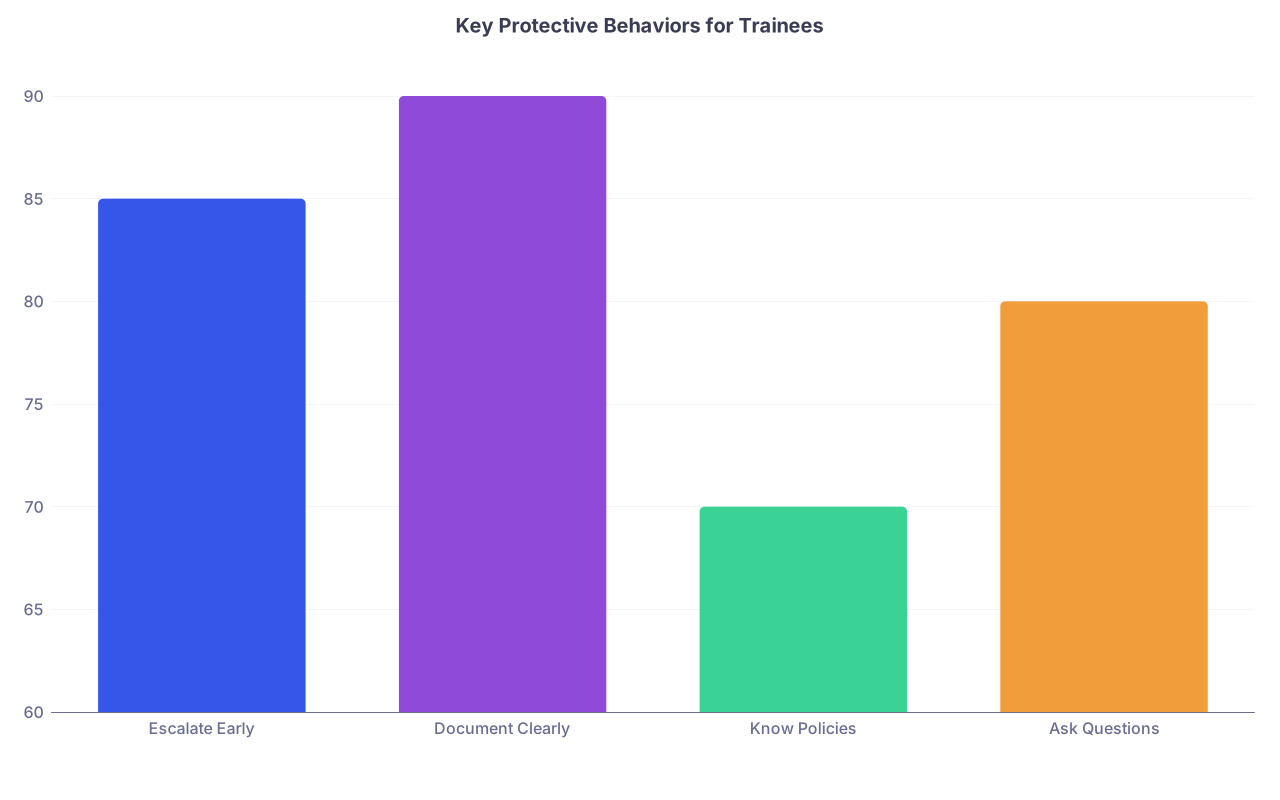
| Category | Value |
|---|---|
| Escalate Early | 85 |
| Document Clearly | 90 |
| Know Policies | 70 |
| Ask Questions | 80 |
The One Thing That Matters Most Legally
If you remember nothing else from this rant, remember this:
Courts and risk management people look at whether you acted like a reasonable trainee in your position, with your level of training, under those circumstances.
Reasonable doesn’t mean perfect. It doesn’t mean always agreeing, and it doesn’t mean always winning the argument.
Reasonable, in practice, looks like:
- noticing red flags,
- trying to get the right people involved,
- not doing something you know is clearly unsafe, and
- leaving a trace of what you saw and what you did about it.
You’re not powerless, even though it feels that way at 3 a.m. on night float.
FAQ (4 Questions)
1. If my attending’s plan seems wrong but not dangerous, do I still need to document disagreement?
Usually no. If it’s more about style (“I would diurese more” or “I would order this extra test”) than safety, this is more of a learning moment than a legal one. Ask questions, understand their reasoning, maybe jot a quick personal note for yourself, but you don’t need a big “disagreement” statement in the chart every time your gut says you’d do it differently.
2. Can I get sued even if I followed my attending’s orders exactly?
You can be named in a lawsuit even if you barely did anything. It’s unpleasant but common. Whether you’re found liable is a different question. If you followed a reasonable plan from your supervisor, escalated concerns appropriately, and didn’t do anything obviously outside your training, the legal risk to you personally is much lower, even if your name appears on the initial complaint.
3. What if I call my attending and they’re dismissive or angry—should I still keep calling?
Yes, if the patient is actually unstable or deteriorating. Professional discomfort doesn’t outweigh patient safety. Document objectively that you called, what you reported, and what was decided. If you truly believe the situation is unsafe and your attending won’t act, that’s when chain-of-command policies exist. It’s scary, but this is where you decide if you’re more afraid of an awkward interaction or a dead patient.
4. Could writing that I “expressed concern” in the chart get me in trouble later?
As long as you’re factual and neutral, it usually helps more than it hurts. Courts and lawyers care that you recognized a potential problem and took reasonable steps. Don’t editorialize (“unsafe,” “reckless”). Do state facts: what you saw, who you spoke to, what was decided. That creates a record that you didn’t just passively drift along.
Open one of your last notes right now and read a big decision point—an admission, a discharge, a major change in management. Ask yourself: “If this went badly, would someone reading this know what I saw, who I talked to, and why we did what we did?” If the answer is no, tighten the next one you write.