
It’s 4:30 p.m. You’re post-call tired, your preceptor’s running behind, and you suddenly realize: you gave a patient the wrong prep instructions this morning. Or you said something inaccurate about their lab results. Or you forgot to follow up on something you promised.
Now your stomach drops.
You’re replaying the whole thing in your head, and the real question isn’t just “what do I do?” It’s:
If I admit this to the patient, will my evaluation tank?
Will my attending think I’m unsafe?
Will this end up in my dean’s letter and haunt me forever?
I’m going to be blunt: this is the stuff everyone worries about, but most people won’t say out loud on rounds. So let’s actually say it.
The Fear: “If I Admit a Mistake, I’ll Get Labeled Unsafe”
Here’s the nightmare script that runs in your brain:
You: “Mr. Smith, I need to tell you I made a mistake earlier today.”
Attending (inside voice): “Wow. This student is dangerous.”
Evaluation: “Unprofessional. Poor judgment. Do not recommend.”
You’re scared that if you admit an error, it won’t be seen as honesty; it’ll be seen as incompetence.
But here’s what actually matters in real life (and on evaluations):
- Was anyone actually harmed or put at significant risk?
- How fast did you recognize and address it?
- How did you handle disclosure and follow-up?
- Did you learn anything, or will you repeat it?
Most attendings are far more worried about the student who hides things or minimizes them than the student who says, “I messed up — this is what happened, and this is what I’ve already done to fix it.”
I’ve literally seen two students in the same month do almost the same thing:
Student A caught a medication documentation error, quietly fixed it in the chart, never told anyone. Nurse later found conflicting info. Attending: “Why didn’t you say something?” Evaluation: “Needs to improve reliability and communication.”
Student B ordered a lab under the wrong attending, realized it, told the resident immediately, disclosed to the patient with the team, corrected the order, documented clearly. Evaluation: “Demonstrates professionalism and accountability; identifies and corrects errors appropriately.”
Same basic screw-up. Completely different interpretation because of how it was handled.
What the Ethics and Law Actually Say (Not the Urban Legend Version)
You’re not just dealing with attendings. In your head you’re also hearing: malpractice, lawsuits, “never admit fault,” “don’t say sorry,” all that.
Reality check:
Ethically, in modern medicine, you are expected to disclose significant errors to patients. That’s not controversial. That’s standard. Hiding a serious mistake is way more likely to be seen as a professional red flag than admitting it.
Legally, the culture has shifted a lot. Many systems now have formal “disclosure and apology” policies. Some states even have “apology laws” that make expressions of sympathy or apology inadmissible as evidence of liability in court.
Let me be precise so this doesn’t just sound like vibes:
| Aspect | Hiding the Error | Disclosing the Error |
|---|---|---|
| Patient safety | Potentially compromised | Prioritized and actively addressed |
| Ethical expectation | Violated | Met or exceeded |
| Legal risk to system | Often increased | Often reduced with proper process |
| How attendings usually react | Distrust, concern | Respect, teachable moment |
| Evaluation impact | Can be seriously negative | Usually neutral or even positive |
The legal risk piece: you, the med student, are not the main liability target. You’re supervised. You shouldn’t be doing disclosures alone anyway. The hospital, attending, and risk management are the ones living in that legal headspace.
Where you can get hurt is not in a courtroom. It’s in your professionalism narrative. A pattern of not telling the truth, or hiding errors? That’s a dean’s letter problem.
So no, admitting a mistake — done properly, with supervision — does not automatically destroy your evaluation. Quietly burying it and hoping nobody notices? Much more dangerous.
How Attendings Actually Think When You Admit a Mistake
Let me decode what’s probably going through an attending’s head when a student comes up and says, “I think I made a mistake with this patient.”
They’re rapidly categorizing:
- Is this patient in immediate danger?
- Do I need to fix something right now?
- Is this a system/communication issue or a reckless behavior issue?
- Is this an honest, early disclosure or a late “oh by the way” confession?
- Does this student take ownership, or are they deflecting?
They’re not (usually) thinking, “Wow, what an idiot.” They’re thinking, “Okay, is the student safe, honest, and teachable?”
The student who says early, “I’m worried I might have screwed something up” signals three things teachers love:
- Insight into limitations
- Respect for patient safety
- Willingness to be supervised
Those three show up in comments like “mature,” “professional,” “trustworthy,” “strong team member.” That’s the stuff that’s gold on an evaluation, not perfect knowledge.
The red flag for attendings isn’t error. It’s lack of insight + lack of disclosure.
How to Admit a Mistake Without Setting Yourself on Fire
Now the practical part. Because yes, you can also handle this in a way that creates more drama than needed.
Step 1: Tell your resident/attending FIRST
Do not go straight to the patient on your own. You’re still in training and you’re not the legal decision-maker.
You say something like:
- “Dr. Nguyen, I’m worried I gave Mr. Johnson incomplete/incorrect instructions earlier.”
- “I just realized I didn’t follow up on Mrs. Lee’s potassium like I said I would.”
- “I documented X, but I think that might be inaccurate and I wanted to let you know.”
Let them get mildly annoyed at the situation if they want. That’s fine. What they really clock is: you came to them instead of hiding it.
Step 2: Be specific, not dramatic
You don’t need a confessional speech. You need a short, clear summary.
Bad: “I totally messed everything up with this patient, I’m so sorry, I don’t know what I was thinking.”
Better: “At 10 a.m., I told him he didn’t need to be NPO after midnight for the procedure tomorrow. I later checked and realized he does need to be NPO. I haven’t corrected it yet.”
Attendings hate vagueness. It triggers their “What else am I not hearing?” alarm.
Step 3: Let your supervisor decide how disclosure happens
Sometimes they’ll say, “Let’s go talk to the patient together.”
Sometimes: “I’ll handle this one.”
Sometimes: “Call the nurse right now and fix the order, then we’ll talk to the patient later.”
You absolutely can be part of the conversation with the patient — in fact that can earn you points. But it should be invited, not you freelancing a solo malpractice monologue.
You can say to your attending:
“I’d like to be part of the conversation with the patient if you think that’s appropriate, since I was the one who gave the information.”
That line communicates integrity without looking like you’re trying to heroically fall on your sword.
What Actually Hurts Your Evaluation Around Mistakes
Your brain is probably fixated on the wrong risk. It’s not “I made one mistake and admitted it.” It’s the pattern.
The stuff that actually shows up as negative comments:
- Repeatedly making the same error without adjusting
- Blaming others when it’s clearly your error
- Getting defensive or argumentative when feedback is given
- Minimizing things that could have actually harmed a patient
- Going directly to the patient with dramatic confessions without looping in the team
- Being vague or inconsistent about what happened
A single, well-handled error usually turns into a quiet, forgettable teaching moment. Or even a positive line in your eval: “Recognizes and corrects mistakes.”
But a student who hides something, gets caught, and then backfills the story? That’s when people start quietly saying things like “I just don’t fully trust them,” which is code for “this is going in the professionalism memory bank.”
When It Can Become a Big Deal (and What to Do Then)
There are rare times where the mistake is serious. Wrong patient, wrong medication, significant delay in care, something that absolutely could have harmed someone.
Your fear in those moments goes nuclear: “This is it. I’m done. They’re going to write me up, I’ll get reported, my career is over.”
Here’s the ugly truth and the reassuring truth together:
Ugly: If the error is severe and clearly linked to reckless behavior or ignoring instructions, yeah, this can lead to formal remediation or documentation. That’s real.
Reassuring: Those cases are usually not single, isolated events. They’re patterns. And even serious events are survivable if you’re honest, cooperative, and actually learn from them.
If you ever find yourself in a really serious situation:
- Immediately tell your senior/resident/attending.
- Don’t alter documentation to make yourself look better. That’s how minor errors turn into career-enders.
- Answer truthfully, but you don’t need to speculate or assign blame. Just facts.
- If your school has a student affairs or ombudsperson, talk to them. Early.
- Do not isolate yourself and catastrophize alone. You’ll spiral and make worse decisions.
Serious mistakes need systems-level handling. You are not supposed to manage that alone as a trainee.
The Quiet Reality: Most “Mistakes” You’re Panicking About Are Fixable
Let’s be honest: a big chunk of what keeps you up at night are relatively small things that feel huge because you care a lot and you’re terrified of being judged.
Forgot to mention a lab to the team.
Misstated a minor part of the plan to a patient, then corrected it later.
Wrote the note in the wrong section and had to amend.
Told someone you’d come back and then got pulled to something else and forgot.
Annoying? Yes. Unprofessional if chronic? Yes.
Career-ending? No. Also usually not evaluation-ending.
The ethical move in those situations is simple:
- Acknowledge.
- Apologize briefly if it affected the patient.
- Correct the information.
- Put a small safeguard in place for next time (write things down, set a reminder, ask for confirmation).
The attending watching you do that sees someone who can function in real medicine, not fantasy perfection medicine.
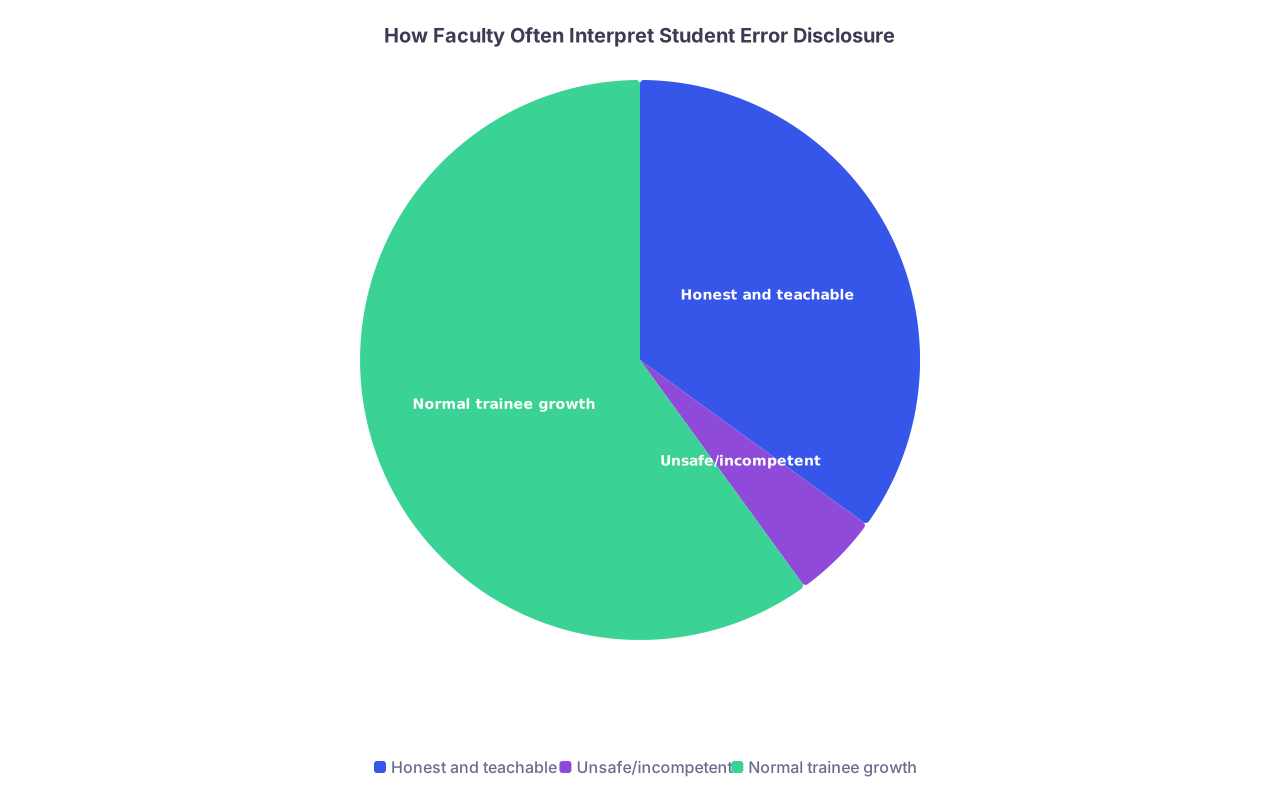
| Category | Value |
|---|---|
| Honest and teachable | 35 |
| Unsafe/incompetent | 5 |
| Normal trainee growth | 60 |
How to Talk to the Patient Without Making It Worse
Let’s say your attending agrees you’ll be part of the disclosure. The fear then shifts to: “What if I say the wrong thing and the patient hates me and complains?”
A simple, non-theatrical structure usually works:
- Briefly state what happened
- Own your role without dramatics
- Correct the information/plan
- Express empathy and, if appropriate, a straightforward apology
- Reassure about next steps
Example for a minor instruction error:
“Mr. Davis, earlier today I told you that you didn’t need to stop eating after midnight before your test tomorrow. I checked again with the team afterward and realized that was incorrect. You do need to stop eating and drinking after midnight so we can do this safely. I’m sorry for the confusion — I know that’s frustrating. I wanted to correct it as soon as I realized.”
That kind of thing does not usually trigger “this student is terrible” complaints. Patients are used to humans being human. What they hate is being misled, brushed off, or having things covered up.

| Step | Description |
|---|---|
| Step 1 | Notice possible mistake |
| Step 2 | Check facts quickly |
| Step 3 | Tell resident or attending |
| Step 4 | Immediate team action |
| Step 5 | Plan correction and disclosure |
| Step 6 | Team speaks with patient |
| Step 7 | Document clearly and learn |
| Step 8 | Patient at risk? |
FAQ: The Anxious Version
1. Will admitting a mistake automatically show up in my dean’s letter/MSPE?
No. Routine, everyday trainee mistakes that are promptly disclosed and handled almost never go anywhere near your MSPE. What lands there are patterns: repeated professionalism issues, formal remediation, probation. A single “I mixed up instructions and we fixed it” moment is not MSPE material.
2. Should I ever not tell the patient about a mistake?
You should not decide that alone as a student. That’s a team-level, often institutional-level call. Your job is: if you think something might be an error that affects care, tell your resident/attending. Disclosure decisions are then made with them, sometimes with risk management. Don’t play solo ethicist in the room.
3. What if my attending actually does punish me on the eval for being honest?
It happens occasionally. There are attendings who confuse “no errors reported” with “good student,” and that’s bad teaching. If you sense your honesty is being misread, talk to your clerkship director or student affairs. Also remember: most faculty like honesty. One unfair eval does not define your career.
4. Will a patient complaint about my mistake destroy my chances at residency?
A single, isolated complaint, especially if your school knows you were honest and cooperative, is unlikely to destroy anything. Programs care about patterns and major red flags. If something serious happens, work closely with student affairs so they can contextualize it if it ever comes up.
5. Can I get sued personally as a med student for admitting a mistake?
Med students are almost never individually targeted in lawsuits because you’re supervised and not the one in charge. Also, you shouldn’t be doing formal disclosures alone anyway. The legal risk you should actually care about is not malpractice; it’s falsifying documentation or hiding things. That’s what really ruins careers.
6. What if I’m not even sure it’s a “mistake,” but I feel weird about it?
Then treat that feeling as a warning light and talk to your senior or attending. You don’t need to label it. You can say, “Something about what I said/did with this patient doesn’t feel right to me; can I run it by you?” That kind of self-awareness is exactly what good evaluations praise.
Bottom line, before your brain spins again tonight:
- Admitting a mistake — early, clearly, and with your team — almost never destroys your evaluation. Hiding one can.
- Ethics and modern medical culture expect disclosure, not perfection. Integrity matters more than never screwing up.
- The students who own their errors and learn from them are the ones attendings actually trust — and trust is what writes strong evaluations.