
The biggest moral crises in training almost never happen on an ethics exam. They happen at 2 a.m. when your senior does something that feels wrong and you’re too scared to say anything.
You’re not crazy for being scared. You’re right to be scared. Because this situation is actually hard.
Let me lay it out bluntly: you’re stuck in the crosshairs between patient safety, your career, and a hierarchy that’s been around for decades and really doesn’t like being questioned. And you’re probably thinking, “If I report this and it goes badly, I’m done.”
Let’s talk about that. Properly. Not in the sugar‑coated “see something, say something” poster way.
What “unsafe” actually means (and what it doesn’t)
First fear: “What if I’m overreacting? What if this is just how medicine is?”
That’s how they keep people quiet, by the way. You start doubting your own eyes.
There’s a difference between “they’re kind of sloppy and I dislike their style” and “this person is a real danger to patients.” Your brain probably keeps looping through both and you can’t tell which it is anymore.
Think about patterns like these (you don’t need all of them):
- They repeatedly ignore critical lab values, vital signs, or clear red flags.
- They consistently override nurses’ concerns with no reasoning, just ego.
- They practice outside their competence and don’t ask for help.
- They’re impaired: smell of alcohol, slurred speech, nodding off mid‑shift, clear substance misuse.
- They falsify or “tweak” notes, orders, or documentation to hide mistakes.
- They’re reckless with procedures, won’t use time‑outs, don’t check consent, rush through things.
- They’re openly abusive to vulnerable patients or retaliate against anyone who questions them.
Not just once on a horrible night. Patterns.
If you’ve got this gnawing, sick feeling in your stomach because you’ve seen multiple things that made you think, “If I were the patient, I’d be terrified to be under their care” — that’s not you being dramatic. That’s your ethical radar working.
Now, separate that from:
- They’re abrupt and not warm.
- They sometimes make non‑critical mistakes but fix them.
- They’re stressed and forgetful but open to feedback.
- They follow norms that feel harsh but are actually standard practice.
Annoying? Yes. Unsafe? Not necessarily.
Here’s the scary part: in real life, it’s blurry. You almost never get the clean, textbook “clearly intoxicated surgeon” moment. You get a lot of gray. And gray is exactly what makes you freeze.
Why you’re so afraid to report (and why your fear isn’t irrational)
Let me validate the fear list you probably have in your head:
- “They’ll retaliate against me.”
- “Everyone will say I’m overreacting.”
- “My evaluation will tank.”
- “They’ll call me unprofessional or ‘not a team player.’”
- “This will follow me to residency / fellowship.”
- “What if I ruin someone’s career and I’m wrong?”
- “What if nothing happens and now I’m the ‘problem’ student?”
You’re not imagining these possibilities. I’ve watched versions of this play out.
Here’s the awful tension: you owe a duty to the patient and you also owe a duty to your own survival in the system. Morally, the “right” answer is: protect the patient no matter what. Realistically, you’re asking yourself: am I supposed to throw my entire career in front of that bus?
Let’s anchor this in how the system is supposed to work vs. how it really works.
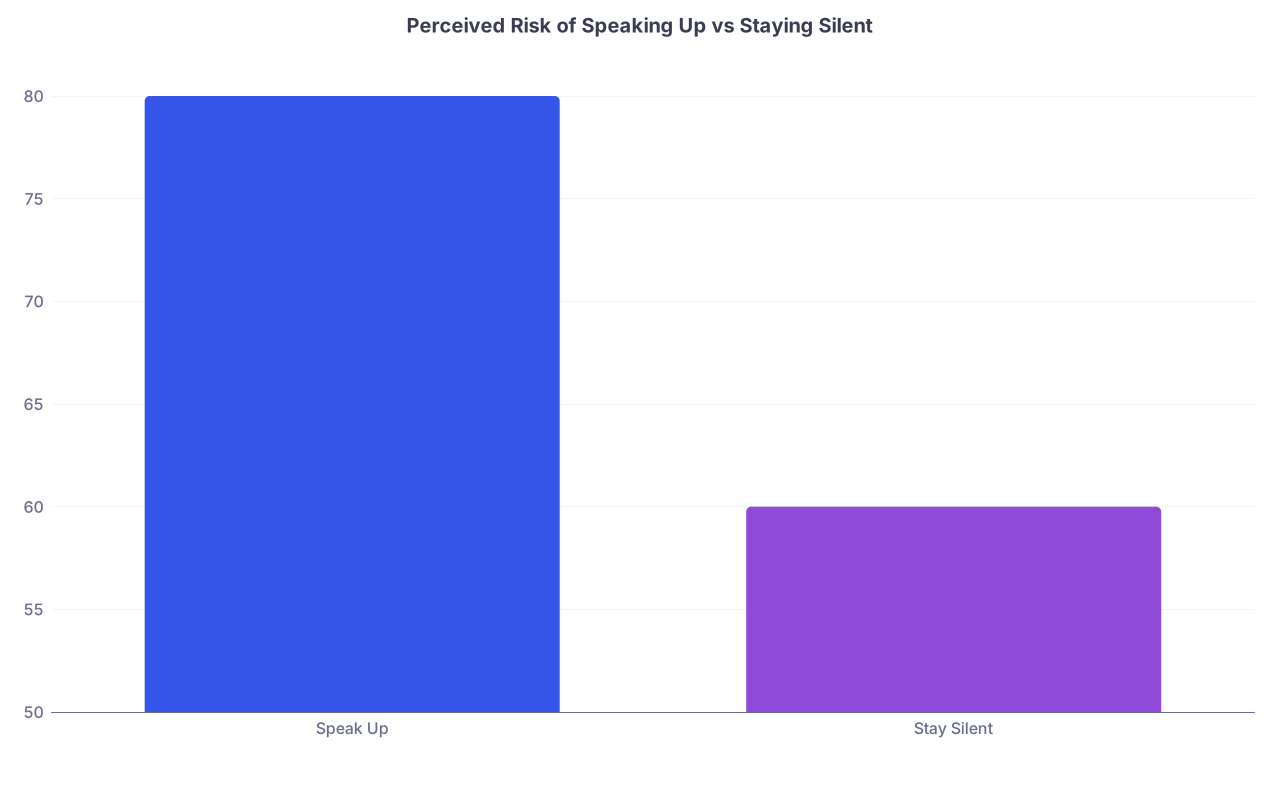
| Category | Value |
|---|---|
| Speak Up | 80 |
| Stay Silent | 60 |
In training, speaking up often feels more dangerous than staying silent, even when the reverse is actually true for the patient. That mismatch is exactly why you feel stuck.
The law and institutional policies are (theoretically) on your side. Every hospital has policies about reporting unsafe practice, impaired clinicians, disruptive behavior, etc. They all say things like “no retaliation” and “good faith reporting is protected.”
Do people still get burned? Sometimes. But I’ve also seen good programs quietly absorb and protect trainees who did the right thing. Both stories exist. You just hear the horror ones louder.
Your actual obligations: ethics vs. law vs. reality
There are three overlapping circles here:
Ethical duty: As a physician‑in‑training (or pre‑med aiming there), you have an obligation to protect patients from harm. That includes harm from colleagues.
Legal duty: In many jurisdictions, you can get into serious trouble if you knowingly ignore impairment, abuse, or gross negligence that harms a patient. Licensing boards look really poorly on “I knew about it but said nothing.”
Institutional duty: Your school/hospital expects you to follow reporting procedures. On paper, they want bad behavior surfaced early.
So no, “I didn’t want to mess up my evaluation” will not age well if something catastrophic happens and emails are pulled and people ask, “Who knew what, when?”
But here’s the nuance almost no one says out loud: you can respect those duties and be strategic about how you act so you’re not just flinging yourself unprotected into a political storm.
That’s not cowardice. That’s survival.
Before you report: slow down, document, and get quiet advice
Your fear is screaming “Do something right now.” Your anxiety brain is also screaming, “Don’t do anything ever.”
Both are bad advisors. What you need is deliberate action.
Step one: write things down. For yourself, not in the EMR.
- Date, time, location.
- What exactly happened. Concrete, not emotional. “Patient with BP 75/40, lactate 6.5, raising concern x2, senior refused fluids or escalation, said ‘stop bothering me’.”
- Who else was there. Nurses, RT, other residents, pharmacists.
- Any direct quotes you remember.
Keep this in a secure, private place. Not on hospital computers. Not in your school email. This is to keep your own memory straight, because when you’re anxious and weeks pass, things blur. You’re not building a legal case; you’re building clarity.
Step two: find one trusted person who isn’t directly in your senior’s chain of command.
This could be:
- A faculty mentor who’s not in your eval line.
- An ombudsperson at your med school.
- A student affairs dean.
- A resident you deeply trust in a different team/service.
- If you’re a pre‑med scribe or MA, maybe a senior nurse you trust or an HR/education contact.
You’re not “reporting” yet. You’re saying, “Here’s what I’ve seen, here’s what I wrote down, I’m struggling to figure out whether this is just harsh culture or truly unsafe.”
If the first person blows you off, that’s not the end of the story. It just means you picked the wrong person.
How to speak up in the moment without detonating your future
You might be thinking, “I don’t even know how to push back in real time. I freeze.”
Same. And honestly, no one trains you properly for this. They say “speak up” but never show you how to word it so you’re less likely to get crushed.
Here are some phrases that are more survivable in a hierarchy:
- “I’m worried about X. Can we double‑check Y?”
- “Can I clarify the plan? I’m concerned because Z.”
- “Just to confirm, we’re choosing not to do [intervention] even though [abnormal finding]. I want to be sure I document correctly.”
- “Nursing has raised this concern twice; I’m also worried. Could we reassess the patient together?”
- “Would you be okay if I run this by [attending / chief / pharmacy] just so I understand the reasoning?”
You’re signaling concern without saying “you’re incompetent.” Sometimes this is enough to nudge a safer decision. Sometimes they’ll shut you down. But at least you’ve tried to create a visible record of concern.
If it’s truly emergent — someone will die in front of you — that’s different. Then you escalate fast: straight to attending, charge nurse, code button, whatever. In those cases, your fear about evaluations has to lose. The law, ethics, and your conscience all align on that.
For ongoing patterns though, it’s usually slow burn, not one disaster. That’s where strategy matters.
Formal reporting: where, how, and what actually happens
At some point, if the behavior is real and ongoing, “I’m afraid” stops being enough to justify silence. That’s the sickening part. You feel like the only one standing between this person and future patients.
Here are your main channels in most hospital/med school setups:
| Channel | Typical Use Case |
|---|---|
| Course/Clerkship Director | Student concerns on rotations |
| Program Director | Resident behavior/performance |
| GME / Student Affairs | Systemic or serious concerns |
| Compliance / Risk Hotline | Anonymous or high‑risk issues |
| Ombuds Office | Confidential, exploratory discussion |
Some tips from watching this process play out:
- Anonymous hotlines exist, but anonymity is soft. Details give you away. Use them when you genuinely fear retaliation and don’t care if nothing happens fast.
- Going to your school’s student affairs or GME office can sometimes create a buffer. They can advise, role‑play conversations, or even approach the department abstractly at first.
- Documentation matters. Your written notes with dates and specifics make you look credible, not emotional.
- Reporting doesn’t always mean “they’re fired tomorrow.” It might mean extra supervision, silent chart review, or having them removed from direct involvement with you quietly.
You will almost never see the full outcome. That’s maddening, because you’ll interpret silence as “They did nothing, and now everyone hates me.” Often the reality is: they’re handling it behind closed doors and legal HR walls that you’re not allowed to see through.
What if they do retaliate?
Let’s be honest: sometimes, people do.
Bad evals. Cold shoulders. Comments like “not a team player” or “overly sensitive.” Your worst‑case scenario.
Here’s the thing almost no one tells you: a single suspiciously harsh evaluation in the context of a well‑documented concern can sometimes backfire on them, not you — if you’ve pulled the right people in early.
If you’re going to stick your neck out:
- Tell student affairs / GME before the eval cycle that you’re worried about retaliation.
- Ask explicitly, “How can we protect against this? Can I rotate away? Can my evaluation be reviewed by someone else?”
- Keep copies of emails and notes describing your concerns and the timing.
Most big institutions are terrified of the optics and legal risk of someone retaliating against a trainee for raising patient safety concerns. They don’t always get it right, but the instinct is there.
And if you do get a bad eval, context matters. PDs and future programs don’t just look at one line; they look at patterns. One outlier attached to a known reporting situation is survivable.
You know what’s much harder to defend later? “I saw unsafe behavior multiple times and stayed quiet because I wanted a good letter.”
The moral injury no one talks about
Even if nothing explodes — no lawsuit, no board complaint, no career‑ending mess — this whole thing leaves a mark.
Staying silent when you think patients are unsafe hurts. I’ve watched students cry in stairwells because they watched something awful happen and feel like they participated by saying nothing.
Reporting and feeling iced out afterward hurts too. You start doubting whether you belong in medicine at all.
Your brain is probably doing this loop: “If I were truly ‘meant’ to be a doctor, I’d either be brave enough to report and not care what happens, or confident enough to know I’m overreacting. I’m neither. So maybe I just don’t belong.”
That’s a lie your anxiety is telling you.
Real doctors struggle exactly like this. I’ve heard attendings admit that as residents they swallowed things they regret. I’ve seen others break down in their 40s talking about the one time they reported and got wrecked for it.
This isn’t a sign you’re weak. It’s a sign you actually care and you’re awake to how ugly the system can be.
A tiny, practical plan you can follow today
You’re not going to solve medical hierarchy tonight. You can do this though:
- Write down what you’ve seen. One page. Neutral language. Dates and facts.
- Circle the things that are truly unsafe, not just harsh.
- Identify one person outside your senior’s chain whom you might trust.
- Draft an email that says: “I’d like to discuss something sensitive related to patient safety and training. Is there a time we can talk confidentially?”
- Don’t send it yet. Read what you wrote. Sleep on it. Then decide.
If you can’t think of a single person you’d trust with this? That’s a problem in your environment, not in you. In that case, student affairs/GME/ombuds is usually your next best bet.

Special cases: when it’s clearly over the line
There are a few categories where you skip the “am I overreacting?” phase:
- Substance use at work.
- Physical abuse or sexual contact with a patient.
- Documented falsification of records to cover harm.
- Overt discrimination that affects care (e.g., refusing care to certain patients).
Those are big‑red‑button issues. Legally and ethically, you’re on solid ground escalating fast. Usually this means directly to:
- Compliance/risk hotline, or
- Student affairs/GME with the clear label: “This may be an impaired or abusive provider issue.”
You may still be afraid. That’s normal. But this is where your moral duty is loudest.

| Step | Description |
|---|---|
| Step 1 | Notice unsafe pattern |
| Step 2 | Document details privately |
| Step 3 | Call code / attending / charge nurse |
| Step 4 | Seek confidential advice |
| Step 5 | Trusted mentor or student affairs |
| Step 6 | Formal report to program or hotline |
| Step 7 | Monitor, re-assess, document |
| Step 8 | Emergent danger now |
| Step 9 | Ongoing serious risk |

You’re not responsible for fixing the whole system
One last point, because I can almost hear you saying: “If I don’t stop this person, I’m responsible for every future patient they hurt.”
No. You’re responsible for acting in good faith with the power and knowledge you have right now.
You’re not the program director. You’re not the hospital CEO. You’re not the licensing board. You are one trainee or pre‑med trying to do the right thing in a stacked system.
The fact that you’re even thinking about this, that it’s making you lose sleep, actually tells me you’re exactly the type of person medicine needs more of.
You might get this wrong in one direction or the other occasionally. Over‑report. Under‑report. That’s painful. But the worst outcome is letting fear be the sole decision‑maker every time.
So here’s today’s move: open a blank document and write, in detail, the last incident that made you think, “My senior is unsafe.” Then ask yourself: if this shows up on the front page of a malpractice complaint five years from now with a timestamp and your name attached as a witness, would you be okay with “I said nothing” as your only line?
If the answer is no, it’s time to talk to someone real.