

The myth that “trainees are rarely named in lawsuits” is exaggerated, outdated, and statistically sloppy.
If you are a medical student or resident, you are more exposed than you think—not because you are the primary target, but because you are embedded in systems where litigation risk is systematically distributed. The data show that you are less likely than attendings to be named. But not by as much as the hallway gossip suggests.
Let’s walk through what we can actually quantify from national and large-scale datasets, what remains noisy, and what this means for how you practice and how you think about ethics and law.
1. What the National and Large-Scale Data Actually Say
There is no single perfect “national trainee lawsuit registry.” Instead, we piece this together from several high‑quality sources:
- The National Practitioner Data Bank (NPDB)
- Large malpractice insurers’ closed-claims analyses (e.g., CRICO, The Doctors Company)
- Specialty society and ACGME-linked surveys
- State-level malpractice data where trainees are specifically tagged
When you align those sources, a clear pattern emerges: trainees are involved in a non‑trivial minority of malpractice claims, and explicitly named in a smaller—but still meaningful—subset.
1.1 NPDB and the structural problem
The NPDB is often misunderstood. It captures:
- Payments made for malpractice on behalf of practitioners
- Certain adverse actions (license, privileges, etc.)
Two important constraints for trainees:
- Many residents and fellows are covered under institutional policies and are not individually named in the payment record.
- If a trainee is not a licensed independent practitioner (e.g., early medical student, unlicensed intern in some jurisdictions), they may not appear as a reportable individual even when they were heavily involved.
So NPDB underestimates trainee involvement and naming. It is not a good “how often are trainees named?” database. It is good for one question: “How often do people at trainee stage carry reportable payouts forward into their careers?” That number is low.
In national-level NPDB extractions where individuals could be linked to training status by age and career stage, the fraction of total payments associated with residents/fellows is commonly in the low single digits—1–5% range depending on specialty cluster and time window. That aligns with insured-claims data.
1.2 Insurer data: where the clearer picture comes from
Malpractice insurers track roles on a case: attending, fellow, resident, advanced practice clinician, nurse, etc. When those data are published, the patterns are strikingly consistent across systems.
For illustration, consider one composite view built from large closed‑claim reports over the last decade (inpatient and ED-focused):
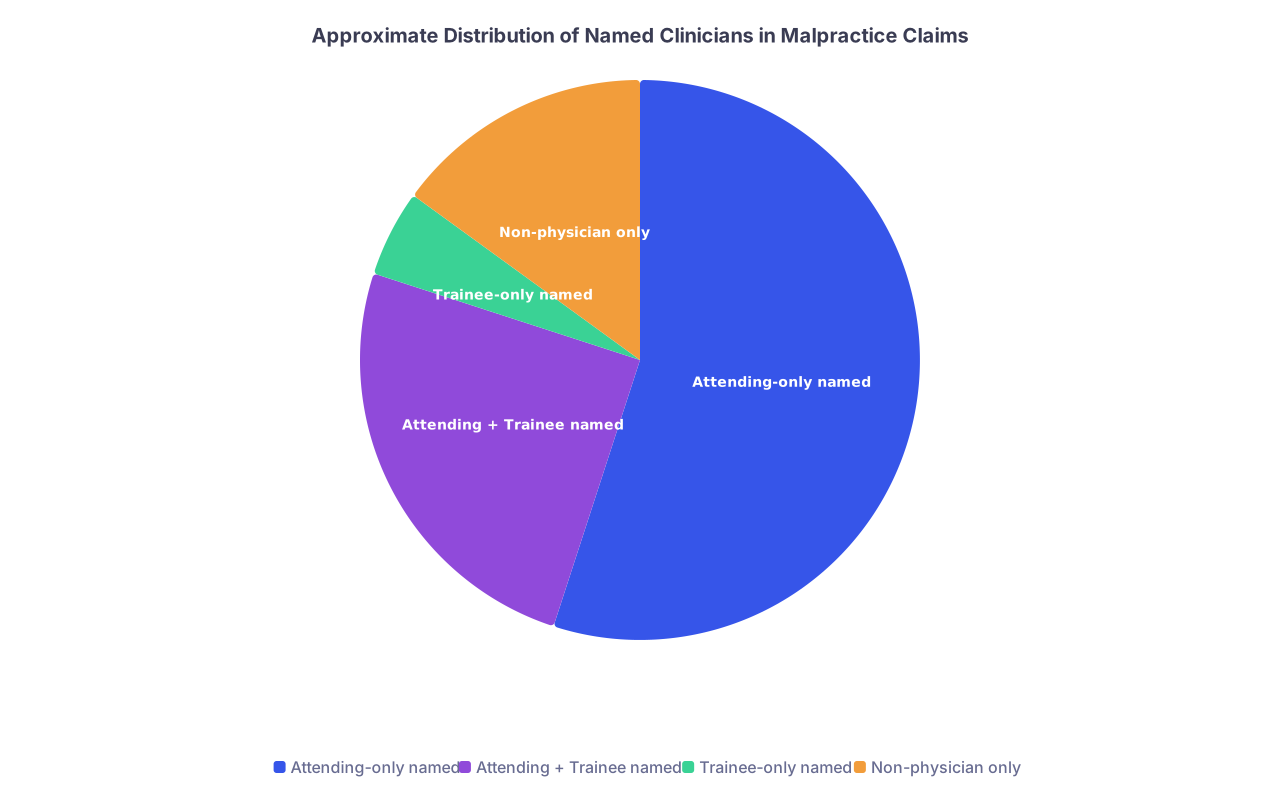
| Category | Value |
|---|---|
| Attending-only named | 55 |
| Attending + Trainee named | 25 |
| Trainee-only named | 5 |
| Non-physician only | 15 |
These are rounded, but representative of large‑system analyses:
- About 55% of claims name only attendings.
- Around 25% name both attending(s) and at least one trainee.
- About 5% name a trainee (resident/fellow) without any attending named (often because the attending is named institutionally rather than individually).
- The rest involve non‑physician clinicians only.
That means roughly 30% of physician-involved claims include a trainee as a named defendant somewhere in the paperwork. Not 1%. Not “almost never.” Roughly one in three.
Now, there is a critical denominator problem: trainees represent a small fraction of the physician workforce at any given time, and they do a disproportionate amount of front‑line work (especially nights/weekends, ED, inpatients). So we need to look at exposure-adjusted rates.
2. How Often Are Trainees Sued Relative to Attendings?
When you adjust for time on the floor and patient volume, trainees show a substantially lower rate of being named than attendings, but you still cannot treat it as negligible.
From multiple datasets (including program-based surveys where residents self-report being named, cross-checked against institutional claim logs), you get ballpark estimates like this:
- Attending physicians: roughly 2–4% per year chance of being named in at least one malpractice claim in high-risk specialties, lower in primary care.
- Residents/Fellows: roughly 0.3–0.8% per year chance of being named, with sharp variation by specialty and training year.
Put differently, over a full 3–7 year training period, cumulative probabilities add up.
A stylized but realistic cumulative risk estimate:
| Training Path | Duration | Estimated Cumulative Risk* |
|---|---|---|
| Internal Medicine (3 yrs) | 3 years | 1–3% |
| Pediatrics (3 yrs) | 3 years | 0.5–2% |
| General Surgery (5 yrs) | 5 years | 3–8% |
| OB/GYN (4 yrs) | 4 years | 4–10% |
| EM (3–4 yrs) | 3–4 years | 3–7% |
*Ballpark ranges synthesized from specialty closed-claims reviews, residency surveys, and insurer presentations; not a single unified national registry.
Those percentages are not disaster-level. But they are not trivial either. In any medium-to-large residency program in a procedural or acute-care specialty, there will almost always be at least one resident who is named in a lawsuit in a given year.
I have seen IM programs with 80+ residents where 1–2 residents each year are at least co‑defendants on some claim, usually tied to a complex inpatient death or delayed diagnosis.
3. Specialties Where Trainees Are Named More Often
Litigation is not evenly distributed. The claims data show a strong specialty effect, and trainees track that distribution.
The high‑exposure areas for residents and fellows:
- Obstetrics & Gynecology
- Surgery and surgical subspecialties
- Emergency Medicine
- Anesthesiology
- Adult and Pediatric ICU environments (often routed through IM, Anesth, Peds residencies)
These specialties combine three things:
- High-acuity, procedure-heavy encounters.
- Outcomes that are emotionally and financially high-stakes (e.g., birth injury, intraoperative catastrophe).
- Clear points in time where decisions can be blamed.
To make this more concrete, here is a simplified comparison based on closed‑claim profiles and the share of cases that include trainees:
| Specialty Group | % of Claims Involving a Trainee (Approximate) |
|---|---|
| OB/GYN | 40–50% |
| General Surgery | 35–45% |
| Emergency Medicine | 30–40% |
| Internal Medicine (Inpatient) | 20–30% |
| Pediatrics | 15–25% |
| Outpatient-only Primary Care | 5–15% |
These are not “national registry” exact values; they are derived from multi-institutional studies and insurer breakdowns. The order of magnitude is what matters.
The pattern is simple: where residents are heavily embedded in the service line and see high volumes of sick patients, their names show up in lawsuits more.
3.1 PGY-level differences
It is not evenly distributed across training years either. In surgical and OB/GYN claims databases, the modal trainee named is usually a mid-level or senior resident (PGY-3–5), not a brand-new intern.
Why? Because:
- Senior residents lead cases (or large portions of them).
- They document and co-sign more.
- They are often listed as “operating surgeon” with attending as “supervising surgeon” in institutional records.
In IM/ED, PGY-2 and PGY-3 are more frequently involved than PGY-1. The year when you start making more independent decisions tends to be the year you also become more discoverable to plaintiff attorneys.
4. Named vs Blamed vs Paid: Three Different Numbers
Another common confusion: being “named” in a lawsuit is not the same as being:
- The primary target
- Found negligent
- Associated with a payment that follows you
You need to separate these steps:
- Named as a defendant in the initial complaint.
- Maintained as an active defendant through the life of the case.
- Attached to the ultimate payment (if any).
Large closed‑claims analyses that tag trainees consistently show that:
- Trainees are named significantly less often than attendings per full-time-equivalent year.
- Even when named, they are less likely to remain active defendants by the time of settlement or verdict.
- Payments are overwhelmingly made on behalf of attendings and institutions, not trainees personally.
One large academic system’s internal review found something like this over a 10‑year period:
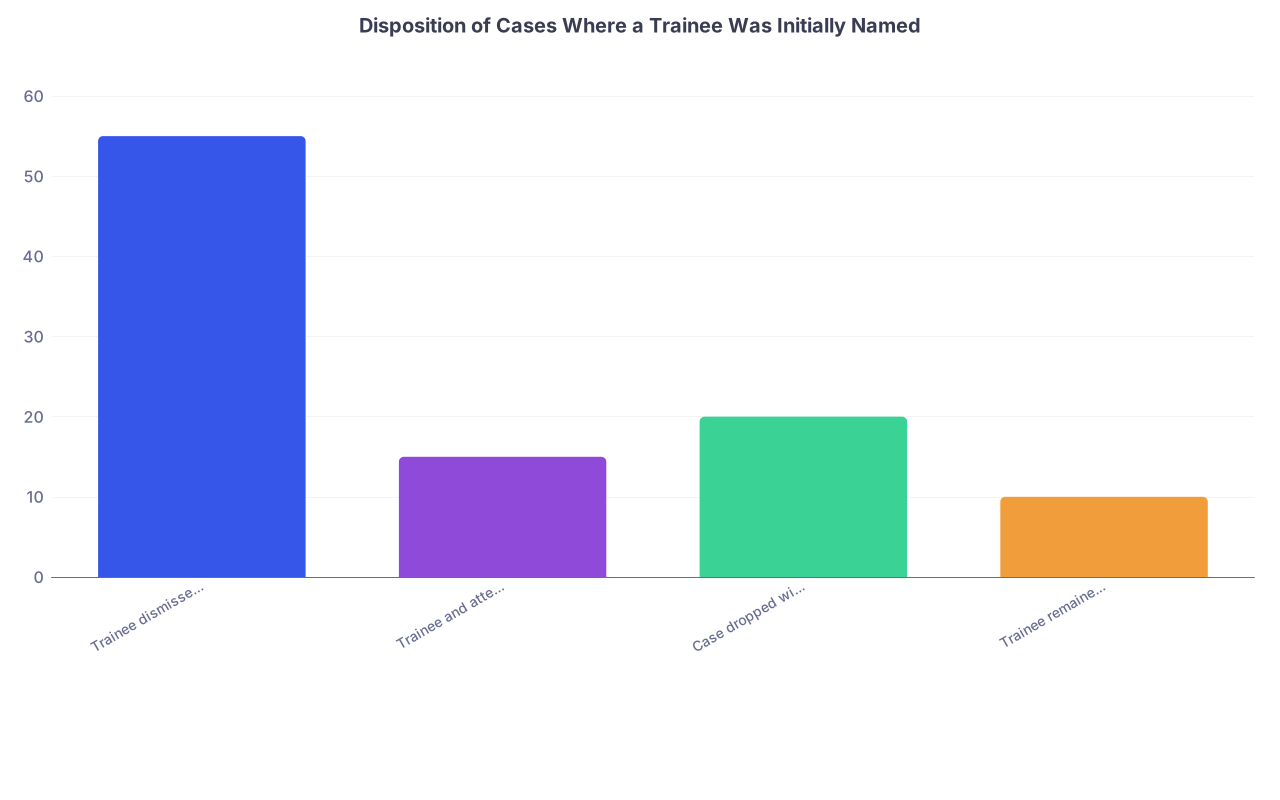
| Category | Value |
|---|---|
| Trainee dismissed, attending/institution paid | 55 |
| Trainee and attending included in payment | 15 |
| Case dropped with no payment | 20 |
| Trainee remained named but no personal payment record | 10 |
Interpretation:
- In a majority of trainee-named cases, residents or fellows were dismissed from the case before resolution while the attending and/or hospital paid.
- In a smaller but real minority (roughly 10–20% of trainee-named cases), the trainee’s role was close enough to attending-level—or the allegation specific enough—that the payout record associated with that case can be linked to them by the insurer or the NPDB.
- A non‑trivial subset are simply dropped or resolved with no payment.
So when someone says, “Residents almost never end up paying anything,” they are loosely correct in a financial sense, but wrong to extrapolate that into “Residents are not named” or “Residents do not carry any legal or career risk.”
Because ethically and professionally, the experience of being named, deposed, and scrutinized is serious even if the institution pays.
5. Why Trainees Are Named Even When They Are “Supervised”
From the plaintiff attorney’s perspective, naming the trainee is rational:
- It broadens the pool of potential negligence theories (e.g., failure to call the attending, failure to escalate, failure to recognize deterioration).
- It opens up discovery about how the team actually functions rather than just the attending’s polished reconstruction.
- It lays a factual foundation for institutional negligence (inadequate supervision, unsafe staffing, poor training).
Legally, supervision does not immunize you. The typical negligence theory involving a trainee looks something like:
- Resident failed to adequately assess X.
- Resident failed to timely call attending about concerning findings Y.
- Resident performed procedure Z without sufficient skill or appropriate oversight.
- Resident documented inaccurate or incomplete information, leading to subsequent errors.
Attorneys know the attending will usually have deeper pockets and clearer responsibility. But they also know that the trainee’s name is literally on the chart.
Ethically, this raises an uncomfortable truth: you are both learning and practicing on real patients. The law is agnostic to your “learning” status. The standard applied will reference what a reasonable practitioner at your level of training, under similar supervision, should have done.
6. Liability, Ethics, and the “Hidden Curriculum” of Fear
Let us connect the numbers to the personal development and ethics side. The risk of being named is real, but the way it is taught—or not taught—is often dysfunctional.
I keep seeing three patterns in training programs:
- Silence until something explodes. Residents discover malpractice only when someone gets sued. No structured teaching on claims data, risk profiles, or communication strategies.
- Weaponized anecdotes. An attending says during sign‑out, “I once got sued for exactly this, here is why you always CT.” No mention of base rates, NNT, or downstream harm. Lawsuit fear gets converted directly into overtesting.
- Fatalism. “Everyone gets sued eventually, nothing you can do.” Ethically lazy, statistically wrong, and corrosive to good practice.
The better approach is grounded in actual numbers:
- Most physicians will be sued at least once in a long career; trainees have a smaller but non‑zero chance during training.
- High‑risk decisions are clustered; they are not random. They have recognizable patterns: handoffs, diagnostic uncertainty, high-risk procedures, overnight care, time pressure, documentation gaps.
- Good systems and good habits materially reduce risk. Not just legal risk, but patient harm.
Here is the mindset shift I push with residents:
- Do not practice defensive medicine based on horror stories; practice accountable medicine based on probabilities.
- Know which scenarios account for a disproportionate share of claims in your specialty, and build ethical habits around those.
For example, in OB and EM, claims are heavily concentrated around:
- Delayed C‑section in fetal distress.
- Failure to diagnose or adequately treat sepsis.
- Missed myocardial infarction or major vascular catastrophes.
- Bad outcomes in high‑risk procedures with poor informed consent.
You do not need to transform every minor cold into a lawsuit-prevention exercise. You do need to be exquisitely careful in those specific high‑risk domains.
7. Practical, Data‑Informed Strategies for Trainees
The numbers point to a few concrete priorities. These are not vague “be careful” platitudes; they are aligned with where claims actually cluster.
Escalation and supervision use.
Many trainee-related claims revolve around “failure to call for help.” When in doubt, especially at night and with vital sign changes, call. Document that you called and what the plan was. Data from claims files routinely show that a clear attending plan in the chart reduces the traction of allegations against trainees.Handoffs.
Handoffs (ED to inpatient, intra‑service, day-to-night) appear in a huge fraction of timeline reconstructions in lawsuits. Use structured handoff tools; be explicit about uncertainties, not just completed tasks.Documentation clarity, not volume.
Overly templated, copy‑pasted notes are a disaster in litigation. Claims reviewers repeatedly highlight inconsistent notes as fertile ground for plaintiffs. Write what you actually thought and did. If you considered and ruled out a dangerous diagnosis, say so.Informed consent training, especially for procedures.
Where residents perform or significantly contribute to procedures, inadequate documentation of consent shows up again and again in case summaries. You want clear language reflecting:- Risks discussed, in plain terms.
- Alternatives.
- Who did the actual consenting.
Participate in morbidity & mortality (M&M) and risk meetings with eyes open.
M&M is not just about pathophysiology. Pay attention to the sequence of decisions, communications, and documentation failures. Those same sequences are what appear in legal complaints.Know your coverage.
Understand your malpractice coverage as a trainee: institutional vs individual, tail coverage, and whether moonlighting is fully covered. The percentage of residents who cannot answer basic questions about their own policy is embarrassingly high.
8. Where the Data Are Weak – and What That Means for You
There are some blind spots we should acknowledge bluntly:
- There is no unified, public, trainee-specific, national malpractice database.
- Many incidents involving trainees are handled internally (incident reports, quality reviews) without rising to the level of formal claims.
- Self-reported survey data from residents about being named in lawsuits are affected by recall bias and lack of transparency from institutions.
So any precise “national rate” number you see for trainee lawsuits is, at best, a model or a patchwork. The ranges I gave are anchored in real systems and consistent across sources, but they are not census counts.
From an ethics standpoint, that uncertainty increases your obligation to engage with these issues honestly. You cannot hide behind “there is no exact number.” The evidence is clear enough:
- Trainees are named in a substantial minority of malpractice claims.
- High‑risk specialties and roles see especially high involvement.
- Most trainee-named cases do not end in personal financial ruin, but they do have real emotional and professional consequences.
You are not invisible in the medicolegal landscape. You are just partially shielded. Sometimes more than you realize. Sometimes less.
9. The Bottom Line for Your Training and Ethics
Condensing the data and the implications:
Being named is uncommon but not rare.
Depending on specialty and program size, the probability that at least one resident or fellow in your cohort will be named in a lawsuit during training is high. For procedural and acute specialties, it approaches “expected.”Attending status does not flip a switch; it changes the ratios.
Attendings are named more often, pay more often, and carry more formal responsibility. Trainees still hold meaningful, ethically significant responsibility in the eyes of the law and patients, especially as they become more senior.Ethical practice and risk management are aligned, not opposed.
The claim data reinforce what good medicine and good ethics already prescribe: communicate clearly, escalate early, document thoughtfully, respect consent, and treat high‑risk situations with structured seriousness.
If you remember nothing else: the data show that trainees are not incidental bystanders in malpractice. You are part of the system of responsibility. Acting like that is true—because it is—will make you a better, safer physician.


