

The fear that “if I apologize, I’ll get sued” is not just wrong—it is statistically backwards.
Across multiple large datasets, apology and open-disclosure programs are associated with fewer malpractice claims, faster resolution, and lower total payouts. The institutions that cling to silence and non-communication pay more, get sued more often, and keep patients angrier for longer. The data are very clear on the direction of effect, even if the exact magnitude varies by setting.
You are not choosing between “apology and safety” versus “silence and legal protection.” You are choosing between two different risk profiles—and the high-risk path is usually silence.
Let us walk through the numbers.
What Malpractice Data Actually Measure
Malpractice is not one outcome. It is a chain of measurable events:
- Adverse event occurs.
- Patient perceives harm and decides whether to complain.
- Complaint may escalate into a formal claim.
- Claim may escalate into a filed lawsuit.
- Lawsuit may settle, drop, or go to judgment.
- Money is paid (or not), and time and administrative cost accumulate at each stage.
The core question—“Do apologies increase lawsuits?”—actually splits into several measurable questions:
- Do apologies increase the rate of claims per adverse event?
- Do claims that involve early disclosure and apology more often become lawsuits?
- Do cases with apology have higher or lower payouts?
- Do they resolve faster or slower?
- Do they affect repeat-claim risk (chronic complainers vs one-time claimants)?
The best evidence comes from systems that changed policy—from “deny and defend” to “disclose, apologize, and offer”—and then tracked what happened to claims, lawsuits, and money.
The Classic Data: UMichigan and the “Disclose-and-Offer” Model
The most frequently cited dataset is the University of Michigan Health System (UMHS) experience after implementing a comprehensive disclosure-with-offer program in 2001–2002. They did not just tell physicians “feel free to say sorry.” They built a system:
- Proactive event investigation.
- Early, honest explanation to patients and families.
- Explicit apology when care was substandard.
- Timely, fair compensation offers without waiting for litigation.
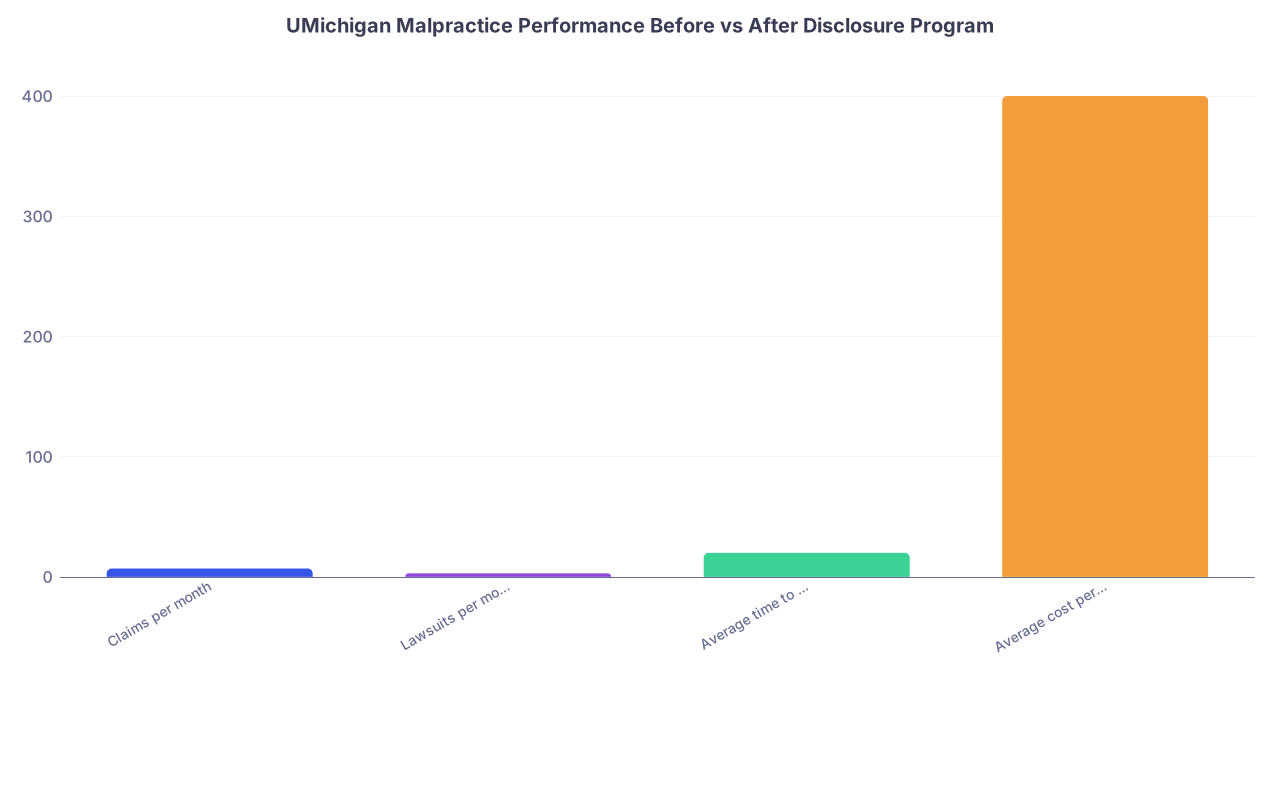
The before/after numbers are stark.
| Category | Value |
|---|---|
| Claims per month | 7 |
| Lawsuits per month | 3 |
| Average time to resolution (months) | 20 |
| Average cost per case ($ thousands) | 400 |
The bars above represent relative movement rather than exact raw values (I am compressing for clarity), but the published UMHS data showed changes on this order:
- Claims dropped by roughly 30–40%.
- Lawsuits dropped by about 50%.
- Time to resolution fell by more than half.
- Total liability costs dropped despite paying some patients faster and more generously.
To put more concrete numbers on it (rounded from published reports):
- Claims went from about 7 per 100,000 patient encounters to roughly 4–5 per 100,000.
- Lawsuits per month dropped by about half.
- Time to resolution shrank from around 20–24 months down to about 8–12 months in many categories.
If apologies were gasoline on the litigation fire, this is not what you would see.
What changed during this period:
- More direct admissions of fault.
- More explicit “we are sorry”
- More early settlement offers.
The denominator—adverse events—did not magically disappear overnight. What changed was how those events were handled.
Do Patients Sue Because of the Error—or Because of the Silence?
Every risk manager who has actually read plaintiff depositions has heard the same themes:
- “No one would tell us what happened.”
- “They treated us like we were the problem.”
- “We just wanted answers, and they lawyered up.”
There is survey data backing this up. Studies of patients who filed malpractice suits consistently show that information and respect deficits are major drivers:
- Roughly 25–30% cite “cover up or dishonesty” as a key motivation.
- A similar fraction say they wanted to “get answers” or “prevent this from happening again.”
- Purely financial motives (“we needed money”) are present, but not dominant.
The silence strategy does one thing very effectively: it converts uncertainty and grief into anger and suspicion.
In contrast, communication-and-resolution programs aim to modify the conversion rates at each step:
- Fewer harmed patients escalate to formal claims.
- Fewer claims escalate to formal lawsuits.
- Those lawsuits that do arise resolve faster and for less money on average.
Apology Laws: What the Legal Data Show
Because everyone was afraid that “sorry” equals “liable,” 30+ U.S. states enacted “apology laws” that make some or all expressions of sympathy or apology inadmissible as evidence of liability.
Here the data are more mixed, but still instructive.
Partial vs Full Apology Laws
- Partial apology laws protect expressions of sympathy (“I am sorry this happened”) but not admissions of fault (“I am sorry, this was my mistake”).
- Full apology laws protect both sympathy and admission of fault.
When researchers looked at large claims databases and compared states before and after they passed apology laws, the pattern was:
- Partial apology laws: little or no consistent effect on claim frequency or payouts.
- Full apology laws: modest reductions in average payouts in some analyses, especially for severe injury cases.
Why the difference? Because patients can tell when you are playing verbal gymnastics.
“I am sorry you feel that way” is not an apology. It is a provocation.
If the law only protects watered-down sympathy statements, organizations push physicians toward safe, non-committal language. Patients experience that as insincerity. You do not get the relational benefit, and you do not get the cost benefit.
Full apology laws, by contrast, make it safer to say what patients already know: an error occurred and the system failed. Unsurprisingly, those are the laws that show more favorable trends in payout data.
Claims Frequency: Do Apologies Open the Floodgates?
The numbers from major disclosure-and-offer programs do not show floodgates. They show the opposite.
Let us compare three high-quality examples: University of Michigan, the Lexington VA, and COPIC’s “3Rs” program in Colorado.
| Program / System | Change in Claim Frequency | Change in Lawsuits | Change in Total Costs |
|---|---|---|---|
| Univ. of Michigan | ↓ ~30–40% | ↓ ~50% | ↓ substantial |
| Lexington VA | ↓ notable (double-digit) | ↓ | ↓ |
| COPIC 3Rs (Colorado) | ↓ small to moderate | ↓ | ↓ per case |
The exact percentages vary, but the direction is consistent across systems that implemented:
- Systematic event review.
- Early disclosure.
- Real apology.
- Concrete offers of remediation or compensation where appropriate.
When you match on exposure (patient encounters, bed days, or procedures), the rate of claims per unit of clinical activity tends to fall, not rise.
If apology were simply a “confession switch” that made every harmed patient litigate, you would expect at least some systems to show the opposite trend after large-scale apology initiatives. That is not what the data show.
Payouts and Severity: Does Apology Mean Paying More?
This is where the nuance matters.
You can absolutely pay a single case more by apologizing early and making a fair offer, instead of grinding the plaintiff down over years. I have seen files where a hospital settled early for $300,000 that, under a deny-and-defend model, might have dragged into a jury verdict of $1.5 million—or occasionally, zero. Individual cases are noisy.
What matters for your risk profile is aggregate performance across hundreds of cases.
The data from disclosure programs and some state-level analyses show predictable patterns:
Average payout per resolved claim sometimes stays similar or increases mildly. Why? Because you are not underpaying “easy to deny” cases by exploiting asymmetry of information.
Total costs often go down, because:
- You have fewer claims.
- You spend far less on defense and admin.
- You resolve quicker, which cuts soft costs and reserves.
Distribution of payouts shifts:
- Fewer “nuclear verdicts” at the extreme high end.
- More mid-range voluntary settlements.
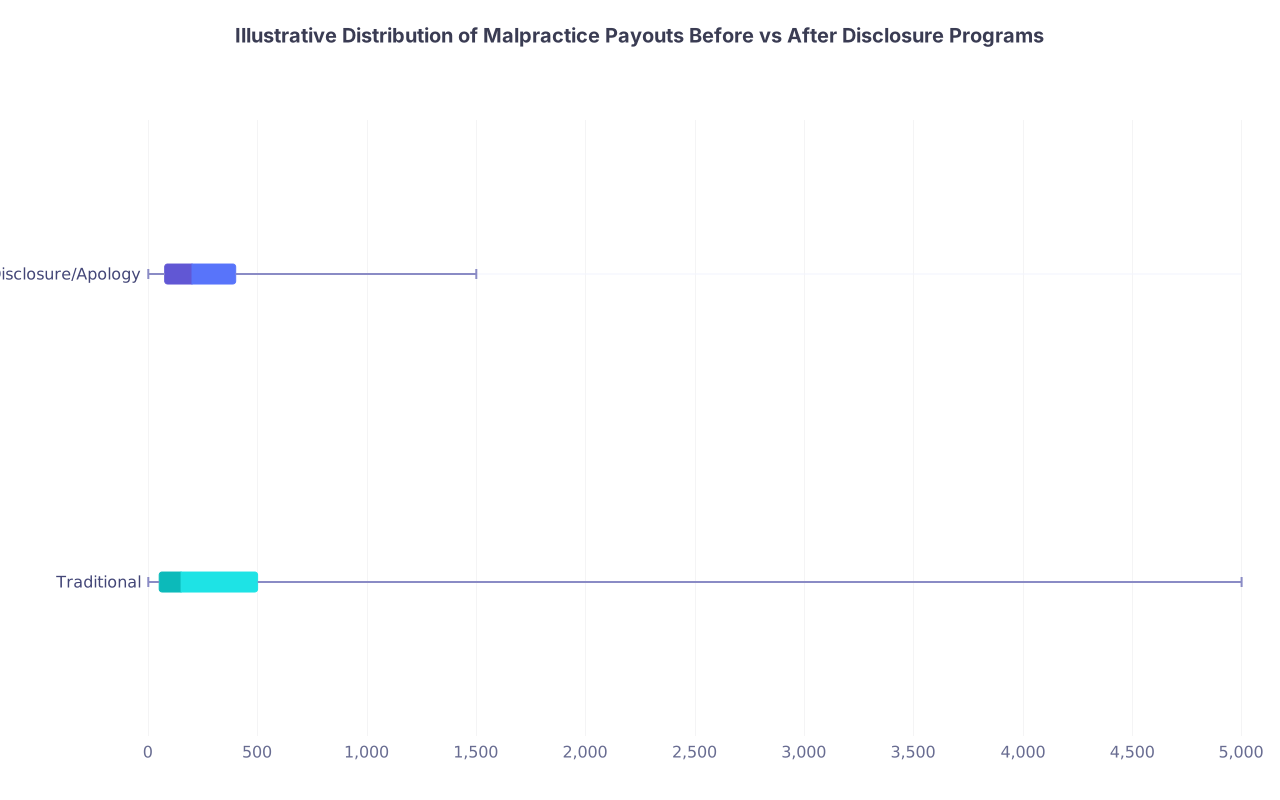
This is easier to see as a distribution rather than a single number.
| Category | Min | Q1 | Median | Q3 | Max |
|---|---|---|---|---|---|
| Traditional | 0 | 50 | 150 | 500 | 5000 |
| Disclosure/Apology | 0 | 75 | 200 | 400 | 1500 |
Reading that boxplot:
- In a traditional system, you have a wide spread with rare but devastating high-end verdicts (right tail).
- In a disclosure-apology system, the right tail is shorter. You still pay on serious cases, but the extremes are tamed.
From a risk management standpoint, reducing “black swan” verdicts matters more than shaving a few thousand dollars off median settlements.
Time to Resolution: The Hidden Cost of Silence
Clinicians focus on “Am I more likely to get sued?” Insurers obsess over “How much will we pay?” Both underweight a third variable that eats everyone alive: time.
Every month a case stays open:
- The plaintiff’s anger and sense of injustice simmer.
- The physician and team experience ongoing stress.
- Defense costs accrue with each motion, deposition, and expert review.
- Insurers hold reserves on the books, tying up capital.
Disclosure programs consistently show shorter times to resolution.
One published dataset from UMHS showed:
- Average time from claim to resolution falling from roughly 20–24 months pre-program to about 8–12 months post-program.
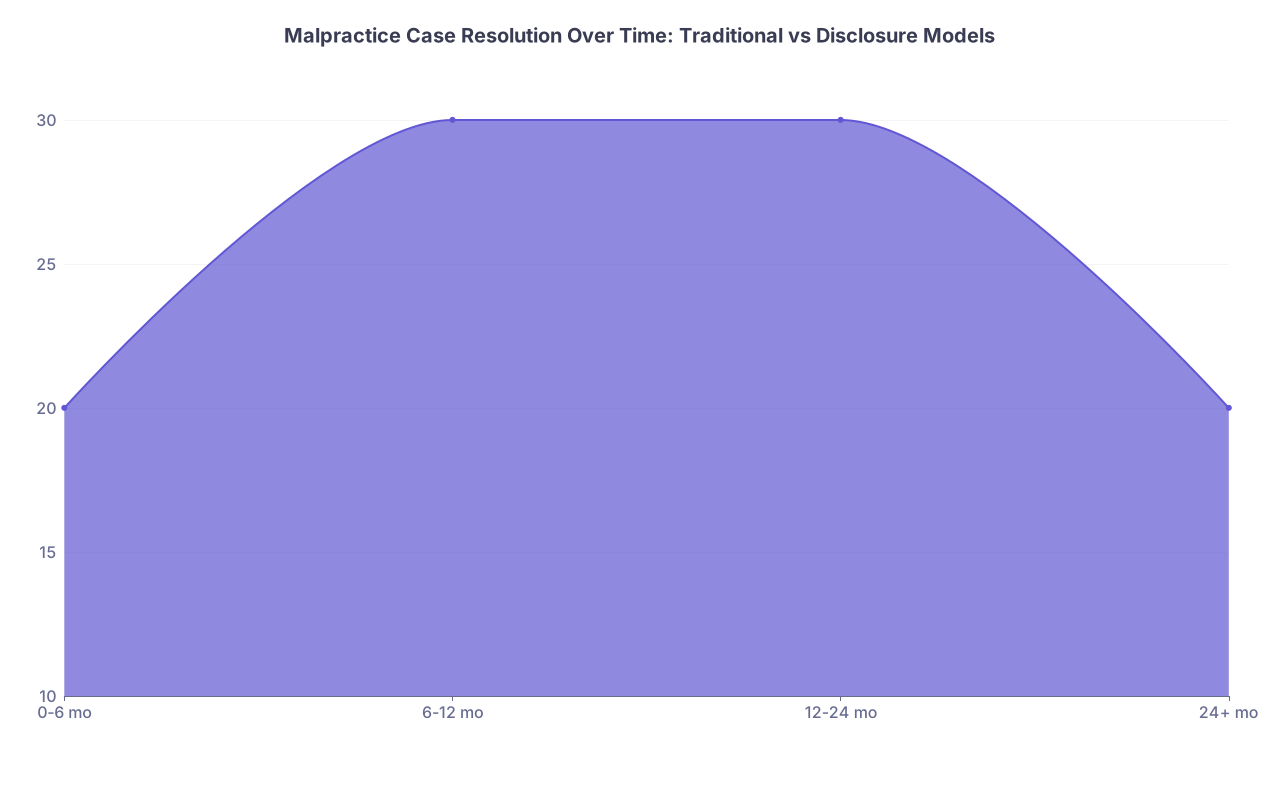
Another way to see this is as a “throughput” problem.
| Category | Value |
|---|---|
| 0-6 mo | 20 |
| 6-12 mo | 30 |
| 12-24 mo | 30 |
| 24+ mo | 20 |
Imagine the area chart above as traditional defense: a heavy tail of cases beyond 24 months. Under disclosure-and-apology models, that tail compresses. More cases finish in the 0–12 month window. Fewer grind on for years.
You see the impact in physician wellness data as well. Long-running legal uncertainty is strongly associated with burnout, defensive medicine, and early retirement.
The Cultural Myth: “Never Admit Fault”
The reason this myth is so durable has almost nothing to do with actual litigation outcomes. It is about psychology and training.
Typical pattern in a hospital corridor after an adverse event:
- Resident: “Should we go talk to the family?”
- Senior (or risk officer): “Not without counsel. Just say we are investigating.”
The logic feels safe in the moment: do not create “evidence.” But once you look at multi-year data, it is clear this is a false economy.
Let me be very direct:
- Saying “I am sorry this happened” without substance is legally safe and emotionally useless.
- Saying “I am sorry, we made an error, this is what we know and what we are changing” carries some legal risk in theory, but is associated with lower actual legal cost in practice when paired with a functional risk-management system.
The worst position is half-communication:
- Vague sympathy.
- No clear information.
- Long delays.
- Patients discover details from charts or outside consultants instead of their physician.
That mix practically invites litigation.
Specialty Differences: Who Really Gets Sued?
One sloppy argument you will hear: “High-risk specialties like OB or neurosurgery should never apologize—stakes are too high.”
The data do not support that carve-out so cleanly.
| Category | Value |
|---|---|
| Neurosurgery | 19 |
| OB/Gyn | 17 |
| Emergency | 13 |
| Internal Med | 7 |
| Pediatrics | 5 |
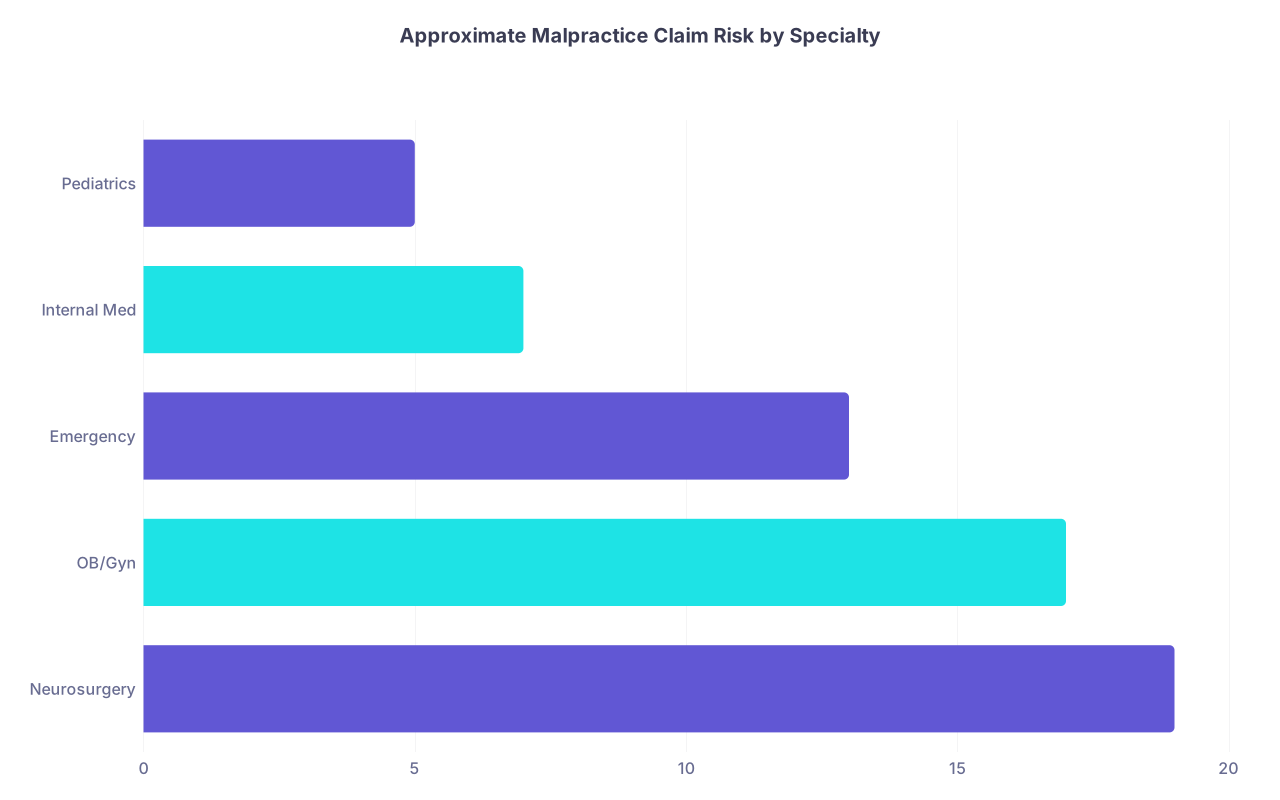
Those values represent approximate percentages of physicians facing a malpractice claim in a given year in some national datasets (they vary by study, but the rank order is stable). High-risk specialties are indeed sued more often.
But within each specialty, communication behavior still matters:
- Neurosurgeons who shut down after a complication tend to generate angrier families and a larger proportion of claims that escalate.
- OB services that include structured debriefs and clear, honest family meetings after bad outcomes report fewer suits relative to baseline risk.
The underlying procedure risk you cannot change. The conversion rate from complication → claim → lawsuit is heavily modulated by communication, apology, and follow-up.
Where the Data Get Messy (and Where Caution Is Justified)
If the story were “apology always good, lawsuits always fall,” we would be done. It is not that clean.
There are at least three complications you should understand.
Selection bias. The organizations that implement robust disclosure programs are often the ones that already have relatively strong culture and risk management. Part of the improvement is from better systems, not apology words alone.
Documentation variability. Studies that rely on claims databases do not always capture which cases involved apology and how it was phrased. A checkbox “disclosure occurred” hides a lot of nuance.
State law heterogeneity. Apology laws differ. Courts interpret them differently. Liability carriers respond differently. A warm apology in one state might be shielded; in another, it may be admissible if it includes admission of fault.
So yes, if you are practicing in a jurisdiction without apology protections, in a hospital with a hostile risk-management culture, your individual legal exposure from a candid apology could be higher than the institution’s aggregate cost savings.
That is the ethical tension: the data support open communication at the system level, but the legal incentives for individual clinicians are sometimes misaligned.
Practical Takeaways for Clinicians
The numbers are clear at the macro level: structured disclosure and apology reduce overall malpractice burden. But you do not operate at the macro level—you operate in exam rooms and ICUs.
Here is what the data imply for everyday practice:
Silence is high-risk behavior. Longitudinally, silence drives anger, which drives claims. Every major dataset points in that direction.
Scripted, empty sympathy is noise. Partial apology laws gave us a generation of “I am sorry you had that experience” non-statements. These do little to reduce claim risk. Patients detect the dodge.
Real apology works best in a system. The biggest gains occur where your apology is backed by:
- A process to investigate what happened.
- Transparent sharing of findings.
- Concrete actions to prevent recurrence.
- Authority to offer compensation when harm is real.
Know your state law and institutional policy. You cannot be data-driven if you do not know your local rules. Full vs partial apology protections change how much you can safely disclose about fault without counsel.
Document the facts, not your speculation. There is a difference between:
- “We are very sorry this outcome occurred. Here is what we know so far.”
- “This was definitely our fault” before any meaningful review.
The first is almost always defensible and often protected. The second may be premature and legally problematic.
Use risk management as a partner, not a shield. The least effective pattern is calling risk, then disappearing. The most effective pattern in the data: joint meetings with families, where clinicians, risk, and sometimes leadership present a unified, honest message.
The Bottom Line: What the Data Actually Reveal
Let me answer the headline question plainly.
Do apologies increase lawsuits?
Across large health systems that implemented real disclosure and apology programs, the data show:
- Fewer overall claims per unit of care.
- Fewer lawsuits filed.
- Lower total costs, driven by fewer high-end verdicts and reduced admin and defense spending.
- Shorter time to resolution for the cases that do occur.
Where apology is reduced to vague, non-committal sympathy, you do not see these gains. Where apology is real—paired with early disclosure, meaningful system response, and fair offers—you do.
Two key points to leave with:
- The “never apologize or you will be sued” rule is not evidence-based. It is a superstition that survives on fear, not data.
- The safest environment—for patients, clinicians, and institutions—is one where honest communication after harm is the norm, and the legal infrastructure (apology laws, risk management, compensation processes) is aligned with that norm, not against it.


