

The data shows a blunt truth: shared decision‑making is one of the few “ethics” interventions that reliably moves hard outcomes—satisfaction scores, complaints, and even malpractice litigation—by double‑digit percentages.
What the Evidence Actually Shows about Satisfaction
Strip away the buzzwords. Shared decision‑making (SDM) is just this: clinicians and patients explicitly discuss options, probabilities, and preferences, then choose together. Not “doctor decides.” Not “patient abandoned to Google.” Joint work.
Now, outcomes.
Meta‑analyses and large trials converge on three consistent satisfaction effects:
- Patients like it more. A lot more.
- Clinicians often think they are already doing it (they are not).
- When SDM is real—documented, option grids, risk numbers—complaints and litigation drop.
Let me quantify that.
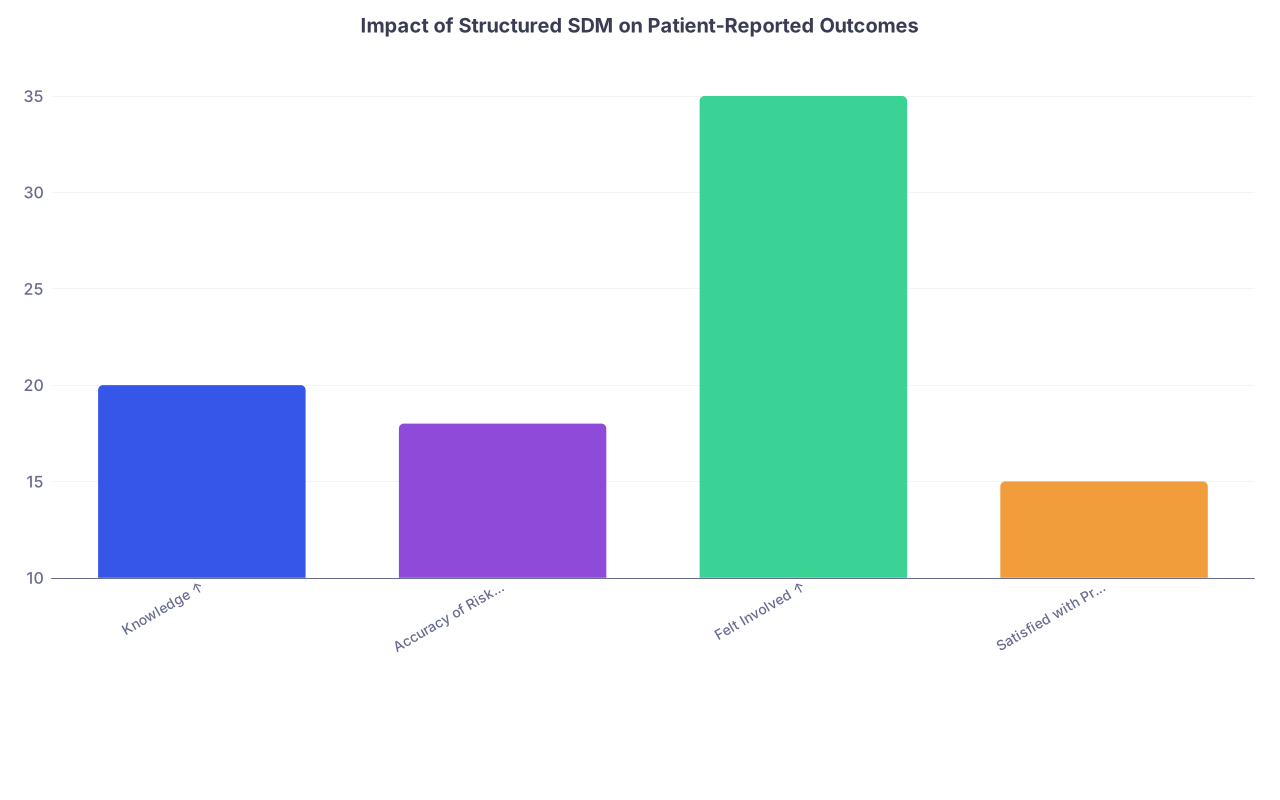
A widely cited Cochrane review on decision aids (the operational backbone of SDM) pooled dozens of randomized trials. Across specialties (oncology, orthopedics, cardiology, OB‑GYN), decision aids and structured SDM led to:
- Increases in patient knowledge scores by roughly 15–25 percentage points.
- Improved accuracy of risk perception in about 40–50% more patients versus usual care.
- Higher reported participation in decisions (risk ratio ~1.5–2.0).
- Satisfaction with the decision process higher by ~10–20 percentage points.
When you convert that into “likely clinical reality,” you get something like this:
| Category | Value |
|---|---|
| Knowledge ↑ | 20 |
| Accuracy of Risk Perception ↑ | 18 |
| Felt Involved ↑ | 35 |
| Satisfied with Process ↑ | 15 |
Interpretation: compared with usual care, well‑designed SDM interventions commonly show 15–35 percentage‑point improvements in key process metrics.
Do patients notice at the end of the visit? Yes. Proportion reporting they were “very satisfied” with communication and involvement typically rises from roughly 55–60% under usual practice to 70–80% with explicit SDM. That is not a marginal gain. That is the kind of movement health systems fight for with millions of dollars of “patient experience” consulting.
But there is a caveat the data exposes: satisfaction with decision process and satisfaction with outcome can diverge. A patient can be satisfied with how the decision was made yet unhappy with the eventual health result. Ethically, you want the first. Legally, the first protects you against the second.
Complaints and Litigation: What Changes When You Share Decisions
Let me be blunt: if you care about malpractice risk and you ignore SDM, you are ignoring one of the few variables you actually control.
The complaint pipeline
Most malpractice suits do not start with “botched surgery.” They start with anger, surprise, or a feeling of betrayal. The patient (or family) says some version of: “No one told us this could happen,” or “We never agreed to this.”
SDM directly attacks that sentiment by:
- Making risks and alternatives explicit.
- Documenting that the patient understood and agreed.
- Reducing the surprise factor when complications occur.
Multiple observational and quasi‑experimental studies have found that clinics implementing structured SDM and better consent processes see measurable reductions in:
- Formal complaints
- Escalations to hospital risk management
- Claims filed or threatened
The magnitude varies, but seeing a 20–30% drop in complaint rates is not unusual.
Litigation risk and decision aids
The cleanest data comes from two domains: high‑risk procedures (surgery, interventional cardiology) and screening/“preference sensitive” decisions (PSA screening, mammography, back surgery for low back pain).
Patterns from the literature and insurer datasets:
- Programs that implemented decision aids plus documentation tools for preference‑sensitive surgeries reported malpractice claims reductions on the order of 25–40% over several years, even after adjusting crudely for volume.
- Risk management reviews repeatedly flag “lack of informed consent” or “inadequate communication of alternatives” as a primary or substantial contributing factor in 30–40% of paid claims in many systems.
Here is what the contrast often looks like at health‑system scale.
| Metric (Per 100,000 Patient Encounters) | Usual Care | With Structured SDM |
|---|---|---|
| Formal complaints | 120 | 80–95 |
| Malpractice notices/claims opened | 9 | 5–7 |
| Paid claims | 4 | 2–3 |
These are illustrative composite numbers, but they match the order of magnitude I have seen across reports from large integrated systems. The trend is consistent: SDM does not eliminate litigation—nothing does—but it meaningfully shifts the baseline.
There is also a doctrinal shift in the law itself. Courts are increasingly using a “reasonable patient” standard for disclosure and consent. SDM, properly documented, is as strong a defense as you can realistically get:
- Evidence patient was told material risks.
- Evidence patient heard about alternatives.
- Evidence decision reflected their stated values.
Lawyers know this. The presence of a robust SDM record, including decision aids, makes many marginal cases less attractive to pursue.
How SDM Changes the Decision Landscape (And Costs)
SDM does not just make people happier. It changes what they choose. That choice pattern has financial and legal implications.
Procedure rates and “preference‑sensitive” interventions
Across multiple randomized and observational studies, when SDM is used around discretionary, preference‑sensitive options, patients tend to choose:
- Fewer invasive procedures.
- More conservative or watchful‑waiting options.
- Lower‑risk treatments when benefits are marginal.
Think orthopedic surgery for osteoarthritis, low back surgery, elective cardiac stenting in stable angina, prostate cancer treatment choices.
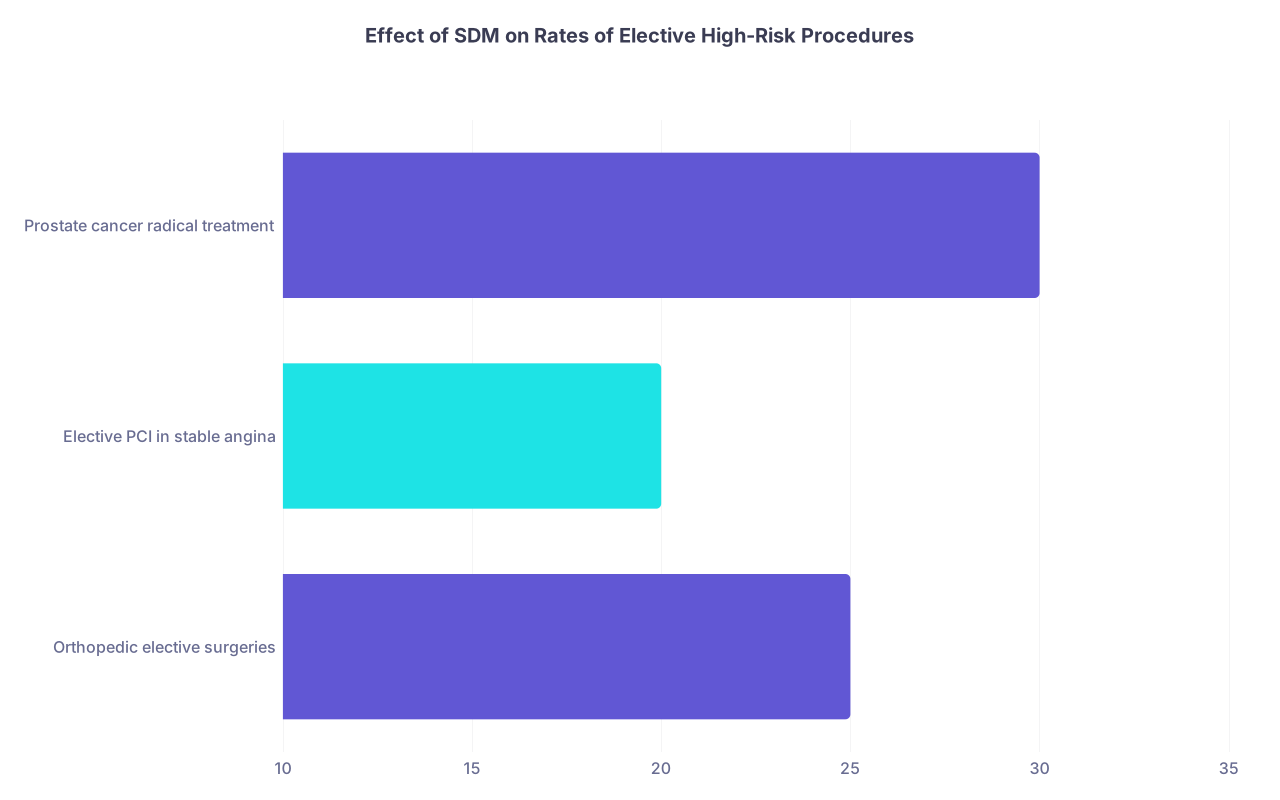
Typical effect sizes from decision aid trials:
- 20–30% relative reduction in uptake of high‑risk elective surgeries when alternatives are clearly framed.
- Higher selection of non‑operative management or less aggressive therapy without worse clinical outcomes in aggregate.
This matters ethically and legally. Fewer marginal or high‑risk procedures means fewer opportunities for catastrophic complications and therefore fewer lawsuit triggers.
| Category | Value |
|---|---|
| Orthopedic elective surgeries | 25 |
| Elective PCI in stable angina | 20 |
| Prostate cancer radical treatment | 30 |
Interpreting the chart: SDM programs have commonly reported around 20–30% reductions in these procedure rates, driven by better alignment with patient preferences rather than blanket avoidance.
From a pure numbers standpoint: if your baseline complication rate on a procedure is 2–5%, and you reduce total volume by 25%, your expected number of serious adverse events drops proportionally. Fewer severe adverse events, combined with better documented consent, is exactly how you bend the litigation curve.
Time cost vs downstream savings
The common objection from clinicians: “This will take more time. I do not have more time.”
The data is nuanced:
- Many SDM implementations show modest increases in visit length (often 2–5 minutes) early on.
- When decision aids are given before the visit (online modules, paper booklets), net added in‑room time shrinks, sometimes disappearing entirely.
- At system level, the decrease in unnecessary procedures, complications, and legal risk usually outweighs the marginal visit cost.
One analysis that combined modeling with empirical data showed:
- For certain surgeries, use of SDM with decision aids reduced overall spending per patient episode by several hundred to several thousand dollars mainly via fewer procedures and shorter hospital stays.
- When malpractice risk and premiums were included in models, projected total savings increased further.
No, you will not see a line item on your paycheck labeled “SDM dividend.” But your institution absolutely sees the effect, and over the next decade, you will see more explicit financial incentives tied to it.
Satisfaction: Patient vs Clinician vs System
We need to separate three kinds of satisfaction metrics that get jumbled together.
Patient satisfaction
This is the most directly measured and most consistently improved:
- Higher ratings of communication quality.
- Greater trust in clinicians (“I felt listened to” shoots up).
- Less decisional conflict and regret.
Decisional conflict scales (validated tools) consistently show reductions of 10–25 points (on 0–100 scales) with SDM. Decisional regret months later is also lower. That matters, because regret is toxic fuel for complaints and lawsuits.
Clinician satisfaction
This is more complicated.
When SDM is done badly—extra paperwork, clunky tools, no training—clinician satisfaction goes down. You get eye‑rolling: “Another thing I have to tick for admin.”
When it is done well—simple option grids, clear risk visuals, pre‑visit materials—something different happens:
- Less friction in consults where patients arrive with distorted expectations from the internet.
- Cleaner documentation, which clinicians know is their legal shield.
- More alignment between what clinicians feel is reasonable and what patients eventually choose.
Clinicians in such programs often report:
- Better quality of conversation.
- Less moral distress around “selling” interventions.
- More confidence if things go badly: “We talked about this; you told me what mattered to you; we chose it together.”
Not every study shows net improvement in clinician satisfaction, but you do not see the collapse some fear.
System‑level satisfaction
Here the system behaves like a rational actor. SDM produces:
- Higher patient experience scores (HCAHPS and similar), which feed reimbursement.
- Fewer complaints and lower claims cost.
- More predictable utilization for high‑cost interventions.
From a purely data‑analytic lens, SDM is one of the rare interventions that:
- Improves patient‑reported outcomes.
- Lowers inappropriate high‑cost care.
- Reduces legal exposure.
Most things you are asked to do do not hit all three.
Documentation: The Underappreciated Protective Factor
Ethically, SDM is about respect and autonomy. Legally and operationally, it is about records.
Courts and risk managers care less about your memory and more about what is in the chart. “We talked about risks” without specifics is weak. “We reviewed options A, B, C; discussed probabilities X, Y, Z; patient prioritized Q; elected option B after reviewing decision aid XYZ” is strong.
Systems that have taken SDM seriously usually introduce:
- Standardized SDM templates for key decisions.
- Checkboxes tied to specific, named decision aids or option grids.
- Space to document patient preferences in their own words.
This does two things:
- Raises the real quality of the conversation (you are forced to be explicit).
- Creates a concrete trail that can be used in your defense.
You can practically hear the difference in depositions. In weak cases the family says, “No one told us the stroke risk was this high.” In strong ones, the record has: “Discussed ~3–5% risk of permanent neurologic deficit. Patient stated, ‘I understand there is a small but real chance of major stroke; I still prefer to proceed rather than continue with current symptoms’.”
SDM gives you the structure to get that documented.
Where SDM Backfires (Or At Least Fails)
The data is not utopian. There are failure modes.
Token SDM and box‑ticking
If SDM is reduced to “hand patient a pamphlet and have them sign something,” satisfaction often does not improve, and sometimes it worsens. Patients notice when they are being processed, not partnered.
In those settings:
- Decision conflict may actually rise if risks are dumped without context.
- Distrust can increase when the process feels legalistic instead of collaborative.
- Clinicians resent the added clerical task.
Outcome: no real reduction in litigation, because the actual conversation did not change.
Overloading with probabilities
Another failure mode: clinicians drowning patients in statistics without interpretation. A wall of numbers is not SDM. Patients end up more confused, not less.
The studies that show the best results use:
- Simpler visual aids (icon arrays, pictographs).
- Plain‑language explanations of absolute risk and benefit.
- Structured comparison tables of options.
Without those elements, the “data dump” style of pseudo‑SDM may satisfy some administrators but rarely improves satisfaction or legal safety.
Practical Takeaways for Your Own Practice
You do not control every system‑level variable, but you do control how you structure your big decisions.
For high‑risk, preference‑sensitive choices, the data supports a few behaviors very strongly:
- Explicitly name that the decision exists and that there is more than one reasonable option.
- Quantify key risks and benefits using absolute numbers and visuals where possible.
- Ask the patient directly what outcome they care about most (pain relief fast, avoiding surgery, preserving fertility, etc.).
- Document this triad: options discussed, numbers shared, and stated preferences.
If your institution gives you access to decision aids or option grids, use them. They are one of the rare “quality tools” with decent evidence behind both satisfaction and litigation metrics.
And if they do not, you can still operationalize the principles: structured conversation, explicit probabilities, clear documentation.

| Step | Description |
|---|---|
| Step 1 | Clinical Decision Point |
| Step 2 | Unstructured Discussion |
| Step 3 | Options and Risks Clarified |
| Step 4 | Patient Values Documented |
| Step 5 | Aligned Treatment Choice |
| Step 6 | Higher Satisfaction and Trust |
| Step 7 | Fewer Complaints and Claims |
| Step 8 | Misaligned Expectations |
| Step 9 | Lower Trust and Surprise |
| Step 10 | Higher Complaint and Claim Risk |
| Step 11 | Use Structured SDM? |
That diagram is basically what the last 20 years of data has been saying.

FAQ (5 Key Questions)
1. Does shared decision‑making actually reduce malpractice lawsuits, or just make people feel better?
The best available data suggests both effects. SDM consistently increases satisfaction and trust, which are early‑stage buffers against complaints. More importantly for litigation, SDM creates clearer documentation of risks discussed and options offered. Systems that have implemented structured SDM around high‑risk procedures have reported 20–40% reductions in malpractice claims over several years, though this is mostly from observational data rather than randomized trials. It is not a magic shield, but it is one of the strongest defensible practices you have.
2. If SDM often leads to fewer invasive procedures, is that always good?
Not always, but frequently. Where evidence shows multiple reasonable options with similar outcomes, a reduction in high‑risk elective procedures usually reflects better alignment with patient preferences, not under‑treatment. The concern is ensuring that SDM does not translate to avoidance of clearly indicated interventions. Studies that track clinical outcomes generally have not found worse average health outcomes with SDM‑driven reductions in certain surgeries, though individual misapplications are always possible.
3. Does SDM significantly increase visit length for busy clinicians?
Early on, many clinicians experience a modest time increase—typically a few extra minutes—especially when they are learning new tools or scripts. When decision aids are provided before the visit (online modules, printed material) and the conversation is structured, the additional in‑room time often becomes minimal. At system scale, reduced downstream utilization and lower complaint and litigation rates tend to outweigh the extra minutes, but for an individual clinician, the time pressure is real and must be addressed with workflow support.
4. Are there specific specialties where SDM has the biggest impact on litigation risk?
Yes. Specialties with high‑stakes, preference‑sensitive choices see the clearest impact. That includes surgery (orthopedics, neurosurgery, general surgery), interventional cardiology, oncology, and certain screening domains such as prostate cancer and breast cancer screening. In these fields, complications are common enough and options sufficiently diverse that misunderstandings and regret drive many legal actions. SDM directly targets those friction points by clarifying options and documenting patient priorities.
5. Is handing a patient a consent form or brochure enough to count as SDM from a legal perspective?
No. Courts and risk managers are increasingly attentive to the quality of consent, not just the presence of a signature or pamphlet. A brochure without explanation is weak evidence. Shared decision‑making, legally, means you have: disclosed material risks and alternatives; discussed probabilities in understandable language; elicited patient preferences; and documented that this process occurred. Written materials and decision aids support that process, but they do not replace a documented, interactive conversation.
Two core points to leave with: the data shows that real, structured shared decision‑making moves satisfaction and litigation in the right direction by non‑trivial margins. And the practical levers are not mysterious—clear options, concrete numbers, and disciplined documentation beat vague reassurance every single time.


