
The fastest way to end your career is to handle opioid requests on autopilot.
You are not just deciding “yes” or “no” when a patient asks for opioids and your gut says something is off. You are balancing three hard truths:
- People are in real pain and undertreatment is unethical.
- Opioids can destroy lives when prescribed poorly.
- One reckless chart note can follow you for decades—legally, professionally, and emotionally.
Let’s fix the chaos and turn it into a clear, ethical protocol you can actually use on Monday morning.
1. Anchor Yourself: What You’re Actually Responsible For
You are not responsible for:
- “Making the patient happy”
- “Proving” that someone is lying
- Guaranteeing zero diversion in the world
You are responsible for:
- Treating pain seriously and respectfully
- Prescribing controlled substances in a medically and legally defensible way
- Documenting your reasoning clearly
- Protecting yourself, your license, and your patients from foreseeable harm
When your brain screams, “This feels wrong,” you need a structured response, not panic.
Here is the ethical frame I use:
- Beneficence – relieve suffering when you reasonably can
- Nonmaleficence – do not cause or contribute to addiction, overdose, or diversion
- Autonomy – respect that patients have a say but not a veto over your medical judgment
- Justice – do not let stigma or bias decide who gets pain relief
Once that’s clear, we can move from vague guilt to specific steps.
2. A 10-Step Protocol for “Opioid Requests You Doubt”
When you suspect misuse, exaggeration, or diversion, follow this. Step by step. Every time.
Let’s break this into real-world actions.
Step 1: Start With Respect, Not Suspicion
Even if you are 99% sure this is drug-seeking, your opening move should always be the same:
- Sit down.
- Make eye contact.
- Start with:
- “I can see you’re really uncomfortable. Let’s go through what is going on so I can understand your pain and what has helped or not helped so far.”
You are doing two things:
- Signaling you take pain seriously.
- Buying time to gather data before deciding.
What you never say:
- “You’re just drug seeking.”
- “We do not give narcotics here.” (As an opening line.)
Those phrases destroy trust and are ethically lazy. You can say “no” later, firmly, but only after you have done the work.
Step 2: Get a Focused, High-Yield History
You are not just checking boxes. You are stress-testing the story.
Ask, in plain language:
- Onset and cause:
- “When exactly did this start? Any injury, surgery, or clear trigger?”
- Pattern:
- “Is the pain constant or does it come and go?”
- “What makes it better or worse?”
- Prior treatments:
- “What have you tried so far? Doses, how long, did it help?”
- Function:
- “What are you unable to do today that you could do before this started?”
- Red flags for OUD:
- “Any history of problems with alcohol or other substances?”
- “Anyone in your family with addiction problems?”
Listen for:
- Vague, inconsistent timelines
- Overly specific drug requests (“Only oxycodone 30s work for me”)
- Refusal to consider non-opioid options
- History that does not match known disease patterns
Do not interrogate. Just calmly collect data.
Step 3: Examine Like It Matters
If your physical exam is two seconds long and perfunctory, your chart will look like you prescribed (or refused) based on vibes.
Do a focused exam:
- Area-specific: range of motion, tenderness, neurovascular status
- Look for objective findings if relevant (swelling, deformity, spasm)
- Screen for sedation, intoxication, withdrawal signs
Document the negative findings just as clearly as the positive ones. That is what saves you when your judgment is questioned later.
Step 4: Check Objective Data – PDMP, Records, UDS
If you have any doubt at all and you are considering opioids, you should be pulling objective data:
- PDMP (Prescription Drug Monitoring Program):
- Look for multiple prescribers, overlapping prescriptions, high doses, early refills
- Prior records (if accessible):
- Imaging, previous notes, pain contracts, ED visits
- Urine drug screen (if clinically appropriate):
- Not as a “gotcha” but as part of your standard protocol when prescribing or continuing chronic opioids in a concerning scenario
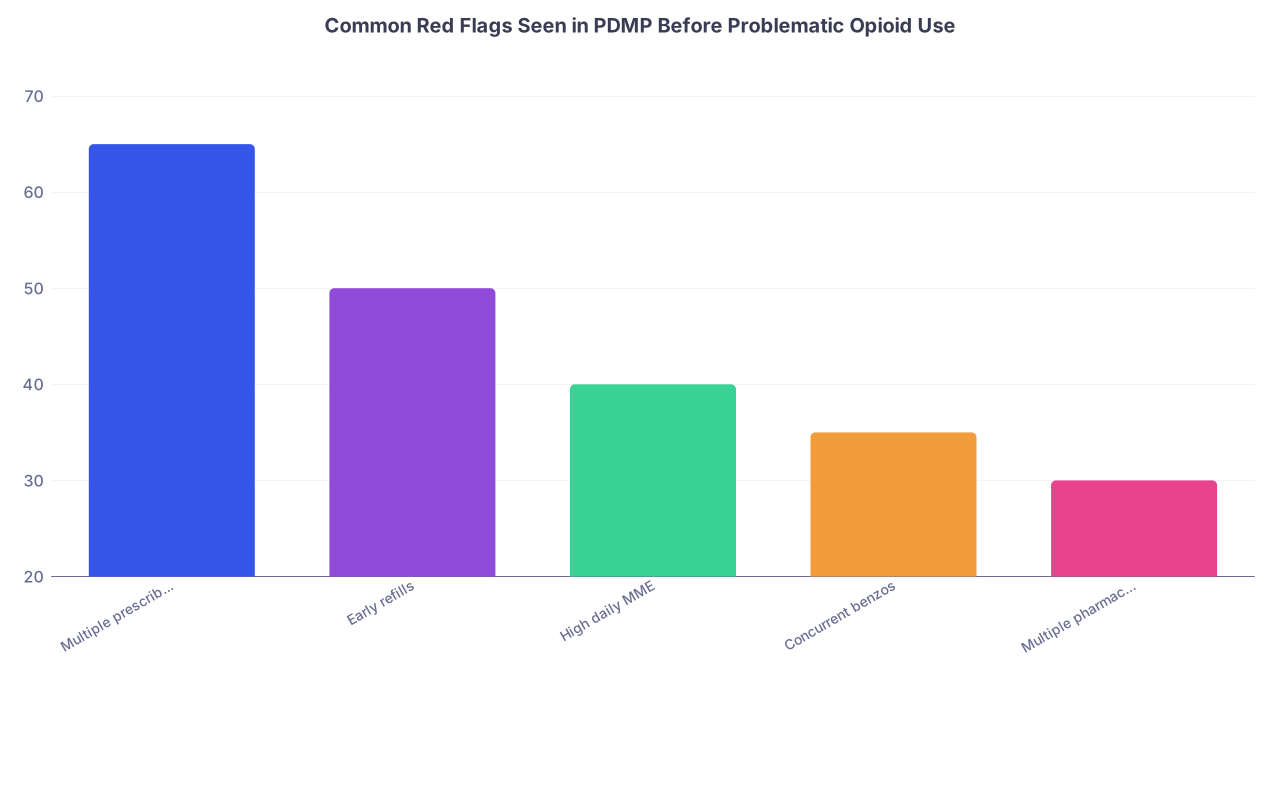
| Category | Value |
|---|---|
| Multiple prescribers | 65 |
| Early refills | 50 |
| High daily MME | 40 |
| Concurrent benzos | 35 |
| Multiple pharmacies | 30 |
You are not required to prove deception. But if the data clearly contradicts the story, you must respond.
3. How to Talk About Your Concerns Without Blowing Up the Relationship
This is where most clinicians fail. They either avoid the conversation (and prescribe) or slam the door (and lose the patient).
Here is a simple script that works.
Step 5: Name the Conflict Clearly and Calmly
After you have history, exam, and PDMP:
You might say:
- “I do not doubt that you are in pain. I also have to prescribe medications in a way that is safe and medically appropriate. Right now, I am concerned about a few things that make strong opioid prescriptions risky.”
Then be specific. Two or three points. Max.
- “The PDMP shows multiple recent opioid prescriptions from different clinics.”
- “Your exam and imaging do not show a problem that opioids are likely to help more than other options.”
- “You mentioned a history of addiction. That makes ongoing opioid use significantly more dangerous for you.”
You are separating:
- “Your pain is real”
from - “This specific medication is not a safe or appropriate solution.”
That distinction is ethically important.
Step 6: Set a Clear Boundary on Opioids
Do not waffle. The worst thing you can do is say things like “maybe” or “just this once” because you feel uncomfortable.
Decide, then state:
- No opioids at all today
- Very limited, time-bound prescription (e.g., acute fracture, post-op rescue)
- Maintain or slightly adjust an existing appropriate regimen (if clearly justified)
Examples:
Firm no:
- “Given your current medications, history, and what I see today, I am not going to prescribe opioids for this pain. I know that may be disappointing, but prescribing them here would not be safe or appropriate care.”
Very limited:
- “Because this is a new fracture, a short course might be reasonable. I am comfortable prescribing X tablets for Y days, with no refills, while we get you set up with follow-up. After that, we will need to rely on non-opioid options.”
Never invite negotiation over strength and quantity like you are bargaining at a market. You decide the medication plan, not the patient.
4. What You Must Do Ethically When You Say No
Saying “no” ethically does not mean doing nothing. You still owe the patient a plan.
Step 7: Offer Real Alternatives, Not Throwaways
If you block opioids and offer nothing, that is abandonment dressed up as prudence.
Create an alternative plan on the spot:
- Non-opioid medications:
- NSAIDs (if safe), acetaminophen, topical agents
- Neuropathic agents (gabapentin, duloxetine, etc.) if indicated
- Muscle relaxants short term if appropriate
- Non-pharmacologic measures:
- Ice/heat, splints, TENS, physical therapy referral
- Brief education on positioning, pacing, activity modification
- Adjuncts for chronic or complex pain:
- Referrals: pain clinic, physiatry, behavioral health, addiction medicine
- Sleep hygiene basics, CBT for pain if resources exist
Phrase it like this:
- “I am not leaving you without help. I cannot safely prescribe opioids, but here is what I can do today…”
Then you actually do it. Prescriptions. Referrals. A return visit. Write them.
Step 8: Address Addiction Risk Directly When Needed
If you are worried about opioid use disorder, say it. Carefully, but clearly.
For example:
- “Based on your history and the prescriptions I see in the database, I am concerned that opioids may already be causing harm. I am worried about the possibility of opioid use disorder. That is a medical condition, not a moral failure, and we can treat it. Would you be open to talking about medication-assisted treatment or addiction support?”
Ethically, ignoring OUD while simply refusing opioids is cowardly. You are obligated to at least open the door to treatment.
If they refuse, you still document that you raised the concern and offered resources.
5. Documentation That Protects You and Honors the Patient
If it is not in the note, it did not happen. And with opioids, sloppy notes are dangerous.
When you doubt an opioid request, your documentation should include:
Subjective
- Patient’s pain description, stated intensity, functional impact
- Direct quote of opioid request if notable (“only oxy 30s work”)
Objective
- Relevant exam findings, including normal findings
- PDMP results (e.g., “PDMP shows 4 prescribers in past 3 months, overlapping oxycodone and hydrocodone”)
- UDS if done, with key positives/negatives
Assessment
- Working diagnosis (e.g., “Acute low back pain without neurologic deficit”)
- Explicit risk assessment:
- “High risk of misuse/diversion due to X, Y, Z”
- Or “Low suspicion for misuse; acute injury consistent; minimal risk factors”
Plan
- Your decision regarding opioids and why
- Non-opioid treatments offered (meds, referrals, instructions)
- Any discussion of addiction risk or OUD
- Patient response, especially if upset or refusing alternatives
A defensible line looks like:
“Discussed that given PDMP findings of multiple overlapping opioid prescriptions and patient’s report of prior addiction treatment, risks of new opioid prescription outweigh benefits. Offered non-opioid pain management, referral to pain management and addiction services. Patient declined addiction referral but accepted NSAIDs and PT referral.”
This is how you protect your license and show you tried to care, not just avoid risk.
6. Legal and Policy Guardrails You Cannot Ignore
You do not practice in a vacuum. Laws and institutional policies around opioids are real and unforgiving.
At minimum, you should know for your state:
- Are there quantity/day limits for acute opioid prescriptions?
- Are there mandatory PDMP check rules?
- Documentation requirements for high-dose or chronic opioids?
- Special rules for combining opioids with benzodiazepines?
And in your institution:
- Is there a standard opioid prescribing policy or guideline?
- Are there pain contracts or controlled substance agreements you are expected to use?
- Who handles complex pain or addiction referrals (and what is the process)?
| Safeguard Type | Examples to Check Locally |
|---|---|
| Legal limits | Max days for acute pain, PDMP rules |
| Institutional policy | Opioid guidelines, pain contracts |
| Documentation rules | Required elements for chronic opioids |
| Referral pathways | Pain clinic, addiction medicine |
You cannot ethically promise a patient something that violates these. When in doubt, bring policy into the room:
- “Our clinic policy, based on state law and safety guidelines, is that we do not start or escalate long-term opioids in a first visit. What I can do today is…”
That is not hiding behind policy. It is aligning your individual ethics with system-level safeguards.
7. Protecting Yourself Emotionally When Patients Get Angry
If you practice long enough, someone will:
- Threaten to complain to administration or the board
- Call you uncaring, racist, cruel, or “just another pill pusher who will not help”
- Slam the door, swear, or give you a one-star review
You still do not cave.
Here is the internal script I use when someone is furious that I refused opioids:
- “My obligation is to practice safe medicine, even when it is unpopular.”
- “Their anger is real, but it does not make my assessment wrong.”
- “I offered help; I did not abandon them.”
And externally, you respond with:
- “I hear that you are upset. My job is to keep you safe and to prescribe in a way that is medically appropriate. I cannot change my decision about opioids today, but I am still willing to work with you on other ways to manage your pain.”
If they become threatening or unsafe, follow your clinic’s safety protocol. You do not have to tolerate abuse to prove you care about pain.
8. Building a Personal Opioid Playbook Before the Next Encounter
You do not want to invent your ethical approach on the fly every time. That is how people burn out or get sloppy.
Take one afternoon and build a simple, written opioid response playbook for yourself:
Default rules
- When you will never start opioids (e.g., chronic non-cancer pain on first visit, active untreated OUD, clear diversion).
- When you might consider a very short course (e.g., acute fracture, post-op, major trauma).
Standard phrases you feel comfortable saying
- For refusing opioids
- For questioning discrepancies (“Help me understand…”)
- For raising OUD concerns
Checklist you follow before prescribing
- History + focused exam
- PDMP check
- Consider UDS
- Non-opioid alternatives considered
Referral map
- Who your go-to pain specialist is
- Who your addiction medicine contacts are
- How to get PT, behavioral therapy, etc., started quickly
Once you have this, you stop making decisions based on how exhausted or anxious you feel that day. You run the playbook.
9. Common Scenarios and How to Handle Them Ethically
Let me walk through three real-world patterns I see all the time.
Scenario 1: “Lost” or “Stolen” Prescriptions
The script:
- “I am sorry that happened; that sounds stressful. Because of the risks with these medications and the regulations we follow, our clinic policy is that we do not replace lost or stolen controlled substance prescriptions. What I can do is review other options for managing your pain safely.”
Then you:
- Document the report
- Offer non-opioid support
- Consider whether the incident changes your ongoing opioid plan going forward
Scenario 2: New Patient Wanting You to “Take Over” High-Dose Regimen
The script:
- “I see you have been on high-dose opioids for some time. Before I can safely take over these prescriptions, I need to fully review your records and assess your pain and risk. Today, I can provide a short bridge prescription at a safer dose while we gather that information, or we can start moving toward alternative options. I am not comfortable indefinitely continuing this dose without a structured plan.”
You are allowed to not continue unsafe regimens just because someone else started them. Ethically and legally.
Scenario 3: Known OUD Patient Asking for Opioids for Pain
This is where many clinicians panic and either:
- Refuse all opioids forever, regardless of clinical situation
- Prescribe like nothing is different, because they feel bad
The middle, ethical path:
- Treat acute pain seriously (they still have pain)
- Recognize their risk is higher, so doses and duration must be tightly controlled
- Prioritize non-opioids and regional or procedural approaches
- Offer or strengthen addiction treatment (buprenorphine, methadone, etc.)
You might say:
- “Your history of opioid use disorder makes these medications much riskier for you. We will focus as much as we can on non-opioid and other strategies, and if we use opioids at all, it will be at the lowest dose for the shortest time, with a clear plan.”
10. Turn Ethical Theory Into Muscle Memory
Ethical opioid prescribing is a skill. Not a personality trait. You build it by repetition, not by reading policy PDFs once a year.
Here is your concrete next step for today:
Open one recent chart where you prescribed or refused opioids in a borderline situation.
- Read your note as if you are a medical board investigator or plaintiff attorney.
- Can a third party see:
- Why you believed or doubted the story?
- What objective data you checked (or did not check)?
- How you balanced pain relief against risk?
- What alternatives you actually offered?
If the answer is “not really,” rewrite that encounter in your head using the 10-step protocol above. Then commit: for the next three opioid-related visits, you will follow this structure and document it clearly.
Do that, and you are not just “trying to be careful.” You are practicing medicine that is ethically solid, clinically defensible, and actually helpful to the people sitting in front of you.