

The biggest mistake clinicians make with agitated but competent patients is trying to “win the argument” instead of regaining control of the situation.
You are not there to win. You are there to lower the temperature, protect safety, and respect autonomy while still doing your job. That requires a structure, not vibes.
Below is a step‑wise strategy I have seen work in EDs, psych units, medical wards, and outpatient crisis situations. It is built on three pillars:
- Safety first
- Autonomy where possible
- Documentation every single time
We will walk through a practical protocol you can run almost on autopilot when the room starts to go sideways.
1. Step 0: Know Your Ethical and Legal Ground
If you do not know the rules, you will either overreact (unnecessary restraints, illegal detention) or underreact (unsafe discharge, abandonment).
For agitated but competent patients, the core points:
Competent patients have the right to:
- Refuse treatment (including leaving AMA)
- Be told the risks, benefits, and alternatives
- Be treated with dignity, even when angry or unpleasant
You must protect:
- The patient from serious and imminent self‑harm
- Others (staff, other patients, visitors) from violence
- Yourself from harm
Capacity ≠ agreement.
A patient can be furious, swearing, and still fully capable of making decisions. You do not get to override them solely for being “difficult.”
Know the capacity triggers
You are ethically and legally safer if you can articulate when you must switch from “de‑escalation with a competent adult” to “possible lack of capacity / involuntary pathway.”
Quick capacity check (you should be able to document this in one paragraph):
- Can they understand relevant information?
- Can they appreciate how it applies to them?
- Can they reason about options and consequences?
- Can they communicate a stable choice?
If yes to all four → you are in the competent but agitated zone. That is this article.
If no → you are in “assess capacity seriously / consider emergency or involuntary measures” territory. Different algorithm.
2. Step 1: Instant Safety Scan and Self‑Control
Before you speak, you do two things fast.
1. Environmental safety check
Walk into any escalating room with this automatic scan:
- Where is the door relative to you and the patient?
- Any obvious weapons or projectiles? (IV poles, metal stands, heavy chairs, sharps)
- Is the room packed with staff standing over the patient? (If yes, that is gasoline on fire.)
- Do you have an easy exit route?
- Do you have a safe person nearby (security, senior nurse)?

If the environment is unsafe, you fix that before you start de‑escalation:
- Remove extra people who are not helping
- Move objects out of reach
- Position yourself between the patient and the door, but not blocking escape like a bouncer
- Keep at least 2 arm lengths distance
2. Your own state
If you walk in angry, rushed, or sarcastic, you lose before you start.
Do this micro‑reset at the doorway:
- One slow breath in
- One slow breath out
- Drop your shoulders consciously
- Uncross arms, hands visible
Then enter slowly, at their eye level if possible, with a neutral to calm tone.
3. Step 2: First 60 Seconds – Anchor the Interaction
The first 60 seconds decide whether the situation escalates or cools.
Use a simple script, then adapt to the person in front of you.
Introduce and legitimize their emotion
- “I am Dr. Patel. I can see you are really upset right now.”
- “You look frustrated and that makes sense in a place like this.”
State your purpose, not your power
- Bad: “You cannot behave like this.”
- Good: “I want to help you get through this safely and as quickly as possible.”
Give them initial control where you can
- “Do you prefer that the door stays open or closed while we talk?”
- “Would you like to sit or stand?”
Set a basic behavioral frame without lecturing
- “I will talk with you as long as we can keep this to words and not physical contact.”
- “We can raise voices a bit, but no threats. Is that fair?”
You are drawing a boundary that is about safety, not morality. You are not their parent. You are a professional responsible for a safe environment.
4. Step 3: Diagnose the Agitation Before “Fixing” It
Trying to solve agitation without understanding the driver is like pushing random buttons in the dark.
Most competent but agitated patients fall into a few predictable categories:
| Driver of Agitation | Clues You See/ Hear | First-Line Approach |
|---|---|---|
| Fear / Feeling ignored | "No one is listening", tearful | Listen, summarize, reassure |
| Perceived disrespect | "You people are rude", personal jabs | Acknowledge, apologize for system |
| Loss of control | Demands to leave, pacing | Offer choices, clear info |
| Physical discomfort | Pain, withdrawal, shortness of breath | Treat symptoms quickly |
| System delays / logistics | "I have been here 6 hours" | Give timeline, concrete steps |
Ask one targeted question
After your initial anchoring, use one focused line:
- “What is making this situation worst for you right now?”
- “If I could fix one thing first, what should it be?”
Let them talk. Do not interrupt the first 30–60 seconds if possible. People burn off a surprising amount of steam when someone actually listens.
As they talk, you are doing two things:
- Identifying the primary driver (fear, pain, control, etc.)
- Assessing risk (are there direct threats? weapons? escalating language?)
Reflect back one clear sentence of what you heard:
- “So, you feel like nobody has told you what is going on and it scares you.”
- “You are furious that you have been here this long and no one has given you results.”
This short reflection is not soft. It is strategic: it tells them you heard the actual grievance, not just the noise.
5. Step 4: De‑Escalation Core Moves (The Working Algorithm)
Now the actual strategy. Think of this as a ladder. You only climb as high as you need.
Step 4A – Listen, Label, and Legitimize
For a competent patient, respect is non‑negotiable. You demonstrate it by:
- Giving them space to speak
- Naming their emotion
- Validating that emotion (not necessarily the behavior)
Examples:
- “You are angry. I would be too if I had been waiting without updates.”
- “You are scared this might be something serious. That is understandable.”
Avoid:
- “You need to calm down.”
- “You are overreacting.”
- “There is nothing to be mad about.”
You are not doing psychotherapy. You are doing triage for conflict.
Step 4B – Clarify Limits and Non‑Negotiables
Once you have shown you understand, you define the playing field.
Non‑negotiables usually include:
- No physical aggression
- No credible threats to staff or others
- No destruction of property
You state limits calmly, without moral judgment:
- “I want to keep working with you. I also need to be very clear: if you hit anyone or throw anything, we will have to bring in security and possibly use medication or restraint. I do not want that for you.”
You then redirect back to autonomy:
- “Within those limits, we have options and I want your input.”
Step 4C – Offer Concrete Choices (Regain Control Without Losing Safety)
Agitated competent patients are often reacting to feeling powerless. You restore some control using bounded choices.
Give 2–3 realistic, safe options, not 10 theoretical ones:
“You can:
- Stay, we complete tests and treatment;
- Take a break in the waiting area and we call you when the next step is ready; or
- You can decide to leave after we discuss risks. Which is closest to what you want?”
“Would you like your partner in the room, or prefer we talk just us two for now?”
You are not tricking them. You are structurally channeling their need for control into safe paths.
Step 4D – Address Legitimate Grievances Fast
If the agitation is partly your system’s fault (and often it is):
- Delays
- Poor communication
- Staff tone earlier
Then you fix what you can in real time.
Examples of useful apologies:
- “You are right that you should have been updated sooner. That did not happen. I am sorry for that, and I am here now to fix it.”
- “The way that sounded earlier probably felt dismissive. That was not the intention, but I hear how it landed.”
Then you act:
- Check the lab yourself
- Call radiology
- Re‑prioritize analgesia
- Ask charge nurse for a room move if feasible
Visible action calms people far more than reassuring words.
6. Step 5: Special Situation – The Angry but Competent “I’m Leaving”
Here is where ethics and law get real. A competent adult can leave, even if you think it is a terrible idea.
Your job is not to imprison them. Your job is to inform, advise, and document.
Mini‑protocol for “I’m leaving now”
Reconfirm capacity briefly
Ask in plain language:
- “Tell me what you understand is going on medically.”
- “What do you think could happen if you leave now without treatment?”
You want to hear:
- Reasonable understanding of the working diagnosis/uncertainty
- Recognition of serious risks (even if they say “I accept that”)
- Clear, consistent choice
Give a clear risk statement
Simple, specific, not melodramatic:
- “If you leave now, we could miss a heart attack, which can cause permanent damage or death.”
- “If this is an infection in your blood and we do not treat it, you could become very sick, very quickly.”
Offer safer alternatives
- “Could we compromise by finishing this one blood test and EKG, which takes 30–45 minutes, and then reassess?”
- “If waiting here is unbearable, we can arrange urgent follow‑up tomorrow with [clinic / primary doctor].”
Respect the final decision
If they still want to go and you believe they have capacity:
- Provide AMA form if your institution uses one
- Give printed discharge instructions when possible
- Offer return precautions: “If X, Y, or Z happens, please come back immediately.”
Do not weaponize care
Never say:
- “If you leave, we will not treat you later.”
- “Sign this or you will not get anything else from us.”
Ethically and legally indefensible.
7. Step 6: When Agitation Escalates Despite Your Best Work
Sometimes, despite clean de‑escalation, a competent patient continues to escalate behavior into unsafe territory.
You are allowed to act.
Clear behavioral triggers to escalate response
You move from verbal de‑escalation to security/physical measures if:
- The patient attempts or threatens physical harm (swinging, shoving, spitting with intent)
- The patient is destroying property in a way that could cause harm
- There is a credible verbal threat (specific, realistic, not a vague insult)
When you escalate, you keep it professional and transparent:
- “You have just thrown the chair and almost hit another patient. This crosses the safety line I explained earlier. I am calling security now.”
Do not debate in that moment. Safety first, ethics second, hospitality last.
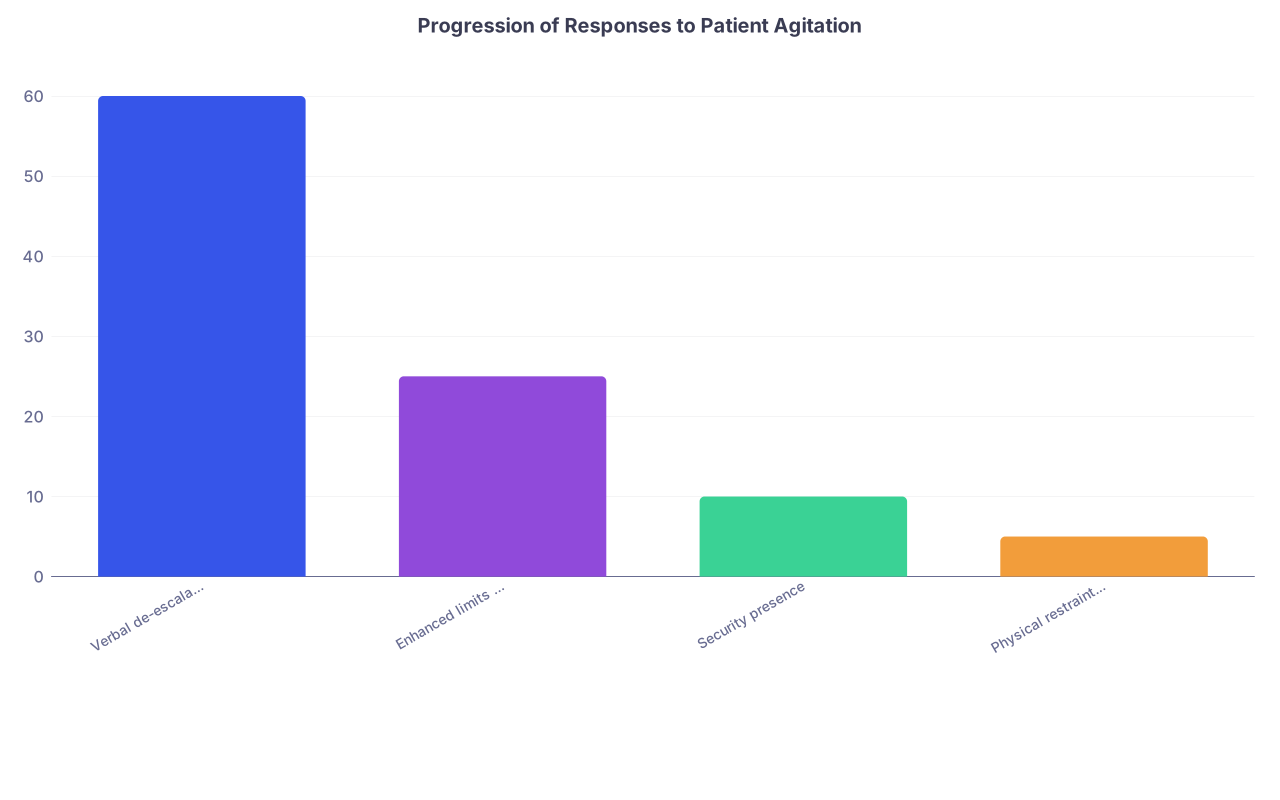
| Category | Value |
|---|---|
| Verbal de-escalation only | 60 |
| Enhanced limits & choices | 25 |
| Security presence | 10 |
| Physical restraint/meds | 5 |
Once the patient is calmer and the immediate crisis has passed, you re‑assess capacity. Competent again? Then you are back to the earlier algorithm, including their right to leave if no legal detainer applies.
8. Step 7: Documentation That Actually Protects You
Most people document agitation badly. Either nothing (“patient agitated”) or a novel that says everything except the important parts.
What you need is concise, targeted documentation that does three things:
- Shows you assessed capacity
- Shows you tried de‑escalation and respected autonomy
- Shows you took safety seriously
A quick mental template:
Behavior and trigger
- “Patient became verbally agitated after being informed of continued wait time for CT results, raised voice, pacing but no physical aggression.”
Capacity elements
- “Patient alert, oriented to person/place/time/situation. Able to state working diagnosis (possible appendicitis) and articulate risks of leaving (rupture, infection, death). Demonstrated reasoning: ‘I understand there is a risk but I have caregiving responsibilities at home and accept that risk.’”
De‑escalation attempts
- “Provided opportunity to express concerns, acknowledged frustration, apologized for delay, offered options: remain for full workup, return later, or leave with clear return precautions. Patient chose to remain after explanation.”
OR - “Patient insisted on leaving despite explanation of risks. Offered compromise (complete CT then decide); patient declined.”
- “Provided opportunity to express concerns, acknowledged frustration, apologized for delay, offered options: remain for full workup, return later, or leave with clear return precautions. Patient chose to remain after explanation.”
Safety measures
- “No physical threats; security not required.”
OR - “Due to chair thrown toward staff, security called. Patient redirected, no restraints used. Risks and boundaries explained.”
- “No physical threats; security not required.”
Outcome and instructions
- “Patient discharged AMA, verbalized understanding of written instructions and return precautions.”

| Step | Description |
|---|---|
| Step 1 | Agitated but responsive |
| Step 2 | Assess safety |
| Step 3 | Assess capacity |
| Step 4 | Verbal de-escalation |
| Step 5 | Offer options and clarify limits |
| Step 6 | Continue care or discharge |
| Step 7 | Security / higher measures |
| Step 8 | Document capacity, options, decision |
| Step 9 | Still unsafe? |
If a lawyer, administrator, or ethics committee reads that note a year later, they should be able to say: “This clinician thought, acted, and documented reasonably.”
9. Practicing the Skill: This Is Not Theoretical
You will not suddenly become good at this in a real crisis if you only read about it.
Build micro‑scripts
Take 3–4 lines from above and memorize them. For example:
- “I can see you are really upset. I want to help you get through this as safely and quickly as possible.”
- “Within the limits of keeping everyone safe, I want to give you choices.”
- “Tell me what you understand is going on and what you think could happen if you leave now.”
These become automatic under stress.
Run low‑stakes drills
On your next shift, do this in 2–3 “mildly irritated” encounters:
- Practice naming the emotion out loud.
- Practice giving 2–3 bounded choices instead of a command.
- Practice one‑paragraph capacity documentation.
Treat each mildly irritated patient as practice for the one who might punch a wall.
10. Red Flags: What Not To Do
You can do 90% of de‑escalation right and still blow it with one bad move. I have seen all of these.
Avoid:
- Sarcasm. “You know, yelling really helps the lab work faster.”
- Power flexes. “I am the doctor; you do what I say.”
- Threats framed as care. “If you walk out that door, do not come back.”
- Public shaming. Calling them out loudly in front of a crowded area.
- Over‑promising. “You will be out in 30 minutes” when you have no control over that.
Most of these are ego protection for the clinician, not care actions for the patient.
11. Quick Reference: Step‑Wise Strategy Summary

Step 0 – Know the rules
- Capacity basic test
- Right to refuse vs duty to protect
Step 1 – Safety and self‑control
- Environmental scan
- Calming yourself before entering
Step 2 – First minute
- Introduce + acknowledge emotion
- State purpose (safety and help)
- Set minimal behavior frame
Step 3 – Diagnose the agitation
- Ask: “What is making this worst for you right now?”
- Identify main driver: fear, disrespect, loss of control, pain, delay
Step 4 – Core de‑escalation
- Listen, label emotion, legitimize
- Clarify non‑negotiables (no violence)
- Offer bounded choices
- Fix what you can quickly
Step 5 – If they want to leave
- Brief capacity check
- Clear risk explanation
- Offer safer alternatives
- Respect decision if capacity intact
Step 6 – If behavior crosses safety line
- Activate security
- Use restraint/meds if necessary
- Reassess capacity once calm
Step 7 – Document
- Behavior + trigger
- Capacity elements
- Steps you took to de‑escalate
- Safety actions
- Final decision and instructions
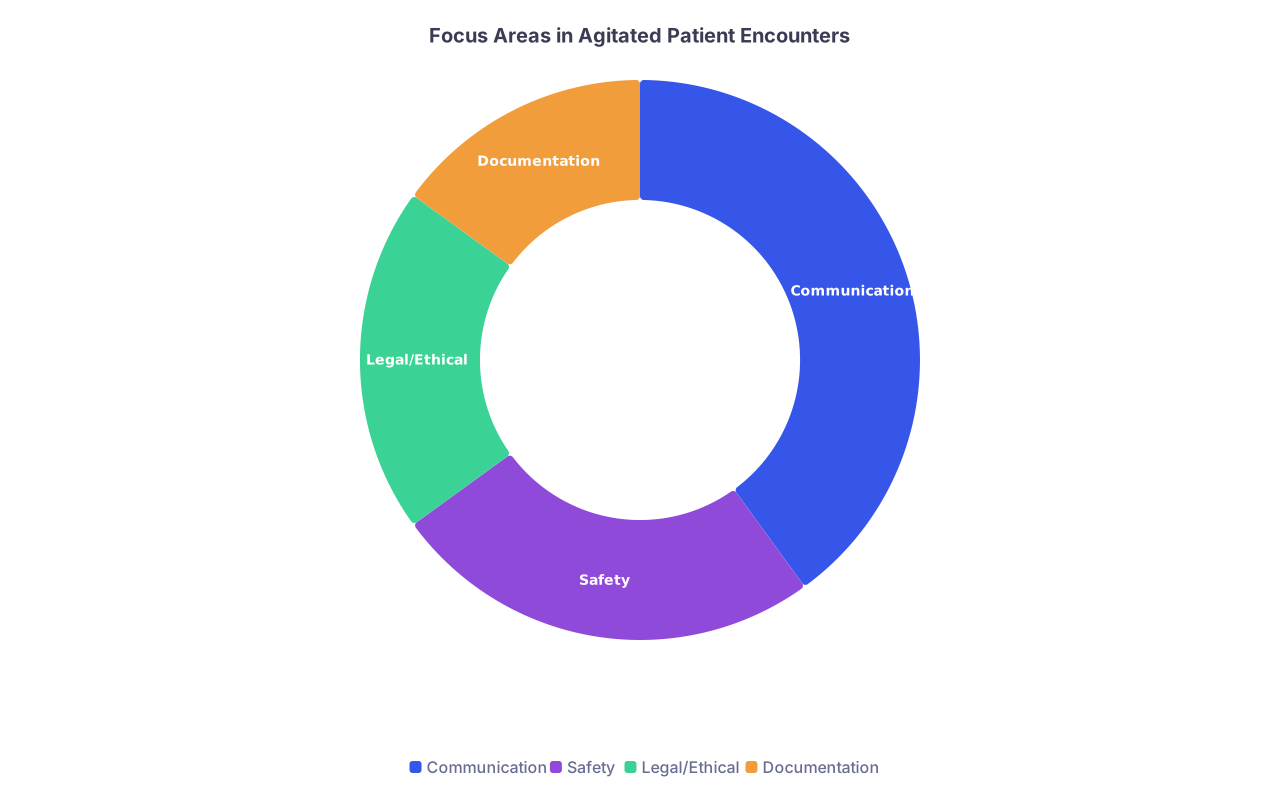
| Category | Value |
|---|---|
| Communication | 40 |
| Safety | 25 |
| Legal/Ethical | 20 |
| Documentation | 15 |
FAQ (Exactly 3 Questions)
1. How do I handle family members who are escalating the patient’s agitation?
First, separate roles. Calmly ask to speak with the patient alone if they are competent: “I need a few minutes one‑on‑one to make sure I understand what you want, then I will bring your family back in and update everyone together.” You can ask a highly agitated family member to step out: “Right now your frustration is making this harder for [patient]. I need you to wait outside while I stabilize things, then I will come talk with you.” Document who was present, how family behavior affected the situation, and that you prioritized the competent patient’s preferences.
2. What if I suspect capacity is borderline but I am not sure?
Err on the side of a more formal capacity assessment, not instinct. Document specifically which elements you are unsure about: understanding, appreciation, reasoning, or communication. Consult a senior, psychiatry, or ethics if available. In emergencies with clear imminent risk, you can provide necessary care even with uncertain capacity, but that does not excuse you from doing the work to clarify it as soon as practicable and documenting your rationale.
3. Can I ever restrain a competent patient purely because they are verbally abusive?
No. Verbal abuse alone, while unacceptable, does not justify physical restraint or forced medication in a competent adult. You can set limits (“If you continue to speak to staff that way, we may ask you to leave once it is safe”) and you can involve security for presence and staff protection. Physical measures require a safety‑based justification: credible threat, attempted harm, or behavior that creates an immediate unsafe environment. Restraints for staff comfort or punishment are ethically and legally indefensible.
Open your last three difficult‑patient notes and check: did you clearly document capacity, the options you offered, and the exact safety boundaries you set? If not, rewrite one of them now as if an attorney or ethics committee will read it tomorrow.


