

The most dangerous patient on your list is often the one who is “medically stable” but clearly not ready to go home.
You know the type. The vitals are fine, labs look decent, imaging is “reassuring,” and the attending wants the bed. But the patient is confused, alone, unsafe at home, or simply does not understand what is happening. You feel sick signing the discharge order.
This is where physicians get burned ethically, legally, and emotionally. And it is fixable—if you follow a disciplined checklist.
Below is a practical, step‑by‑step discharge safety checklist to use when you think a patient is being discharged too early or to an unsafe situation. It is built around three goals:
- Protect the patient.
- Protect you and your license.
- Create a paper trail that shows you acted responsibly, even if others did not.
1. Start With One Core Question: “What Exactly Feels Unsafe?”
Vague discomfort is a warning sign, but it will not hold up in a chart, an ethics consult, or court. You need to translate your gut feeling into specific, documentable concerns.
Ask yourself, and write down:
- Is the patient medically unstable?
- Uncontrolled pain?
- O2 needs not clearly established?
- Unresolved diagnostic concerns?
- Is the patient functionally unable to care for themselves?
- Cannot transfer, toilet, dress, feed independently?
- New mobility impairment with no support arranged?
- Is the patient cognitively impaired?
- Delirium, dementia, post‑ictal, encephalopathy?
- Cannot understand meds, follow‑up, red‑flag symptoms?
- Is there a safety risk at home?
- Lives alone with no help?
- Known domestic violence, exploitation, or neglect?
- Active substance use with high relapse/overdose risk?
- Is there a logistical barrier that makes discharge unsafe?
- No meds, no money, no pharmacy access
- No way to get to follow‑up
- No equipment (walker, oxygen, wound supplies)
Turn that into one sentence in your own head:
“This discharge feels unsafe because ____.”
That sentence becomes the backbone of your actions and your documentation.
2. Clarify Decision-Making Capacity Before Anything Else
You cannot responsibly discharge someone if you do not know whether they have capacity to participate in that decision. This is both ethical and legal ground zero.
Quick capacity check (and document it)
Capacity is task‑specific and time‑specific. For discharge, the patient needs to be able to:
- Understand their condition and the proposed plan.
- Appreciate how the plan (or lack of plan) applies to them.
- Reason about options and consequences in a basic way.
- Communicate a stable choice.
Do a short, focused exam and document something like:
- “Patient able to state diagnosis and why hospitalization occurred.”
- “Patient explains that if they do not take x medication, y consequence may occur.”
- “Patient compares options (home vs SNF vs staying in hospital) and gives reasons.”
- “Patient clearly states preference and is consistent over repeated questioning.”
If they fail any of these, you have a capacity problem. That does not automatically mean they stay forever, but it absolutely changes what you must do and who you must involve (surrogate, ethics, risk management).
3. Escalation Ladder: Who You Involve and When
When you think discharge is unsafe, you do not just complain. You escalate—in a structured way. Here is the ladder I teach residents.

| Step | Description |
|---|---|
| Step 1 | You recognize unsafe discharge risk |
| Step 2 | Clarify specific concerns |
| Step 3 | Discuss with primary attending |
| Step 4 | Document and finalize safe plan |
| Step 5 | Involve charge nurse and case manager |
| Step 6 | Consult social work and PT OT as needed |
| Step 7 | Contact ethics or risk management |
| Step 8 | High risk - strengthen documentation |
| Step 9 | Consider second attending or subspecialty input |
| Step 10 | Issue resolved? |
| Step 11 | Still unsafe? |
| Step 12 | Persistent disagreement? |
Walk this ladder in order, unless the situation is emergent.
Step 1: Primary attending
Be direct, specific, and brief:
“I am concerned this discharge is unsafe because [concise reason]. Here is what I am seeing: [1–2 key facts]. I recommend [alternative plan].”
Avoid vague language like “I’m just not comfortable.” That gets dismissed quickly. Use safety language:
- “High risk for readmission”
- “High fall risk at home with no support”
- “Lacks capacity to understand discharge instructions”
- “Unsafe home environment documented”
Ask explicitly:
“Can we keep them until [condition] is met or arrange [specific resource] before discharge?”
Step 2: Nursing + case management
If the attending still wants to discharge:
- Discuss with the charge nurse or bedside nurse:
- Often they have concrete examples of functional or cognitive limitations you have not seen.
- Loop in case management early:
- Home health
- Short‑term rehab / SNF placement
- Equipment (walker, commode, oxygen)
- Transport options
There is strength in a team‑based concern. When nursing and case management agree this is unsafe, attendings tend to listen.
Step 3: Social work and PT/OT
You are not an expert in home safety assessments or family dynamics. Use people who are.
- Social work:
- Assesses home environment, family support, caregiver strain.
- Can file Adult Protective Services (APS) or involve community resources.
- PT/OT:
- Provides objective functional assessments.
- Recommends rehab vs home, equipment, need for 24‑hour supervision.
Get their specific phrases into the chart. Those notes are gold in any later review.
Step 4: Ethics and risk management
If you still believe the discharge is unsafe and the team insists on moving forward:
- Call ethics if:
- There is disagreement between team and patient/surrogate.
- There is tension between autonomy (“I want to leave”) and beneficence/non‑maleficence (you think they will be harmed).
- Call risk management if:
- There is serious risk of harm and disagreement within the team.
- You are worried about legal exposure for the hospital or you personally.
You are not “being difficult” by doing this. You are doing exactly what policies expect in high‑risk situations.
4. The Discharge Safety Checklist: Clinical, Social, Cognitive, Legal
Now the core checklist. When your gut says “they are not ready,” walk through these domains systematically. It forces you to either solve the problems or clearly document why they could not be solved.
| Domain | Key Question |
|---|---|
| Clinical | Are acute issues stabilized? |
| Functional | Can they manage basic self-care? |
| Cognitive | Do they understand and retain the plan? |
| Social | Is there reliable support at home? |
| Practical | Do they have meds, follow-up, transport? |
| Legal/Ethics | Capacity, consent, documentation solid? |
4.1 Clinical stability – not just “labs are better”
Ask yourself:
- Are vitals stable on the planned home regimen?
- Example: Are they stable on room air if you are not sending them with oxygen?
- Are pain, nausea, or dyspnea controlled with oral meds?
- Are key diagnostic questions reasonably answered?
- If you are discharging with “undiagnosed chest pain, maybe anxiety,” that is risky without clear documentation of negative workup and explicit return precautions.
- Are you stopping or changing critical meds without clear follow‑up?
If the clinical picture is still evolving or fragile, you need either:
- More time in hospital; or
- An explicit reason why discharge now is safer or more appropriate (for example, palliative focus, patient preference after informed discussion).
4.2 Functional status: can they actually live where they are going?
This is where people get hurt. A “medically stable” 78‑year‑old who now cannot get to the bathroom is a disaster waiting to happen.
Ask and answer:
- Can they:
- Transfer from bed to chair?
- Walk to bathroom safely?
- Toilet and clean themselves?
- Prepare simple food and take meds correctly?
You do not guess this. You:
- Ask nursing about mobility and ADLs.
- Look at PT/OT notes.
- If no PT/OT yet and you see issues, request a rapid functional assessment.
If functional status is below what home requires, push for:
- Short‑term rehab / SNF
- Increased home support (family, hired caregivers, home health aides)
- Environmental modifications (bedside commode, walker, etc.)
4.3 Cognitive and educational readiness
Here is the ethical and legal trap: you give perfect discharge instructions to someone who cannot remember them thirty minutes later.
Test understanding in simple language:
- “Tell me in your own words why you were in the hospital.”
- “What medications do you need to take when you get home?”
- “What are the signs that something is wrong and you need to call or come back?”
If they cannot answer, try:
- Using a family member or caregiver at bedside or via phone.
- Simplifying language and using written materials.
- Involving a nurse educator, pharmacist, or interpreter.
If despite efforts they still do not understand:
- Either they lack capacity for this decision, or
- They need a reliable surrogate/caregiver to receive and carry out the plan.
Discharging an unaccompanied, cognitively impaired patient to “home alone” is one of the most indefensible decisions you can make.
5. Social and Practical Realities: The Stuff That Actually Fails
You will not be the first person to discharge a “stable” patient who then never picks up their meds or misses the first follow‑up. Fix that before they leave.
Key questions:
- Medications
- Do they have a way to pay?
- Is the pharmacy open and accessible today?
- Has med‑to‑bed or bedside delivery been offered?
- Follow‑up
- Is an actual appointment scheduled, with a date and time, not “follow up with PCP”?
- Can they physically get there? Who is driving?
- Home environment
- Stairs? Clutter? Pets they cannot manage?
- Oxygen or wound care that requires a higher level of organization?
If the answer to any of these is “no” or “I don’t know,” then you have a gap to close with:
- Social work
- Case management
- Home health
- Family/caregivers
6. Documentation: Your Legal Shield When You Lose the Argument
Sometimes you will do everything right, everyone will know the discharge is marginal, and the patient will still go home—because they insist, or because the attending insists.
At that point, documentation is not busywork. It is how you prove, years later, that you recognized the risk and took appropriate steps.
What to explicitly document
- Your specific safety concerns
- “I am concerned that patient is at high risk for falls at home due to new weakness and limited mobility, lives alone, and has no 24‑hour caregiver.”
- Who you spoke with and when
- “Discussed concerns with Dr. Smith (attending) at 14:30; attending feels patient is appropriate for discharge with home health PT.”
- “Discussed discharge safety with charge RN and case manager; both aware of risks and agree on plan for home health nursing.”
- Capacity assessment
- “Formal assessment of decision‑making capacity performed as above; patient deemed to have capacity to understand and accept risks of discharge.”
- Patient/surrogate discussion
- “Discussed risks of discharge vs staying in hospital with patient and daughter. Explained potential for falls, readmission, and worsening function. Patient verbalized understanding and still prefers to go home today.”
- Resources offered and accepted/declined
- “Offered SNF placement; patient declined.”
- “Home health PT/OT arranged; start date 2 days post‑discharge.”
- Return precautions and follow‑up
- “Provided clear written instructions and reviewed red‑flag symptoms warranting immediate ED return.”
This is the kind of note courts, boards, and risk managers respect. It tells a story of thoughtful, reasonable care even if the outcome is bad.
7. Against Medical Advice (AMA) vs “Discharge You Disagree With”
Do not confuse two different scenarios:
- Patient leaves Against Medical Advice (AMA)
- Team discharges patient; you personally think it is unsafe
They are not the same legally.
When it is truly AMA
AMA applies when:
- The medical recommendation is to stay; and
- The patient has capacity; and
- They choose to leave anyway.
Then you:
- Explain risks and benefits.
- Offer alternative treatment if possible.
- Document the conversation thoroughly.
- Have them sign an AMA form, if available (still discharge them safely: prescriptions, follow‑up, return precautions).
When the team’s plan is discharge, and you object
That is not AMA. The official plan is discharge.
Your responsibility then:
- Escalate as above.
- Make the safest discharge you can.
- Document your concerns and the steps you took.
- If your name is on the discharge summary, make sure your note reflects your evaluation and actions.
If you feel the plan crosses a line into clearly unsafe or unethical care, you have one more tool: politely refuse to write or sign the discharge order and request the attending enter it themselves. I have seen this change the discussion very quickly.
8. Legal and Ethical Anchors: What The Law Actually Cares About
You do not need to be a lawyer, but you should know what gets scrutinized after a bad outcome.
Themes that protect you
- Capacity assessment: Did you reasonably assess and document capacity for the discharge decision?
- Informed discussion: Did you communicate risks, benefits, and alternatives in a way the patient/surrogate could understand?
- Reasonable clinician standard: Did your actions and thought process match what a prudent clinician at your level would do?
- Use of resources: Did you involve the right services (nursing, SW, CM, PT/OT, ethics, risk) when indicated?
- Paper trail: Does the chart show your concerns, actions, and the shared decision‑making process?
Courts and boards do not require perfection. They punish negligence and indifference. Your goal is to be visibly neither.
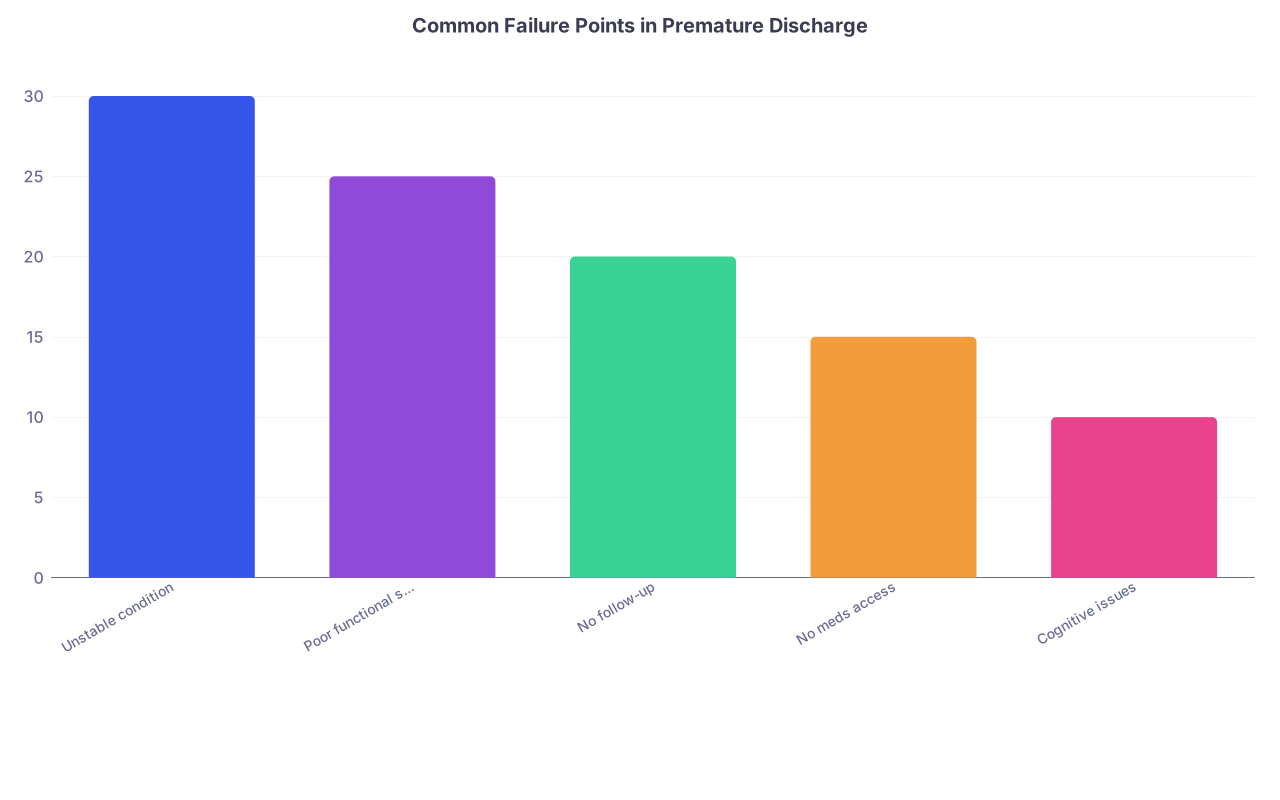
9. Quick Reference: A 10-Point Discharge Safety Checklist
Here is a condensed version you can literally keep on your phone or a sticky note.
| Category | Value |
|---|---|
| Unstable condition | 30 |
| Poor functional status | 25 |
| No follow-up | 20 |
| No meds access | 15 |
| Cognitive issues | 10 |
Before you sign or cosign a discharge for a patient you think is not ready, confirm:
- Vitals are stable on the regimen they will have at home.
- Pain and key symptoms are reasonably controlled with oral meds.
- A basic capacity check is done and documented.
- They (or a caregiver) can explain the diagnosis and main meds in their own words.
- PT/OT and nursing input match the plan (or disagreements are documented).
- Home supports are real, not imaginary: actual names, actual commitments.
- Medications are affordable, available, and a plan exists to obtain them.
- Follow‑up appointment is scheduled—with date, time, and transport plan.
- Social work/case management and, if needed, ethics or risk have been involved when there are serious safety concerns.
- Your note clearly describes your concerns, what you did, and what the patient/surrogate decided after being informed.
If you cannot check off multiple items on this list, you either fix them or you document why they could not be fixed and what you did instead.
10. Training Yourself: Turning Discomfort Into a Habitual Response
You will face this situation repeatedly as a student, resident, and attending. The worst outcome is getting desensitized and going along with unsafe discharges because “that is what everyone does.”
Build a habit loop:
- Trigger: “My gut says this patient is not safe to go.”
- Routine: Run the safety checklist + escalate.
- Reward: You sleep at night, and your patients have fewer preventable crashes.
You will not win every argument. You will not save every patient from a bad home situation. But you will stop being the passive participant who signs orders that make your stomach drop.
And that matters—for your patients and for you.
FAQ
1. What if my attending dismisses my concerns and tells me to “just write the discharge”?
You escalate respectfully. State your concern clearly and briefly. Involve nursing, case management, and social work. If you still lose the argument, you document your concerns and the attending’s decision. If you feel the plan is clearly unsafe, you can ask the attending to place the discharge order themself, and you document that as well.
2. Can I be held personally liable if I am “just the resident” following orders?
Yes, you can. “Just following orders” is not a defense if your name is in the chart and you had enough training to recognize the risk. That is why independent documentation and escalation are critical. Courts look at what you knew, what you reasonably should have done, and what you actually did.
3. How do I handle a patient who insists on going home even though I think it is dangerous, but they clearly have capacity?
You respect their autonomy while doing everything possible to reduce harm. That means a thorough discussion of risks, clear documentation of the conversation, explicit return precautions, arranging whatever support you can (home health, family, equipment), and making follow‑up concrete. It is not your job to make their life risk‑free; it is your job to make sure their decision is informed.
4. When should I involve an ethics consult for a discharge decision?
Call ethics when there is a real conflict between safety and autonomy, when there is disagreement between team members or with family about capacity or goals of care, or when institutional pressures (like bed shortages) seem to be driving a discharge that feels wrong. The earlier you call in complex cases, the better the support and documentation you receive.
Open one of yesterday’s discharge summaries right now. Ask yourself: if this patient had a bad outcome, would a stranger reading your note know that you thought about safety, capacity, support, and follow‑up—or would it look like a template you clicked through? Fix one note today. Then make that your new standard.


