

You are in the tiny windowless conference room off the ICU.
On one side of the table: three siblings, exhausted, one angry, one crying, one quiet and staring at the floor.
On the other side: you, the resident who has been following their father for two weeks, plus the intensivist, a consulting surgeon, and a nurse who has actually known the patient longest.
The surgeon has already said (in the hallway), “If they want us to try, I am willing to operate.”
The intensivist has already said, “This is not survivable in any meaningful way.”
The nurse muttered, “We are torturing him,” while you were writing your note.
They are not on the same page.
You are supposed to lead this meeting.
Here is how you do it without losing control, losing trust, or violating your ethical obligations.
Step 1: Get Your Own House in Order Before You Walk In
If the team is divided and you just walk into the room hoping it will magically sort itself out, you are volunteering for chaos. Do not do that.
You need a pre-meeting huddle. Non‑optional.
1.1 Call a 10–15 minute team huddle
Minimum people:
- The primary attending (or whoever is in charge of the plan)
- You (if you are running the meeting)
- Bedside nurse
- Key consultants with major stakes (e.g., surgery, oncology, cardiology)
- If available: palliative care, social work
In that huddle you must explicitly clarify:
Medical facts
- What is actually going on, in plain language.
- Best case, worst case, and most likely clinical trajectory.
- Time course: hours, days, weeks?
Prognosis and reversibility
- What is potentially reversible with reasonable treatment.
- What is non-reversible regardless of treatment.
- What an “alive but dependent” outcome looks like in this specific case.
Each service’s recommendation
- Intensivist: “I recommend no further escalation beyond current measures.”
- Surgeon: “I can physically do the operation, but I do not recommend it.”
- Oncology: “No further cancer‑directed therapy is likely to work.”
You are not looking for unanimous agreement on details. You are looking for:
- A consistent, aligned narrative about:
- What is happening.
- What is possible.
- What is medically recommended vs merely technically possible.
1.2 Label the disagreement clearly
Say it out loud in the huddle.
Examples:
- “So, surgery is willing to offer the procedure if the family insists, but does not recommend it. The ICU team believes it is medically inappropriate. That is the conflict.”
- “We all agree prognosis is poor, but we differ only on whether one more short trial of pressors is reasonable.”
When you do not name the disagreement, it leaks out sideways during the family meeting. In passive-aggressive comments. In body language. In the “Well, some people might say…” nonsense that destroys families’ trust.
1.3 Decide who is the clinical captain
This is the attending whose recommendation is primary for this decision. Generally:
- Global prognosis / goals of care → primary attending / ICU / palliative.
- Procedure‑specific questions → procedural specialty, but within the frame set by global prognosis.
You need one person whose statement carries final weight if there is inconsistency.
If that is not clear, you stop and fix that first. Otherwise the family will sense the vacuum and the meeting will fracture.
1.4 Agree on what will not be offered
This is critical, ethically and legally.
You must decide before the meeting:
- What treatments the team considers:
- Medically inappropriate (no benefit, only harm)
- Outside standard of care
- Futile in the strict sense (cannot achieve the intended physiologic goal)
Those do not get presented as “options.”
You say internally:
- “We will not offer CPR because it is non‑beneficial in this context.”
- “We will not offer the surgery as a recommended treatment. At most, we can explain why we do not recommend it.”
This is where people get into trouble: they throw every option onto the table and then blame the family for “choosing wrong.” That is cowardly. You are the medical professional. You have an obligation to filter.
Step 2: Know the Patient, Not Just the Case
You cannot run a high-stakes meeting on medical data alone. You need moral data: who this person is and what matters to them.
2.1 Review what is already known
- Any advance directive or living will?
- POLST/MOLST forms?
- Prior documented conversations (progress notes, palliative consults)?
- Comments from the bedside nurse: “He always said he never wanted to be ‘a vegetable’.”
If nothing is documented, ask staff who have spent time with the patient conscious (or with long‑term caregivers).
2.2 Build a one-line “values summary”
You want a single sentence in your head that captures the patient’s priority, for example:
- “Mr. R values independence and being mentally sharp more than simply being alive.”
- “Ms. L prioritized time with her grandchildren even if that meant more hospital time.”
- “He explicitly said he did not want to be on machines long‑term.”
That one sentence becomes your North Star during the meeting. When things get messy, you keep dragging the discussion back to that.
Step 3: Structure the Meeting from the First Sentence
Walk into the room with a plan, not vibes.
You are going to:
- Set the ground rules and your role.
- Share a concise medical summary.
- Elicit values and prior wishes.
- Make a recommendation tied to those values.
- Address disagreement, confusion, and emotion.
- Clarify decisions and next steps.
3.1 Opening the meeting: script it
Something like:
“Thank you all for coming. I know this is very hard and you are exhausted.
I am Dr. X, the medicine resident working with Dr. Y, the ICU attending. With us are Dr. Z from surgery and your nurse, [Name].
Our goal today is to explain clearly where things stand, understand what mattered most to [patient name], and then talk together about what medical decisions best fit who they are.”
Then set expectations:
“We will start with a brief medical update, then I will ask you a few questions about [patient name] as a person, and then we will give you our medical recommendation. You will have time to ask questions at any point.”
You are claiming the structure. That alone reduces chaos.

Step 4: Present a Unified Medical Story (Even If the Team Disagrees Behind the Door)
Families can handle bad news. They cannot handle contradictory news.
Your job is to translate the pre‑meeting huddle into one coherent narrative.
4.1 Use the “headline – a few key points – forecast” structure
Example:
“The headline is that your father’s infection has overwhelmed his body, and he is now in multi‑organ failure.
We are supporting his blood pressure with medicines, his breathing with the ventilator, and his kidneys have essentially stopped working.
We are not seeing signs that his body is recovering despite these treatments.
Looking ahead, our expectation is that he will not get back to an independent life. Without the machines, he would likely die within hours to days. With them, his organs are continuing to fail.”
Short. Clear. No euphemisms like “doing poorly” or “very sick” without defining them.
4.2 Name the limits of medicine
You must clearly separate:
- What medicine can do (physiologically).
- What medicine cannot do (restore prior function, cure underlying disease).
For example:
“We can continue the ventilator and add dialysis. That may keep his heart beating for some additional time.
What we cannot do is reverse the brain injury or make him the independent man you knew again. That part is not fixable.”
This framing is where a lot of ethical confusion clears up. The “more treatment” vs “less treatment” frame is useless. You want “treatment that aligns with achievable goals” vs “treatment that does not.”
4.3 Coordinate specialties carefully
If multiple doctors will speak, choreograph it in advance:
- One person (ideally you or the primary attending) owns the global story.
- Consultants speak only to their slice, but respect the global framing.
If the surgeon must say something, coach them beforehand:
- Wrong: “We can do the surgery if you want, but it is risky.”
- Right: “From a surgical technical standpoint, it is possible to operate. However, because of his overall condition, I agree with Dr. X that this operation is very unlikely to help him wake up or return to his prior life. For that reason, I do not recommend surgery.”
If someone starts freelancing in the meeting and undermines the shared narrative, you may need to gently realign:
“Thank you, Dr. Z. To connect that back to the big picture: even with that procedure, we would still have the same problems with his brain and other organs. That is why, as a team, we are recommending against it.”
You are allowed to steer your colleagues back into alignment in real time. Do it respectfully but firmly.
Step 5: Elicit Values Before You Ask for Decisions
Where teams and families go wrong: jumping straight to “Do you want X or Y?” without grounding decisions in what matters to the patient.
You fix that by asking targeted values questions.
5.1 Ask specific, not abstract, questions
Avoid “What would she want?” as your only question. It is too big. Break it down:
- “When she thought about being very sick, did she ever talk about what would be acceptable or unacceptable to her?”
- “What worried him most about getting older or sicker?”
- “If he could hear us now, and we told him the best we can do is keep him alive on machines, unable to talk or think clearly, how do you think he would respond?”
You want concrete statements like:
- “She said she would never want to be kept alive on machines.”
- “He always said, ‘Do everything,’ as long as he could still talk to us.”
- “She was okay with treatments if they would help her get home, but not if it meant living in a nursing home long-term.”
Write those down. Quote them back later when you make your recommendation.
5.2 Recognize surrogate distress vs patient values
Sometimes the family’s fear or guilt hijacks the conversation.
You might hear:
- “I can’t be the one to decide to ‘pull the plug’.”
- “If I stop now, my brother will blame me.”
- “God decides when it is time, not us.”
Instead of arguing theology or morality, reframe:
“I am not asking you to decide whether he lives or dies. His illness is causing his organs to fail, and that part we cannot change.
What I am asking is for your help understanding what kind of care he would want from us now, given what is possible and not possible.
Our job together is to follow his values as best we can.”
You are shifting the burden from “you are killing him” to “you are representing him.” Ethically and psychologically, that matters.
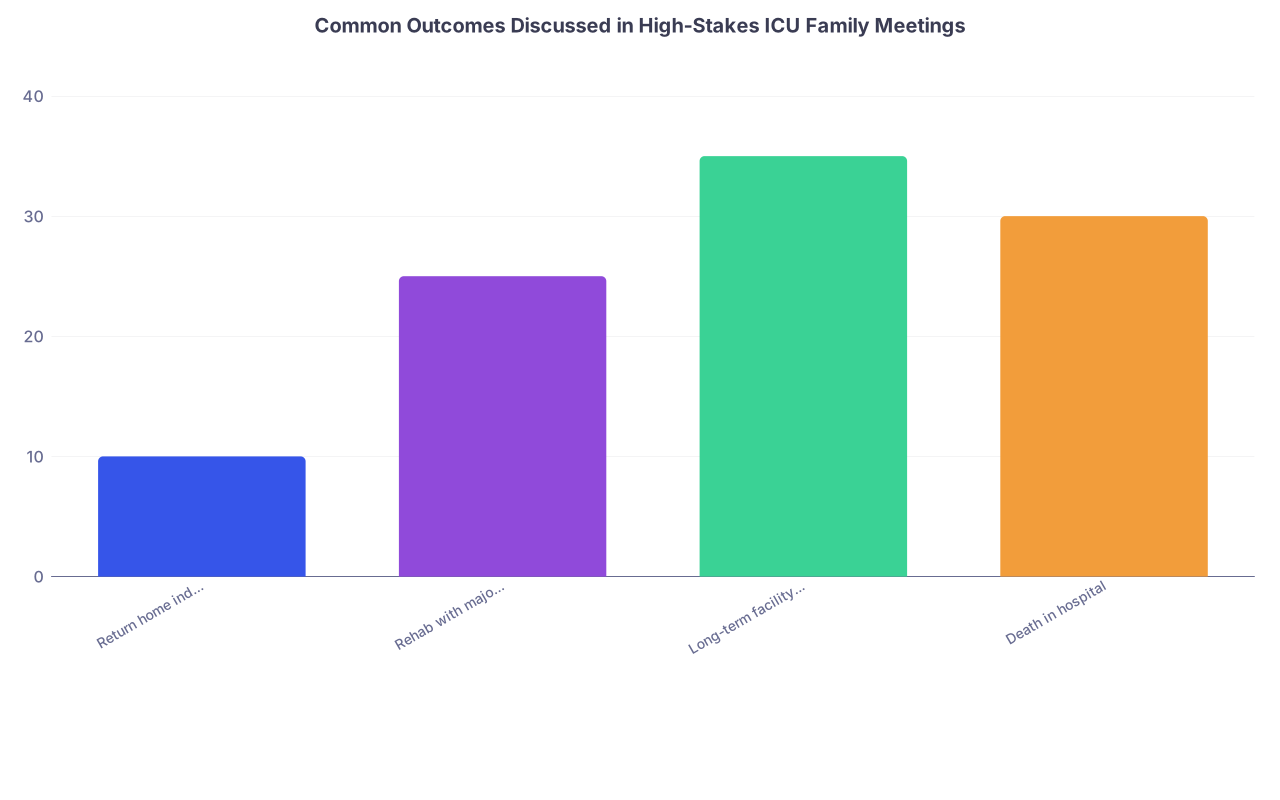
| Category | Value |
|---|---|
| Return home independent | 10 |
| Rehab with major deficits | 25 |
| Long-term facility dependent | 35 |
| Death in hospital | 30 |
Step 6: Make a Clear Recommendation (Do Not Dump Options)
You are not a waiter listing menu items. You are a professional giving your best clinical and ethical judgment.
6.1 Tie recommendation directly to values
Structure it like this:
- State the value.
- State the medical reality.
- Connect to a recommendation.
Example:
“You told me that what mattered most to your father was being able to think clearly and live at home, and that he would not want to be kept alive on machines if that was not possible.
Medically, we do not see a path back to him living independently or coming off the ventilator in a meaningful way.
Because of that, my recommendation is that we focus now on keeping him comfortable and allow a natural death, which means we would not start new machines like dialysis and we would talk about removing the breathing tube when you are ready.”
Then stop. Let silence do some work.
6.2 Use “We recommend” language, not “Do you want…”
- Wrong: “Do you want us to do everything?”
- Slightly less wrong but still weak: “Would you like us to make him DNR?”
- Right: “Given what you have told us and what we know medically, we recommend that when his heart stops, we allow him to die naturally and not perform CPR. That would be a Do Not Resuscitate order.”
You can add:
“This is our best medical and ethical judgment of what fits who he is. You do not have to decide this second. Tell us what questions or worries you have about that plan.”
6.3 If the team is divided on the recommendation
If you could not get true agreement in the huddle, you still must not present chaos.
You have two options:
- Primary attending gives the unified recommendation, others keep quiet about internal disagreement in the room. This is often the best choice.
- If a dissenting view must be shared, frame it explicitly as secondary and clarify standard of care.
For example:
“As a team, our recommendation is to focus on his comfort and not escalate treatments.
Dr. Z from surgery has said that while they do not recommend an operation, technically it could be attempted. However, it would not change his chance of meaningful recovery, and it carries a high risk that he would die in the operating room. It is not standard of care, and we worry it would cause more harm than benefit.”
You do not let a consultant say “I would do it if you want” without that full context. That is how you end up with moral distress and accusations of “you pushed us into this.”
Step 7: Manage Emotion Without Losing Direction
High-stakes meetings are not just about reasoning. They are about grief, fear, anger, and sometimes decades of family baggage.
You are not a therapist, but you cannot ignore it either.
7.1 Let the first emotional wave land
When you deliver bad news or a strong recommendation, expect reactions:
- Silence.
- Tears.
- “So you are giving up?”
- “I knew this would happen.”
- “You don’t know him like we do.”
Do not immediately defend yourself or restate the data. Give 10–20 seconds of silence. Then one validating statement:
- “I can see how much you love her.”
- “This is not what you were hoping to hear.”
- “I hear how angry and scared you are.”
That buy‑in earns you the right to continue the conversation.
7.2 Name and reframe “Do everything” demands
When someone says, “Do everything,” respond with:
“When you say ‘do everything,’ can you tell me what you are hoping those treatments would accomplish for him?”
Then clarify:
“We will always do everything to treat his pain, his breathing comfort, and his dignity.
Some treatments, like more shocks and chest compressions, will not help his underlying condition and will likely cause suffering. Those are the things we are recommending against.”
You are not refusing “everything.” You are refusing non-beneficial interventions. Language matters.

| Step | Description |
|---|---|
| Step 1 | Pre-meeting huddle |
| Step 2 | Clarify facts and prognosis |
| Step 3 | Identify patient values |
| Step 4 | Open family meeting |
| Step 5 | Share medical story |
| Step 6 | Elicit values from family |
| Step 7 | Give recommendation |
| Step 8 | Clarify orders and next steps |
| Step 9 | Address concerns and emotions |
| Step 10 | Plan follow-up meeting / ethics / palliative |
| Step 11 | Family agrees? |
| Step 12 | Still conflict? |
Step 8: When the Family and Team Still Disagree
Sometimes, even after a perfect meeting, you have a hard conflict:
- Family demands CPR or surgery the team finds non‑beneficial.
- One sibling wants comfort care; another wants maximal interventions.
- Religious or cultural framing leads to different conclusions.
You are not powerless. You just need a structured approach.
8.1 Separate cannot from will not
First question: Is what they are asking medically possible and within the bounds of standard of care, even if not recommended?
- Example: One more day of pressors in the ICU → possibly acceptable as a time-limited trial.
- Example: High-risk surgery with near-zero chance of meaningful survival → likely beyond standard of care.
- Example: CPR on a dying metastatic cancer patient with multi-organ failure → medically non‑beneficial and can be ethically withheld.
You should not provide treatments that are strictly futile (cannot achieve intended physiologic effect) or clearly outside accepted practice just because the family insists. That is not shared decision-making; that is abandonment of professional responsibility.
8.2 Offer time-limited trials when appropriate
For certain conflicts, a time‑limited trial can align values with reality.
Structure it clearly:
- Specific intervention(s).
- Specific time period.
- Specific clinical markers of “success” vs “failure.”
- Pre-agreed change in plan if markers are not met.
Example:
“You have said that you need to know we tried everything reasonable.
We can try continuing the ventilator and pressors for the next 48 hours.
If during that time he shows X and Y signs of improvement, then we can reconsider.
If he does not, or if he worsens, then we would recommend stopping these treatments and focusing on comfort. Does this plan sound like something that would honor what he would want?”
Put this in the chart. Explicitly. Vague “trials” become endless when not documented.
8.3 Escalate help early: palliative care and ethics
If you sense that disagreement is deep (values-level, not just information-level), pull in support early, not on day 17.
- Palliative care – for communication, symptom management, values exploration.
- Ethics consultation – when you have genuine ethical uncertainty or conflict about what is appropriate to offer or withhold.
- Social work / chaplaincy – to deal with family dynamics and spiritual distress that you cannot resolve.
From a legal/ethical perspective, involving ethics does two things:
- Protects the patient’s interests by bringing in broader expertise.
- Documents that the team took the conflict seriously and used institutional processes, which matters if things go sideways.
8.4 Know your local law and policy basics
You do not need to quote statutes, but you must respect core principles:
- Surrogates are supposed to represent the patient’s wishes and values, not their own.
- In most jurisdictions, clinicians are not legally required to provide treatments they judge to be non‑beneficial or outside standard of care.
- Many hospitals have futility policies or conflict-resolution pathways. Know them. Use them.
When you reach the point where the team believes a requested treatment is ethically inappropriate, you do:
- Clear documentation of rationale.
- Repeat conversations with the family, explaining your reasoning.
- Ethics consultation.
- If policy allows, process to transfer care to another willing clinician or institution, if feasible.
You do not threaten legal action. You do not abandon. You do not secretly sabotage treatments. You use the formal processes designed for exactly this situation.
Step 9: Close the Loop: Orders, Documentation, and Debrief
The meeting is not done when everyone leaves the room. It is done when:
- Orders match what was agreed.
- The chart reflects what happened.
- The team has processed the outcome.
9.1 Convert decisions into explicit orders
Right after the meeting:
- Update code status orders.
- Adjust treatment plans (e.g., no new pressors, no ICU transfer, no escalation to surgery).
- Write comfort‑focused orders if transitioning to palliative care or hospice.
Do not leave verbal plans hanging without orders. Night teams will revert to maximal interventions when plans are vague.
9.2 Document like a lawyer is going to read it
Your note should include:
- Who was present (family and clinicians).
- Clear medical summary given.
- Specific values and quotes from the family about the patient.
- The recommendation you gave and the rationale.
- The family’s response, including explicit consent or disagreement.
- Any time-limited trials agreed upon, with criteria.
- Plans for follow-up meetings or consultations (palliative, ethics).
If there was internal team disagreement, document the final unified plan and, if relevant, that ethics/palliative will be involved. You do not need to air every intra-team spat in the chart, but do not hide reasoned dissent that affects patient care.
9.3 Debrief with the team
After a high-stakes meeting, especially a hard one:
- Quick 5–10 minute hallway debrief:
- What went well?
- What felt off?
- Are nurses and consultants clear on the plan?
This is not fluff. It reduces moral distress and prevents individuals from going rogue later because they felt unheard.
Step 10: Build Your Own Skill Set Over Time
You will not be perfect the first 10 times. No one is. But you can get systematically better.
Concrete ways:
- Watch your attendings and palliative colleagues in these meetings. Steal their lines.
- Keep a short list of phrases that work for you:
- “The headline is…”
- “What worries you most right now?”
- “Help me understand what ‘everything’ means to you.”
- “Given what you have told me, my recommendation is…”
- Ask for feedback afterwards: “Anything I should have said differently?”
Ethically, the bar is not perfection. The bar is:
- Honest, clear communication.
- Respect for the patient’s values.
- Professional integrity about what is medically appropriate.
- Willingness to use institutional resources when conflict persists.
You can meet that bar, even as a trainee, if you stop winging it and start using a structure like the one above.
Key Takeaways
- Do the pre‑work. Run a short team huddle before the meeting to align on facts, prognosis, boundaries of what you will and will not offer, and who is the clinical captain.
- Anchor in values, then recommend. Elicit concrete patient values, tie them to the real medical trajectory, and give a clear, unified recommendation instead of dumping options.
- Use structure when conflict persists. Time-limited trials, palliative and ethics consults, and clear documentation are your tools when families or team members disagree about high-stakes decisions.


