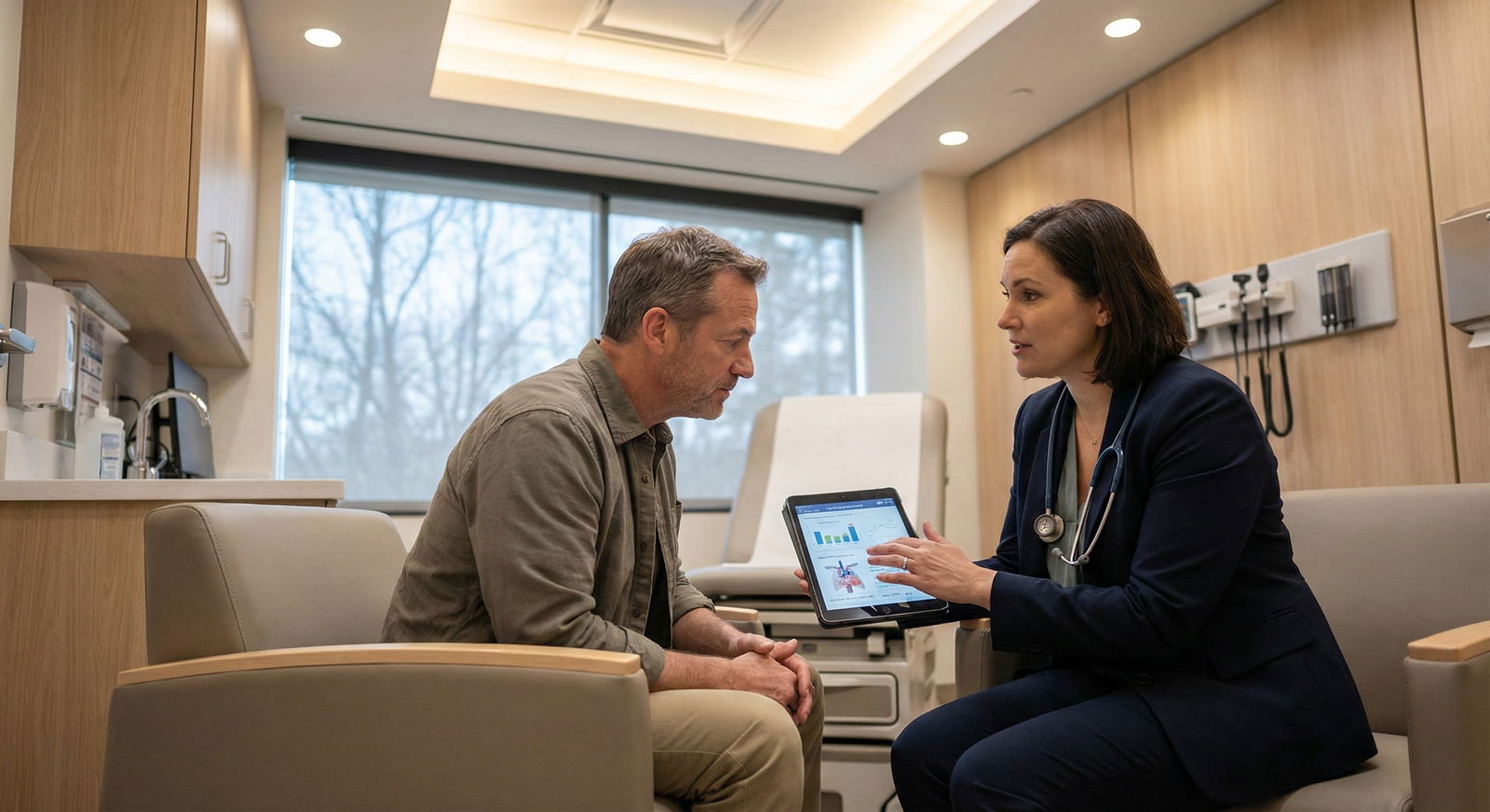
The most dangerous conflicts with consultants are not the loud arguments. They are the quiet moments when everyone is polite, no one wants to push, and the patient gets hurt.
You are not paid to keep consultants comfortable. You are paid to keep patients safe.
Let me walk you through how to handle this like a professional who actually protects patients, not just documents concern in the chart and hopes for the best.
1. Understand What You Are Up Against
Conflicts with consultants are rarely about medicine alone. They are about:
- Power and hierarchy
- Ego and reputation
- Time and workload
- Fear of liability
If you pretend it is “just a difference of opinion,” you will lose these battles.
Here is the core ethical rule you cannot outsource to any consultant:
If you believe a patient is at significant risk of harm, you own that concern until it is truly resolved or safely handed off. Not when someone else says, “It’s fine.”
Most of the failures I have seen around this fall into a few predictable patterns:
The “drive-by” refusal:
Consultant: “This is not a surgical abdomen. Call medicine.” Click.The blame shift:
Consultant: “If ED would stop over-calling, we would not be burned out.”
Resident: “Maybe I am over-calling.” Patient: deteriorates at 03:00.The documentation shield:
Team: “Disussed with consultant X, who does not recommend intervention at this time.”
And then…nothing else. No escalation. No second opinion. Just a note.
That last move is ethically lazy and legally dangerous. Documentation does not replace action.
So the mindset shift:
- You are allowed to disagree with a consultant.
- You are allowed to escalate.
- You are obligated to act when patient safety is in question.
2. A Simple Structure for High‑Risk Consultant Calls
You need a repeatable structure. When things get heated, your brain will want to shortcut. That is when you miss details, sound unsure, and give the consultant an easy way to say “no.”
Use a tight, predictable format every time the situation has any safety risk:
Preparation – 2 minutes max
- Review vitals, labs, imaging yourself.
- Know the core numbers: BP, HR, RR, O2 sat, temp, urine output, lactate, key imaging result.
- Write down your specific ask in one sentence:
“I am calling to request emergent cath.”
“I am calling to request admission to your service.”
Presentation – 60–90 seconds
- Start with urgency and trajectory, not a novel:
- “This is an unstable patient with worsening hypotension and rising lactate.”
- Then a crisp SBAR (or similar):
- Situation: 1–2 lines
- Background: 3–4 key points
- Assessment: what you think is happening
- Recommendation: what you are asking them to do
- Start with urgency and trajectory, not a novel:
Clarify and Nail Down the Plan
- Ask: “What is your working diagnosis and what is your specific plan for the next 2–4 hours?”
- If their plan is vague (“We will watch”), that is not enough in a high‑risk situation.
Safety Check
- If you still feel the plan is unsafe, say so directly:
- “I am still concerned that this plan does not address X, and I believe this puts the patient at risk for Y.”
- If you still feel the plan is unsafe, say so directly:
This structure does two things:
- It focuses the consultant on the risk and the ask.
- It creates a clear record of what was requested and what was declined or agreed.
3. Language That Works When Consultants Push Back
You do not need to be rude. You do need to be unambiguous.
Here are phrases I have seen work in real conflict scenarios.
When the consultant dismisses your concern
Consultant: “They are not that sick. Just admit to medicine and we will see them in the morning.”
You:
- “Let me state my concern clearly. Their blood pressure has dropped from 110 to 80 over two hours, lactate has risen from 2.0 to 4.5, and they are requiring increasing oxygen. I am worried about decompensation before morning.”
- “Given that, I am specifically requesting [ICU admission / emergent endoscopy / cath / stat CT]. Are you declining that request?”
That last line is important. Ask them if they are declining. It forces clarity. No one likes to hear themselves say, “Yes, I am declining an ICU transfer in a shocky patient.”
When the consultant wants to avoid responsibility
Consultant: “Happy to follow as a consult, but this is not our admission.”
You:
- “Right now, my concern is not the admitting service label. It is that the patient needs [intervention/level of care]. Can you take ownership of that piece while we sort out the bed?”
If they still resist:
- “I understand you may not want the admission. I am asking specifically: will you or will you not perform [procedure / intervention] in this timeframe?”
When things are deteriorating and they are still minimizing
Consultant: “Call me back if they get worse.”
You (and you say this once):
- “They have already gotten worse. That is why I am calling. If they deteriorate further, we may not have time for [procedure / transfer]. I believe the safe window is now.”
Then you escalate. Which brings us to the real leverage point.
4. Escalation: How to Do It Without Burning the House Down
Most residents know they “can escalate.” Very few know how to do it effectively and ethically without starting a war.
Here is the rule: Escalate the problem, not your emotions.
A. Internal escalation first
Before you go over a consultant’s head, pull your own chain of command:
- Call your senior or attending
- “I want to run a safety concern by you. I believe patient X is at risk, and I am not getting adequate response from consultant Y.”
- Present the case tightly.
- End with: “My ask is that we escalate this, but I want your input on the best way.”
Nine times out of ten, your attending has had the same fight with this consultant before. They know exactly what phrases work and who to call.
- Use your institution’s existing pathways
Many hospitals have:
- Rapid response teams
- ICU outreach teams
- “Surgeon of the day” or “hospitalist triage” lines
- Formal “chain of command” policies for unresolved disagreements
If your gut says “this feels like overreacting,” check yourself. Patients go to the ICU all the time because someone overreacted early. Almost no one dies because the ICU got involved too soon.

| Step | Description |
|---|---|
| Step 1 | Identify Safety Concern |
| Step 2 | Call Consultant |
| Step 3 | Implement Plan |
| Step 4 | Call Senior or Attending |
| Step 5 | Use Chain of Command or Rapid Response |
| Step 6 | Document and Debrief |
| Step 7 | Resolved and Safe? |
| Step 8 | Still Unsafe? |
B. External or cross‑consult escalation
Sometimes the issue is not “surgery vs medicine.” It is “surgery says no, but I know someone else can help.”
Examples:
- IR declines emergent embolization, but surgery is available.
- Cardiology declines cath, but ICU can at least provide closer monitoring and advanced support.
- Neurosurgery declines intervention, but neurology can co‑manage and help push for ICU.
You are allowed to call another service when:
- The risk is high, and
- You believe another specialty might offer a safer plan.
Your script:
- “I have spoken with [Service A], who do not feel intervention is indicated. I remain concerned about [specific risk], and I am asking if your service can evaluate and provide recommendations to reduce that risk.”
You are not required to say, “Service A is wrong.” You just state facts and your concern.
5. Documentation That Actually Protects Patients (and You)
Documenting conflict is not about throwing consultants under the bus. It is about clearly recording the clinical reality, your concerns, and the decision paths.
Here is the wrong way, which I see constantly:
“Discussed with surgery. No acute intervention at this time. Will monitor.”
That sentence might as well not exist.
You need three things in the chart:
Objective facts about the patient’s condition
- “Blood pressure decreased from 110/70 to 82/50 over 3 hours despite 2L IV fluids. HR 120–130. Lactate increased from 2.1 to 4.2. O2 requirement increased from 2L NC to 6L.”
Your expressed concern
- “I am concerned for evolving septic shock with risk of rapid decompensation without higher level of care.”
The content (not just existence) of the consultant interaction
- “At 23:10, discussed case with Dr. Smith (general surgery). I requested emergent operative evaluation for suspected bowel ischemia and transfer to ICU. Dr. Smith’s assessment: low suspicion for surgical abdomen at this time. Plan from surgery: no operative intervention now; re-evaluate in AM rounds. I reiterated concern for ongoing hypotension and rising lactate and risk of deterioration overnight.”
You do not need to editorialize or insult anyone. Just facts, concerns, and what was said and done.
Then, crucially: document what you did after that:
- “Given persistent concern for patient safety, discussed with ICU team at 23:20. ICU agreed that patient meets criteria for higher level of care. Patient transferred to ICU at 23:45.”
If your attending escalated:
- “Discussed with ED attending Dr. Lee, who contacted surgery attending Dr. Jones to re-discuss need for emergent evaluation.”
This kind of documentation shows:
- You recognized risk.
- You tried to intervene.
- You used the chain of command.
- You pursued safer options.
| Aspect | Weak Charting Example | Strong Charting Example |
|---|---|---|
| Consultant note | 'Discussed with surgery.' | Time, name, service, summary of their assessment and plan |
| Your concern | Not mentioned | Explicit statement of risk (e.g., 'concern for shock and decompensation') |
| Next steps | 'Will monitor' | Concrete actions: escalation, second consult, level of care change |
6. Legal and Ethical Ground You Are Standing On
You are not being “difficult” when you push for safer care. You are following both ethical duties and legal expectations.
Ethically
Core principles apply here:
- Beneficence: Act to benefit the patient, not the consultant’s schedule.
- Nonmaleficence: Avoid harm—including harm from delay, under-triage, or under-treatment.
- Respect for persons: The patient deserves a clinician who will actually advocate, not pass the buck.
- Justice: Patients with less “appealing” problems (chronic disease, obesity, substance use) still deserve aggressive care when acutely ill.
The conflict arises when a consultant’s threshold for action is higher than yours, or influenced by fatigue, bias, or workload. Ethically, you do not default to the higher threshold if you think it is unsafe.
You are obligated to:
- Voice your concern clearly.
- Seek help when you cannot resolve it.
- Document your concern and the response.
Legally
No one expects you to be smarter than every specialist. They do expect you to:
- Recognize and respond to deterioration.
- Use reasonable steps to obtain necessary care.
- Not ignore red flags because “consultant said no.”
Typical legal allegations in these scenarios:
- Failure to escalate
- Failure to transfer to higher level of care
- Failure to re‑evaluate worsening condition
- Over‑reliance on consultant advice despite ongoing instability
You protect yourself by:
- Timely escalation
- Using institutional pathways (rapid response, chain of command)
- Solid, factual documentation of your ongoing concern and actions
7. Communication Skills That Defuse, Not Inflame
You can be firm and still be someone consultants respect. That is the sweet spot.
Keep your voice low and your language neutral
- Avoid: “You are wrong,” “You are missing this,” “You are refusing care.”
- Use: “I remain concerned about…,” “From my perspective, the risk is…,” “I am asking specifically for…”
Be very cautious with sarcasm, threats (“I’ll document that you refused”), or emotional outbursts. They feel satisfying in the moment and cost you credibility for years.
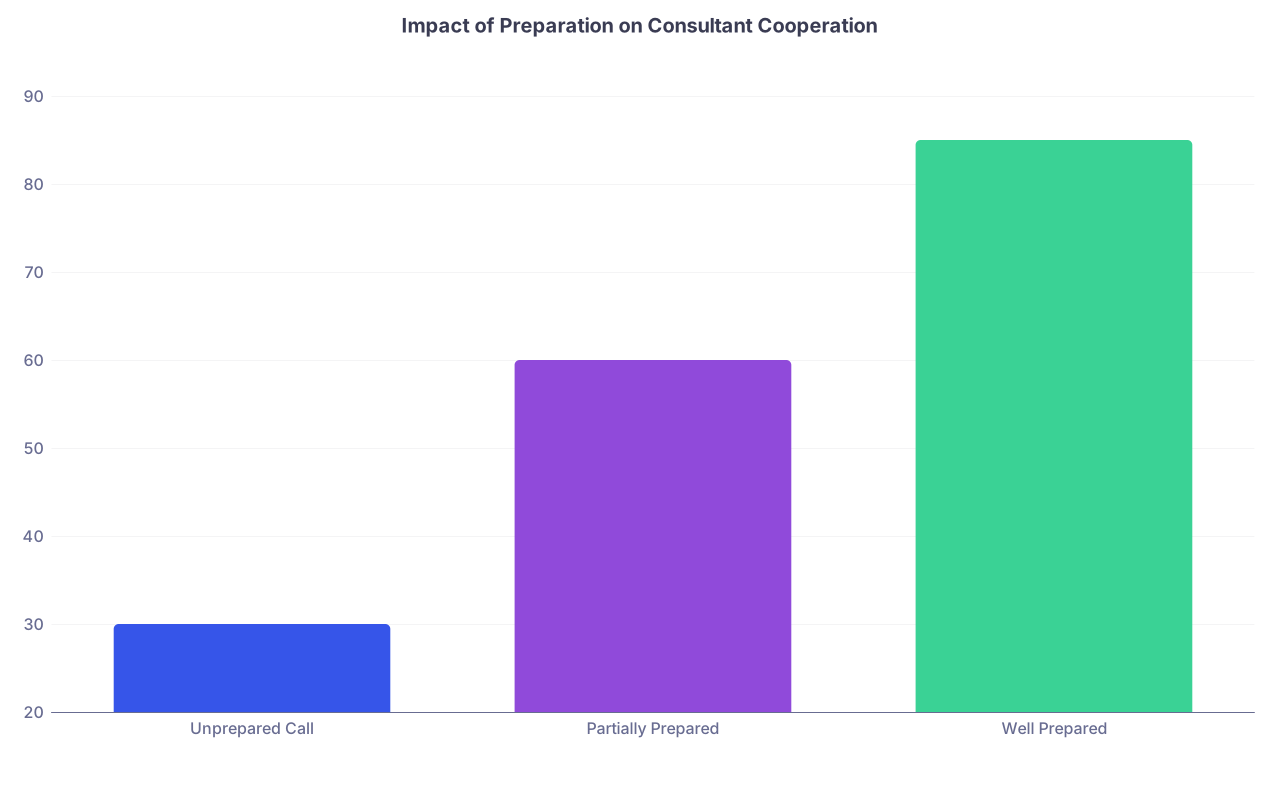
Demonstrate you did your homework
Consultants are far more cooperative when it is obvious you are prepared:
- Have the latest labs up.
- Have the imaging read or at least prelim.
- Know the med list and allergies.
- If the guideline is clear, mention it once, calmly:
- “Our sepsis protocol recommends ICU when lactate is above 4 with ongoing hypotension. That is why I am pushing for higher level of care.”
| Category | Value |
|---|---|
| Unprepared Call | 30 |
| Partially Prepared | 60 |
| Well Prepared | 85 |
(The numbers are illustrative, but I have watched consultant tone change dramatically when the caller obviously knows the case cold.)
Know when to stop arguing and start escalating
Past a certain point, continuing to argue directly with the same consultant is wasted time. Once you have:
- Presented clearly
- Asked specifically
- Stated your ongoing concern
…you switch to: “Thank you for your time. I am going to discuss this with my attending and we may call you back.”
Then you do exactly that. No threats. Just action.
8. Training Yourself: A Practical Personal Protocol
You will not rise to the level of your ideal self in a crisis. You will fall to the level of your training and habits.
So build a simple protocol for yourself.
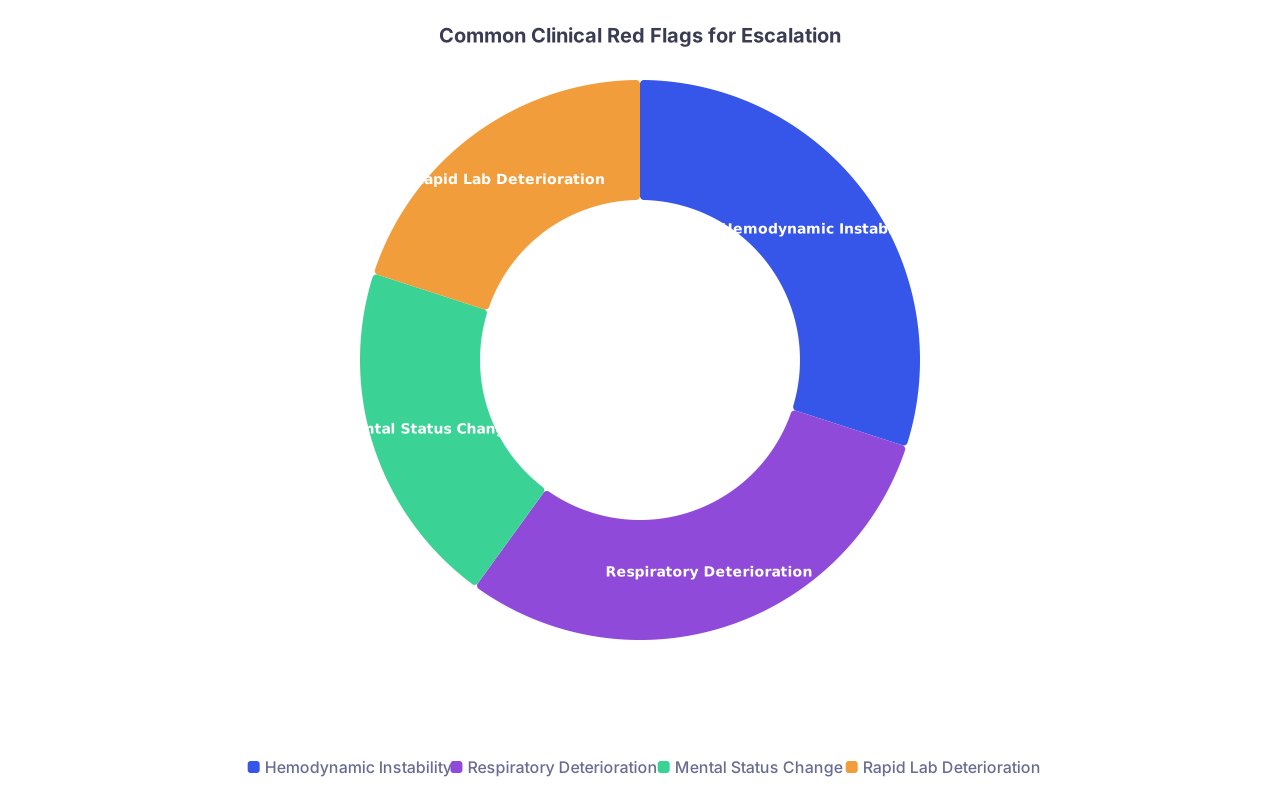
Step 1: Personal “red flag” triggers
Make a short list of situations where your default is to push harder, not softer:
- Rapidly changing vitals (BP dropping, RR rising, O2 needs increasing)
- Rising lactate, troponin, creatinine, or potassium
- New altered mental status
- Active bleeding or chest pain with concerning features
- Any time a nurse says, “I am really worried about this patient”
If any of these are present, you automatically:
- Prepare carefully before calling.
- Use formal structure (SBAR) for consultant calls.
- Are more willing to escalate.
| Category | Value |
|---|---|
| Hemodynamic Instability | 30 |
| Respiratory Deterioration | 30 |
| Mental Status Change | 20 |
| Rapid Lab Deterioration | 20 |
Step 2: Pre‑rehearsed phrases
Write down 3–4 sentences you are comfortable saying when pushed. Practice them a few times. You are aiming for calm, steady delivery, not volume.
Examples:
- “To be clear, I am worried that if we delay, this patient may deteriorate significantly.”
- “I hear your assessment. Mine is that the risk is still unacceptably high without [intervention/transfer].”
- “I need to involve my attending at this point because of my ongoing concern for patient safety.”
Sounds simple. Under stress, you will be grateful you rehearsed them.
Step 3: Post‑event debrief
After a serious conflict, do not just move on. You will keep repeating the same mistakes if you do.
Brief 5–10 minute personal or team debrief:
- What went well in how I handled that?
- Where did I hesitate or back down too quickly?
- At what moment should escalation have started?
- How will I handle that exact same scenario next time?
This is personal development and ethics training in its most real form. Not an online module. Actual cases where someone could have been harmed.

9. When You Are the Consultant: Do Not Become the Problem
Eventually, you will be on the other side of this conversation. And you will be tempted to do exactly what bothered you as a trainee.
Resist that.
When you are the consultant:
- If a junior calls and says, “I am really worried about this patient,” you take that seriously, even if the numbers look “not terrible.”
- You go see the patient when there is any real concern, even if you “know how this will turn out.”
- If you decline an intervention, you say why, in plain language, and offer concrete alternatives to reduce risk.
- You invite escalation: “If you or your attending still feel uncomfortable, I am happy to discuss this with my attending as well.”
Ethically, your job as a consultant is not to protect your service from work. It is to help the primary team manage risk and uncertainty safely.

10. A Quick Example: Putting It All Together
Let us run one realistic scenario.
- 68‑year‑old with atrial fibrillation on apixaban, presents with abdominal pain, mildly hypotensive, lactate 3.0, CT shows possible bowel ischemia.
- Surgery resident: “Looks okay, call medicine, we will see in the morning.”
- Over next 2 hours: BP 100 → 85, HR 95 → 120, lactate 3.0 → 4.8, increasing O2 needs.
What you do:
- Recognize red flags: dropping BP, rising lactate, rising O2.
- Prepare: Pull up vitals trend, labs, CT read, write down: “Request emergent re‑evaluation and ICU transfer.”
- Call surgery back using structure:
- “Since your last eval, BP fell to 85 systolic despite fluids, lactate up to 4.8, O2 now 6L. I am concerned for evolving shock and bowel ischemia. I am requesting emergent re‑evaluation and transfer to ICU.”
- Consultant: “This still does not sound surgical. Just give more fluids, call us if they crash.”
- You:
- “I remain concerned that without higher level of care and more urgent surgical assessment, this patient is at high risk for rapid deterioration. Are you declining ICU transfer and emergent reassessment at this time?”
- They say yes.
- You immediately call your attending:
- “Patient worsening, surgery declines ICU and re‑eval, my concern is decompensation. I want to escalate.”
- Attending calls surgery attending and ICU. ICU accepts. Surgery attending comes back down.
- Documentation reflects all of this, objectively.
You were not heroic. You were just disciplined, structured, and willing to push.
That is how you keep patients safe without becoming the “difficult” doctor no one wants to work with.

Key Takeaways
- You are responsible for ongoing patient safety, even after a consultant says “no.”
- Use structured communication, clear safety language, and a defined escalation pathway instead of arguments.
- Document facts, concerns, decisions, and your actions—then debrief and refine your own personal protocol so the next conflict goes better.