

It is 8:45 p.m. You are post-call in a crowded step-down unit. The patient is stable but not good. Labs pending, consultants slow to respond, nursing short-staffed.
The son flies in from out of town, walks straight to the nurses’ station and says loudly:
“I am an attorney. This care has been unacceptable. Someone is going to get sued if my father does not get an MRI and a second opinion tonight.”
The nurse looks at you. Everyone else suddenly finds a chart to stare at.
Now it is your problem.
This article is about that moment. And the ten other versions of it you will see this month.
You are not going to “nice” your way out of every situation. But you can handle demanding or entitled families in a way that:
- Protects the patient
- Protects you legally and professionally
- Preserves your sanity
Here is the playbook.
1. Know What You Are Actually Dealing With
Before you react, you need a quick mental triage: What kind of “difficult” is this?
Typical patterns I see repeatedly:
- The Terrified Advocate: Sounds aggressive, but it is fear. “No one is telling us anything!”
- The Consumer-Customer: Treats the hospital like a hotel. “We are paying for this; we want…”
- The Status/Power Player: Lawyer, executive, “I know the CEO,” expecting special rules.
- The Misinformed Google Expert: Convinced you are ignoring the “real” treatment.
- The Genuinely Unsafe Person: Threatening, abusive, maybe intoxicated.
You do not handle all of these the same way. But you always start with the same first move:
Slow down your reaction. Speed up your assessment.
Classic mistakes I see trainees make:
- Arguing with emotion using data
- Getting defensive and talking too much
- Making promises they cannot keep (“I will get that MRI right now”)
- Calling security too late or for the wrong reasons
Let me give you a simple internal checklist you can run in 15–30 seconds.

| Step | Description |
|---|---|
| Step 1 | Family upset |
| Step 2 | Call security and notify charge nurse |
| Step 3 | Focus on patient first |
| Step 4 | Engage legal/surrogate process |
| Step 5 | Schedule focused conversation |
| Step 6 | Is there immediate safety risk |
| Step 7 | Is patient decision maker capable |
Your priorities, in order:
- Safety
- Patient’s own wishes and capacity
- Legal surrogate and proper consent
- Family’s emotional and informational needs
Once you are clear on that, then you move to tactics.
2. The Conversation Framework That De-escalates 80% of Situations
There is a bad habit in medicine: we think “good communication” means “say everything you know.” It does not. It means saying the right thing in the right order.
Here is a structure that works. I have used variations of this thousands of times.
Step 1: Acknowledge the temperature, not the content
You start with emotion, not facts.
- “I can see you are really worried and frustrated.”
- “You sound angry, and I do not blame you for being upset. This has been a hard day.”
You are not agreeing with their accusations. You are acknowledging that the room is hot.
Do not start with:
- “We are doing everything we can.” (They do not believe you yet.)
- “Actually, the MRI is not indicated.” (You just picked a fight.)
Step 2: Name the shared goal
You need to get on the same team before you talk details.
- “You and I both want the same thing here: the safest plan for your father and the best chance for recovery.”
- “We both want to avoid anything that would harm her or delay her getting better.”
Once that is stated, it is harder for them to cast you as the enemy.
Step 3: Clarify the decision in front of you (narrow the problem)
Demanding families love to expand the battlefield: past grievances, staff they disliked, bills, parking, food. Do not get dragged into the whole story at once.
Narrow it:
- “Right now, the immediate decision is about [X] — for example, whether to transfer him to the ICU or keep him here and monitor closely.”
- “Let me focus on the question about surgery timing, and then we can come back to the other concerns you raised.”
This keeps the conversation from turning into an unsatisfying life review of the entire hospitalization.
Step 4: Give a brief, concrete medical summary
Not a lecture. Not a grand rounds. Two to three sentences that show you know the case.
- “He came in with [problem], we did [core interventions], and right now his [vitals/labs/mental status] look like [brief interpretation].”
Then follow with the risk/benefit tradeoff. People understand tradeoffs better than “indications”:
- “The MRI tonight would mean quickly moving him, sedating him, and pulling him away from monitoring. The potential benefit is low because [reason]. The real risk is [specific, not vague] — like worsening his blood pressure or delaying critical treatment.”
Step 5: Draw a clear boundary around what is not going to happen
This is where many clinicians fold and overpromise. Do not.
Use language like:
- “I am not going to order that test because it will not change his care and it carries more risk than benefit.”
- “Transferring him right now would be unsafe for these reasons…”
- “I am not able to discharge her tonight because it is not safe and it violates hospital policy about [x].”
You can be firm and respectful simultaneously. It is actually more reassuring than fuzzy language.
Bad:
- “We will see what we can do.” (They hear: “So you can do it if I push harder.”)
Better:
- “What I can do is [alternative you actually support]. What I cannot do is [the thing they are demanding].”
Step 6: Offer something real that shows you heard them
You are not a concierge, but you can usually give something:
- “I will update you again after the MRI results are back, even if there is no big change.”
- “Let me step out and ask the nurse manager about the visitor policy exception you requested.”
- “I will page the consultant now and let you know if there is any change to the plan.”
If they ask for something that is nonsense, reframe:
They: “We want all possible tests done.”
You: “You want to be sure we are not missing anything serious. That is exactly what I want too. The tests that actually help us answer that question for him are A, B, and C. The others would add risk without giving us better information for his care.”
That structure—acknowledge → shared goal → narrow → explain → set boundary → small concession—defuses most “entitled” interactions when done calmly.
3. Legal and Ethical Guardrails You Cannot Ignore
Demanding families often push you right up against the edges of law and ethics. You need some bright lines in your head.
3.1. Who is the decision maker?
Huge problem I see: people negotiating for hours with the loudest family member, not the legally appropriate surrogate.
Basic hierarchy (varies by jurisdiction, but the pattern is similar):
| Priority | Surrogate Type |
|---|---|
| 1 | Court-appointed guardian |
| 2 | Health care proxy / POA |
| 3 | Spouse / domestic partner |
| 4 | Adult children |
| 5 | Parents |
You do not let the out-of-town cousin override the spouse. I have seen it happen. It ends badly.
What you do:
- Check the chart for:
- Advance directive
- Health care power of attorney
- Any court orders
- If unclear, call case management or legal early.
- Use precise language with the family:
- “By law, your mother is the medical decision maker for your father, because she is his spouse. I absolutely want your input, but the final decisions will go through her.”
3.2. Patient capacity and wishes
Entitled families often override the patient’s voice. You do not let that happen.
- If the patient has decision-making capacity: they are your primary partner.
- “I hear your son’s concerns. Let me first ask you what you want to do.”
- If you have prior clear statements from the patient (advance directive, documented goals-of-care): use them. Out loud.
- “Your mother told us last month and again this admission that she did not want aggressive life support. My job ethically and legally is to respect those wishes, even when it is painful.”
When there is conflict between family demand and prior patient wishes, you stick to the patient.
3.3. Futility and non-beneficial care
Sometimes the “demand” is to “do everything” in a patient who is actively dying with no realistic benefit. This is where many physicians cave because they want to avoid conflict.
You have both an ethical and legal basis in most jurisdictions to refuse non-beneficial, harmful interventions. But you must do it correctly.
Key steps:
- Get your attending or senior on the same page. You do not shoulder this alone as a trainee.
- Document prognosis clearly: organ failures, expected outcome, treatment limits.
- Involve: palliative care, ethics, case management. Early, not as a last resort.
- Use language that does not frame “no CPR” as “giving up”:
- “I am concerned that doing chest compressions would break his ribs, cause internal injuries, and not bring him back in a way he would recognize as living. That would be harm, not help. So I am recommending we allow a natural death.”
If the family is pushing for interventions purely out of guilt or denial, you still do not cross into torture for their emotional comfort. That is harsh, but it is the truth.
4. Handling Specific Difficult Behaviors
Let us get specific. Here is what to do when you hit certain common patterns.
4.1. “I am going to sue you”
You treat this as a risk signal, not a conversation you can “win.”
Do:
- Stay calm, neutral tone.
- Say: “You have every right to share your concerns. I want to focus on your father’s care right now. I also encourage you to speak with our patient relations department so they can help review your concerns formally.”
- Immediately: document in the chart factually what was said and your response.
- Notify your attending and, if indicated, risk management. Early.
Do not:
- Argue about legal issues.
- Threaten back (“If you sue, I will…”).
- Change good medical decisions out of fear.
If they explicitly ask for records or say “I want to make a formal complaint,” you support their right to do so and direct them to the proper channels. You do not obstruct.
4.2. “I want a different doctor / transfer now”
Sometimes reasonable. Sometimes power play.
Your response:
- Start by validating the desire for trust:
- “It is important you feel comfortable with your care team.”
- Then clarify what is actually possible:
- “In this unit tonight, I am the resident on duty and Dr. X is the attending. We can involve other teams for consults, but a full transfer or new attending requires [policy explanation].”
If they demand a transfer to another hospital right now:
- Assess medical stability.
- If transfer is unsafe:
- “I understand you prefer another facility. Medically, a transfer at this moment would put him at serious risk because [specific]. Once he is more stable, we can help arrange that.”
Document their request and your explanation.
4.3. “I want special treatment because I know people”
This is the “VIP” or pseudo-VIP pattern. Ethically, you treat their medical needs like any other patient, but you may coordinate communication more tightly.
What you do:
- Acknowledge their connection without promising exception:
- “Thank you for letting me know. My responsibility is to give your mother the same standard of high-quality care we give all patients. I will make sure the team is up to date on her condition and your questions.”
- Do not skip safety steps or change indications because of status. Ever.
I have seen more errors in “VIP” patients because people bend rules. It is a trap.
4.4. Abusive or unsafe behavior
There is a line between “difficult” and “unsafe.” You do not tolerate threats or abuse.
Examples that cross the line:
- Threats of physical harm
- Repeated screaming, insults, racist or sexist slurs
- Interfering with care (blocking procedures, pulling staff away)
Your protocol:
- Give one clear warning, if safe:
- “You may be angry, but you cannot yell at or insult the staff. If this continues, I will have to ask security to remove you from the unit.”
- If behavior continues or risk is high:
- Step away. Notify charge nurse. Call security.
- Document concretely:
- “At 21:10, son entered room, yelled, stated ‘You are all incompetent idiots,’ and blocked nurse from administering medications. Security called at 21:15. Son escorted out without incident.”
You are not there to be abused. Protecting staff is part of ethical practice.
5. Documentation: Your Quiet Shield
Good documentation is not defensive paranoia. It is part of ethical, accountable care.
What to document when you have a difficult family encounter:
- Who was present (names, relationship to patient)
- Main concerns raised, in neutral language
- Your medical assessment and recommendations
- Any refusal of recommended care, including your explanation of risks
- Any demands for non-indicated care and your response
- Threats, abusive behavior, security involvement
- Involvement of consultants, ethics, risk management, case management
Avoid value judgments. Write what happened, not what you think of them.
Bad:
- “Family continues to be unreasonable and obstructive.”
Better:
- “Family refused to allow arterial line placement despite explanation of need for blood pressure monitoring. Repeatedly stated ‘No more procedures.’ Explained risks of not placing line, including inability to titrate pressors appropriately.”
Think of it this way: if an external reviewer read only your notes, would they see a thoughtful clinician trying to do the right thing under pressure? That is the bar.
6. Protecting Yourself from Burnout and Bitterness
Demanding families wear people down. I have watched excellent residents turn cynical after a few months in an ICU with constant conflict.
You cannot afford that. Patients cannot either.
You need a few internal rules.
6.1. Do not take on jobs that are not yours
Your roles:
- Make sound medical decisions
- Communicate clearly and honestly
- Respect patient autonomy and legal frameworks
- Treat people with basic human dignity
Your roles do not include:
- Fixing decades of family dysfunction
- Erasing their guilt for not visiting sooner
- Absorbing their grief as punishment
Once you define what is yours and what is theirs, you can stop personalizing every attack.
6.2. Build small, repeatable debrief rituals
After a rough interaction, do something consistent:
- Step out, get water, take 3–5 slow breaths
- Tell a colleague: “That was rough. I am not okay with how they spoke to the nurse.”
- Jot one line in a notebook: “Family conflict with Mrs. X—remember to call palliative early next time.”
These small rituals keep resentment from just marinating silently.
6.3. Learn when to tag out
You are allowed to ask for backup.
Examples:
- Another team member with better rapport takes the next conversation
- Attending leads the goals-of-care talk
- Palliative handles the next family conference
You are not “weak” for recognizing you are no longer the best messenger. You are being professional.
7. Preventive Moves: What You Do Before It Blows Up
The best interaction is the one that never escalates.
Three preventive habits:
Set expectations early
- “In this unit, doctors typically round between 8–11 a.m. I may not always be available immediately, but the nurse can reach me for urgent issues.”
- “Test results often come back in pieces. You may see them in the patient portal before we call. We will call if there is anything concerning or if it changes the plan.”
Name uncertainty clearly
- “We do not yet know if this is reversible. Over the next 24–48 hours we will be watching X and Y to get a clearer picture of prognosis.”
Families tolerate uncertainty better when it is named explicitly rather than hinted.
- “We do not yet know if this is reversible. Over the next 24–48 hours we will be watching X and Y to get a clearer picture of prognosis.”
Do early, honest goals-of-care talks
Bring in palliative or have your own conversation before the crisis hits.- “Given her multiple illnesses and the seriousness of this problem, it would help to know what she considers an acceptable quality of life and where she would draw the line on aggressive interventions.”
Early clarity prevents the “Do everything!” showdown at 3 a.m.
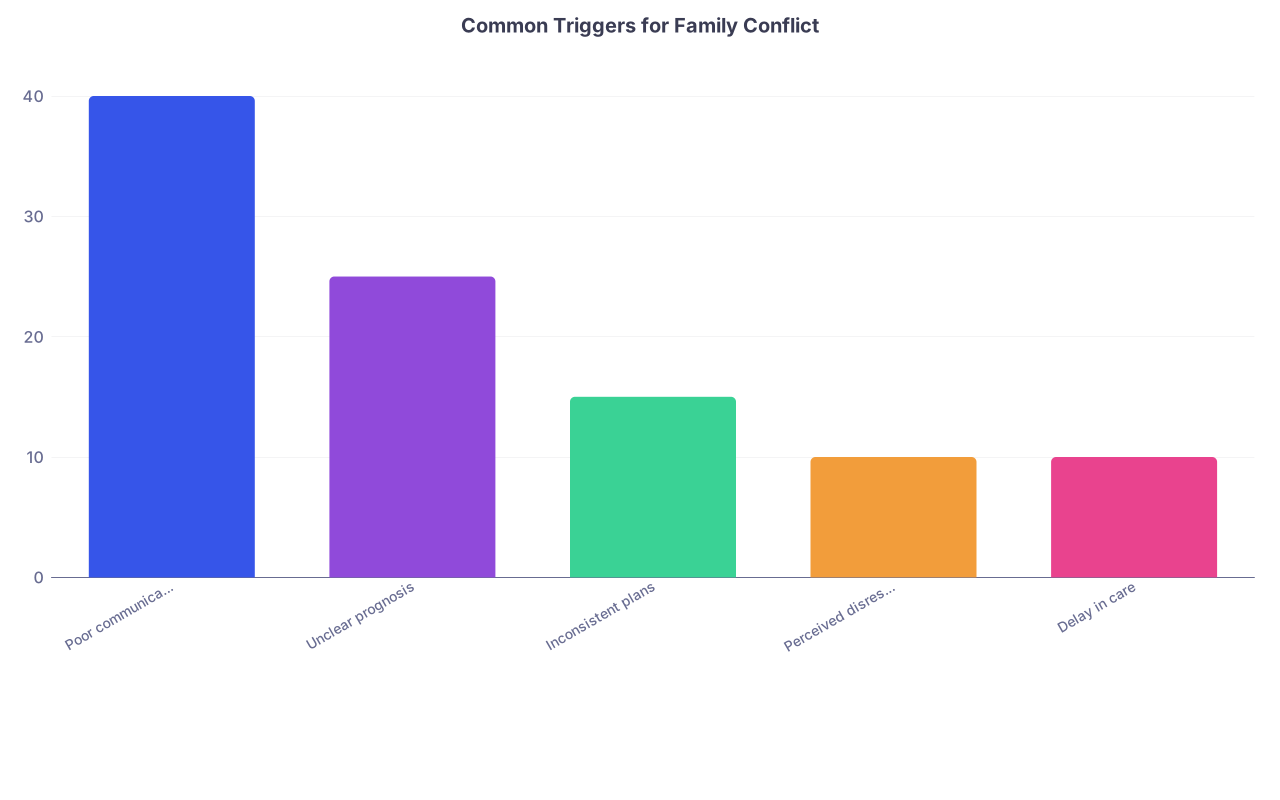
| Category | Value |
|---|---|
| Poor communication | 40 |
| Unclear prognosis | 25 |
| Inconsistent plans | 15 |
| Perceived disrespect | 10 |
| Delay in care | 10 |
Most “entitled” behavior is sitting on top of one or more of these triggers. Address them upstream and you will fight fewer fires.
8. A Simple Playbook You Can Memorize
You will not remember an essay at 2 a.m. You can remember a short script.
Think of it as the CALM-B approach:
C – Check safety and decision maker
- “Is anyone unsafe? Who is the legal decision maker? Does the patient have capacity?”
A – Acknowledge emotion explicitly
- “I can see how upset and worried you are.”
L – Limit the issue (narrow the decision)
- “Right now the question is whether we do X or Y.”
M – Make a clear medical recommendation
- “Based on his condition, I recommend we do X because [brief reason].”
B – Boundaries + backup
- “I am not going to do [unsafe/non-indicated thing], but I can do [reasonable alternative]. If you still feel uncomfortable, I can involve [attending, palliative, patient relations].”
That is your mental index card.

| Step | Description |
|---|---|
| Step 1 | Resident/Primary MD |
| Step 2 | Charge nurse |
| Step 3 | Attending physician |
| Step 4 | Palliative care or consultant |
| Step 5 | Ethics or case management |
| Step 6 | Risk management |
| Step 7 | Security |
You are not alone in this. Use the chain.
Your Next Step Today
Do one small, concrete thing now, before your next shift:
Write out a two-sentence script you can use the next time a family member comes at you hot. Something like:
“I can see how worried and frustrated you are. You and I both want the same thing: the safest and best plan for your mother. Right now the immediate decision is about [X], and based on her condition I recommend [Y] because [one reason].”
Put it in your notes app or on a small card in your white coat.
Next time the room heats up, use it. Then build the rest of the playbook around that opening.


