

The way many clinicians handle requests for nonindicated tests is wrong—and it burns time, money, and trust.
You do not fix this by caving “to keep the patient happy.” You also do not fix it by stonewalling with, “Insurance will not cover that.” You fix it with a repeatable, ethical protocol that protects the patient, protects you, and does not wreck the relationship.
This is that protocol.
1. Get Clear On What “Nonindicated” Actually Means
If you are fuzzy here, you will wobble in front of patients. They smell that. Then the encounter goes sideways.
“Nonindicated” in practice usually means one of three things:
No evidence of benefit for this patient in this situation
- Example: Healthy 32-year-old with no risk factors demanding a CT coronary angiogram “because my coworker had one.”
Risk > potential benefit
- Example: CT abdomen for vague chronic pain with red-flag-free history and exam, already evaluated conservatively.
Not aligned with guideline-based care or standard of practice
- Example: Daily D-dimers for a stable medical ward patient “just to be sure we don’t miss a PE.”
Your duty is not “patient gets what they want.”
Your duty is beneficence + nonmaleficence + respect for autonomy within the boundaries of professional integrity and justice (resource stewardship).
To anchor yourself, remember:
- You are not a vending machine for labs and imaging.
- You are a professional who recommends and orders tests based on clinical indication and evidence.
That mindset shift alone makes the rest easier.
2. Know the Common Scenarios (So You Are Not Surprised)
Most nonindicated test requests fall into predictable buckets. If you prepare language for each bucket, the visit goes faster and smoother.
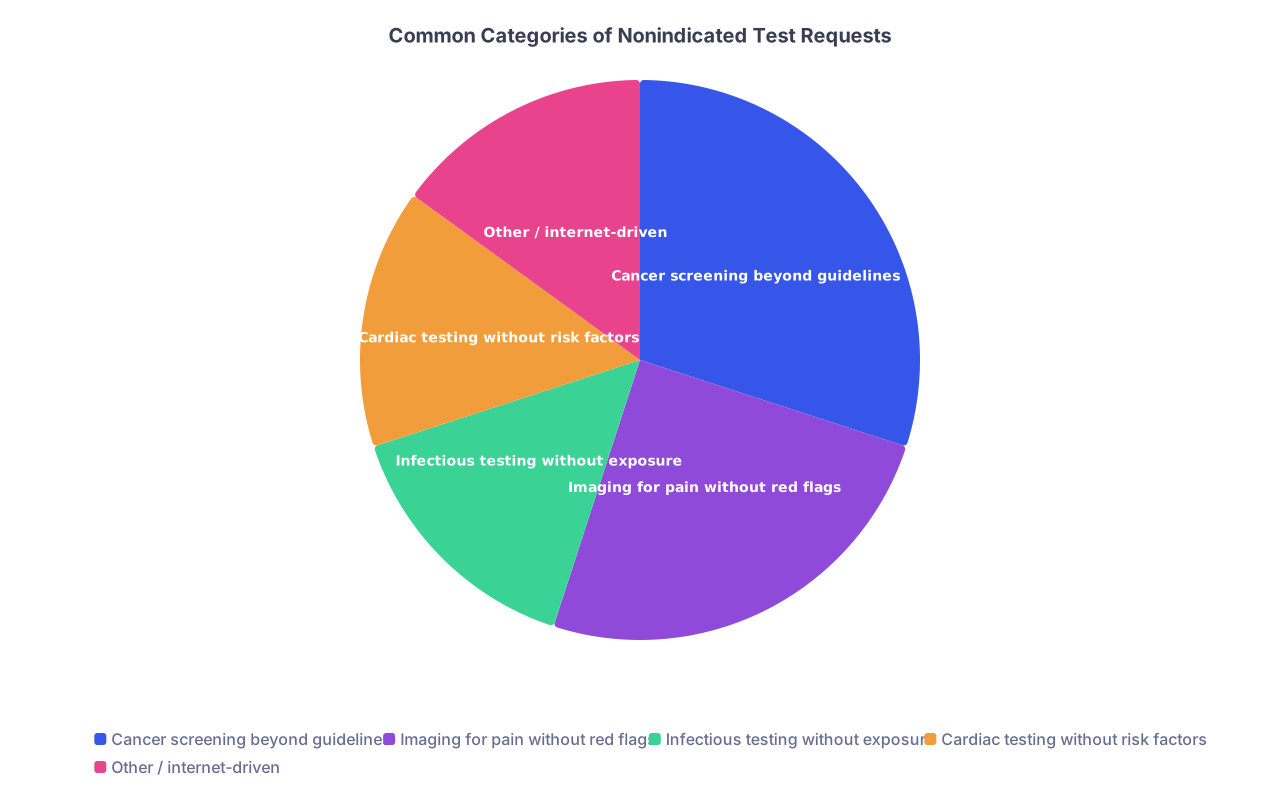
| Category | Value |
|---|---|
| Cancer screening beyond guidelines | 30 |
| Imaging for pain without red flags | 25 |
| Infectious testing without exposure | 15 |
| Cardiac testing without risk factors | 15 |
| Other / internet-driven | 15 |
Typical patterns:
- “Full-body scan” to “rule out cancer”
- MRI for uncomplicated low back pain
- CT head for chronic tension headaches without neuro findings
- Antibiotics and “a chest X-ray to make sure it’s not pneumonia” for a clear viral URI
- Cardiac stress test for a young, asymptomatic person with normal exam and EKG
- Broad “cancer blood tests” because “I just want to be sure”
If you are early in training, literally write out and practice 1–2 stock responses for each of these. Out loud. It feels silly. It pays off.
3. The 6-Step Protocol For Handling Any Nonindicated Test Request
Here is the core playbook. Use this structure every time; customize the content to the case.
Step 1: Slow Down and Name the Request
Do not reflexively say no. First show that you heard them.
Example phrases:
- “You are asking for an MRI of your back to make sure we are not missing anything serious.”
- “You would like a CT scan to rule out brain cancer, because your friend was diagnosed late.”
This does three things:
- Lowers defensiveness.
- Buys you time to think.
- Prevents talking past each other. (I have seen residents start explaining why a CT is not needed when the patient actually wanted a simple X-ray.)
Step 2: Ask “What Are You Most Worried About?”
This question is gold. The request is almost never about the test. It is about fear.
Examples:
Patient: “I want an MRI.”
You: “What are you most worried that we might be missing?”
Patient: “Spinal cancer. My uncle had it.”Parent: “I want a CT for my child’s head bump.”
You: “What is your biggest concern right now?”
Parent: “That there is bleeding in the brain and we will go home and he will die in his sleep.”
Now you know the real problem you need to address.
Step 3: Give a Brief, Clear Risk–Benefit Framing
Do not launch into a mini-lecture. Two to four sentences.
Structure:
- Briefly state what the evidence says.
- Link it to their situation.
- Emphasize risk and limitation of the test.
Script template:
- “In people with your symptoms and exam, the chance of finding something serious on [test] is extremely low. The test also has harms—like [radiation / false positives / unnecessary biopsies / anxiety]. So the risk and cost of the test outweigh the benefit for you today.”
Real examples:
CT head for chronic tension headaches, normal neuro exam:
“In someone with headaches like yours and a normal neurological exam, the chance a CT finds a dangerous cause is extremely low, well under 1%. The scan exposes you to radiation, and we can also find incidental spots that are harmless but lead to more scans and biopsies. Based on national guidelines and the evidence, a CT is not recommended in your situation.”MRI lumbar spine for 2 weeks of mechanical low back pain, no red flags:
“For back pain like yours without concerning signs, early MRI does not help people get better faster. What it does do is find normal age-related changes that look scary on paper and sometimes lead to unnecessary procedures and surgery. That is why guidelines recommend exercise, physical therapy, and time, not imaging at this stage.”
Step 4: Offer a Safer, Evidence-Based Plan (With Something Concrete)
Never just say “No”. You need to replace the test with an alternative path and a safety net.
Build a brief plan using:
- Symptom management (meds, PT, lifestyle changes)
- Clear follow-up window
- Red-flag return precautions
- Sometimes: a smaller, more appropriate test
Example:
For back pain:
“Here is what I recommend instead. We start with anti-inflammatory medication, a home exercise program, and referral to physical therapy. I want to see you back in 4–6 weeks or sooner if things are not improving. If you develop red-flag symptoms—like trouble controlling your bladder or bowel, new weakness in your legs, or severe pain that wakes you up at night—call immediately or go to the ER. In those situations, imaging is indicated.”For fear of heart disease in a low-risk 30-year-old:
“Your risk of a heart event in the next 10 years is extremely low based on your numbers. A stress test in your case does not improve outcomes and can generate false alarms. What does matter is blood pressure control, not smoking, and exercise. I would like to check your lipids, review your diet, and make a plan to keep that risk low long term. We can recheck every few years or sooner if you develop symptoms like chest discomfort with exertion.”
You are acknowledging the fear and giving them something to do. People handle “no” better when they do not feel abandoned.
Step 5: Address Nonmedical Drivers Honestly
A lot of “test requests” are really about:
- Insurance requirements
- Work demands (“My job needs this report.”)
- Travel rules (“They won’t let me board without a chest X-ray report.”)
- Family pressure (“My spouse insists I get this.”)
Name the constraint and be clear what is inside or outside your role.
Examples:
“Your employer is asking for a CT scan. Medically, it is not indicated, and I cannot order a test just to satisfy an employer request if it exposes you to risk without benefit. I am happy to write a letter explaining that we have medically evaluated you and found no evidence of serious disease. You can share that with them.”
“The travel policy is requiring TB testing. We can do a TB skin test or blood test, which are the standard recommended options. A chest X-ray alone is not sufficient, and using it as screening for someone without symptoms would expose you to radiation without benefit.”
Sometimes the ethical answer is: “I will not order this, and I will not falsify medical justification.” Full stop.
Step 6: Close the Loop and Document
Wrap up explicitly:
- “So to summarize, the CT head is not recommended because… Instead, we will… If X, Y, or Z happens, do… Does that plan make sense to you? Any remaining worries I have not addressed?”
Then chart like a lawyer is going to read it later. Because one might.
Key elements to document:
- Patient request and their stated concern
- Your clinical assessment
- Your explanation of risk/benefit and guideline basis
- Alternative plan offered
- Safety-net and follow-up
- Patient’s response (accepted, upset but agreed, still demanding, etc.)
That note protects the patient and protects you.
4. What You Must Never Do (If You Care About Ethics and Self-Respect)
I have watched good clinicians slowly erode their standards because they did not want conflict. Here are the traps.
Trap 1: “I’ll Just Order It and Let Insurance Deny It”
This is lazy and unethical.
You are:
- Exposing the patient to potential harm.
- Weaponizing payers to avoid your own duty to give a professional opinion.
- Wasting system resources and staff time.
Say what you mean:
- “I am not ordering that test because medically it is not appropriate and carries more potential harm than benefit for you.”
If they want to pursue it out-of-pocket elsewhere, that is their right. But you do not dodge responsibility by hiding behind insurance.
Trap 2: Inventing a Diagnosis to Justify the Test
Do not do this. Ever.
Examples I have seen:
- Coding “chest pain” for an asymptomatic patient to get a stress test covered.
- Listing “weight loss” when there is none to justify CT.
- Putting “bloody stool” when it is actually hemorrhoids only by self-report, never observed or evaluated.
This is insurance fraud. It is also a clean way to lose your license.
Your integrity is more important than this encounter going smoothly.
5. Using Ethics Principles as Your Backbone (Not as Decoration)
Let us translate principles into decisions.
| Principle | What It Demands in This Context |
|---|---|
| Beneficence | Recommend tests that help, avoid those that do not |
| Nonmaleficence | Avoid unnecessary radiation, false positives, cascades |
| Autonomy | Give honest info so patient can decide on *reasonable* options |
| Justice | Use resources responsibly, avoid waste |
Beneficence + Nonmaleficence
Concrete implications:
- If a test does not change management in any plausible scenario, you should not order it.
- If a test meaningfully increases the chance of harm (radiation, contrast nephropathy, invasive follow-ups) without a matching probability of benefit, you should not order it.
You are not neutral. You are obligated to push against harmful overtesting, even when a patient says “I want it.”
Autonomy (The Grown-Up Version)
Respecting autonomy does not mean, “The customer is always right.”
It means:
- Give accurate, unbiased information.
- Clarify options that are within standards of care.
- Support the patient in making choices among those reasonable options.
Sometimes there is a range of acceptable practice. Example:
- Borderline-indicated tests where guidelines are flexible.
- Edge cases in cancer screening for older adults.
In those cases, it is entirely appropriate to say:
- “This is a situation where reasonable doctors disagree. Here are the tradeoffs. I slightly favor X, but if you strongly prefer Y after hearing the pros and cons, we can do that.”
Different from: “This is not recommended and mostly harmful, but if you want it, sure.” Do not blur that line.
Justice (Resource Stewardship Without Being Sanctimonious)
You are not the hospital CFO. But you are part of a system.
You do not need a speech about “societal costs.” One sentence is usually enough:
- “Beyond the risk of harm to you, these tests are also very expensive, and part of my job is to use them when they actually help people.”
If a patient throws back, “I pay for insurance, I can have whatever test I want,” you can calmly reply:
- “Paying for coverage does not mean every possible test is appropriate or safe. My responsibility as your physician is to recommend what is medically right for you, not everything that exists.”
6. Special Cases: When You Might Bend (And How to Do It Safely)
Medicine is not a purity test. There are gray zones.
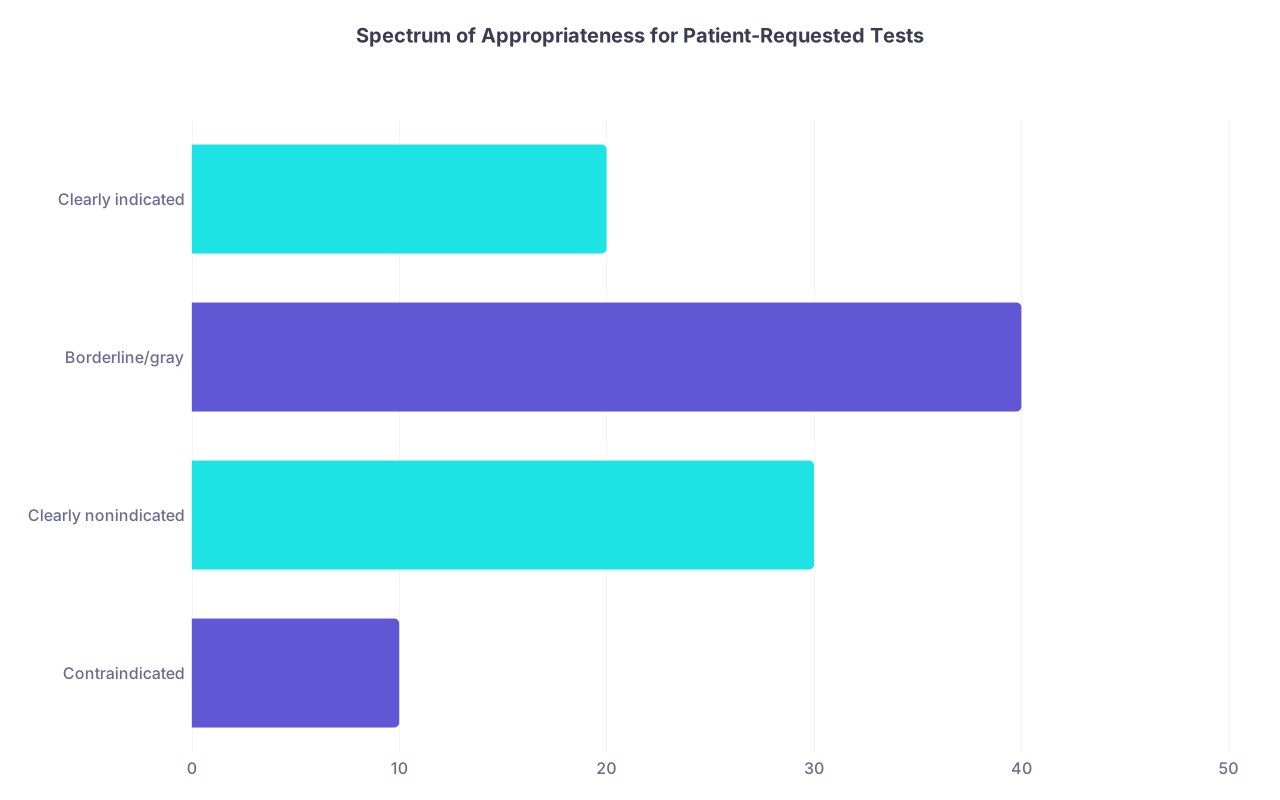
| Category | Value |
|---|---|
| Contraindicated | 10 |
| Clearly nonindicated | 30 |
| Borderline/gray | 40 |
| Clearly indicated | 20 |
Case 1: Gray-Zone Risk with High Anxiety
Example:
- Middle-aged patient with very low but non-zero risk, persistent chest discomfort, normal workup so far, high anxiety.
You might:
- Do one limited additional test (e.g., stress test) if:
- It is within guidelines as “consider” rather than “recommended/avoid”.
- You have explained uncertainty.
- You are clear this is not routine screening but a tailored judgment.
Key is transparency in the chart:
- “Patient with low pretest probability but ongoing concern. Discussed pros/cons of stress testing; test ordered after shared decision-making given patient values and gray-zone evidence.”
Case 2: Patient Will Not Accept No and You Have Less Risky Alternatives
Example:
- Patient wants CT abdomen with contrast; you prefer ultrasound first.
- Parent insists on “blood work for infection” for a viral URI; you know a CBC will not help but also will not hurt much.
You can sometimes agree to a low-harm, low-cost test as part of a compromise, if:
- It does not pull you into fraud (no fake coding).
- It is not exposing the patient to significant risk.
- You are honest that you are not expecting it to change management.
Language:
- “This test is very unlikely to change what we do, but it is safe and inexpensive, and if it helps reassure you, I think it is reasonable to add. I want to be clear: even if it is normal, I still want you to watch for [red flags].”
Do not make a habit of this. But you do not have to die on every hill.
7. How to Respond When the Patient Pushes Back Hard
You will get:
- “So you are saying it is about the money.”
- “My last doctor always ordered this.”
- “If you are wrong, I will sue.”
- “You do not care about me, you just want to go home.”
You need a few ready responses that are calm, firm, and repeatable.
Script 1: “My Responsibility”
- “My job is to recommend what is medically right and safe for you, even when that is not what you were expecting. I understand you are disappointed. I still do not think this test is appropriate or safe enough to order in your case.”
Script 2: “Respect and Boundaries”
- “I hear that you are frustrated. I respect that. At the same time, I cannot order a test that I believe is more likely to harm than help you, even if you are asking for it.”
Script 3: “Transfer of Care (As a Last Resort)”
If the relationship truly breaks:
- “It seems we have a fundamental disagreement about how to approach your care. You deserve a clinician whose approach you are comfortable with. I am happy to provide a copy of your records and help with a transition to another provider.”
You are not obligated to practice bad medicine to keep a patient.
8. Legal and Documentation Safeguards (Do Not Skip This Part)
Most lawsuits I have seen around this topic look like:
- “Doctor ignored my concerns and refused appropriate testing” (from the patient side).
- Or
- “Doctor ordered unnecessary tests that led to harm and costs” (from system / payer side).
Your defense is thoughtful reasoning + clear documentation.

Key elements in your note when refusing a requested test:
- History and exam supporting low pretest probability.
- Explicit statement:
- “Patient requested [test] due to concern about [disease].”
- “Based on current evidence and guidelines ([name organization] if relevant), [test] is not indicated in this context because…”
- Alternative plan and safety net, including when testing would become indicated.
- Patient education:
- “Discussed risks including radiation exposure, false positives, incidental findings, potential for unnecessary invasive procedures.”
- Patient response:
- “Patient expressed understanding and agreement.”
- Or: “Patient remained dissatisfied but agreed to follow the outlined plan.”
You are not documenting to “cover yourself” in a defensive way. You are documenting your reasoning so another reasonable clinician can see that you acted within standard of care.
9. Building Your Own “Nonindicated Request Playbook”
If you want this to become automatic, do some upfront work.

| Step | Description |
|---|---|
| Step 1 | Identify Common Requests |
| Step 2 | Review Guidelines |
| Step 3 | Draft Stock Phrases |
| Step 4 | Practice in Simulation |
| Step 5 | Use in Real Encounters |
| Step 6 | Reflect and Refine |
Practical steps:
Keep a running list for 1–2 months of:
- Tests commonly requested in your clinic / hospital.
- The actual disease the patient is afraid of.
For each, look up guidelines once:
- USPSTF, Choosing Wisely, specialty society statements.
- Save links or PDFs in a small personal folder.
Write two stock explanation phrases per scenario:
- One short (for calm patients).
- One slightly longer (for anxious patients).
Practice out loud:
- During commute.
- With colleagues.
- In simulated OSCE/role-play if you are a student or resident.
After tough encounters, ask:
- “What did I say that worked?”
- “Where did I lose them?”
- Make small tweaks. Do not reinvent the wheel every time.
The goal is not to be scripted. It is to have enough structure that you can stay calm and clear, even at 4:30 p.m. on a Friday when you are 45 minutes behind.
10. Final Thoughts: Your Spine Is Part of the Treatment
You are not just treating disease. You are shaping how patients think about health, risk, and medicine itself.
If you routinely give in to nonindicated tests:
- You train people to expect medicine to be test-driven, not reasoning-driven.
- You feed anxiety instead of containing it.
- You contribute to the very overtesting culture everyone complains about.
If you hold the line respectfully:
- You help patients learn that not doing a test can be the safest, most evidence-based choice.
- You model what it looks like to put long-term safety over short-term reassurance.
- You keep your own professional integrity intact.
Two or three key points to remember:
- Have a clear, repeatable protocol: name the request, uncover the fear, explain risk–benefit in plain language, offer an evidence-based alternative, and document.
- Use ethical principles as a backbone, not wallpaper: you are obligated to avoid harm and waste, even when the patient wants the opposite.
- You can be kind and still say no. In fact, for nonindicated tests, saying no is often the most ethical form of care you can give.


