

You are standing at the foot of the bed. Saturation is 84% on room air. Blood pressure is 78/40. Your team is ready with fluids, blood, pressors. The patient looks you straight in the eye and says, very clearly: “No. I do not want that. Let me die.”
Your intern freezes. The nurse looks at you. The family is in the hallway, demanding “Do everything.” You know that if you move fast, you can probably save this patient’s life. You also know that forcing treatment on a competent adult is battery.
This is where people discover whether they actually understand autonomy, capacity, and refusal of care—or whether they only understood them for the exam.
Let me cut through the noise. There is a protocol for this. You are not supposed to improvise ethics and law at the bedside. Here is how to handle it in a way that protects the patient and protects you.
Step 1: Stop “Fixing” and Start Assessing
Your reflex is to fix the physiology. You must first fix your understanding of the person in front of you.
Everything hangs on one question:
Is this a capacitated refusal or not?
You do not answer that by vibes. You answer it systematically.
A. Get out of “panic mode”
You have about 60–120 seconds to reset the room:
- Ask everyone to pause: “Give me one minute to speak with the patient.”
- Lower your voice. Sit down if you can. Eye level matters.
- Dismiss nonessential chatter. “One voice only, please.”
You are setting the stage for a clean capacity assessment and informed refusal. If this looks chaotic, it will look bad in court and in the chart.
B. Run a quick, focused capacity check
You are not doing a full neuropsych evaluation. You are answering four questions:
Can they communicate a choice?
Unambiguous yes or no. Not fluctuating minute to minute.Do they understand the relevant information?
Use simple language, then ask them to teach back.- “You have a serious infection. Your blood pressure is dangerously low.”
- “If we do not give you fluids and medication to raise your blood pressure, you will likely die. Possibly in the next few hours.”
Then: “Tell me in your own words what is going on with your body right now.”
Can they appreciate the consequences for themselves?
They must connect the facts to their own situation.- Ask: “What do you think will happen if we do nothing?”
- “What do you expect the next day or two would look like if we treat vs if we do not?”
Can they reason about options?
They do not need to be “smart.” They need a sensible decision path.- “Tell me why you are choosing to refuse this treatment.”
- “What matters most to you right now in making this decision?”
If they can do those four reliably, you probably have capacity for this decision, even if the decision feels irrational to you.
If they cannot, you do not have a valid refusal yet. Different playbook (we will get there).
Step 2: Give Real Informed Refusal, Not a Speech
Most clinicians are decent at informed consent and terrible at informed refusal. You need both.
You must cover four elements clearly:
- Diagnosis (to the extent known)
- Proposed intervention
- Material risks and benefits of accepting
- Material risks and alternatives of refusing
Keep it concrete. Avoid vague doom language.
Example script in plain language:
- “Right now your blood pressure is very low because your body is not circulating blood properly. That can cause your organs to fail.”
- “The treatment I am recommending is intravenous fluids and medication to raise your blood pressure, and possibly intensive care support.”
- “If you accept, there are risks—heart strain, fluid in the lungs, possible need for a breathing machine. But your chance of surviving this hospitalization is much higher.”
- “If you refuse all of this, the likely outcome is that your heart or brain will fail. You may become unconscious soon and could die within hours. We would keep you comfortable, but we would not try to resuscitate you.”
Then you verify comprehension:
- “Tell me, what are the options as you see them right now?”
- “Which one are you choosing, and why?”
If they repeat back something wildly inaccurate, that is not informed refusal. You correct misunderstandings and try again.
Step 3: Separate “Bad Reasons” from Incompetent Reasons
You are going to hear refusals you personally dislike:
- “I do not want to live with a colostomy.”
- “I will not take a blood transfusion because of my religion.”
- “I’m tired. I’ve had cancer for 5 years. Let me go.”
These are not evidence of incapacity. They are evidence of values you disagree with.
Capacity is not about what they decide. It is about how they decide.
Here is the rough mental grid I use:
| Scenario | Likely Capacity? |
|---|---|
| Jehovah’s Witness refusing blood, calm, consistent with prior statements | Yes |
| Depressed patient refusing antibiotics because “I deserve to die and the CIA controls me” | No |
| Elderly patient refusing dialysis after months of discussion, clear about tradeoffs | Yes |
| Hypoxic patient ripping off BiPAP, confused about place and year | No |
| Patient refusing surgery because “aliens will fix me tonight” | No |
If the reasoning is anchored in:
- Fixed delusions
- Severe disorganization of thought
- Profound misperception that you cannot correct with explanation
then you probably do not have capacity.
If the reasoning is anchored in:
- Religious belief
- Long-standing life priorities
- Fear of particular outcomes (ventilator, amputation, institutionalization)
then you probably do have capacity.
You will not like every choice. You are not required to like it. You are required to respect a capacitated choice.
Step 4: When Capacity Is Questionable—Stabilize While You Clarify
This is the gray zone where people make mistakes. You suspect the patient might lack capacity, but you are not sure. Time is short.
You have three tools:
- Emergency exception
- Surrogate decision-making
- Time-limited treatment while assessing
A. Emergency exception
Ethically and legally in most jurisdictions:
If all of these are true—
- Immediate threat to life or serious harm
- No evidence of prior refusal (clear, documented, capacitated)
- Patient currently lacks decision-making capacity
—then you are generally allowed (and expected) to treat in the patient’s best interests without formal consent.
Example: Alcohol-intoxicated trauma patient with a ruptured spleen yelling “No surgery!” while GCS is 11 and they think they are in a bar. That is not a valid refusal. You take them to the OR.
You still document the reasoning carefully (we will talk documentation later).
B. Surrogate decision-maker
If there is no emergency seconds-to-minutes window, or the threat is serious but not immediate, and the patient lacks capacity, you move to surrogates:
- Check for existing advance directive or durable power of attorney for health care first.
- If none, follow your hospital / state’s hierarchy (spouse, adult children, parents, siblings, etc.).
You do not ask the family, “What do you want us to do?”
You ask, “What would the patient choose, if they could speak for themselves, given their values?”
Surrogates are supposed to apply substituted judgment, not their personal preference. They will often fail at that. You keep bringing them back to the patient’s known or reasonably inferable wishes.
C. Time-limited trial while sorting things out
Sometimes you simply cannot get all the information or do a full capacity eval before the window closes.
You can use a time-limited trial of life-saving treatment:
- “Given how unclear things are and how fast this might progress, I recommend we start treatment now while we confirm with [psychiatry/ethics/family/records]. We’ll re-evaluate in 2 hours.”
- You start fluids, pressors, BiPAP, whatever is needed to prevent immediate irreversible harm.
- You simultaneously call:
- Psychiatry (if available) for capacity assessment support.
- Ethics consult (if your institution has it).
- Risk management / legal if things are particularly contentious.
This is not cowardice. It is risk management for the patient and for you.
Step 5: When Capacity Is Clear and the Answer Is “No”
Let us assume now: you have done a proper assessment. You are convinced the patient has decision-making capacity for this choice. They understand. They can reason. They appreciate. And they refuse.
Here is what you do.
A. Keep trying—but stop pressuring
You are allowed to keep exploring. You are not allowed to bully.
Focus on:
Understanding the root concern
- Fear of pain? Offer aggressive analgesia.
- Fear of prolonged ICU stay? Offer a time-limited trial—“We will attempt X for 48 hours and stop if no improvement.”
- Mistrust? Consider second opinions or another clinician speaking with them.
Negotiating modifications
Maybe they will accept:- Fluids and antibiotics, but not intubation.
- A do-not-intubate status but OK with pressors.
- Surgery if there is a clear limit on post-op life support.
You do not make promises you cannot keep (“You definitely will not go to the ICU”) but you can outline plans (“If you go to ICU, we can agree to a maximum of X days on the ventilator unless you change your mind”).
B. Respect a clear, consistent refusal
If, after this, they still say, “No. I understand I may die,” you stop trying to override.
You then shift from curative to palliative frame:
- “Given you are choosing not to proceed with these treatments, my focus now will be on:
- Controlling your pain and shortness of breath.
- Supporting you and your family.
- Making sure you are not alone or suffering.”
You should:
Offer palliative care consult if available.
Clarify code status explicitly (DNR/DNI? Limited interventions?):
“If your heart stops or you stop breathing, would you want us to try CPR or put a breathing tube in, or would you want us to let you die naturally?”
Document the answer. Place appropriate orders.
Do not sneak in treatments the patient refused just because family demands it. Family wishes do not override a competent adult’s explicit refusal.
Step 6: When the Family Wants “Everything” and the Patient Does Not
This is one of the ugliest dynamics I see repeatedly.
The rule is simple:
Capacitated patient’s wishes > family wishes.
Your job is to:
- Protect the patient’s stated choices.
- Communicate with family clearly but without caving.
Practical script:
- “I want to be very clear with you. Your [mother/father/etc] is able to make their own medical decisions. We have spoken at length, and they understand what is happening and what the options are.”
- “They have clearly told us that they do not want [intubation / surgery / dialysis]. Legally and ethically, we are required to respect that choice.”
- “That does not mean we are doing nothing. Here is what we will be doing to keep them comfortable and support them.”
Then you stop debating the original decision with the family. You anchor on comfort and support.
If family is particularly volatile, you:
- Ask for social work.
- Consider security if staff safety is at risk.
- Loop in risk management if the word “lawsuit” starts flying.
You still do not provide treatments the patient refused.
Step 7: Document Like Someone Will Read It Aloud in Court
Because one day they might.
You want your note to show:
- You assessed capacity.
- You gave informed refusal counseling.
- The patient understood and made a clear choice.
Bare minimum structure:
Context
- “Patient with septic shock, recommended ICU-level care with vasopressors, high risk of death without treatment.”
Capacity assessment
- Mental status (alert/oriented).
- Ability to communicate a choice.
- Evidence they understood (include direct quotes).
- Evidence of appreciation and reasoning.
Information given
- Diagnosis and prognosis.
- Proposed interventions.
- Specific risks of accepting and refusing.
Patient decision
- “Patient stated: ‘I understand that I may die today if I do not go to the ICU or take these medications. I still do not want them. I want to be kept comfortable and allowed to die naturally.’”
- Specify code status.
Witnesses
- Who was present: family, nurse, another clinician.
Plan
- Palliative measures.
- Consults (palliative care, ethics).
Example snippet:
“Capacity: Patient alert, oriented to person, place, time, and situation. Explained diagnosis of septic shock and recommendation for ICU admission with vasopressors and possible intubation. Discussed that without such treatment, there is a high likelihood of death within hours to days. Patient able to verbalize understanding: ‘I know my infection is very bad. If I don’t go to ICU, I will probably die soon.’ When asked about reasons for refusal, patient stated: ‘I have been in and out of the hospital for a year. I do not want to be on machines. I would rather be comfortable, even if I die.’ Reasoning is coherent and consistent with prior expressed values per chart and family. No evidence of psychosis, delirium, or severe cognitive impairment. Judgment intact for this decision.”
That paragraph will save you more grief than any lawyer.
Step 8: Know the Common Legal/Ethical Landmines
A few situations where you must be more cautious and often involve others early:
A. Minors refusing life-saving care
- Generally, parents/guardians hold decision-making authority.
- Mature minor doctrines and specific statutes (e.g., for reproductive health, STIs, substance use) vary by jurisdiction.
- A 16-year-old refusing chemotherapy with parents insisting on treatment is very different from a 16-year-old whose parents are refusing on religious grounds.
In these cases:
- Involve hospital legal, ethics, and child protective services as needed.
- Court orders are sometimes sought to authorize treatment.
Do not manage this solo.
B. Psychiatric illness and refusal
Having a psychiatric diagnosis does not automatically remove capacity. Many people with depression, bipolar disorder, or schizophrenia make competent decisions.
Red flags for incapacity in psychiatric patients:
- Suicidal intent directly tied to refusal (“I’m refusing insulin because I want to die.”)
- Prominent delusions driving refusal (“The staff are agents trying to poison me.”)
- Cognitive disorganization preventing understanding or reasoning.
If you suspect psychiatric drivers of refusal:
- Ask for a psychiatry consult for capacity assessment.
- Consider emergency holds/commitment proceedings if they meet involuntary treatment criteria in your jurisdiction (danger to self / others, grave disability).
C. Cultural and language barriers
Refusals made via:
- Family “interpreters”
- Broken language comprehension
- Cultural misunderstandings about prognosis
…are dangerous.
Non-negotiables:
- Use professional interpreters for serious discussions.
- Check understanding via teach-back in the patient’s language.
- Be explicit about prognosis and options.
If the patient’s “refusal” is actually based on garbled information filtered through a relative, you do not have valid informed refusal yet.
Step 9: Build Your Personal “Refusal Protocol”
You should not be rebuilding this from scratch every time. Create a mental checklist.
Here is a clean framework you can run in under five minutes:

| Step | Description |
|---|---|
| Step 1 | Patient refuses life saving treatment |
| Step 2 | Stabilize environment |
| Step 3 | Rapid capacity check |
| Step 4 | Provide clear risk explanation |
| Step 5 | Emergency exception or surrogate |
| Step 6 | Document informed refusal and shift to comfort care |
| Step 7 | Proceed with treatment |
| Step 8 | Time limited trial and consult psych/ethics |
| Step 9 | Reassess capacity and plan |
| Step 10 | Capacity present? |
| Step 11 | Refusal persists? |
Put your own words on it, but keep the structure:
- Environment: Stop chaos. One voice. Sit.
- Capacity: Communicate choice, understand, appreciate, reason.
- Information: Clear, specific risk-benefit and alternatives.
- Decision: Explore concerns, negotiate if possible.
- If capacitated refusal: Respect, shift goals, document.
- If no capacity or emergency: Best-interest treatment + surrogate + documentation.
Step 10: Develop the Emotional Muscle to Tolerate “Letting Go”
This is personal development and ethics, not just law.
You will have a case that sticks with you:
- The 42-year-old with curable leukemia who refuses chemotherapy.
- The young trauma patient who refuses further interventions after a catastrophic injury.
- The elderly person who calmly chooses to stop dialysis.
You will feel anger, frustration, grief. You will want to label it “wrong” so you can feel better about your discomfort.
Do the harder thing:
- Name your reaction privately: “I am angry because I feel like we are abandoning them.”
- Then separate your distress from their right to self-determination.
Use supervision, debriefing, or peer discussion, not the patient’s body, to process your feelings. The less you have done that work, the more tempted you will be to override under the guise of “helping.”
One thing I tell trainees:
You cannot ethically claim to respect autonomy if you only respect choices you like.
The real test is this:
Can you sit with a dying patient who refused your best treatment, hold their hand, and still give them excellent care? If you can, you are actually practicing medicine, not control.
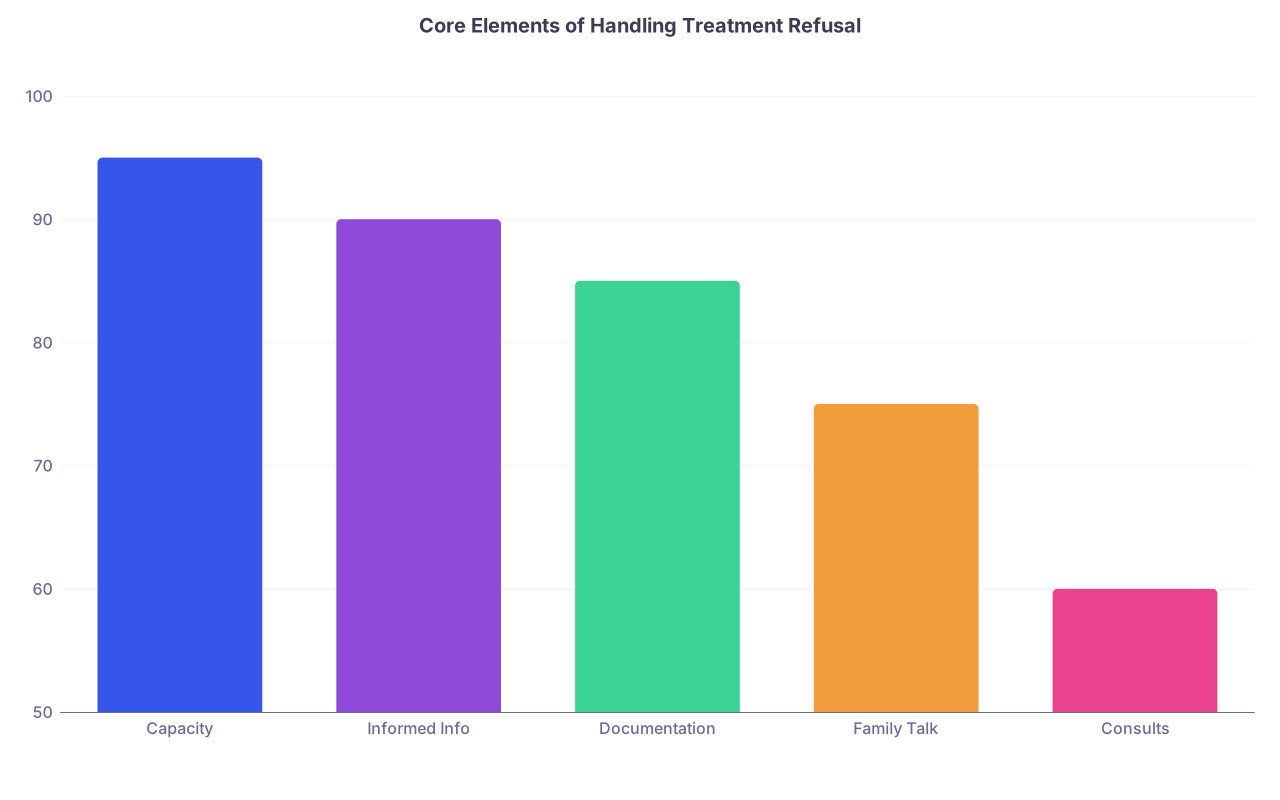
| Category | Value |
|---|---|
| Capacity | 95 |
| Informed Info | 90 |
| Documentation | 85 |
| Family Talk | 75 |
| Consults | 60 |
Your Next Step Today
Do not wait for the 3 a.m. septic shock scenario to figure this out.
Today, do this:
- Open one of your recent complex cases in the chart.
- Pretend the patient is now refusing a life-saving intervention.
- Write a mock capacity and informed refusal note in that chart (do not sign or save it if that is not appropriate—use a private template or Word doc).
- Force yourself to include:
- One direct patient quote showing understanding.
- A clear risk description of refusing.
- Your explicit capacity judgment.
If you cannot do that cleanly on paper, you will not do it cleanly at the bedside.
Build the muscle now, while nobody is crashing in front of you.


