

Most of the moral panic about “treating undocumented patients” in the ED is based on myths, not law or ethics.
Let me be blunt: in the emergency department, your ethical obligation to the undocumented patient in front of you is not ambiguous. You treat them. Fully. Without playing amateur immigration officer, without financial gatekeeping, and without moral grandstanding about “taxpayers.”
The nuances are not about whether to treat. They are about how to handle confidentiality, documentation, social risk, resource constraints, and your own biases in a system that quietly punishes vulnerability.
I will walk you through the real friction points the way they actually show up at 2 a.m. on a crowded ED shift.
1. The Legal Floor: What The Law Really Requires (And Forbids)
The ethical conversation is meaningless if you misunderstand the legal baseline. A lot of clinicians do.
EMTALA: The Non‑Negotiable Core
For emergency departments that participate in Medicare (that is basically all of them in the United States), the Emergency Medical Treatment and Labor Act (EMTALA) sets the floor.
EMTALA requires that you:
Provide an appropriate medical screening examination (MSE) to anyone who comes to the ED and requests evaluation, regardless of:
- Insurance status
- Ability to pay
- Immigration status
Stabilize any emergency medical condition (or active labor) within the hospital’s capabilities, or appropriately transfer the patient to a facility that can.
There is no carve‑out for “illegal immigrants.” None.
Asking about immigration status to decide whether or how you’ll treat is not just unethical; it invites serious legal trouble if it delays care or leads to disparate treatment.
You Are Not an Immigration Agent
Clinicians sometimes ask: “Am I required to report undocumented patients to ICE or law enforcement?”
Answer: No.
There is no federal statute that requires health professionals to report patients based on undocumented status. HIPAA allows information sharing for law enforcement in narrow scenarios (e.g., court order, certain crime reporting), but “being undocumented” is not a reportable offense. Hospitals that act like extensions of immigration enforcement destroy trust and drive vulnerable patients away until they are critically ill. Ethically indefensible.
HIPAA and Confidentiality
HIPAA is often misunderstood here.
Key points in the ED context:
- Immigration status, if known, is protected health information if it is documented in the chart or used in the clinical context.
- You may disclose PHI for:
- Treatment, payment, healthcare operations
- Certain mandated public health reporting (TB, certain STIs, abuse)
- Law enforcement, under specific conditions (warrants, subpoenas, certain crime investigations)
What you cannot do ethically or legally is:
- Voluntarily call immigration authorities because you “suspect” someone is undocumented.
- Share immigration‑related details with non‑care staff who have no legitimate need to know.
If someone from law enforcement—immigration or otherwise—asks about a patient in your ED, your default answer is some version of: “I’m bound by privacy law. Please contact our legal/risk management office.”
2. Core Ethical Principles Applied To Undocumented Patients
The four textbook principles do not change because the patient’s passport is missing. But they collide with the politics and realities in very specific ways.
Beneficence: Obligation to Help, Not Minimize
Beneficence in the ED often becomes a knife‑edge: do we “do the minimum to stabilize” or do we treat as we would any other patient with follow‑up, full work‑up, and advocacy?
Common rationalization I hear from residents:
“We just need to stabilize and discharge; they probably cannot afford the work‑up anyway.”
Ethically weak.
Beneficence requires that:
- Your diagnostic threshold not shift downward because you assume low resources.
- You offer best-available care within your setting and level of expertise, not a downgraded “charity package.”
Example:
- A middle‑aged, undocumented man with chest pain. There is a temptation to do a single troponin and EKG, and if negative, send him home because he “won’t get a cardiologist anyway.”
- A beneficence‑consistent approach: standard risk stratification (serial troponins, appropriate observation or admission) as you would for an insured citizen with the same story.
Once you’ve done that, then you can pivot to what’s realistic for follow‑up and cost, but you do not pre‑limit the care upfront because of legal status.
Non‑maleficence: Avoiding Harm in Ways You Do Not Document
Harm in these cases is not just under‑treating disease. It is also:
- Creating fear of seeking care
- Exposing patients to immigration risk
- Documenting details that can later be used against them or their families
You harm an undocumented patient when:
- You loudly question their ID in a crowded hallway.
- You document speculative statements like “likely undocumented” just because the patient speaks limited English and has no insurance.
- You allow security to hover at the bedside “just in case,” sending a clear message: you are suspicious.
This is not theoretical. I have seen patients walk out against medical advice because they heard staff whisper “ICE” down the hall.
Non‑maleficence demands:
- You separate clinical risk from legal/political risk and minimize both where possible.
- You do not introduce immigration fears into the encounter unless absolutely necessary for the patient’s informed understanding of their situation (very rare in the ED).
Justice: Resource Allocation Without Xenophobia
Justice is where things get tense. Physicians are not blind to cost. Nor should they be. But justice does not mean you quietly discount the undocumented.
Two competing justice claims:
- Fair distribution of limited healthcare resources.
- Fair treatment of individuals regardless of morally irrelevant characteristics (race, nationality, immigration status).
Immigration status is ethically irrelevant to clinical priority. It might be relevant to planning long‑term care solutions, but not to:
- How fast you evaluate a patient
- Who goes to the ICU
- Who gets the last available ventilator
Triage is based on clinical need and prognosis, not immigration documentation. If you are tempted otherwise—own that as bias, not “tough choices.”
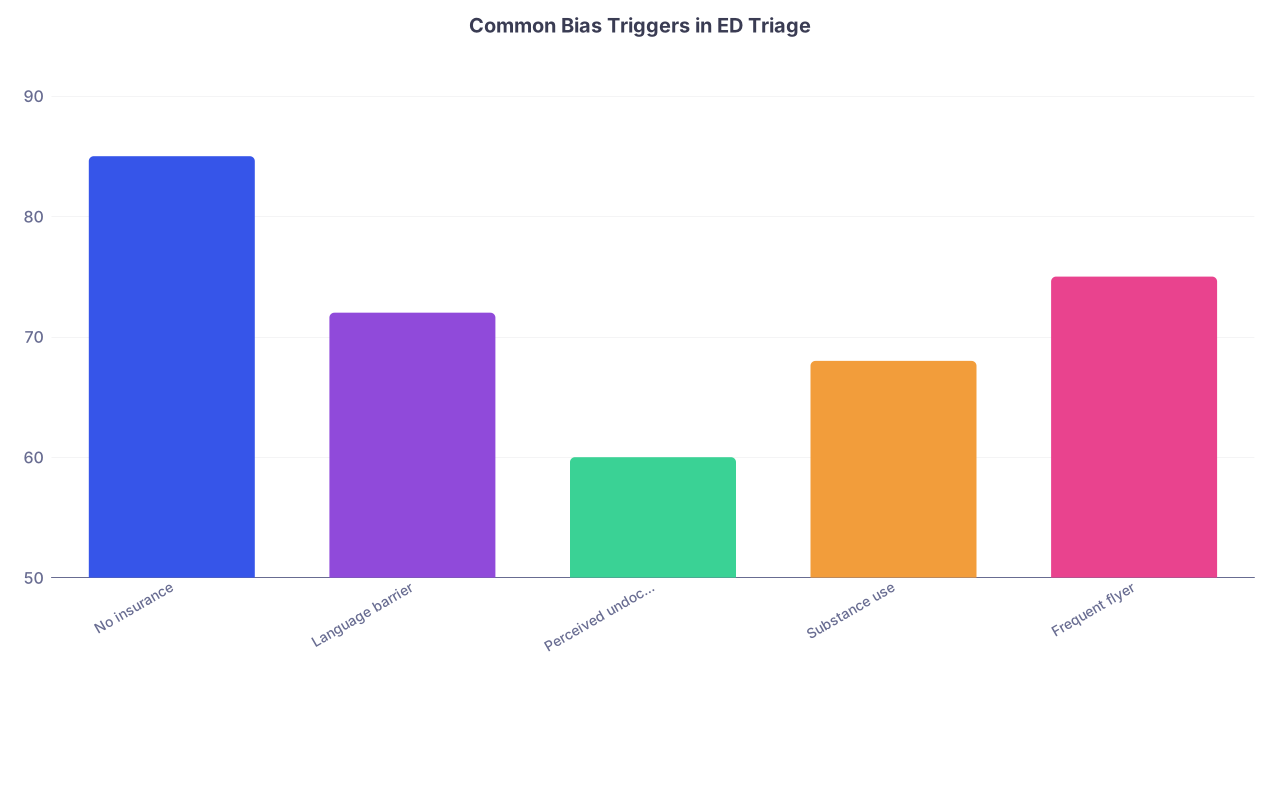
| Category | Value |
|---|---|
| No insurance | 85 |
| Language barrier | 72 |
| Perceived undocumented | 60 |
| Substance use | 68 |
| Frequent flyer | 75 |
Numbers here are illustrative, but the pattern is real: clinicians are more likely to down‑prioritize or emotionally distance from patients who press their frustration buttons. Undocumented status often overlaps with several of these triggers.
A justice‑consistent approach:
- Standard triage tools (ESI, etc.), applied rigidly to clinical data, not social assumptions.
- Clear policies that explicitly prohibit discrimination based on immigration status, reinforced in training.
Respect for Autonomy: Real Consent in a Context of Fear
Autonomy for undocumented patients in the ED is constrained by:
- Language barriers
- Mistrust of institutions
- Fear of exposing family members
- Poor health literacy due to lack of prior healthcare access
If an undocumented patient “refuses admission” after a big scare about bills and deportation, is that genuine informed refusal? Or is that coerced by structural terror?
Your job:
- Use professional interpreters. Not the teenage child, not the cousin, not “I know a little Spanish.”
- Make clear:
- The ED does not report to immigration.
- Their decision to accept or decline care will not be reported to authorities.
- Financial counseling is separate from clinical care.
Only then does “refusal of care” start to look like autonomous choice rather than panic.
3. Documentation, Data, and What You Put in the Chart
Here is where your pen (or keyboard) can quietly hurt people.
Do Not Speculate on Immigration Status in the Medical Record
If a patient tells you directly, “I am undocumented,” you might be tempted to write it down as psychosocial context. Think carefully.
Ask three questions:
- Does this information change my clinical management?
- Does it significantly shape discharge planning (e.g., specific low‑cost clinic referrals)?
- Could this be used against the patient in legal proceedings, insurance disputes, or immigration cases?
Often:
- It does not change acute care.
- It can be addressed by documenting “uninsured” or “no primary care provider,” which is clinically sufficient.
- It could absolutely be used against them in a hostile environment.
Ethically, minimal necessary documentation wins. You document:
- Medically relevant social factors: uninsured, lacks regular access to care, housing instability, language barrier, etc.
- Not: “undocumented immigrant,” unless the patient requests some immigration‑related support that directly depends on it (e.g., forensic documentation for an asylum claim or U‑visa evaluation) and you are acting in that role.
Billing, Registration, and “Real Names”
Registration staff often sit at the collision of policy and fear:
- “We need a real name for the record.”
- Patients give aliases or partial names.
Your ethical stance as a clinician:
- You do not coerce identity details beyond what is necessary for safe care and continuity.
- You support the use of institutional policies for “alias” or “unknown” name registrations when patients legitimately fear harm from being fully identified.
The chart is not an immigration tool. It is a clinical and safety tool. That should shape what goes in it.
4. Communication, Fear, and Trust at 3 A.M.
The hardest ethical work with undocumented patients is not in the textbooks. It is in the conversation.
The Unspoken Question: “Will I Be Deported for Being Here?”
Many undocumented patients will not ask this out loud. But it is there.
You can address it without an interrogation:
- When introducing yourself:
“We care for everyone here, regardless of insurance or immigration status. My only focus is your health and safety tonight.” - When patients hesitate about imaging, admission, or providing demographic info:
“Using our hospital does not involve immigration authorities. Your information is private within the healthcare system.”
This is not politics. It is trauma‑informed care.

Interpreters: Non‑Negotiable, Not a Luxury
Ethical nuance disappears fast if you do not understand each other.
You cannot get informed consent, assess capacity, or have any serious ethical conversation without clear language. That means:
- Use certified medical interpreters (in person, phone, or video).
- Avoid:
- “I speak enough [language] for this.” You do not, for complex risk discussions.
- Children as interpreters. It is exploitative and error‑prone.
- Family as sole interpreters for sensitive issues (domestic violence, sexual assault, reproductive decisions).
For undocumented patients, interpreters do double duty:
- They clarify clinical content.
- They signal respect and safety in a system that often erases them.
5. High‑Risk Scenarios Where Ethics Get Messy Fast
Let us walk through the situations where clinicians usually trip.
A. Law Enforcement or Immigration Agents at the Bedside
Scenario: A patient in your ED is suspected of being undocumented. Local police or immigration agents show up and ask to speak with them or demand records.
Your ethical and practical response ought to be structured.

| Step | Description |
|---|---|
| Step 1 | Officer request info or access |
| Step 2 | Notify charge nurse and admin |
| Step 3 | Contact hospital legal or risk |
| Step 4 | Limit access, protect PHI |
| Step 5 | Follow legal guidance |
| Step 6 | Explain privacy obligations |
| Step 7 | Valid court order or warrant |
Key points from the ethics side:
- The ED is a place of care, not a fishing ground for immigration enforcement.
- You limit law enforcement access to:
- Patients who consent (with capacity)
- Situations of immediate public safety risk
- Legally compelled scenarios (warrant, subpoena), processed through the hospital’s legal channel
You do not:
- Voluntarily provide medical details beyond what’s allowed.
- Abandon the patient during questioning; you stay alert to coercion and capacity.
B. Refusing Care Because of Cost or Status
Sometimes this is not explicit. It looks like:
- Telling an undocumented patient they “should go to a free clinic” before completing a standard ED work‑up.
- Offering subpar options because “they cannot pay anyway.”
Ethically unacceptable. EMTALA aside, the professional obligation is:
- Stabilize and assess emergent conditions first, with appropriate diagnostics.
- Only then discuss disposition, which can absolutely include:
- Low‑cost clinics
- Charity care programs
- Community resources
The sequencing matters. Clinical decisions first. Financial logistics second.
C. Discharge Planning Without a Safety Net
Here is a genuine ethical tension. You treat the acute problem, but:
- They have no insurance.
- No PCP.
- Fear of using public programs.
- Possibly unstable housing or employment.
Do you just treat, print a discharge summary, and walk away? No.
Ethically sound ED practice for undocumented patients means:
- You proactively involve:
- Social work
- Case management
- Community health workers or navigators, if available
- You identify:
- Low‑cost or sliding‑scale clinics
- Federally Qualified Health Centers (FQHCs)
- NGO‑run health centers (e.g., in many cities serving migrant populations)
| Resource Type | Key Features |
|---|---|
| FQHC | Sliding scale, no status check |
| Free/Charity Clinic | Volunteer based, limited hours |
| County Clinic System | Often open to all residents |
| NGO Health Center | Targeted migrant services |
| Hospital Charity Care | For major procedures only |
You will not solve structural injustice from the ED. But you do have an ethical duty not to knowingly discharge into a void without at least trying to connect them to something.
6. Your Own Bias, Moral Fatigue, and Systemic Hypocrisy
We have to talk about you for a second.
The Quiet Resentment
I have heard variations of this in ED break rooms more times than I can count:
- “Our ED is full of people who aren’t even supposed to be in the country.”
- “We are footing the bill for everyone else’s problems.”
That resentment is usually less about the individual patient and more about:
- Being overworked and under‑resourced
- Watching hospital administrators obsess over RVUs while asking you to do social work
- Feeling the mismatch between your responsibility and the system’s support
But here is the ethical line: your anger at the system cannot be offloaded onto the most vulnerable patient in the room. Undocumented patients did not design EMTALA. They did not set hospital reimbursement rates. They are simply sick and scared.
You can:
- Advocate at policy levels for better funding and rational immigration and health policy.
- Join or support hospital committees that address access and uncompensated care.
- Push for on‑site social work, legal aid partnerships, and institutional guidelines.
What you cannot ethically justify:
- Cutting corners on their care because you’re angry about macro‑level issues.
Moral Distress in Prolonged or Complex Cases
Undocumented patients often sit at the center of ethically draining cases:
- Critically ill with poor prognosis
- No clear surrogate decision‑maker
- Families afraid to visit the hospital
- Fear of transferring to long‑term facilities due to documentation needs
You will feel stuck:
- Keep them in the ICU indefinitely?
- Withdraw care?
- Discharge to what, exactly?
The right move:
- Use formal ethics consultation when available.
- Apply the same standards you would for any other patient:
- Prognosis
- Patient’s values (if known)
- Best interest when values are unclear
- Recognize that “they are undocumented” is not itself ethically relevant to decisions about code status, withdrawal of life support, or palliative care.
7. Building a Better Default: What “Good Practice” Actually Looks Like
You are not going to fix the immigration system. But you can decide what kind of clinician you become.
Reasonable “gold standard” for treating undocumented patients in the ED:
Clinical care identical to citizens with the same presentation:
- Same triage priority
- Same diagnostic thresholds
- Same stabilization standard
No immigration screening for clinical purposes:
- Do not ask about status unless directly pertinent to a specific legal or social service the patient wants.
- Do not document speculative or unnecessary immigration data.
Clear privacy stance:
- You explicitly reassure patients that care is not linked to immigration enforcement.
- You route all law enforcement requests through legal channels, not bedside improvisation.
Robust language access:
- Professional interpreters used as a norm, not an exception.
Minimum necessary documentation:
- Socioeconomic details framed in terms of access to care, not legal status.
- Sensitive info recorded only if it directly serves the patient’s interests.
Active discharge support:
- Social work involvement when possible.
- Concrete, realistic referrals, not just “follow up with PCP.”
Self‑awareness and advocacy:
- You examine your own frustration honestly.
- You push your institution to adopt clear, humane policies on care regardless of immigration status.
FAQ (Exactly 6 Questions)
1. Am I ever required to report an undocumented patient to immigration authorities?
No. There is no general legal requirement in the U.S. for clinicians to report patients based on immigration status. You may be required to report certain conditions (like TB) or abuse, but those are public health or safety issues, not immigration status. Voluntary reporting based solely on suspected undocumented status is ethically wrong and legally risky.
2. Should I document that a patient is “undocumented” if they tell me directly?
Usually no. You should ask whether that fact changes immediate clinical management or is essential for a specific service they are requesting (like an asylum medical affidavit). If it is not clinically necessary, it is safer and more ethical to document functional issues (uninsured, no primary care, unstable housing) rather than legal status labels that could later harm the patient.
3. Can I factor lack of insurance or undocumented status into my triage or decision to order tests?
You must not change triage priority based on insurance or immigration status. Tests and interventions should be guided by medical need and evidence, not citizenship. You can discuss costs and alternatives honestly, but only after you have ensured that emergent and indicated care is not compromised.
4. What if a law enforcement or immigration officer demands records or to speak with the patient?
You should not handle that solo at the bedside. Notify your charge nurse and follow your hospital’s policy: typically involve risk management or legal. Under HIPAA, you can release information only under specific conditions (warrant, court order, certain crime investigations). You also must consider the patient’s condition and capacity; access can be delayed if it interferes with emergency care.
5. How do I handle consent and risk discussions when the patient is terrified of being identified?
Use professional interpreters and clarify that accepting care in the ED is not an immigration enforcement trigger. Separate clinical decisions (tests, admission, procedures) from financial or administrative steps. Acknowledge their fear openly. Only if they understand that distinction can refusal or acceptance of care count as meaningful informed consent.
6. Is it ethically acceptable to steer undocumented patients toward cheaper or charity options at discharge?
Yes, as long as you have already provided appropriate emergency care and you are not withholding indicated treatment just because of status. It is actually ethically responsible to help them find sustainable, affordable care (FQHCs, free clinics, NGO services). The line you cannot cross is downgrading necessary acute treatment or manipulating them into refusing care because you assume they cannot or should not pay.
Key takeaways:
- In the ED, immigration status is ethically irrelevant to how you triage, diagnose, and stabilize patients.
- The real nuances are in confidentiality, documentation, communication, and discharge planning—where your decisions can quietly increase or decrease risk for already vulnerable people.
- You cannot fix structural injustice from the ED, but you can refuse to add to it. Treat the person in front of you with full clinical rigor, minimal unnecessary documentation, and explicit protection of their privacy and dignity.


