
The most dangerous thing about incidental findings is not missing them. It is handling them badly.
That is where people get sued, colleagues lose trust, and patients lose confidence.
Let me break this down specifically, because “oh, that’s probably nothing” is not an ethical framework.
What exactly is an incidental finding?
An incidental finding is a result that:
- Was not the target of the imaging (or test), and
- Has potential health implications for the patient.
Classic examples:
- CT abdomen ordered for trauma → small indeterminate renal mass
- MRI brain for headache → incidental unruptured aneurysm
- CT chest PE protocol → 6 mm lung nodule in a young non‑smoker
- CT KUB for stones → thickened endometrium in a postmenopausal woman
What is not an incidental finding?
- Normal variants with no clinical consequence (e.g., benign prominent perivascular spaces)
- Clearly artifactual “findings”
- Expected comorbid pathology directly contributing to the indication (e.g., degenerative disc disease on MRI for radiculopathy – still relevant, not really “incidental”)
The ethical tension comes from this triangle:
- Duty to benefit (beneficence) – you do not ignore possible serious disease.
- Duty to avoid harm (nonmaleficence) – you do not trigger a spiral of unnecessary invasive testing for every benign variant.
- Respect for autonomy – the patient has a right to know things that reasonably affect their future health decisions.
Most clinicians sit in that triangle and improvise. Which is how you get inconsistency, moral distress, and medicolegal exposure.
You need a stepwise approach.
Stepwise framework: from image to conversation
Think of it as a five‑step pipeline:
- Detection and description
- Risk stratification
- Contextualization (patient, clinical, and system factors)
- Communication and documentation
- Follow‑through and ownership
We will walk through each step with concrete patterns you actually see on call.
Step 1 – Detection and description: get the basics right
Most “ethical” problems here are actually sloppy radiology or distracted clinician reading.
You cannot ethically manage what you do not explicitly recognize and describe.
Radiologist responsibilities
On the radiology side, good practice means:
- Actively scanning for non‑target but important structures
- Using structured or semi‑structured reporting so incidental findings do not fall into free‑text oblivion
- Providing clear, actionable language – not vague impressions that paralyze the referring clinician
Weak report:
“Small lesion in right kidney, could be cyst or mass. Correlate clinically.”
Ethically robust report:
“12 mm well‑circumscribed, homogeneous hypoattenuating lesion in the interpolar right kidney, –HU on non‑contrast images, most consistent with a simple cyst. No enhancement. No further imaging follow up is required in the absence of new risk factors or symptoms.”
Or, if indeterminate and potentially serious:
“1.3 cm partially exophytic right renal lesion, 35 HU pre‑contrast, 65 HU post‑contrast, suspicious for enhancing solid lesion. Recommend urology referral and further characterization with dedicated CT or MRI renal mass protocol.”
Notice:
- Specific size and location
- Objective measurements
- Explicit “no follow up needed” or “follow up needed” guidance
That specificity is ethical. It prevents both overreaction and neglect.
Referring clinician responsibilities
On the clinical side, you do three things when you see an incidental finding in the report:
- Acknowledge it – in your own mind and in the chart.
- Translate it – convert radiology language into risk language for yourself and the patient.
- Decide – is this “ignore,” “monitor,” or “act now”?
Clinically lazy behavior looks like: “Radiology mentioned some lung nodule, but main issue is the PE, so I’ll just treat PE and discharge.”
Ethically clean behavior:
- You read the impression fully.
- You check if the nodule meets guidelines for follow up.
- You document: “Incidental 6 mm RUL lung nodule; per Fleischner guidelines for low-risk patient, recommend CT at 12 months. Discussed with patient.”
You are already doing step 2 there, which is risk stratification.
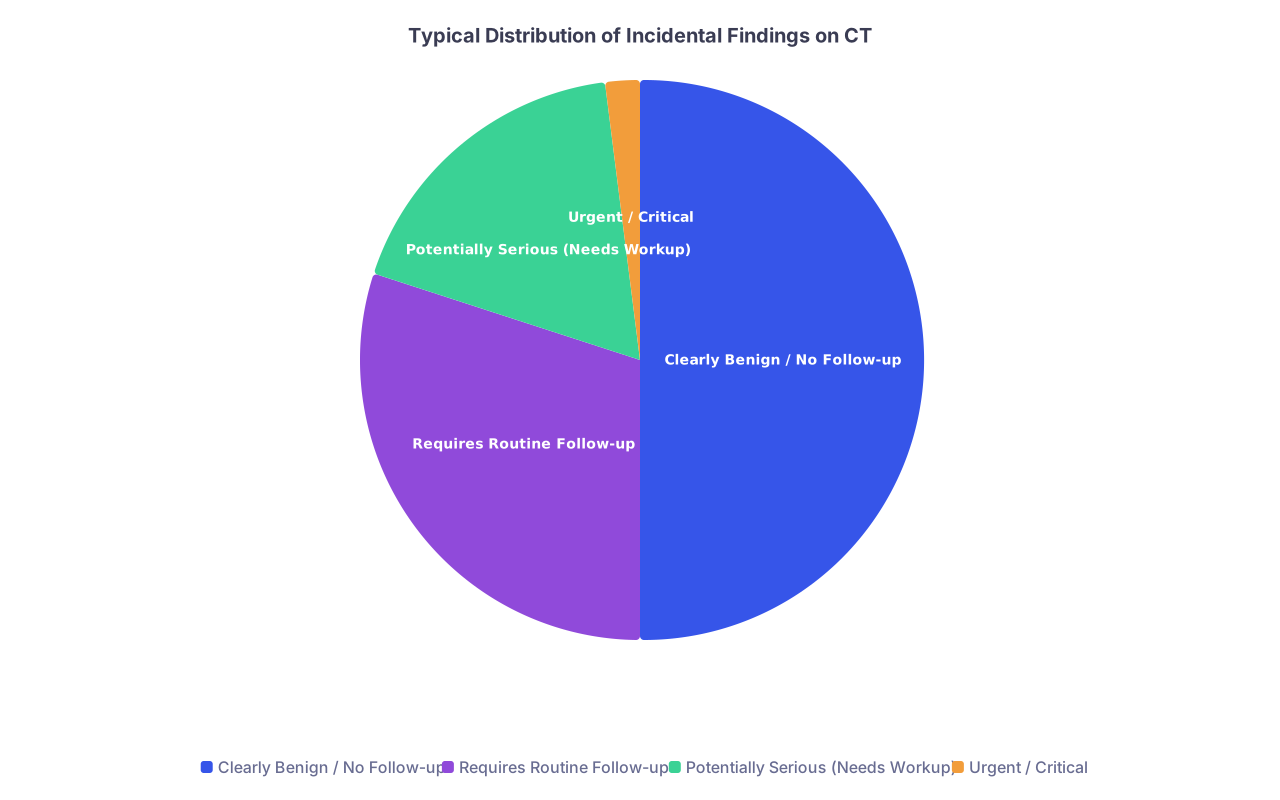
| Category | Value |
|---|---|
| Clearly Benign / No Follow-up | 50 |
| Requires Routine Follow-up | 30 |
| Potentially Serious (Needs Workup) | 18 |
| Urgent / Critical | 2 |
Step 2 – Risk stratification: benign noise vs high‑stakes signal
Not all incidental findings belong in the same category ethically.
You need a mental sorting system. I use a four‑tier model:
- Trivial / benign – no follow up appropriate
- Low-to-moderate risk, delayed follow up
- Significant risk, near‑term workup
- Critical or emergent – immediate action
Let me show you how this plays out by domain.
Example: Incidental lung nodules
Guidelines exist (e.g., Fleischner Society) and you should actually use them rather than guessing.
- Young, low‑risk, 4 mm solid nodule → usually no follow up
- 65‑year‑old smoker, 8 mm spiculated upper lobe nodule → near‑term CT or PET, pulmonology / thoracic surgery referral
The ethical failure modes:
- Over‑escalation: 3 mm nodule in 22‑year‑old → serial CTs for 5 years. Unnecessary radiation, anxiety, cost.
- Under‑escalation: 10 mm irregular nodule in 70‑year‑old smoker → “probably scarring, ignore.” That is indefensible.
Example: Incidental adrenal masses
- Classic lipid‑rich adenoma with benign washout pattern in well patient without cancer history → benign, no further workup in many cases
- 3 cm indeterminate adrenal lesion in patient with weight gain, hypertension → biochemical workup and endocrine referral
The ethical key: use existing specialty guidelines when they exist. The law will assume you should know them, or at least seek them.
When guidelines do not cover it cleanly
Not everything fits. Tiny meningiomas. Small pancreatic cysts. Asymptomatic men under 40 with borderline aortic dilation.
You still stratify based on:
- Probability of serious disease
- Magnitude of potential harm if disease is real and ignored
- Burden and risk of the proposed workup
If low probability, low harm, and high workup burden → lean to conservative.
If even moderate probability but high potential harm (e.g., aneurysm, malignancy) and low‑to‑moderate workup burden → lean to active follow up.
This risk triage is ethics in action. It is not a side note.

Step 3 – Contextualization: this is about this patient, not a textbook
The same incidental finding has a different ethical weight depending on the patient’s context. This is where a lot of “algorithm-only” thinking fails.
Factor 1 – Clinical status and prognosis
You cannot ethically manage incidental findings in a vacuum.
Compare:
- 85‑year‑old with advanced metastatic pancreatic cancer, on hospice, with an incidental 5 mm thyroid nodule
- 45‑year‑old otherwise healthy woman, same thyroid nodule on neck CT done for trauma
Exact same radiologic “finding”. Totally different ethical response.
For the hospice patient:
- More testing is almost always burden without benefit
- Best course: document clearly that this finding is not going to be worked up per goals of care, and explain briefly to family if asked
For the healthy 45‑year‑old:
- Reasonable to follow standard thyroid nodule pathways (e.g., ultrasound ± FNA depending on size/features)
This is pure nonmaleficence plus respect for existing goals of care.
Factor 2 – Comorbidities and life expectancy
If someone already has severe dementia, multiple falls, NYHA IV heart failure, and then gets an incidental 1 cm renal mass, your moral calculus is different.
Asking: “Will this workup meaningfully improve the patient’s life or change management in a way that aligns with their values?”
If the answer is almost certainly no, it is ethically acceptable – and often preferable – not to pursue aggressive workup.
But you do not just quietly ignore it. You:
- Note the finding
- Document why you are not pursuing it (“in light of limited life expectancy and patient’s expressed preference to avoid further tests…”)
- Where possible, align this with prior ACP / POLST / palliative discussions
Factor 3 – Patient values and risk tolerance
Two patients, same incidental brain aneurysm:
- Patient A: “I cannot live with this risk in my head, I want to do whatever is reasonable to treat it.”
- Patient B: “I am terrified of brain surgery; if the risk of rupture is low, I would rather not intervene.”
Assuming both positions are within the zone of reasonable medical judgment, your ethical duty is to respect autonomy after you have provided clear, balanced information.
That means:
- Explain absolute risks (not vague language like “small” or “unlikely”)
- Explain the range of management options and their pros / cons
- Check comprehension
You are not obligated to offer futile or harmful care. But you are absolutely obligated to involve the patient in decisions where there is genuine choice.

| Step | Description |
|---|---|
| Step 1 | Imaging Performed |
| Step 2 | Incidental Finding Detected |
| Step 3 | Describe and Measure |
| Step 4 | Document as Benign No Follow up |
| Step 5 | Plan Routine Follow up |
| Step 6 | Order Workup and Refer |
| Step 7 | Urgent Action and Direct Contact |
| Step 8 | Discuss with Patient |
| Step 9 | Document Plan and Rationale |
| Step 10 | Ensure Follow through Mechanism |
| Step 11 | Risk Stratify |
Step 4 – Communication and documentation: where ethics meets law
This is the part that keeps risk managers and lawyers awake. Not the incidental findings themselves, but the silence around them.
There are three communication channels you must manage:
- Radiologist → clinician
- Clinician → patient
- Health system → future clinicians (chart, alerts, follow‑up systems)
Radiologist → clinician: not just dumping text in the report
Most radiology reports are read. Some are skimmed. Some are missed completely during chaotic call nights.
For high‑stakes or urgent incidental findings, written text is not enough. Ethically and legally, best practice often requires direct communication:
- Phone call to the ordering team (or covering team)
- If no response, documentation that attempts were made and escalation to appropriate channels
- Clear “critical results” language in the report
Example: incidental 6 mm MCA aneurysm on MRI done for headaches – stable patient, not emergent. A detailed report is often enough; no 2 a.m. phone call required.
Different case: incidental acute saddle PE on CT aorta done for possible dissection. Patient is in the ED but CT was labeled “non urgent”. That is a critical finding – call must be made and documented.
Clinician → patient: the real ethical test
Here is the uncomfortable truth: a lot of incidental findings never get communicated to patients. Or they get dropped in as a throwaway line that terrifies them without context.
The ethical standard is:
- Patients should be informed of material findings that reasonably affect their future health decisions or require follow up.
- The information should be comprehensible and actionable, not technical jargon.
What does that look like in practice?
Bad way:
“There was something small on your kidney but it is probably nothing.”
Better:
“The CT we did for your abdominal pain also showed a small spot on your kidney. From the way it looks, the radiologist thinks it is likely benign, but because of your age we usually repeat imaging in about a year to make sure it does not grow. I will put that follow‑up into your chart and we can talk more if you have questions.”
You frame it, you give a plan, you normalize their anxiety without dismissing it.
Also, do not forget the right not to know. Very rarely, a patient will say, “I do not want to hear about more possible problems” – often in palliative settings. If that is informed and consistent with their broader choices, it is ethically acceptable to limit information, but only with clear documentation and ideally prior advance care planning.
Documentation: your ethical black box recorder
If you did not document it, it did not happen. That is not just legal doctrine; it is ethics in team-based care.
At minimum, for a clinically relevant incidental finding, your note should include:
- What the finding is, in plain language
- Your risk assessment (e.g., “likely benign,” “suspicious for X,” “requires further evaluation”)
- Whether and how it was discussed with the patient
- What follow‑up is planned, with time frame
- Who is responsible for that follow up
This last point is huge. “We will repeat imaging in 12 months” is meaningless unless someone owns it.
| Risk Level | Example Finding | Typical Action |
|---|---|---|
| Trivial / Benign | Simple renal cyst | Document, no follow up |
| Low to Moderate Risk | 6 mm lung nodule in low-risk pt | Scheduled imaging follow up |
| Significant Risk | Indeterminate adrenal mass | Further imaging, specialist ref |
| Critical / Emergent | Incidental large PE | Immediate treatment and contact |
Step 5 – Follow‑through and ownership: who is actually responsible?
Here is where systems fail. Everyone assumes someone else will track it.
Two common disasters:
- Incidental 5 mm aneurysm in 50‑year‑old → PCP never sees hospital report → no referral, no follow up.
- Lung nodule follow‑up recommended → multiple job or insurance changes → follow‑up CT never happens, years later advanced lung cancer appears.
Ethically, you must address three things:
- Assign responsibility
- Put a system in place
- Close the loop when possible
Assign responsibility
In inpatient settings, the discharging team typically owns the job of:
- Summarizing significant incidental findings
- Indicating who should follow up: PCP vs specialist vs imaging center
- Communicating this at discharge (verbal and written)
In outpatient or ED settings:
- The clinician who ordered the test usually bears primary responsibility to communicate the result and arrange follow up—or explicitly hand that off to another clearly identified clinician.
“Follow up with your doctor” without specifying what and when is not ethical follow‑through. It is hand‑waving.
System support: do not rely on memory
Good systems use:
- Radiology “incidental findings” flags
- EMR reminders or “health maintenance” items for specific follow‑ups
- Incidental nodule or aneurysm tracking programs (larger centers)
- Clear transitions-of-care documentation templates that include a line item for incidental findings
If your workplace has none of this, you get creative:
- Create smart phrases in your notes to force yourself to address incidental findings
- Use task lists or reminders in the EMR for key follow‑ups
- Coordinate with clinic staff to track patients who need time‑based imaging
You cannot fix the whole system alone, but you are responsible for not silently letting significant findings vanish.
Closing the loop
Ideally, for anything beyond the “trivial/benign” category, you see the loop closed:
- Follow‑up imaging done (and reviewed)
- Specialist consultation occurred
- Decision for ongoing surveillance vs no further action documented
You will not get 100%. Patients move, decline, or refuse. That is reality. What matters ethically is that:
- You made reasonable, documented efforts.
- The patient had a fair opportunity to benefit from the information.
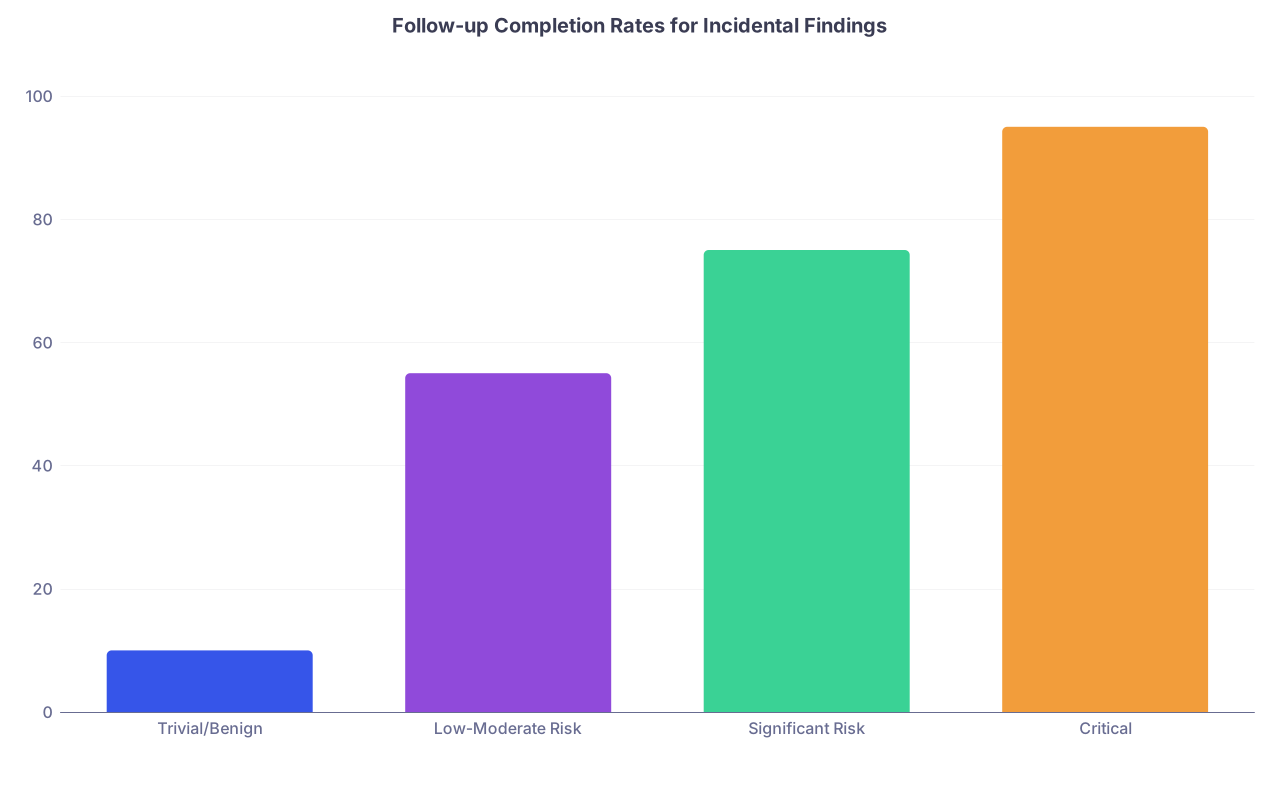
| Category | Value |
|---|---|
| Trivial/Benign | 10 |
| Low-Moderate Risk | 55 |
| Significant Risk | 75 |
| Critical | 95 |
The ethical principles underneath the protocol
Let’s anchor this in the classic four pillars, because exam writers love them and real practice uses them implicitly:
Beneficence
- Detecting and appropriately acting on significant incidental findings prevents morbidity and mortality. That is straightforward beneficence.
- Using guidelines and risk tools to avoid under-recognition of serious conditions sits here.
Nonmaleficence
- Over‑testing every minor abnormality exposes patients to radiation, biopsy complications, labeling, and chronic anxiety.
- Ethically mature clinicians recognize that restraint can be just as moral as intervention.
Respect for autonomy
- Patients cannot exercise real autonomy if they never learn about incidental but important findings.
- Conversely, autonomy includes the right to decline follow up after informed discussion – especially when benefits are small and burdens are large.
Justice
- Overreaction to low‑risk incidentalomas burns limited imaging and specialty resources, delaying care for patients who actually need it.
- Health systems that design tracking programs for only “insured, stable patients” while everyone else is left ad hoc are drifting into unjust territory.
If you remember nothing else: managing incidental findings is core medical ethics, not a radiology side quest.
Common scenarios and how to handle them cleanly
Let me give you a few quick, exam‑style and real‑life scenarios.
Scenario 1 – Incidental 1 cm pulmonary nodule on trauma CT in 30‑year‑old non‑smoker
Stepwise:
- Radiology: describes nodule, suggests follow up per guidelines (often optional or long interval).
- You: recognize low cancer risk; factor in age, no smoking, solitary, size.
- Plan: likely one follow‑up CT at 12 months or even no follow up depending on guideline and exact features.
- Conversation: explain low risk, purpose of any follow up, reassure.
- Document: risk level, shared decision, exact plan, and who is responsible (you vs PCP).
Ethical danger: unnecessary serial CTs for years because nobody wanted to say, “We can safely not chase this further.”
Scenario 2 – Incidental 3 mm anterior communicating aneurysm on MRI for migraine
- Radiology: mentions likely tiny aneurysm, suggests neurology / neurosurgery consult.
- You: appreciate that rupture risk exists but is low; but consequences are catastrophic.
- Plan: outpatient neurology or neurosurgery referral, blood pressure optimization, counsel on smoking if relevant.
- Conversation: balanced explanation of small but real risk; emphasize that recommending expert opinion is standard, not panic.
- Document: that patient understands risk / options and agrees to referral.
Ethical danger: writing it off as “too small to matter” without any discussion.
Scenario 3 – Incidental 1.5 cm pancreatic cyst in 82‑year‑old with severe dementia
- Radiology: suggests MRI or EUS depending on features.
- You: step back and consider comorbidities, functional status, goals of care.
- If patient is frail with limited life expectancy and burdensome testing would not change overall trajectory, reasonable to defer further workup.
- Conversation: with family / surrogate, focusing on quality of life and avoiding burdensome tests; explain why not pursuing is a positive choice aligned with goals.
- Document: rationale linked to prognosis and expressed values.
Ethical danger: mindlessly following imaging algorithm without regard to patient context.
Bringing this into your daily practice and exams
If you are early in training, your job is to build a reflex:
Whenever you see “incidental” or “also noted” in a report, ask yourself:
- What is this really, in risk language?
- Does it need action, follow up, or nothing?
- How will the patient find out about it?
- Who will make sure any plan actually happens?
If you answer those 4 questions explicitly—even in your head—you are already ahead of many practicing clinicians.
For exam questions (ethics, law, or clinical):
- They often test: duty to inform, appropriate level of follow up, involvement of patient in decision, and avoidance of both over‑ and under‑treatment.
- The “best next step” is rarely “ignore it”. It is usually: inform the patient, discuss risks and benefits, arrange appropriate follow up, document.
FAQ (exactly 4 questions)
1. Do I have to tell patients about every incidental finding, even trivial ones?
No. Ethically, you focus on material findings—those that reasonably affect health decisions, prognosis, or require follow up. A clearly benign anatomic variant that requires no action and carries no meaningful risk does not need a formal counselling session. That said, anything the radiologist flags as requiring follow up or further evaluation should be communicated and documented.
2. What if I think further workup is pointless but the patient insists?
You are not required to offer harmful, futile, or grossly disproportionate investigations. Your duty is to explain the likely benefits and harms clearly. If, after that, a requested test falls into a gray zone (low yield but not clearly harmful), shared decision making is appropriate. If it is truly inappropriate (for example, invasive biopsy with high risk and essentially no plausible benefit), you should calmly refuse, offer alternatives, and document the discussion.
3. Who is legally responsible if an incidental finding with recommended follow up is missed?
Responsibility is usually shared. Radiologists must clearly document the finding and recommended follow up. Ordering clinicians (or the primary team at discharge) are expected to read the report, communicate significant findings to the patient, and arrange follow up or clear hand‑off. Courts have increasingly taken the view that “the finding was in the report” does not absolve clinicians who never acted on it. Good documentation of your efforts to communicate and arrange follow up is your protection.
4. How do I handle incidental findings in patients with DNR orders or palliative goals of care?
DNR status alone does not mean you ignore significant findings. DNR only governs resuscitation, not all treatment. For patients with broader palliative or comfort‑focused goals, you consider whether investigating or treating the incidental finding aligns with those goals and is likely to improve quality or length of life in a meaningful way. Often the ethically right choice is to not pursue aggressive workup, but that decision should be discussed (with patient or surrogate) and clearly documented along with the reasoning.
Key points:
- Incidental findings demand a structured, stepwise approach: detect, risk stratify, contextualize, communicate, and ensure follow through.
- Ethically sound management balances beneficence and nonmaleficence with autonomy and justice, not reflexive over‑ or under‑treatment.
- Clear communication and documentation—not just technical interpretation—are where most real‑world ethical and medicolegal battles are won or lost.