

You are on call in a mixed med-surg ICU. It is 23:47. The charge nurse leans in: “We have no beds. ED just called a code sepsis. And the floor wants to transfer a crashing COPD patient on 6 liters.” You glance at the board. Every bed is occupied. Two patients are tenuous. One is clearly not going to leave the hospital alive, but the family “wants everything.” The ED attending is asking, “Can I send this one up now?” This is microallocation. Not policy in a conference room. Bedside rationing. Who gets the last ICU bed tonight?
Let me break this down specifically, because this is where ethics stops being abstract and starts feeling like a punch in the gut.
Macro vs Micro: Why Tonight Feels Different
First distinction students and residents routinely blur: macroallocation versus microallocation.
Macroallocation is big-picture: how many ICU beds a hospital funds, how many ventilators a region buys, national decisions about transplant funding, public health budgets. Committees, spreadsheets, public policy.
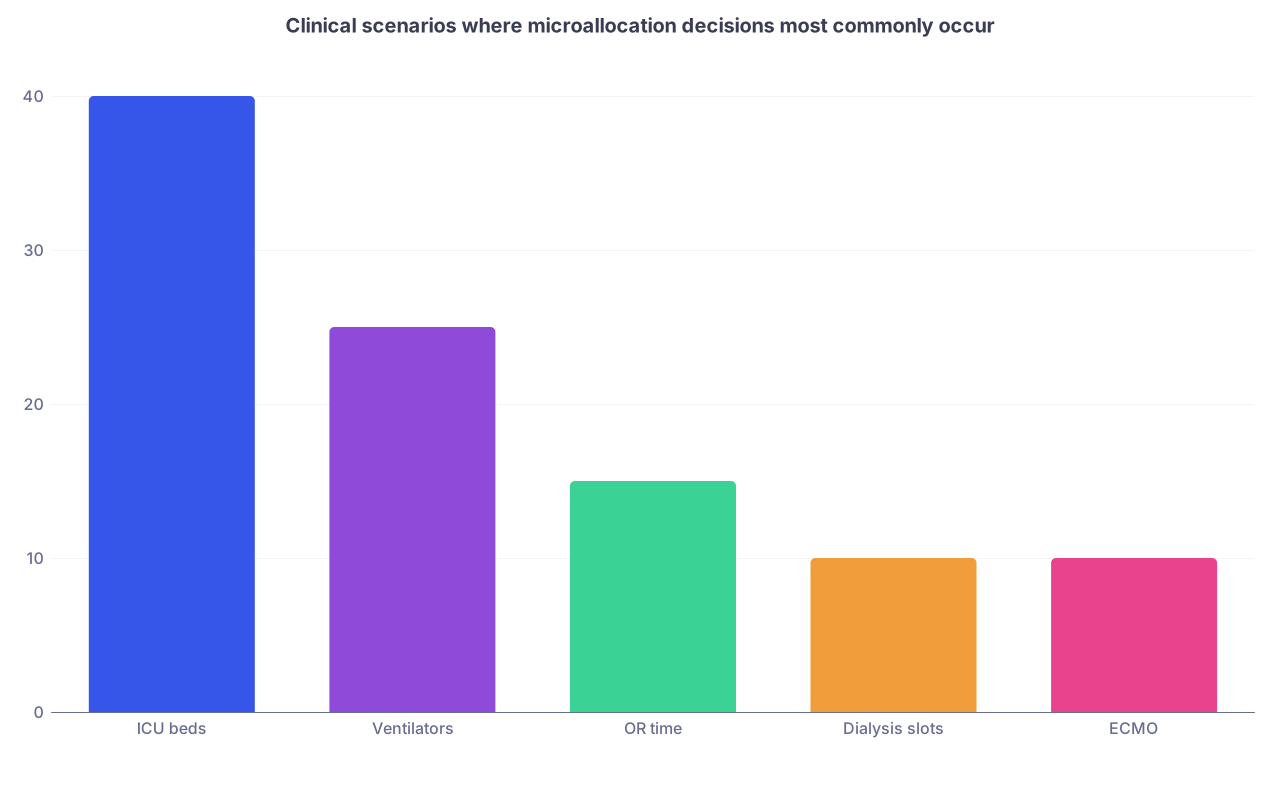
Microallocation is the individual-level call when resources are already limited:
- Which patient gets the single available ICU bed.
- Which of three hypoxic patients gets the only available high-flow nasal cannula unit.
- Whose surgery gets bumped when there is no post-op ICU capacity.
You, on call, are doing microallocation. Often off the books. No policy manual tells you what to do at 23:47. Yet ethically and legally, those decisions are not free-form.
| Category | Value |
|---|---|
| ICU beds | 40 |
| Ventilators | 25 |
| OR time | 15 |
| Dialysis slots | 10 |
| ECMO | 10 |
In most hospitals, the macro-level decision has already been made: “We have 24 ICU beds.” The problem you inherit is that tonight 24 beds are full. And the 25th patient is in the ED.
Ethically mature clinicians recognize this: bedside rationing is inevitable. The question is not whether you ration. It is how you ration, and whether you are honest with yourself about what you are doing.
The Ethical Frameworks: What Actually Guides “Who Gets the Bed?”
You cannot improvise ethics at 23:47. You need a structure in your head before the pager goes off.
There are four classic principles and a handful of allocation frameworks that show up in exam questions, hospital policies, and lawsuit arguments.
Core principles (Beauchamp & Childress)
You know these, but let me tie them directly to tonight’s ICU bed:
Autonomy: Respecting patients’ values and choices.
Problem: Autonomy does not create resources. A patient or family can want ICU care; that does not magically add a bed.
Beneficence: Acting for the patient’s best interest.
Nonmaleficence: Avoiding harm.
With only one bed, beneficence and nonmaleficence force you to think: where can this bed do the most good, and where is withholding it causing the least avoidable harm?
Justice: Fair distribution of benefits and burdens.
This is where most of the friction lies. “Fair” does not mean “first come, first served” by default. Nor does it mean “physician favorite.” Justice is about morally relevant criteria.
Allocation logics at the bedside
When ethicists and allocation committees are forced to be explicit, they usually juggle some mix of:
Utilitarianism – Maximize total benefit
- Get the greatest improvement in health outcomes per unit resource.
- ICU bed goes to:
- Higher likelihood of survival to discharge.
- More years of life saved (sometimes).
- Better functional outcome.
Egalitarian / “Fair chance” – Treat people as moral equals
- Everyone has equal claim; no one has inherent priority.
- Translates into random selection or “first come, first served” when patients are clinically similar.
Prioritarian / Life-cycle – Give some preference to the worse off or to particular life stages
- Example: All else equal, a previously healthy 35-year-old and a 90-year-old with metastatic cancer both need the last bed. Many frameworks quietly favor the 35-year-old because of life-cycle considerations (they have “not yet had their fair innings”).
Social value / Instrumental value
- This is the “critical worker” logic used in pandemics: short-term priority to health workers or others essential to maintaining the system, but not because their lives are worth more. Rather because saving them allows more lives to be saved indirectly.
- Ethically dangerous if extended beyond narrow definitions (easily becomes “VIP medicine”).
ICU triage policies often blend 1 (utilitarian), 2 (egalitarian tie-breakers), and a restrained version of 4 (e.g., during COVID for frontline clinicians).
The Real Cases: Three Patients, One Bed
Let us ground this in a scenario I have seen variations of many times.
You have:
Patient A: 82-year-old, advanced dementia, severe COPD, septic shock on floor for 12 hours, now hypotensive on maxed-out norepinephrine through peripheral line. Code status full per family. SOFA 13. Frailty score high. Estimated survival to discharge maybe 5–10%.
Patient B: 56-year-old, post-op leak after colorectal surgery, now septic in ED, on 2 pressors but improving with fluids, previously independent, no major comorbidities. SOFA 9.
Patient C: 42-year-old, DKA, pH 7.02, Kussmaul breathing, borderline respiratory fatigue, no prior health issues. Responding to insulin but needs close monitoring, maybe intubation if they tire out.
One ICU bed.
Step 1: Clarify your ethical aim
The morally coherent stance many institutions endorse: allocate the bed to maximize benefit while maintaining equal moral worth of persons and avoiding discrimination.
Translated: prioritize the patient with the best chance of meaningful survival with ICU care, not the sickest in a raw sense, and not the one with the loudest family.
Here, that likely points toward Patient B or C, not A.
Step 2: Identify morally relevant vs irrelevant criteria
Relevant:
- Short-term prognosis with ICU care (survival to discharge).
- Long-term prognosis to a basic acceptable level of function (this gets trickier).
- Reversibility of acute condition.
- Amount of ICU resources likely required (weeks on ECMO vs 24–48 hours of insulin and monitoring).
Irrelevant (legally and ethically prohibited as primary criteria):
- Race, religion, sex, disability per se.
- Wealth, insurance status.
- Social “worth” in a broad sense (job title, fame).
- Family likeability or pressure.
- “They have been here longer; they ‘deserve’ it more” (except as a tie-breaker under some frameworks).
So in our case, Patient A has a low probability of benefitting substantively from ICU-level care. Continuing full support might prolong dying rather than restore health.
Patient B has a serious but clearly reversible problem if treated aggressively.
Patient C probably has the highest probability of rapid, complete recovery but might be manageable in a high-acuity step-down or ED holding if that exists.
A strict utilitarian might put C first. A nuanced triage framework might say: B gets the bed, C stays in ED with aggressive monitoring and potential early intubation if they worsen, and A is managed on the floor with a goals-of-care conversation and perhaps a DNR/DNI order if appropriate.
Is that comfortable? No. Is it ethical? In my view, yes—if done transparently, consistently, and with appropriate communication.
The Legal Landscape: What You Must Not Do
You will not find a statute saying, “Doctor, this is exactly how to allocate the last ICU bed.” Law mostly works by boundaries and prohibitions, plus general duties.
Core legal duties relevant to microallocation
Duty of care / Standard of care
- You owe each patient care that meets the professional standard in your locale for similar circumstances.
- In scarcity, this standard adapts. Courts recognize “crisis standards” in disasters and may accept modified care if you act reasonably and non-discriminatorily with the resources available.
Non-discrimination
- You cannot deny or downgrade care on the basis of race, color, national origin, sex, disability, age (in many jurisdictions) when these are not directly and medically relevant.
- During COVID, OCR in the U.S. explicitly warned against triage policies that deprioritized people with disabilities solely because of baseline disability or predicted lower quality of life.
EMTALA (U.S.)
- In the emergency setting, you must provide a medical screening exam and stabilize patients regardless of ability to pay.
- If your hospital has ICU capabilities but is full, you must arrange appropriate transfer if needed. You cannot delay acceptance or transfer based on insurance.
Informed consent and communication
- When ICU care is not offered, you must explain the reasoning, offer alternatives, and document discussions.
- You cannot unilaterally “downgrade” goals of care simply because a bed is not available.
Avoiding arbitrary or capricious decisions
- From a legal perspective, unpredictable and inconsistent decisions are risky. They suggest bias or lack of policy.
The egregious legal violations are almost always about discrimination or abandonment, not the mere fact that one patient did not get an ICU bed.
How Hospitals Try (and Often Fail) to Structure This
Good institutions do not leave microallocation entirely to whoever is most assertive at 23:47. They develop triage policies. Some are decent. Some are useless window dressing.
Common components:
| Element | Typical Content |
|---|---|
| Clinical criteria | SOFA scores, comorbidity thresholds |
| Exclusion criteria | Conditions with near-certain mortality |
| Priority categories | High, intermediate, low priority |
| Reassessment intervals | 48–120 hour time-limited trials |
| Tie-breaker rules | Age bands, lottery, first-come |
Use of scoring systems
You will see:
- SOFA (Sequential Organ Failure Assessment).
- APACHE II / SAPS II.
- Frailty scales in older adults.
These are supposed to support, not replace, clinical judgment. Their calibration in individual patients is imperfect. But they anchor the process and reduce pure “gestalt bias.”
Exclusion and “too sick to benefit”
Some policies say: patients with conditions with near-certain mortality within a short time frame, despite ICU-level care, may be excluded or deprioritized. Examples:
- Refractory shock on multiple pressors with multi-organ failure and no reversibility.
- End-stage neurodegenerative disease with severe baseline functional impairment, when acute illness will not meaningfully change trajectory.
These are controversial. Disability rights advocates (correctly) push back when “baseline disability” is treated as automatic exclusion rather than granular prognosis.
Time-limited trials
One underused but powerful tool: time-limited trials of ICU care with predefined criteria for continuation or withdrawal.
During scarcity, this can be explicit:
- We admit Patient B to ICU for 72 hours.
- We set objective markers: lactate trend, vasopressor requirement, organ function.
- If there is no improvement or clear decline, we recognize the trial as unsuccessful and re-evaluate continuation of aggressive therapy.
This allows some fairness across patients while remaining open to reversibility that is not obvious at admission.
The Bedside Reality: How These Decisions Actually Get Made
Here is the part no textbook captures well. The actual mechanics.
Who really decides?
Officially:
- The attending intensivist (or on-call critical care physician) typically has final say on ICU admissions.
- Sometimes there is an “ICU triage attending” role in larger centers.
Unofficially:
- Charge nurses flag bed status and feasibility.
- ED attendings push firmly for their sickest cases.
- Surgeons pull weight for post-ops they are anxious about.
- Hospital administration occasionally leans in when a VIP appears.
You, as resident or fellow, are in the middle. Your job ethically:
- Surface the relevant facts and prognosis for each candidate.
- Apply the institution’s triage principles consistently.
- Escalate contentious calls to your attending.
- Document your reasoning.
Hidden biases
If you are not self-aware, microallocation will be driven by:
- Who you saw first.
- Who you like more.
- Which family is yelling louder.
- Which service you are on.
I have seen the following more than once:
- Quiet, single, uninsured 50-year-old with sepsis stuck in ED for hours, while a well-connected 75-year-old with marginal benefit gets an ICU bed quickly.
- Younger attending advocating harder for “their” patient, older attending more resigned, and bed goes to the squeaky wheel.
These are ethically indefensible patterns. They are also very human. If you want to be an ethically serious clinician, you must fight this.
Practical Stepwise Approach: What Should You Do Tonight?
Let me give you a concrete decision process that aligns with both ethics and law, and that I have seen work in practice.

| Step | Description |
|---|---|
| Step 1 | Identify ICU candidates |
| Step 2 | Assess clinical need |
| Step 3 | Estimate prognosis with ICU |
| Step 4 | Admit highest priority |
| Step 5 | Compare candidates |
| Step 6 | Apply ethical criteria |
| Step 7 | Select based on prognosis |
| Step 8 | Use policy tie breaker |
| Step 9 | Document reasoning |
| Step 10 | Communicate with teams and families |
| Step 11 | Bed available? |
| Step 12 | Tie? |
Step 1: Clarify who truly needs ICU
Not every “ICU request” is justified. Some floor patients can be managed with:
- Higher nurse ratio.
- Telemetry plus closer observation.
- Non-ICU high-dependency units.
Mislabeling everything as “needs ICU” artificially escalates scarcity. Push referring teams to be specific: what intervention can only the ICU provide that is needed now?
Step 2: For genuine candidates, estimate prognosis and reversibility
Use:
- Clinical gestalt grounded in data.
- Scores (SOFA, frailty).
- Known comorbidities.
- Trajectory over the last 12–24 hours.
Categorize in your head:
- High likelihood of meaningful survival with ICU.
- Intermediate / uncertain.
- Very low likelihood despite ICU.
Step 3: Prioritize based on expected benefit
If you can admit only one:
- Favor patients in the “high likelihood of benefit” bucket.
- Among them, consider resource intensity: a patient needing 2 days of ICU vs 30 days ECMO matters for overall system capacity, though this should not become disguised discrimination.
If two patients have roughly equal prognosis:
- Use your institution’s tie-breaker (lottery, first come, age bands, etc.), not gut instinct or personal preference.
Step 4: Escalate tricky or borderline cases
You are not supposed to shoulder this alone.
- Involve your attending.
- Consult ethics if time and context allow (often not at midnight, but for recurrent patterns or chronic issues).
- If your hospital has a triage committee or protocol, use it.
Step 5: Documentation and communication
This part is routinely neglected and then bites people during complaints or litigation.
Document:
- Patients who were considered and for what reasons.
- Clinical data that influenced prognosis (e.g., SOFA, lactate, comorbidities).
- That the unit was at capacity and no safe alternative bed existed.
- That you followed hospital policy X or triage guideline Y.
Communicate clearly to:
- Referring team: “We are full. Given the current candidates, we are prioritizing patient B for the single bed because…”
- Family (for the patient not getting ICU): frame it truthfully but gently:
- Avoid: “There is no ICU bed and that is why we cannot.”
- Use: “Given your father’s overall condition and prognosis, ICU-level interventions are no longer likely to help him recover. We will focus on his comfort and dignity, and treat him here.”
You are allowed to acknowledge resource constraints, but it should not sound like the only reason you are limiting care is lack of a bed, when ethically you also believe it will not benefit them.
Microallocation vs Bedside Futility: Different but Intertwined
You should separate two questions in your head:
Is ICU-level care medically inappropriate (often called “futile”) for this patient because it will not achieve physiologically or patient-centered goals?
Is ICU care potentially beneficial but unavailable because others would benefit more or we have capacity limits?
In case 1, the appropriate path is goals-of-care discussions and potential limitation of interventions regardless of bed count.
In case 2, you are in the thick of microallocation. Ethically dicey but inevitable.
When people conflate the two, they sometimes justify rationing decisions as “futility” to feel better. That is dishonest and erodes trust. Better to own that you are making a rationing decision, but doing it by a fair process.
Emotional and Professional Impact: This Will Get to You
If you handle these cases enough, you will carry some of them for years. That is normal. It would be concerning if you did not.
Three practical ways to protect your integrity:
Make decisions within a known framework, not by mood
- If you can say, “I followed our triage guidelines and the same principles I used last week,” it stabilizes you morally.
Debrief with colleagues
- Quick, honest “that was rough, here is what I did, does that make sense?” conversations after the shift matter.
- If you cannot justify your choice to a respected peer the next morning, you probably need to re-examine your approach.
Stay away from quiet cynicism
- The easy slide is: “Families always want everything, admin does not care, I do what I want.”
- That is how bad patterns calcify. Force yourself to name the ethical principles in play at least internally.
Looking Ahead: Building the Muscle Before You Are the One Holding the Pager
Where you are now—student, early resident, maybe junior attending—this is exactly the time to start building your triage “reflexes” in a deliberate way.
You can:
- Ask attendings on rounds, “Last night we were full; how would you decide between two patients if this repeats?”
- Read your hospital’s ICU admission and triage policy closely. Most residents have never opened it.
- In M&M or ethics conferences, push for explicit discussion: “What was the allocation logic? Was it defensible?”
- During electives in ICU or ED, shadow bed control and charge nurses for a day. Watch who gets prioritized, and why.
Because here is the reality: there will be another night when there is one bed and two crashing patients. The pager will be in your hand. You will not have an hour to philosophize.
If you have done the work now—understood the frameworks, learned your institution’s policies, confronted your own biases—you will not make it easy. But you will at least make it defensible. And survivable, for you and for your patients.
With those building blocks in place, you are better positioned for the harder layer that comes next: not just “who gets the last ICU bed tonight,” but “how do we, as a profession, redesign systems so that you face that question less often?” That broader structural justice work is the next chapter in your ethics journey.


