

The way we talk about “full code vs DNR” is broken. It shrinks a complex, lifelong ethical reality into a single checkbox at 2 a.m. on admission.
The Myth: Full Code vs DNR Is The Big Ethical Decision
In most hospitals, the admission script goes like this: “If your heart stops, do you want us to do everything?”
That question is loaded, misleading, and ethically shallow.
We’ve turned code status into the centerpiece of end‑of‑life ethics. Families agonize over it. Trainees obsess about “having the DNR conversation.” Hospital policies, order sets, and quality metrics all fixate on whether there’s a documented code status.
Here’s the problem: CPR is almost never the real ethical fork in the road.
Data first.
Out‑of‑hospital CPR for older adults with serious chronic illness? Survival to discharge is often in the single digits. In‑hospital CPR? Overall survival is around 15–25%, and much lower in patients with advanced cancer, multi‑organ failure, or dementia. And survival doesn’t equal good function. A large fraction of survivors have severe neurologic impairment.
We know this. The literature has been consistent for decades.
Yet we act like this is the central ethical choice. As if getting that checkbox right means we’ve done our ethical job.
We have not.
The real ethical work usually happens way upstream of the code. It’s about values, tradeoffs, and proportionality of interventions long before a code blue is called.
What the Data Actually Shows About CPR and Outcomes
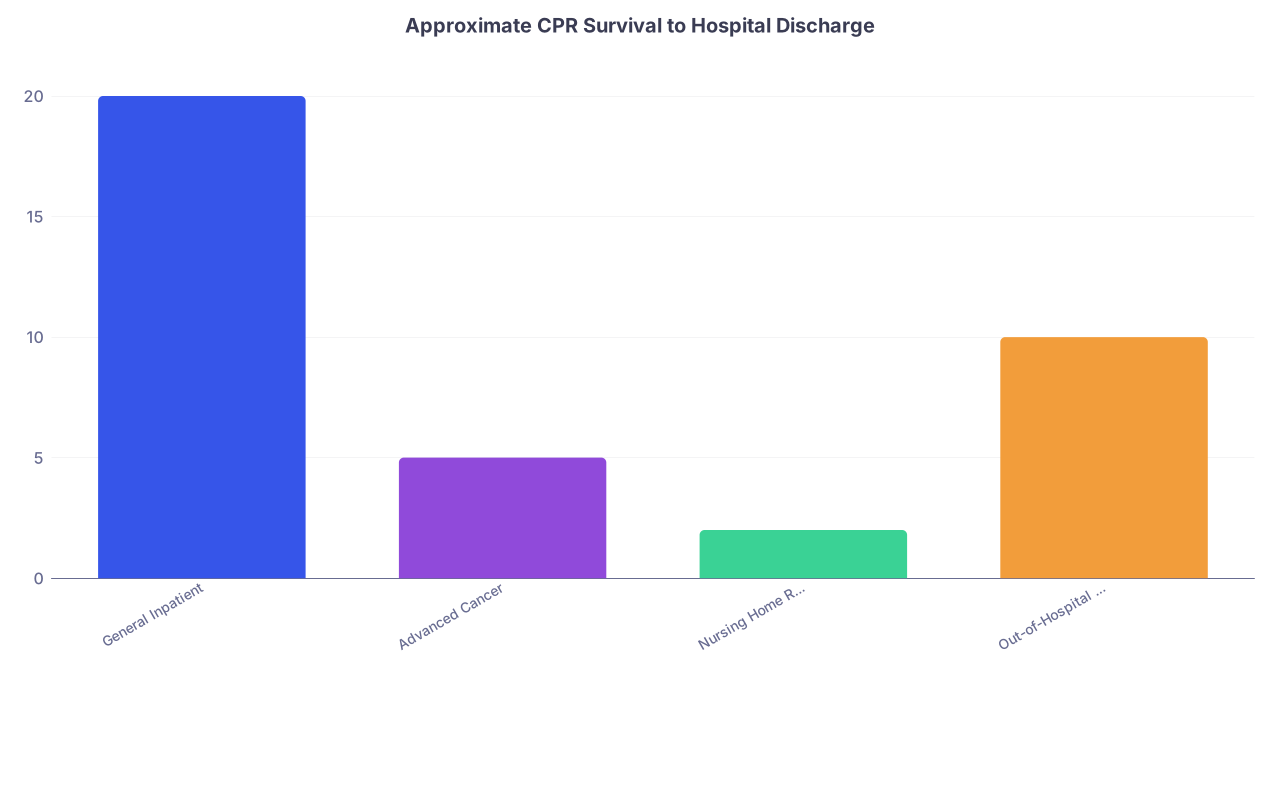
Let’s kill the “do everything” myth with some basic outcome numbers.
| Category | Value |
|---|---|
| General Inpatient | 20 |
| Advanced Cancer | 5 |
| Nursing Home Residents | 2 |
| Out-of-Hospital Adults | 10 |
These are approximate, pooled ballpark numbers from multiple large studies and reviews. They vary by study and era, but the pattern holds:
- General inpatient CPR survival is somewhere around 15–25%.
- For patients with advanced cancer or end‑stage organ failure, survival is usually under 10%. Often much lower.
- In nursing home residents, survival to discharge can drop to 0–3%.
- Out‑of‑hospital adults? Survival to discharge is commonly ~8–12%, but for older, comorbid patients, it falls sharply.
Now fold in neurologic outcomes. Among survivors, 20–50% may have moderate to severe neurologic impairment, depending on context and timing. Family expectations (“He’ll be back to golfing next week”) are frequently fantasy.
So when we present “full code” as default and “DNR” as an active refusal of care, we’re quietly smuggling in a lie: that CPR is a realistic path back to prior quality of life for most very sick, very frail patients. It usually is not.
That’s not an ethical dilemma. That’s a miscalibrated expectation problem.
The real ethical questions are:
- Are we offering interventions that have a reasonable chance of achieving this patient’s goals?
- Are we honest about what those chances actually are?
- Are we scaling back earlier when treatment is futile or disproportionate?
The full code vs DNR checkbox often distracts from those harder, earlier questions.
Why That Binary Framing Is Ethically Lazy
The full code / DNR frame pretends there are only two levers:
- Save life
- Withhold life‑saving intervention
Reality is messier.
CPR is just one intervention among many. It sits on the same spectrum as intubation, vasopressors, dialysis, major surgery, and prolonged ICU care. Focusing on CPR as the moral hinge is like obsessing about the last lap of a marathon and ignoring the first 25 miles.
What I see repeatedly:
An 89‑year‑old with advanced dementia, recurrent aspiration, and severe heart failure. Admitted with pneumonia and septic shock. Still “full code” because “we never had the conversation.” The team spends 25 minutes trying to track down a grandson for a DNR order “in case he codes tonight.”
Meanwhile, the deeper issues are untouched:
- Is it ethical to continue ICU‑level escalation (pressors, central lines, bi‑PAP that he’s ripping off) in a patient with no meaningful chance of returning to his prior (already very poor) baseline?
- Would shifting to comfort‑focused care today align better with his known values, or what his prior self would likely have chosen?
- Are we harming him now by chasing marginal physiologic gains?
You can order DNR and still torture a patient with non‑beneficial interventions for weeks. Or you can keep a patient technically “full code” while focusing on symptom relief and declining invasive measures—only switching to DNR when everyone finally admits what was obvious a week ago.
The binary is fake. The real ethical terrain is proportionality: matching the intensity of treatment to realistic benefit in the context of this patient’s goals.
The Conversations That Actually Matter (And Almost No One Has)
If you zoom out from the emergency CPR frame and actually ask what patients care about, they do not say, “My main concern is chest compressions.”
They say things like:
- “I don’t want to be hooked to machines forever.”
- “I don’t want to be a burden to my family.”
- “If I can’t communicate or recognize my kids, that’s not a life for me.”
- “I care more about being at home and comfortable than living a few extra months in a hospital.”
Those are not code status questions. They’re values questions.
And they need to be translated into treatment preferences across many scenarios, not just cardiac arrest.

| Step | Description |
|---|---|
| Step 1 | Patient values |
| Step 2 | Goals of care |
| Step 3 | Acceptable tradeoffs |
| Step 4 | Specific treatments |
| Step 5 | Code status |
We routinely invert this. We start at “code status” and never get back to values.
An ethically competent conversation sounds like:
- “When you think about the time you have left, what are you hoping for? What are you afraid of?”
- “If we could not fix the heart failure and you were getting weaker, what would matter most to you in that situation?”
- “Some people are willing to go through very aggressive treatments for a small chance of more time, even if it’s in the ICU. Others would rather avoid those treatments and focus on comfort. Where do you tend to fall on that spectrum?”
From there you can talk about chemo, surgeries, ICU, feeding tubes, rehospitalizations, and yes, CPR—as a piece of the larger picture, not the whole story.
When you do this well, the code status usually becomes obvious:
- “Given what you just told me about not wanting to be on machines and living in a nursing home, I would not recommend CPR if your heart stops. It is very unlikely to give you the outcome you’d want, and more likely to cause suffering. We can focus instead on treatments that help you breathe easier and feel better now.”
That’s the ethical move. Not, “Do you want us to do everything?”
The Legal Shadow People Get Wrong
Underneath a lot of the panic around full code vs DNR is fear of legal risk. “We’ll get sued if we don’t code them.” “We need a DNR order or we have to do CPR, no matter what.”
That’s not how the law actually works in most jurisdictions.
Courts and statutes in many countries embrace three converging principles:
- Patients (or legally authorized surrogates) have the right to refuse unwanted life‑sustaining treatment.
- Clinicians are not obligated to provide interventions that are medically futile or non‑beneficial.
- The key legal shield is good documentation of the clinical reasoning and the conversation, not blind adherence to “full code until paper says otherwise.”
Here is where the nuance lives:
| Claim | What Data / Law Typically Shows |
|---|---|
| “Without a DNR, you must always do CPR” | Clinicians may withhold CPR when it’s clearly futile and inconsistent with known wishes, if documented and supported by policy |
| “DNR = do not treat” | Outcomes data shows DNR orders are often misused as global “less care,” but legally they apply only to CPR |
| “Withholding CPR is more serious than withdrawing support later” | Ethically and legally, most frameworks treat withholding and withdrawing as equivalent if based on goals and prognosis |
| “Talking about DNR increases litigation risk” | There’s no evidence that honest, well‑documented goals‑of‑care discussions increase lawsuits; poor communication is the bigger risk |
The cases that actually blow up legally are rarely, “You didn’t do CPR on my dying parent with metastatic cancer and stage IV heart failure, how dare you.”
They’re, “No one told us what was happening, you did things to my mother she never would have wanted, and then you pulled the plug suddenly.”
Translation: communication failures and misaligned care are dangerous. Not refusing CPR when it is obviously non‑beneficial and clearly inconsistent with the patient’s values.
To be blunt: hiding behind “full code” as legal armor is intellectually lazy. Courts typically side with clinicians who can show a thoughtful, documented process that engaged the patient or surrogate and made medically reasonable judgments.
The Other Ethical Questions We Keep Ignoring
If you care about ethics, here are the questions that matter far more often than the code status tick box:
- Are we offering treatments that have any decent chance of restoring an outcome the patient would recognize as acceptable? Or are we extending the dying process because we’re afraid to say “enough”?
- Are we being honest about prognosis, or are we sugarcoating survival numbers to avoid awkward conversations?
- Are we respecting prior expressed wishes (advance directives, POLST, conversations) or defaulting to “do everything” because the daughter from out of state is loudest?
- Are we considering the burdens we place on families—financial, emotional, logistical—when we push futile ICU care?
- Are we equating disability with a life not worth living, or are we actually listening to what the patient with quadriplegia or advanced MS says about their own quality of life?
Those questions show up every day in choices about surgery for frail elders, dialysis initiation in multi‑morbid patients, forced feeding in advanced dementia, and endless readmissions near the end of life.
CPR is just the dramatic, TV‑friendly piece. The ethics of everything before that matters much more.
| Category | Value |
|---|---|
| Code status forms | 60 |
| Real prognosis discussion | 15 |
| Values/goals exploration | 15 |
| Non-beneficial treatment review | 10 |
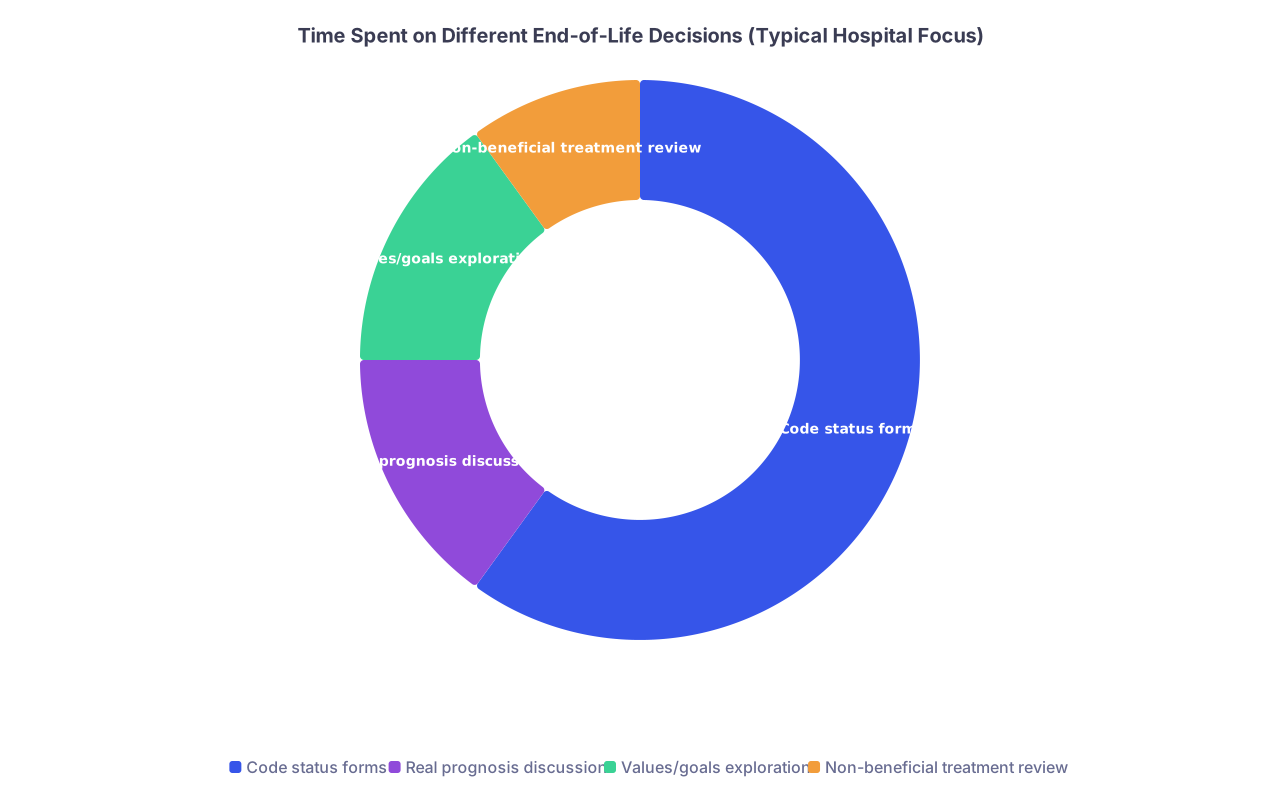
You recognize this distribution if you’ve done any inpatient medicine. Most of the clock time goes to documentation and box‑checking. The smallest slices are the ones that actually protect patients from suffering.
How to Reframe This in Your Own Practice
You can’t fix the system overnight. But you can stop acting like full code vs DNR is the ethical summit.
Here’s the move I’ve seen work repeatedly:
First, you talk about the arc of the illness, not the admission.
Then, you clarify what “doing well” and “doing poorly” would concretely look like for this person.
Only then do you match treatments—including CPR—to those scenarios.
Something like:
- “If things went really well, here’s what I’d expect over the next few months. If things went badly, here’s the kind of decline we might see.”
- “Given both those possibilities, what feels acceptable to you? What would you not want to go through?”
- “Based on that, I recommend we focus on comfort and avoid ICU‑level treatments like intubation. CPR, if your heart stops, is very unlikely to give you the kind of recovery you’d want, so I would not recommend it either. We can document that as DNR.”
You’re not asking them to choose interventions off a menu. You’re presenting a coherent plan, anchored in their values, with CPR logically placed at the end of the cascade.
Once you start doing this, you realize how small the ethical footprint of “full code vs DNR” really is. It’s a downstream, often predictable outcome of conversations that should have happened months or years earlier in clinic, in the dialysis unit, in oncology, in primary care.
But we punt. Then we panic on admission and pretend this one checkbox is our moment of moral heroism.
It is not.
| Category | Value |
|---|---|
| No early talks | 0 |
| Some early talks | 50 |
| Routine early talks | 80 |
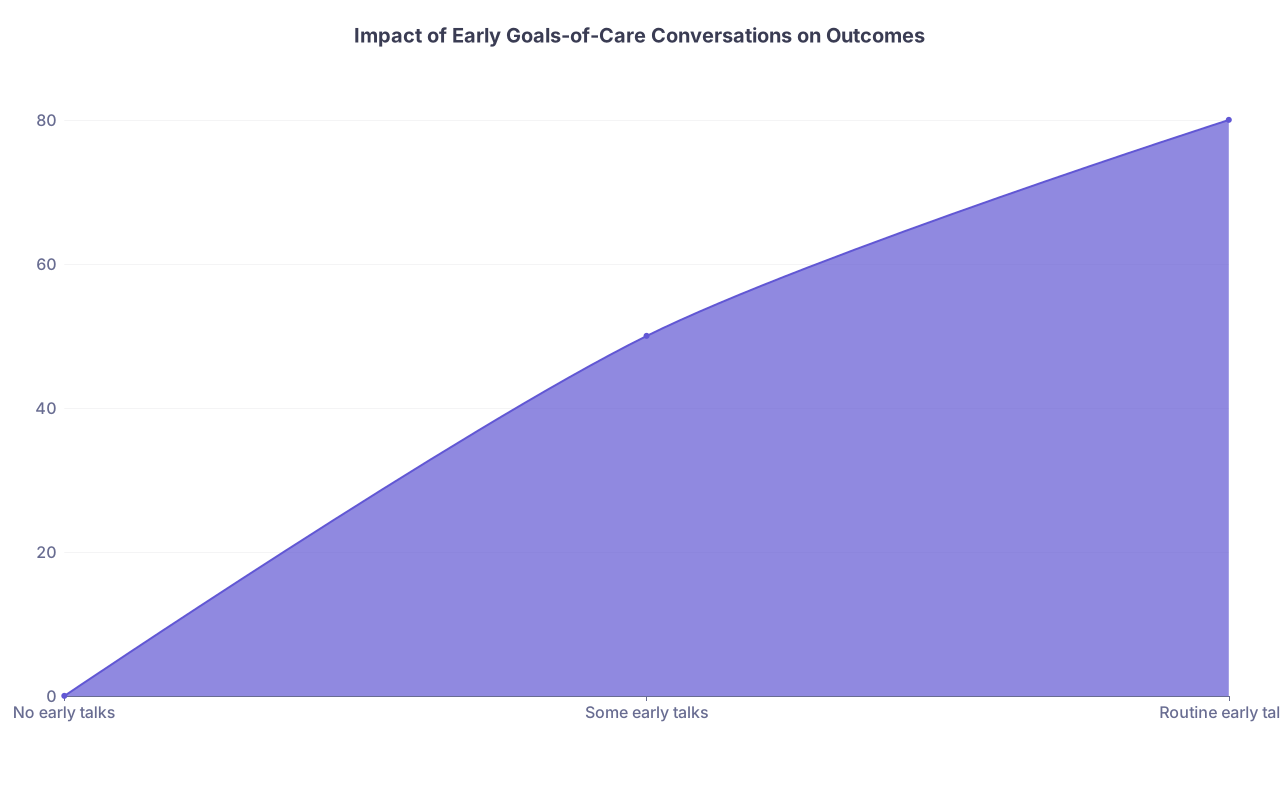
Studies on early goals‑of‑care and palliative involvement consistently show better symptom control, less unwanted intensive care, and sometimes even longer survival. The time to do ethics is not at 3 a.m. during admission orders. It’s upstream.

FAQs
1. Is it ever ethical to do CPR on a frail, terminally ill patient?
Yes, if it aligns with their clearly expressed values and there’s at least a plausible chance of an outcome they’d accept. Some patients value even a small chance of extra time with loved ones, even if the odds are bad. The key is that they understand, in plain language, what the odds and likely outcomes actually look like, and that you are not offering fantasy medicine.
2. Doesn’t a DNR order mean we “give up” and stop active treatment?
No. That’s a common misuse. DNR applies specifically to what happens if the heart stops or they stop breathing. You can be DNR and still receive antibiotics, surgery, non‑invasive ventilation, ICU care, pressors—if those align with your goals. Ethically, the problem isn’t DNR; it’s when clinicians or systems lazily equate “DNR” with “do less” across the board without thought.
3. Are physicians legally forced to do CPR if there’s no DNR?
Generally, no. Law varies by region, but most frameworks allow clinicians to withhold CPR when it is clearly futile or contrary to known wishes, as long as this is documented and consistent with institutional policy. The protective factor is good documentation of your reasoning and the prior discussions, not automatic chest compressions on every dying patient.
4. How early should goals‑of‑care conversations start?
Much earlier than they usually do. Serious illness conversation guides often recommend starting when there’s a significant risk of death within a year, after a major hospitalization, at diagnosis of metastatic disease, or when patients begin to lose functional independence. Waiting until the ICU or the last admission is a setup for rushed, panicked decisions—and for making “full code vs DNR” carry ethical weight it was never designed to bear.
The bottom line:
- Full code vs DNR is a tiny, downstream piece of ethical decision‑making, not the centerpiece.
- The real work is aligning treatments—including but not limited to CPR—with realistic outcomes and the patient’s own values, long before a code.
- Law and ethics both support thoughtful limitation of non‑beneficial interventions; hiding behind the full code checkbox is neither legally necessary nor ethically defensible.


