

42% of ICU patients who receive “everything” at the end of life die after at least one invasive procedure they’d previously said they did not want.
That single number captures the ethical mess around “do everything” orders. Families think they’re asking us to keep someone alive. Clinicians often hear “start or continue every possible intervention, even if it’s non‑beneficial.” The gap between those two meanings is where a lot of suffering happens.
Let me be blunt: “Do everything” is one of the most dangerous phrases in modern medicine. It sounds decisive. It feels loving. It photographs well in malpractice depositions. But as an actual treatment directive, it’s a disaster.
What Families Think They’re Saying vs. What Clinicians Actually Do
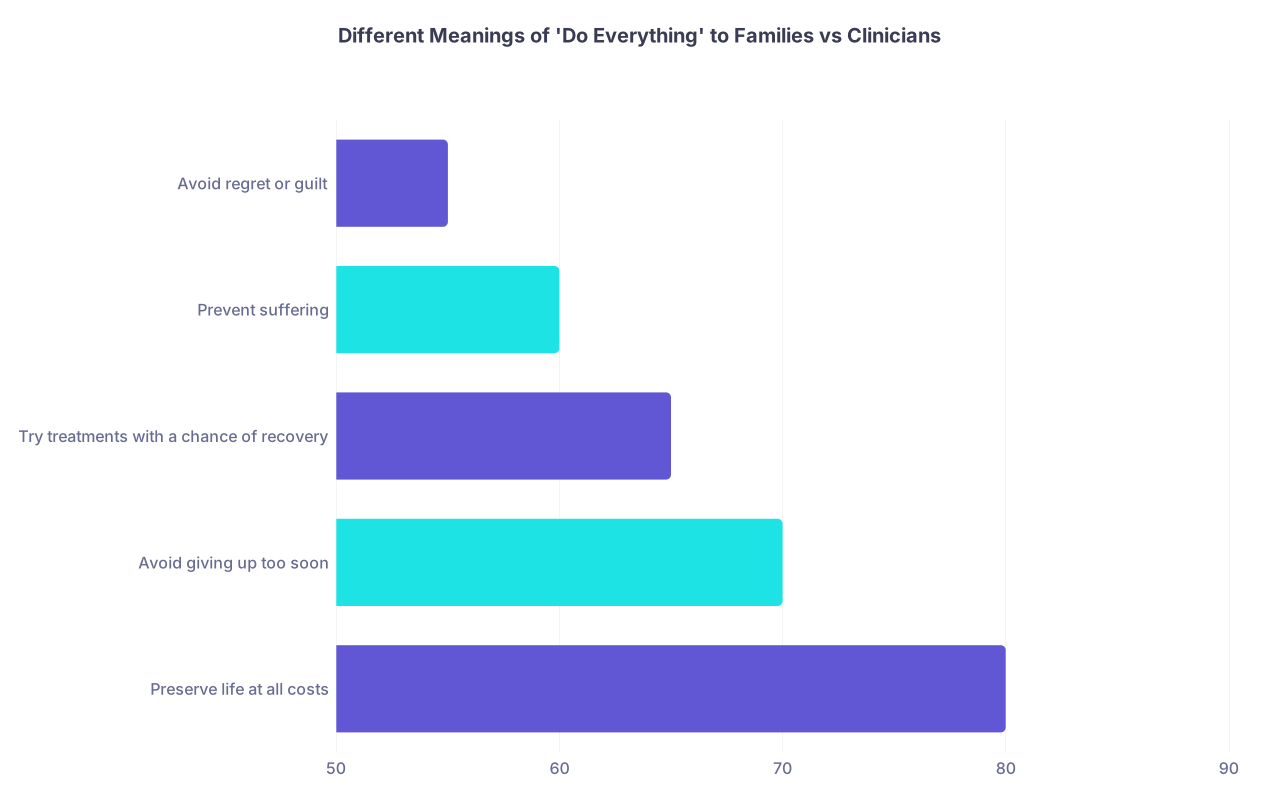
| Category | Value |
|---|---|
| Preserve life at all costs | 80 |
| Avoid giving up too soon | 70 |
| Try treatments with a chance of recovery | 65 |
| Prevent suffering | 60 |
| Avoid regret or guilt | 55 |
Ask a family, “What do you mean by ‘do everything’?” and you’ll get answers like:
- “We don’t want to give up.”
- “We want him to have every chance.”
- “We’re not ready to let her go.”
- “We just want them comfortable, but don’t stop trying.”
Translation: keep pursuing treatments that have some meaningful chance of restoring a tolerable life, and do not abandon us emotionally.
Now walk down the hall and ask the ICU team what “do everything” means. You’ll hear:
- “Full code, intubation, pressors, dialysis, CPR, escalation to ECMO if indicated.”
- “Maximal support, all lines and procedures as clinically appropriate.”
- “No limitations. No DNR/DNI. No treatment withheld for futility unless clear.”
Translation: every invasive, aggressive intervention that might extend physiology, even when the probability of meaningful recovery is near zero.
Same phrase. Completely different content.
And here’s the kicker: when researchers actually sit down with people and show them concrete scenarios—CPR outcomes, intubation for advanced dementia, prolonged ICU stays—most do not want what “do everything” usually triggers.
In one well‑known study of older adults, more than 90% wanted CPR when asked in the abstract. When given realistic numbers—neurologic injury, nursing-home discharge, persistent ventilator dependence—stated preference for CPR dropped into the 30–40% range. That’s not a small mismatch. That’s a semantic trap.
CPR Reality: The Fiction Families Are Sold vs The Data

CPR is the prototype “do everything” intervention. It’s also ground zero for public misunderstanding.
Most families’ mental model comes from TV: chest compressions, a shock, maybe a tense moment, then the patient coughs, gasps, and is back to chatting 10 minutes later.
Here’s what the data actually shows in the hospital setting, aggregated across multiple studies:
| Group | Survive to Discharge With Good Neuro Status |
|---|---|
| Relatively healthy adults | ~15–20% |
| Advanced cancer | ~5–10% |
| Advanced dementia/nursing home | ~2–5% |
| Multi‑organ failure in ICU | <1–2% |
Those are best‑case ballparks. And “good neuro status” doesn’t mean back-to-golf-on-Monday; it often means able to do basic activities with support, possibly with cognitive decline.
This is what “do everything” buys you frequently:
- Multiple cracked ribs.
- Intubation and mechanical ventilation.
- Prolonged ICU stays, often sedated, restrained to keep them from pulling lines.
- Higher chance of dying in a code rather than quietly with family present.
I’ve had families say later, “If I had understood that was what CPR meant for my mom with metastatic cancer, I would never have said ‘do everything’.”
They didn’t change values. They just finally got information.
“Do Everything” ≠ “Don’t Kill My Loved One”
A key myth that poisons these conversations: that if you don’t do everything, you’re causing death.
No. In terminal illness or multi‑organ failure, death is already happening. The underlying disease is driving the bus. Life‑support doesn’t reverse death; it temporarily props up organs while you either fix the cause or wait for the inevitable.
That’s where the language of “allowing natural death” (AND) came from. Clunky phrase, but the ethical distinction matters:
- Withholding or withdrawing non‑beneficial treatment is letting the disease take its course.
- Actively causing death (e.g., giving a lethal injection) is another category entirely and is illegal in most places.
Legally and ethically, there’s a bright line between “we’re not going to start dialysis on this 95‑year‑old with multi‑organ failure” and “we’re going to inject something to stop their heart.” Families routinely collapse these into the same thing emotionally: “You’re killing him.” They’re not. The cancer, the infection, the heart failure is.
The law, professional standards, and decades of bioethics are remarkably aligned on this point: there is no obligation to provide treatments that are physiologically futile or offer no reasonable chance of benefit proportionate to the burden. That’s true even if a family demands “everything.”
Why Clinicians Flinch At “Do Everything” (And Sometimes Ignore It)
There’s another myth here: that “do everything” is some kind of binding legal order. It’s not. At all.
What’s binding are actual medical orders: code status, ventilator orders, dialysis orders, medication orders. “Do everything” is at best an emotional statement, at worst a liability landmine.
So what happens in practice? A few patterns I’ve seen repeatedly:
The “checkbox medicine” response
New resident, 2 a.m., dying patient. Family said “do everything.” Resident orders all of it: pressors, lines, intubation, dialysis, full code. Everyone knows there’s no meaningful chance of recovery. But the family won’t feel “abandoned,” and the note will read, “Family requested full aggressive measures.” Defensive medicine masquerading as compassion.The quiet futility override
Senior ICU attending who’s seen this movie too many times. Patient is in multi‑organ failure with no reversibility. Family keeps saying “do everything,” but the doctor simply doesn’t escalate beyond a certain point. Maybe they don’t re‑intubate after a failed extubation. Maybe they lower pressor goals. They’re practicing beneficence and non‑maleficence while trying not to ignite a family war.The ethics committee standoff
Family insists on maintaining life support in clearly brain‑dead patients or those with catastrophic neurologic injury. Hospital invokes futility policy, legal gets looped in, ethicists are dragged into endless meetings. This is rare, but when it happens, it’s almost always linked to some version of “you must do everything.”
Legally, clinicians are not required to provide treatment that offers no reasonable medical benefit. Ethically, they shouldn’t. But emotionally and politically, saying “no” to “do everything” is hard. So people kick the can, do more, and the patient pays the price.
The Time Horizon Trick: Today Yes, Forever No
Here’s where nuance matters. Sometimes “do everything” is reasonable. For a while.
Take a 45‑year‑old with septic shock from pneumonia, previously healthy. Intubation, vasopressors, central lines, even CPR if they arrest? Absolutely. This is exactly what intensive care is for. You “do everything” because the time horizon makes sense: high burdens now, realistic chance of recovery in days to weeks.
Now compare that with a 90‑year‑old with end‑stage dementia, bedbound, non‑verbal, now with aspiration pneumonia and advanced heart failure. “Do everything” here means months of ICU-level suffering for, at best, a return to a profoundly impaired baseline. More often, it means a slow, technology‑mediated death away from anything that looks like a life.
The ethical mistake is treating those scenarios as equivalent because the phrase is the same.
A better question families should demand from doctors is:
“Given their condition and everything you know, what are you hoping these interventions will realistically achieve, and what’s the most likely outcome?”
If a doctor can’t answer that plainly, you don’t have informed consent. You have ritual.
Why Families Default to “Do Everything”: Guilt, Culture, and Bad Lawyering
Let’s be honest about why “do everything” comes out of families’ mouths.
Fear of regret is huge. I’ve heard it said almost verbatim: “If I say stop and she dies, I’ll never forgive myself. But if I say do everything and she dies, at least I tried.” That’s not a medical choice. That’s a guilt‑management strategy.
Culture matters too. In communities that have been historically mistreated by the health system—Black patients in the US, for example—“do everything” is often code for “don’t you dare give my mother less than you’d give a rich white lady.” Given the data on inequities, that suspicion is not irrational.
Then there’s religion. “Only God can decide when someone dies” gets translated into “never withhold any medical intervention,” even though most major faith traditions do not actually require maximal technological prolongation of dying.
And yes, malpractice lawyers lurk in the background. There’s a pervasive myth that you’re safer, legally, if you throw the kitchen sink at every patient. The actual malpractice data don’t support this as cleanly as people think, but the fear is real. “We did everything” reads well in a chart and even better on the witness stand.
So everyone colludes: families to avoid guilt, doctors to avoid conflict and lawsuits, institutions to avoid headlines. The patient, who often would have chosen a very different path if honestly informed months earlier, just absorbs the fallout.
What “Do Everything” Should Be Replaced With

| Step | Description |
|---|---|
| Step 1 | Patient seriously ill |
| Step 2 | Clinician explains prognosis |
| Step 3 | Discuss goals and tradeoffs |
| Step 4 | Talk with surrogate and review prior wishes |
| Step 5 | Translate goals into specific treatments |
| Step 6 | Write clear orders - code status, intubation, dialysis, feeding |
| Step 7 | Patient can decide? |
If you remember nothing else from this, remember this: “Do everything” is not a goal. It is a placeholder for an unspoken fear.
There are only a few ethically coherent goals in serious illness:
- Prolong life with an acceptable quality as the patient defines it.
- Maximize comfort and minimize suffering, even if that shortens life.
- Try treatments for a limited time, then reassess based on response.
- Focus on specific milestones (meeting a grandchild, making it to a holiday) knowing that tradeoffs are real.
Those goals then drive specific medical orders:
- Full code vs DNR.
- Okay to trial intubation vs “no intubation, BiPAP only.”
- Dialysis yes/no or time‑limited trial.
- ICU transfer vs ward only.
- Artificial nutrition/hydration via feeding tube vs oral intake only.
The ethical and legal apparatus is built around those concrete choices, not vague slogans.
If you’re the clinician, you should be asking, “What are we trying to accomplish that the patient would actually recognize as a win?” If you’re the family, you should be asking, “Given who they are and what they’ve said in the past, which burdens would they accept for which possible benefits?”
Nobody’s deathbed wish has ever been “I want you to follow hospital policy 7.3.1 on aggressive care escalation.” They say things like “I don’t want to be a vegetable,” “Don’t let me suffer,” “Keep me around as long as I can still talk to my kids.” Translate those into orders. Not “do everything.”
How to Avoid the “Do Everything” Trap (On Both Sides of the Bedrail)
If you’re a future or current clinician, here’s the move you make the moment someone says “do everything”:
“Different people mean very different things by that. When you say ‘do everything,’ what are you most afraid of happening? And what would your [mom/dad/partner] say they care about most if they were sitting here telling us themselves?”
Then shut up and listen. The real directive will come out: fear of pain, fear of abandonment, fear of being “killed.” You can work with that.
If you’re a family member:
Stop saying “do everything” in family meetings. Force the specifics.
Ask:
- “What are the realistic chances of getting back to the kind of life they had three months ago?”
- “If they survive, what condition are they most likely to be in?”
- “What are we preventing, and what suffering are we causing, with each intervention?”
- “If this were your parent, knowing what you know medically, what would you do?”
You’re not asking for a guarantee. You’re asking for a professional judgment instead of a menu recitation. That’s exactly what you should be demanding.
The Bottom Line
“Do everything” sounds protective. In practice, it often protects no one.
Three key points:
- The phrase “do everything” hides radically different meanings for families and clinicians, and that mismatch fuels overtreatment, conflict, and suffering.
- There is no ethical or legal obligation to provide non‑beneficial, futile treatment, even if a family demands “everything”; withholding or withdrawing such treatment is not the same as killing.
- Real decisions in serious illness should be about clear goals and specific interventions, not vague pledges—so stop using “do everything” and start asking, and answering, the hard questions directly.


