

Most doctors override patient refusals either too often or not nearly enough—and both can get you in real trouble.
You’re not asking a theoretical question. You’re asking: When can I legally and ethically treat a patient who just said “no”—and when will that be assault, battery, or a Board complaint?
Let’s walk through a practical, real‑world decision tree you can actually use on call.
The Core Rule: Start With Capacity, Not the Diagnosis
If you remember nothing else, remember this:
A capacitated adult can refuse almost anything, even if it kills them.
If they don’t have capacity, you may (and sometimes must) override their refusal in emergencies.
So your first question is never “Is this treatment necessary?”
It’s always: “Does this patient have decision-making capacity right now for this decision?”
Quick capacity checklist (the real-life bedside version)
Capacity is decision-specific and time-specific. The same patient can have capacity for “ibuprofen vs Tylenol” but not for “decline life-saving surgery.”
Legally and ethically, you’re checking four things:
- Can they communicate a choice?
- Do they understand the relevant information? (in your language, explained in theirs)
- Can they appreciate how it applies to them (not just repeat facts)?
- Can they reason about options in a consistent, reality-based way?
If any of those falls apart because of delirium, psychosis, intoxication, severe hypoxia, dementia, etc.—you’re in “likely no capacity” territory.
A Clear Decision Tree: Can I Override This Refusal?
Here’s the basic logic you should run in your head.

| Step | Description |
|---|---|
| Step 1 | Patient refuses care |
| Step 2 | No emergency pathway |
| Step 3 | Stabilize, observe, reassess |
| Step 4 | Provide necessary emergency care |
| Step 5 | Respect refusal and document |
| Step 6 | Respect refusal, explore why |
| Step 7 | Use surrogate or legal pathway |
| Step 8 | Is this an emergency? |
| Step 9 | Immediate risk of serious harm or death? |
| Step 10 | Does patient have capacity? |
| Step 11 | Does patient have capacity? |
Now let’s unpack this in plain language.
Step 1: Is This an Emergency?
Ask: If we do nothing right now, is there a serious risk of death or major harm in the near term?
If yes → you’re in emergency territory. That opens the door to implied consent if there’s no capacity or no surrogate.
If no (chronic issues, elective procedure, non-urgent imaging) → your override options shrink dramatically. You’re back to shared decision making, not forced treatment.
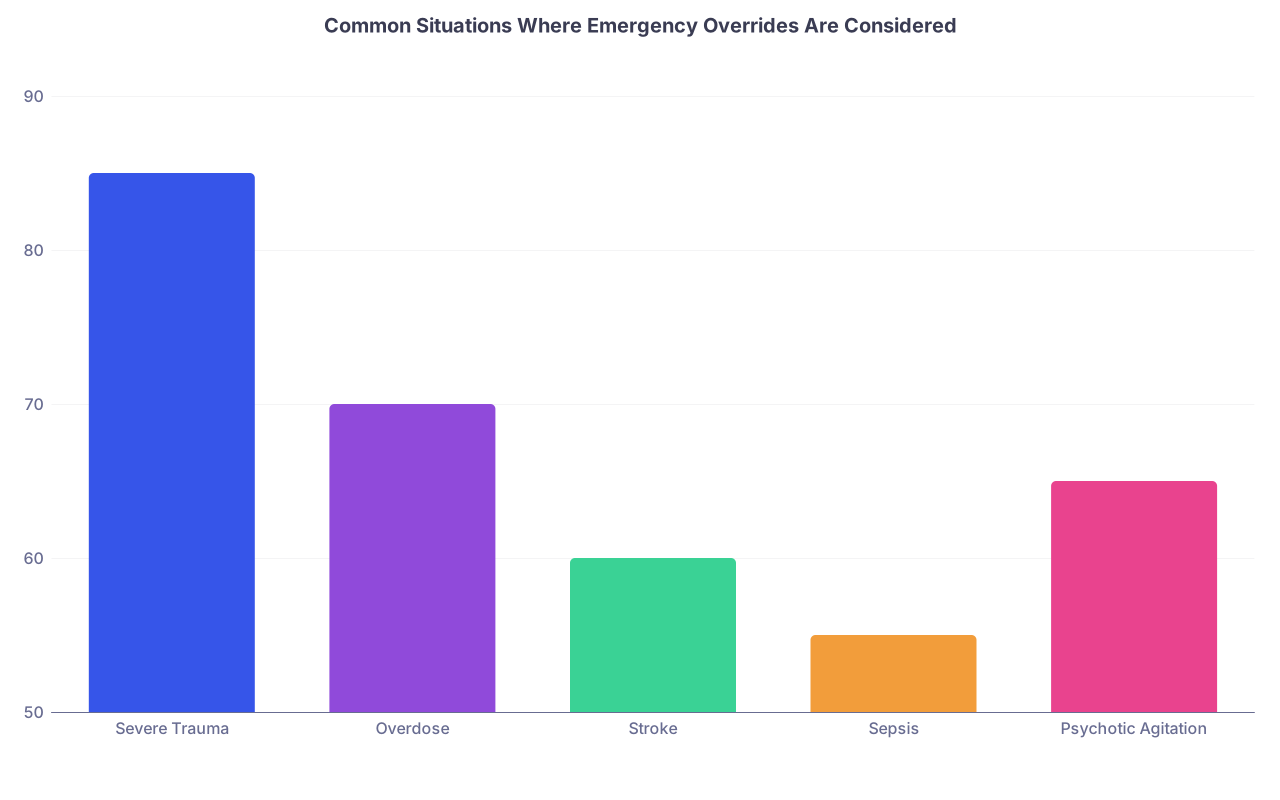
| Category | Value |
|---|---|
| Severe Trauma | 85 |
| Overdose | 70 |
| Stroke | 60 |
| Sepsis | 55 |
| Psychotic Agitation | 65 |
Those percentages are roughly how often I see people try to override refusals in each context. Doesn’t mean they’re always right.
Step 2: Does the Patient Have Capacity Right Now?
You don’t need a psychiatrist for every capacity call. Capacity is a clinical assessment, and it’s on you in the moment.
Signs that should make you doubt capacity:
- They’re disoriented, delirious, severely intoxicated, or fluctuating in attention.
- They parrot phrases like “I don’t want that” but can’t explain what “that” is.
- They deny obviously relevant facts: “I’m not bleeding,” while exsanguinating.
- They give clearly delusional reasons: “I can’t take this medicine, it’s government mind control.”
If capacity is clearly intact and it’s an adult making a specific, informed refusal → you’re almost always required to respect it.
If capacity is impaired or unclear in an emergency → you can often treat under implied consent, especially if delaying to “get psych” would put them at serious risk.
Step 3: Apply the Emergency/Capacity Combo
Here’s how the combinations work in practice:
| Situation | Override Allowed? |
|---|---|
| Emergency + No Capacity | Usually YES |
| Emergency + Capacity | Usually NO |
| Non-emergency + No Capacity | Sometimes, via surrogate or court |
| Non-emergency + Capacity | Almost never |
Now I’ll go through the real-world scenarios you actually see.
Scenario 1: Emergency + Patient Lacks Capacity
This is the cleanest override situation.
Examples:
- GCS 7 trauma patient “refusing” a chest tube by groaning and pulling away.
- Hypoxic, confused septic patient refusing intubation but can’t track the conversation.
- Intoxicated overdose patient with altered mental status pulling out IVs, saying “leave me alone.”
Here, you:
- Treat under implied consent for life-saving or limb-saving interventions.
- Do only what’s necessary to stabilize and prevent serious harm.
- Document decisively: what the emergency was, why they lacked capacity, what you did, and that no surrogate was immediately available.
This is the exact setting where courts and ethics committees usually back you up—if you documented your reasoning.
Scenario 2: Emergency + Patient Has Capacity
This is where people panic.
Example:
A conscious, oriented Jehovah’s Witness with clear, long-standing beliefs refuses blood despite active GI bleed. You explain mortality risk; they understand and accept it.
You cannot override this just because you’re uncomfortable watching them die.
Also:
- Competent patient refusing intubation.
- Competent patient refusing emergent surgery.
- Competent patient leaving AMA with clearly explained, understood risks.
Your job:
- Make sure they truly understand the situation, options, and consequences.
- Assess and document capacity clearly.
- Respect the refusal, even if you hate it.
- Offer alternatives, palliation, and safety planning where possible.
Overriding here is both ethically wrong and legally dangerous. That’s battery.
Scenario 3: Non-Emergency + Patient Lacks Capacity
Now emergency implied consent isn’t such a free pass.
Think:
- Demented patient refusing routine labs.
- Delusional patient refusing antipsychotic for a chronic psychotic disorder.
- Delirious patient refusing non-urgent CT or MRI.
Here, you don’t jump straight to physical override. You:
- Identify a surrogate (healthcare proxy, durable power of attorney, next of kin per local law).
- Use substituted judgment or best-interest standards.
- In psych settings or prolonged refusals, you might need:
- Involuntary hold statutes (danger to self/others/grave disability).
- Guardianship or court order, depending on jurisdiction and intervention.
Psych meds purely for chronic management, without imminent danger, are much harder to forcibly give than people think. Don’t assume “psych patient” = carte blanche to override.
Scenario 4: Non-Emergency + Patient Has Capacity
This is the easy answer that feels hard emotionally:
You don’t override.
Examples:
- Diabetic refusing insulin on the ward.
- COPD patient refusing smoking cessation counseling and pulmonary rehab.
- Cancer patient refusing chemo.
You may strongly disagree; you may think it’s irrational. Doesn’t matter. They’re allowed to make what you think is a bad call as long as:
- They understand the disease, options, and consequences.
- They’re not impaired by depression/psychosis to the point they can’t reason about it.
- They can communicate a stable, consistent choice.
Your move:
- Explore values and fears.
- Negotiate alternatives or harm reduction.
- Document the informed refusal thoroughly.
Special Cases Worth Calling Out
1. Intoxicated patient refusing care
Everyone gets this one wrong at first.
- If they’re clearly intoxicated and the decision is high stakes (CT head, admission, suturing dangerous laceration, etc.), you should assume reduced capacity.
- You can temporarily hold and treat in life- or limb-threatening situations.
- For low-risk decisions (refusing Tylenol, blood draw that doesn’t change acute management), you might reasonably wait and reassess when they’re more sober.
Don’t use intoxication as a blank cheque, but don’t pretend a BAL of 0.25 “has nothing to do” with capacity.
2. Suicidal patient refusing evaluation or treatment
If there’s credible suicidal intent or plan, and they refuse care, the law usually gives you broad authority to:
- Place an emergency psychiatric hold.
- Restrict elopement.
- Provide life-saving or stabilizing interventions if they self-harm.
The core logic: their mental illness is directly impairing capacity to value their own life.
3. Minors refusing care
Short version:
- Parents (or legal guardians) generally decide for minors.
- You can often override a minor’s refusal if the parent consents to necessary care.
- But: many jurisdictions have “mature minor” doctrines or carve-outs for things like contraception, STI care, pregnancy, and sometimes substance use treatment.
Always: check your local rules; they vary a lot. When in doubt, involve risk management or legal early.
4. Advance directives and DNRs
If a capacitated patient signed a valid advance directive or POLST/MOLST, and now they’re incapacitated, you generally cannot override that unless:
- There’s clear evidence the patient changed their mind while still capacitated, or
- The situation truly doesn’t match what the directive anticipated.
“Family wants everything now” does not automatically erase a DNR or directive.
How to Protect Yourself: Documentation and Process
You want a chart that reads like a clear narrative, not a defensive essay.
Hit these beats:
The situation
“Patient with acute GI bleed, Hgb 5.8, hypotensive, recommended emergent transfusion.”Information given
“Discussed risks of no transfusion including death, MI, stroke; alternatives limited.”Capacity assessment details
- Oriented?
- Understood condition?
- Could paraphrase options and consequences?
- Gave stable reasoning?
Their stated preference and reasoning
Use direct quotes: “I know I could die, but because of my religious beliefs…”Consults and witnesses
Ethics, psych, another attending, nursing note. The more controversial the case, the more you want corroboration.Your decision and legal/ethical basis
“Proceeding under implied consent due to lack of capacity and immediate threat,” or
“Respecting refusal due to intact capacity and informed decision.”
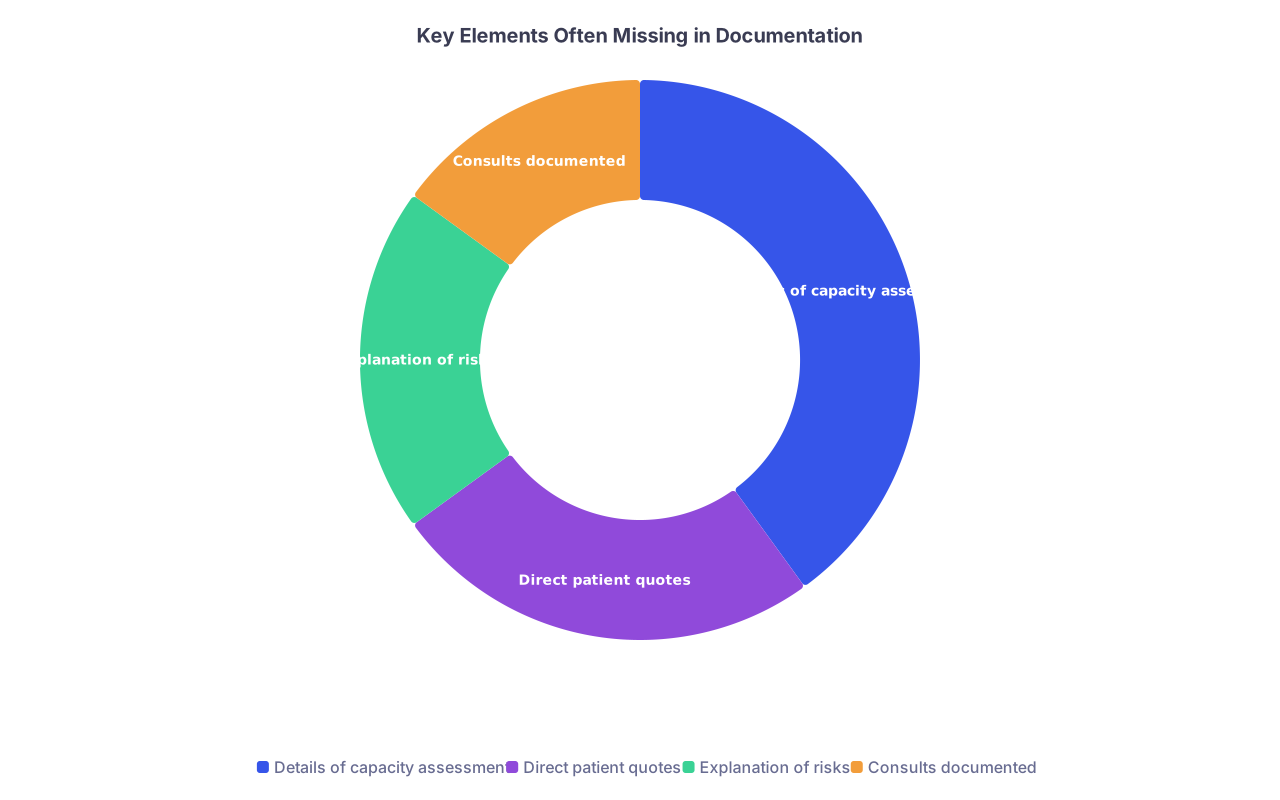
| Category | Value |
|---|---|
| Details of capacity assessment | 40 |
| Direct patient quotes | 25 |
| Explanation of risks | 20 |
| Consults documented | 15 |
Those missing pieces are what get dissected in court and at M&M.
When You Should Pull in Backup
If you feel in over your head, you probably are. Use your resources.
Situations to escalate early:
- Family is threatening legal action on the spot.
- There’s disagreement among the care team (one attending says override, another says don’t).
- Prolonged forced treatment is being considered (e.g., long-term feeding tube over refusal).
- Psychiatric capacity is complex: severe depression, personality disorder, high suicide risk.
Resources:
- Hospital ethics committee.
- Risk management / legal counsel.
- Psychiatry for capacity evaluation (especially in non-emergent, complex decisions).
They won’t magically solve everything, but they help share responsibility and clarify your legal footing.
Quick Mental Model Recap
Here’s the stripped-down version to carry on shift:
- Question 1: Emergency or not?
- Question 2: Capacity or not (for this decision, right now)?
- Question 3: Is there a legal surrogate/advance directive?
Override is mostly justified when:
- There’s an emergency and no capacity.
- Or when there’s no capacity and a properly informed surrogate consents.
Override is almost never justified when:
- The adult has clear capacity and it’s a serious, informed refusal—even if they die.

FAQ: “When Can I Override a Patient’s Refusal of Care?”
1. Can I treat an intoxicated patient against their will in the ED?
Yes, if the decision is high risk (e.g., refusing CT after head trauma, refusing treatment for a serious condition) and their intoxication clearly impairs capacity. Document how intoxication affected understanding, appreciation, or reasoning. Treat to prevent serious harm, then reassess once they’re more sober. For minor or low-risk issues, you should be more cautious about forcing care.
2. What if a suicidal patient refuses evaluation or admission?
In most places, credible suicidal intent or plan justifies an involuntary hold and allows you to override refusal for emergency psychiatric and medical stabilization. Their mental illness is directly compromising their valuation of their own life. You still document capacity concerns, suicidal risk factors, and cite your local involuntary commitment statute or hospital policy.
3. Do I have to follow a patient’s refusal of blood or life-saving surgery even if it feels “irrational”?
If they’re an adult with decision-making capacity who understands the situation and consequences, then yes. Religious or personal values that you don’t share do not equal lack of capacity. You make sure the conversation was clear, check they’re not impaired, document extensively—and then you respect the refusal, even when it’s deeply uncomfortable.
4. Can a family member override a competent patient’s refusal?
No. A capacitated patient’s decision outranks family wishes—even if the family is loud, angry, or tearful. Surrogates only have decision-making authority when the patient lacks capacity. If there’s conflict, focus on clarifying that the patient understands and is consistent, and put that in your note. Involve ethics or risk management if it’s messy.
5. When is it okay to physically restrain a patient to give treatment?
Physical restraint is a last resort. It’s justifiable when: there’s imminent risk of serious harm, the patient lacks capacity (often due to delirium, psychosis, or intoxication), less restrictive options failed, and the intervention is necessary for safety or life-saving care. You document the danger, alternatives tried, duration, and continuous reassessment plan. Long-term forced treatment always needs higher-level review.
6. How do I handle a confused elderly patient refusing meds and labs on the floor?
You don’t just “override” casually. First, assess for delirium vs baseline dementia. Involve family or the legally designated surrogate to see what they want for the patient. For non-urgent interventions, you may delay, optimize environment, or use non-pharmacologic strategies. Only when something is reasonably urgent and the patient lacks capacity do you treat with surrogate consent—or in a true emergency, under implied consent. Again: document your capacity assessment and the surrogate’s role.
Key points to walk away with:
- Capacity + emergency status drive everything. Get those wrong, and everything downstream is wrong.
- A competent adult can refuse life-saving care. Your discomfort doesn’t change that.
- When you do override, make sure it’s for immediate safety, with clear lack of capacity, and backed by rock-solid documentation.


