

Who actually decides if your patient has capacity—the attending, psychiatry, ethics, or you?
Here’s the uncomfortable truth: on most days, it’s you. The frontline clinician. The intern, the senior, the ED resident, the night float who just wanted to reorder home meds and now has a patient refusing everything.
Let me walk you through how this really works, what you’re responsible for, and the practical criteria you should use so you do not either:
- Override a competent patient because you’re anxious, or
- Abdicate responsibility to “psych” when it’s clearly your job.
1. Who legally and practically decides capacity?
First distinction you must burn into your brain:
- Competence = Legal status. Determined only by a court/judge.
- Capacity = Clinical judgment. Determined by a clinician, usually the one directly caring for the patient.
You’ll hear people mix the terms. They’re wrong. Do not copy that.
In most jurisdictions (US, UK, Canada, etc.):
- Any licensed physician can assess and determine decision-making capacity.
- Many systems also allow NPs/PAs to do this clinically.
- Psychiatry is consulted when:
- The case is complex,
- There are major psychiatric issues, or
- The primary team is unsure, conflicted, or anticipating legal challenges.
But psychiatry is not the “capacity police.” They’re specialists, not gatekeepers.
Here’s the hierarchy in real life:
| Role | Typical Situation |
|---|---|
| Primary team MD | Routine and most complex medical cases |
| ED physician | Refusals of care, elopement, AMA |
| Psychiatrist | Psychosis, mania, severe depression, gray-zone cases |
| Ethics consult | Conflicts, unclear surrogate, high stakes |
| Courts/judges | Long-term competence, guardianship |
So who decides?
The clinician responsible for the decision being made at that moment.
- Refusing a blood draw? Bedside nurse may question; physician should assess.
- Refusing a high-risk surgery? Surgeon/anesthesiologist + primary team.
- Leaving AMA after STEMI? ED or admitting team physician.
If you’re the one ordering the risky thing, you’re the one who must be satisfied the patient has (or lacks) capacity to accept or refuse it.
2. The core criteria: what capacity actually means
There are four core abilities. Different sources phrase them slightly differently, but they converge on the same structure. For trainees, I recommend you memorize and actually use these four:
- Communicate a choice
- Understand relevant information
- Appreciate how it applies to them
- Reason about options
That’s it. That’s the framework.
1. Communicate a choice
Question: Can the patient clearly say what they want?
- “Yes, I want the surgery.”
- “No, I do not want dialysis.”
- Not capacity if:
- They’re flipping choices every 5 minutes,
- Their answer is incoherent (“I’ll take the purple one”), or
- They can’t express any consistent preference.
This is usually the easiest one.
2. Understand
Question: Can the patient paraphrase back the key information in their own words?
You’re looking for:
- What is the condition?
- What’s being proposed?
- What are the major risks and benefits?
- Are there any reasonable alternatives (including doing nothing)?
This does not require them to recite your whole informed consent spiel. They need a basic, lay-level grasp.
Example of adequate understanding:
- “You’re saying I have a blockage in my heart, and you want to put a stent in. If I don’t do it, I could have another heart attack or die.”
Inadequate:
- “I don’t know, you just want to… do tests. I don’t remember what for.”
- Or: “No, I don’t have cancer; you’re lying” when you’ve just explained their biopsy-confirmed malignancy and they deny every shred of it without any coherent reasoning.
3. Appreciate
This is the most commonly missed criterion by trainees.
Question: Do they grasp that this information applies to them personally, in their real situation?
Someone might “understand” abstractly but not “appreciate” personally.
Example of impaired appreciation:
- Schizophrenic patient says: “Yes, some people get pneumonia and can die from it, but I’m immortal / protected by God, so that doesn’t apply to me.”
Or the classic:
- Severe anorexia patient: “I know people can die from being underweight, but I’m not that sick. I’m still fine,” at a BMI of 13 with arrhythmias.
They intellectually know the facts but don’t connect them to themselves. That’s a problem.
4. Reason
Question: Can they explain a logical process for why they’re choosing what they’re choosing?
Logical does not mean “what you think is smart.” It means internally coherent.
Example of adequate reasoning:
- “I know surgery would probably help, but I’m 90, I’ve had a good life, and I don’t want to go through a long recovery or risk ending up in a nursing home. I’d rather stay comfortable at home even if that means I might die sooner.”
You might hate that choice. It’s still capacity.
Example of impaired reasoning:
- “I’m refusing chemo because the nurse is part of a government plot. The IV bags have tracking chips. The doctor is a lizard.”
The structure of their reasoning is clearly driven by delusions or severely disorganized thinking.

3. Capacity is decision-specific and time-specific
Another thing trainees mess up: capacity is not a global, fixed label.
You do not have “capacity” or “lack capacity” as a permanent trait. Instead:
- Capacity is decision-specific
- Capacity is time-specific
- Capacity exists on a spectrum of difficulty
A patient might:
- Have capacity to refuse a blood draw
- But not have capacity to refuse life-saving Aortic Dissection surgery, because the risk/benefit analysis is complex and consequences enormous.
The higher the risk and the more complex the decision, the higher the threshold we demand for demonstrating those four abilities.
I’ve seen patients who absolutely had capacity to decide what to eat and where to discharge to, but not to refuse a high-risk intervention they clearly didn’t comprehend.
If the situation changes:
- Delirium improves
- Intoxication resolves
- Infection clears
Capacity must be reassessed. Yesterday’s “no capacity” is not carte blanche for days of paternalism.
4. Your step-by-step: how to actually do a capacity assessment
Here’s a simple, usable process. Use this on the wards or in the ED.
Step 1: Trigger the question
You start a capacity assessment when:
- A patient refuses a recommended test/treatment with serious consequences
- A patient insists on leaving AMA in a risky situation
- A surrogate decision-maker challenges your plan and you’re not sure the patient can decide for themselves
- Nursing staff are worried: “I don’t think he understands what’s going on”
Step 2: Optimize conditions
Before you slap “no capacity” in the chart, fix the reversible stuff:
- Are they in pain? Treat it.
- Hypoxic? Fix oxygen.
- Blood sugar 30 or 550? Correct it.
- Intoxicated or post-ictal? Wait if possible.
- Room noisy, rushed, no interpreter? Fix communication.
You are obligated to make a reasonable effort to maximize their ability to decide.
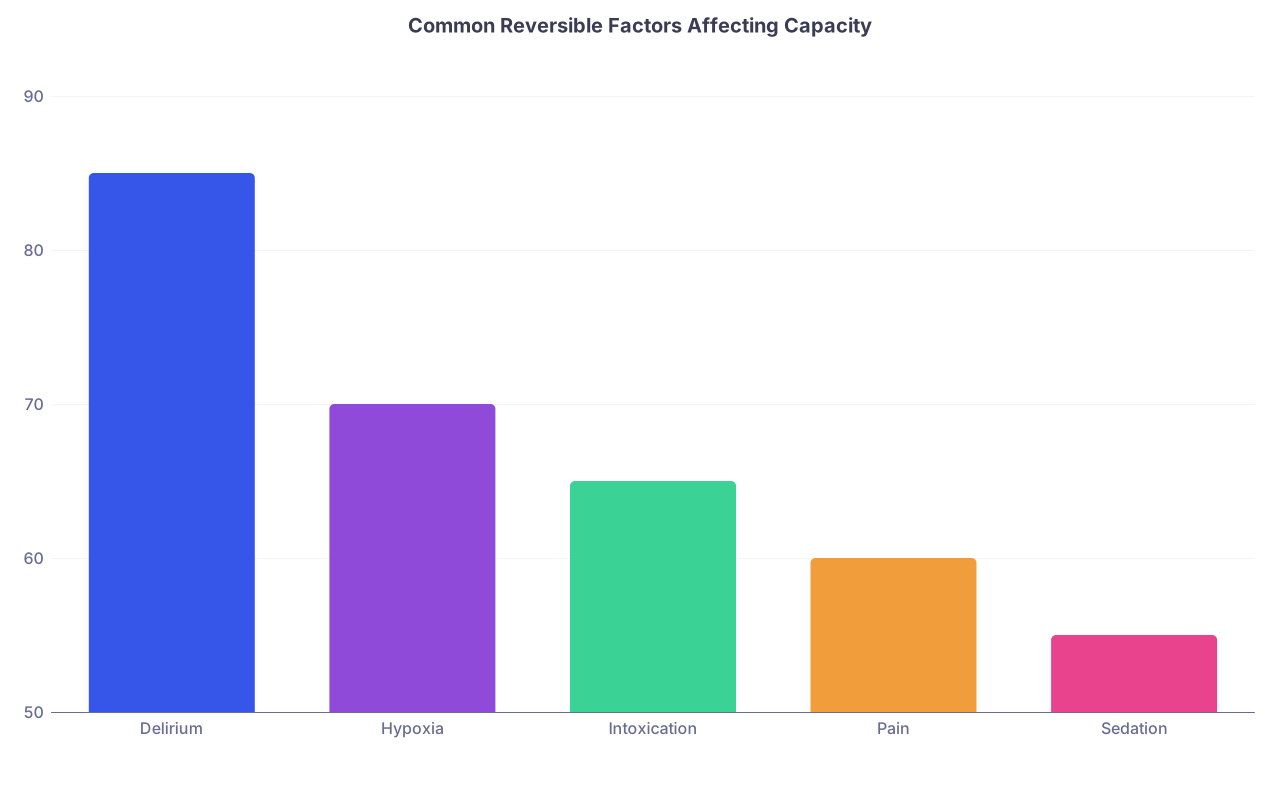
| Category | Value |
|---|---|
| Delirium | 85 |
| Hypoxia | 70 |
| Intoxication | 65 |
| Pain | 60 |
| Sedation | 55 |
Step 3: Explain the situation clearly
Short, direct, non-jargony:
- “You have a serious infection in your blood. We recommend IV antibiotics and staying in the hospital. Without that, you could get much sicker, and it could be life-threatening.”
Then confirm they heard you.
Step 4: Walk through the four abilities (but conversationally)
I’d literally say:
- “Can you tell me in your own words what you understand about your current medical problem?”
- “What treatment are we recommending?”
- “What do you think could happen if you accept it? What if you refuse it?”
- “Why are you leaning toward that choice?”
You listen for:
- Are they concrete?
- Are they making sense?
- Do their reasons hang together, even if you disagree?
Step 5: Document like a lawyer is reading it tomorrow
Because they might.
Example of good documentation:
Capacity assessment performed due to patient refusal of recommended PCI for NSTEMI. Patient able to clearly state choice to decline procedure. Demonstrates understanding: paraphrased diagnosis as “a mild heart attack due to a blocked artery” and described proposed treatment as “a catheter to open the blockage and place a stent.” Appreciates personal risk: stated, “If I don’t do this, I could have another heart attack or die sooner; I know that.” Provides reasoned explanation: “I am 87, do not want invasive procedures, and prefer to focus on comfort even if my life may be shorter.” No evidence of delirium, psychosis, or severe cognitive impairment on exam. In my judgment, patient has decision-making capacity to refuse PCI.
Contrast with the trash version I see too often:
Pt AMA. Says he wants to go. A&O x3. Risks explained.
That won’t protect you ethically or legally.

| Step | Description |
|---|---|
| Step 1 | Concern about capacity |
| Step 2 | Optimize reversible factors |
| Step 3 | Explain condition and options |
| Step 4 | Assess 4 abilities |
| Step 5 | Respect decision |
| Step 6 | Treat as no capacity |
| Step 7 | Identify surrogate |
| Step 8 | Consider ethics or psych consult |
5. When do you call psychiatry, ethics, or legal?
Here is when punting is appropriate, not cowardly.
Call psychiatry when:
- There’s active psychosis, mania, or severe depression driving decisions
- You have serious doubt and high stakes (e.g., life-or-death refusal)
- The family is highly conflicted and questioning your judgment
- You anticipate legal scrutiny or media attention
Psych will use the same four-abilities model. They just have more tools to parse psych vs. personality vs. delirium.
Call ethics when:
- There’s a values conflict among team, patient, and family
- There’s disagreement about whether the patient truly lacks capacity
- Surrogates are requesting clearly non-beneficial or harmful care
- You’re stuck between “legal” and “right” and need a sounding board
Call legal / risk management when:
- There’s a court order, guardianship, or complex custody situation
- A patient’s refusal or AMA decision may have major legal or public implications
- You’re considering involuntary hold or forced treatment in a borderline case
But again: everyone you call is going to ask one thing—What’s your capacity assessment?
You don’t get to skip that step.

6. Common myths trainees believe (and why they’re wrong)
Let me clear out some bad habits I see in notes and signouts.
Myth 1: “He’s A&O x3, so he has capacity.”
Wrong. Orientation is a crude screen for delirium, not capacity. I’ve seen narcissistic CEOs fully oriented, brilliantly articulate, and completely unable to appreciate that their terminal cancer applies to them.
Myth 2: “She has schizophrenia, so she lacks capacity.”
Automatic disqualification? No. Many patients with chronic mental illness can make perfectly rational medical decisions, especially about non-psychiatric issues.
Myth 3: “If I disagree with their choice, they lack capacity.”
No. Irrational to you is not the same as incapable. Capacity protects the person’s right to make what you think is a bad choice.
Myth 4: “AMA = no capacity.”
Leaving AMA is a choice. You only block it if the patient lacks capacity relevant to that choice (e.g., septic + delirious, intoxicated, psychotic, etc.).
Myth 5: “Once they lack capacity, always no capacity.”
Capacity can improve within hours. Siri-level memory: you reassess when consciousness, cognition, or context change.
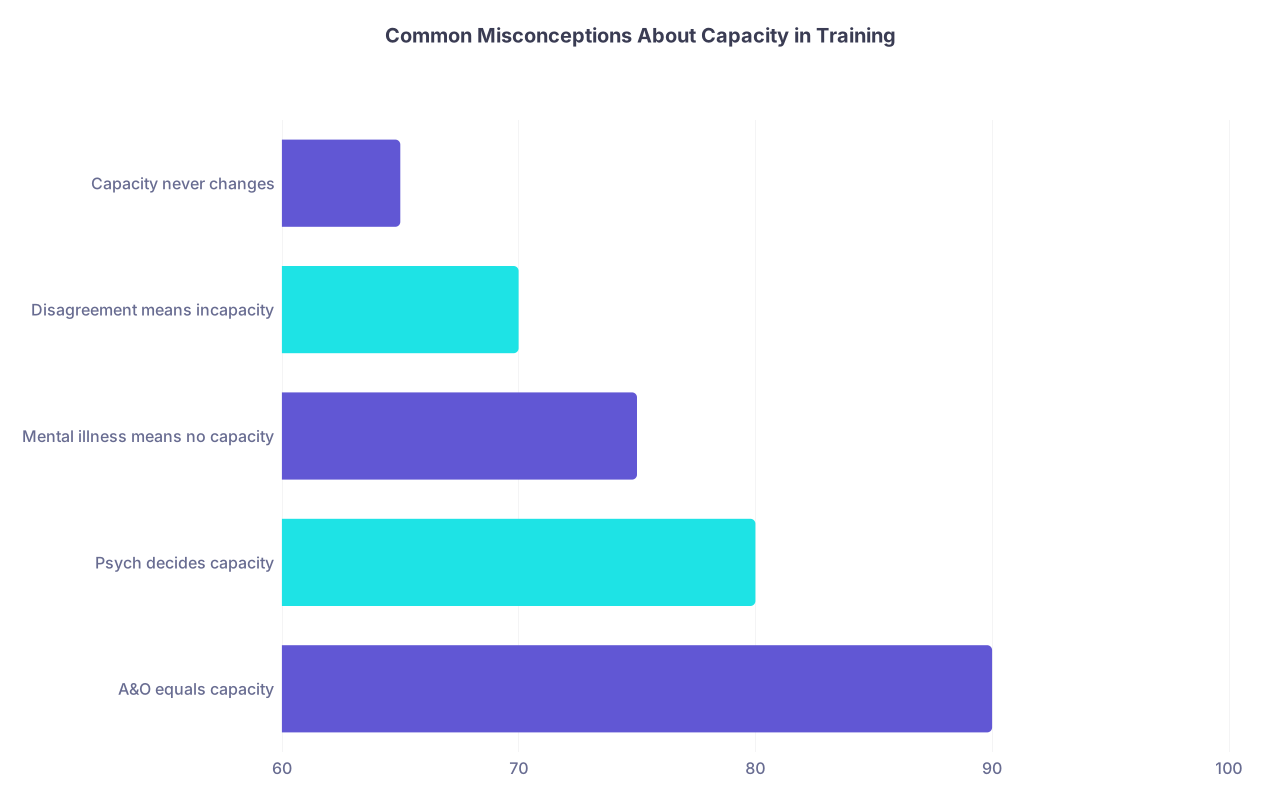
| Category | Value |
|---|---|
| A&O equals capacity | 90 |
| Psych decides capacity | 80 |
| Mental illness means no capacity | 75 |
| Disagreement means incapacity | 70 |
| Capacity never changes | 65 |
7. How this ties into your growth as a clinician
You’re in the “personal development and ethics” phase. So here’s the growth part.
Learning capacity assessment well does three things:
Builds real-world clinical judgment.
You stop reflexively calling psych or hiding behind “policy” and start making grounded, defensible decisions.Protects patient autonomy.
You ensure patients aren’t steamrolled because they’re old, poor, “difficult,” or simply making choices you dislike.Protects you legally and morally.
When things go bad (and in medicine, they sometimes do), you’ll be able to say honestly:
“I talked with the patient. I evaluated their ability to understand, appreciate, reason, and communicate. I documented it clearly. I respected their decision.”
That’s what being a professional looks like.

FAQ: Capacity for Trainees – 6 Common Questions
1. Do I need a formal tool or checklist to assess capacity?
No. You’re not required to use a specific tool, but you are expected to use a structured framework. The four-abilities model (choice, understand, appreciate, reason) is standard. Some hospitals have forms or smart phrases; use them if available. They help you remember to document all four elements, but they don’t replace your clinical judgment.
2. Does a patient need to know every single risk to have capacity?
No. They need to understand the major risks, benefits, and alternatives in broad strokes. If they mix up a 2% vs 3% complication rate, that’s not a capacity issue. If they don’t grasp at all that the procedure could cause serious harm or death, that’s more concerning.
3. What if the family disagrees with my assessment that the patient has capacity?
You still go with the patient, not the family, if the patient has capacity. Document your assessment thoroughly. Then communicate clearly with the family: “I understand you’re worried. I’ve assessed your mother’s decision-making ability, and she does understand the situation and the risks. Since she has capacity, my duty is to follow her wishes.” Ethics can help if it gets heated, but you don’t flip your medical judgment just to appease relatives.
4. Can nurses or other staff decide a patient lacks capacity?
They can and should raise concerns, but the formal determination is on the ordering clinician (physician, and in some systems, NP/PA). If a nurse says, “He doesn’t understand what’s happening,” treat that as a trigger to do your own assessment and document it. Ignoring bedside staff is lazy and dangerous.
5. What if the patient clearly lacks capacity but refuses life-saving care?
Then they legally cannot refuse. You treat them in their best interest and seek a surrogate decision-maker if time allows. If it’s an emergency and no surrogate is immediately available, you act under implied consent. Document your capacity findings and the urgency. If there’s time and it’s borderline, psychiatry or ethics input is wise.
6. How often should I reassess capacity in a borderline case?
Any time the clinical state changes in a way that could affect cognition: delirium waxing/waning, sedatives wearing off, infection improving, intoxication resolving, or a new stressor. In fluctuating cases (e.g., delirium), you might reassess multiple times a day for major decisions. Document each assessment briefly, including what changed.
Key points to walk away with:
- Capacity is a clinical call, usually made by the treating clinician, using four concrete abilities: communicate, understand, appreciate, reason.
- It’s decision- and time-specific, and your job is to assess it, optimize conditions, and document it like it will be read in court.
- Disagreement with you is not incapacity. Your role is to protect competent choices—even the ones you don’t like.


