
Step 1 went pass/fail, and the residency selection process broke. Overnight, program directors lost their blunt-force academic filter. In its place, they turned to the next easiest metric to count: scientific output.
Today, applicants to surgical subspecialties and competitive visual specialties report staggering citation counts. But a quiet panic has taken over medical school hallways. Students routinely ask whether they can squeeze enough papers into an already suffocating M1-M3 clinical schedule, or if they must surrender an entire calendar year to sit in a lab.
Before committing, you should also understand how a gap year and match odds correlate according to recent NRMP data: Gap Year and Match Odds: What Recent NRMP Data Reveals About Outcomes.
You are standing at a strategic crossroads:
- Integrated Research: The incremental path. You publish case reports, systematic reviews, and retrospective cohort studies across M1 to M3 without extending your graduation date.
- The Dedicated Gap Year: The deep-dive path. You take a full 12-month leave of absence, usually between M3 and M4, to work as a clinical research fellow, pump out high-volume manuscripts, and build national connections.
At this point in your training, ideally midway through your M2 year or early in your M3 clerkships, you should be auditing your specialty targets against your current CV. Let's look at what the National Resident Matching Program (NRMP) data actually tells us about these two distinct strategies, and how to execute the timeline for whichever path you choose.
This article is for educational purposes only. It is not financial advice, not legal advice, and not tax advice. Figures vary by individual circumstances, so consult a qualified professional before acting.
The Data Perspective: Quantitative Match Outcomes
The numbers can be deceptive if you don't know how to read them. When program directors review ERAS applications, they see a single bucket titled "Abstracts, Presentations, and Publications."
Look at the latest NRMP Charting Outcomes in the Match data. For hyper-competitive fields like Dermatology, Plastic Surgery, Orthopedic Surgery, and Otolaryngology, matched applicants average anywhere from 12 to 25 total research items. Unmatched applicants in those same fields sit significantly lower, often in the single digits.
If you are unsure if this path is right for you, consider reading: Should You Take a Dedicated Research Year Just to Improve Match Chances?.
Here is the truth about the "Research Year Effect."
Before finalizing your trajectory, review comparative match statistics for research years to better understand the potential impact on your competitiveness.
A dedicated research year rarely turns a non-competitive applicant into a superstar simply by doubling their publication count from six to twelve. Data shows a clear law of diminishing returns. Once your citation count crosses the median threshold for your target specialty, an additional five papers won't save a sub-par Step 2 CK score or a lukewarm Departmental Letter of Recommendation.
If you are specifically debating the merits of this time, read more about whether a research year after not matching is actually worth it to ensure you are weighing the data against the hype.
I've watched students throw away an entire year of life and tuition-adjacent living expenses to push their publication count from 10 to 18, only to discover their match odds didn't move a single percentage point. Why? Because the specialty's program directors care far more about where you published and who wrote your letters than the raw tally on ERAS.
At this point, you should evaluate if an additional research year actually adds structural value to your application, or if your time is far better spent locking down honors on your M3 internal medicine shelf and crushing Step 2 CK.
The Integrated Research Process: Sustained Efficiency
If you decide against a gap year, you cannot approach research passively. You need a deliberate, low-burden, high-output operational framework that runs in the background of your preclinical studies and clinical rotations.
The 12-Month Calendar Batching Method
To keep research from cannibalizing your shelf exam study time, set up a strict batching schedule:
- Months 1-3 (M1 Fall): Scope and IRB Submission. Target one systematic review and two case reports. Never write an IRB protocol from scratch; ask your mentor's lab coordinator for an approved template and modify the variable list.
- Months 4-8 (M1 Spring to Summer): Data Extraction & Analysis. Conduct data collection in pre-scheduled 90-minute morning blocks on weekends, never during prime studying hours.
- Months 9-12 (M2 Year): The Writing Sprints. Limit manuscript drafting to dedicated 3-hour blocks on non-call days.
To maximize efficiency, implement the Waterfall Methodology. Never let a single project yield only one output item.
Every clinical case report should follow a clean pipeline:
- Submit an abstract to a regional specialty conference (Yield: 1 Presentation).
- Present the poster at the meeting (Yield: 1 Abstract).
- Convert the exact poster text into a brief report manuscript and submit it to a peer-reviewed indexed journal (Yield: 1 Publication).
One patient case yields three distinct line items on your ERAS application. That is how integrated applicants match into competitive programs without taking an extra year off.
At this point, you should be creating a 12-month recurring calendar to batch your writing time, ensuring research does not cannibalize clinical study time.
The Gap Year Strategy: When to Pivot
Integrated research works cleanly for students at major academic institutions with built-in research infrastructure. But for many, the integrated route simply isn't enough.
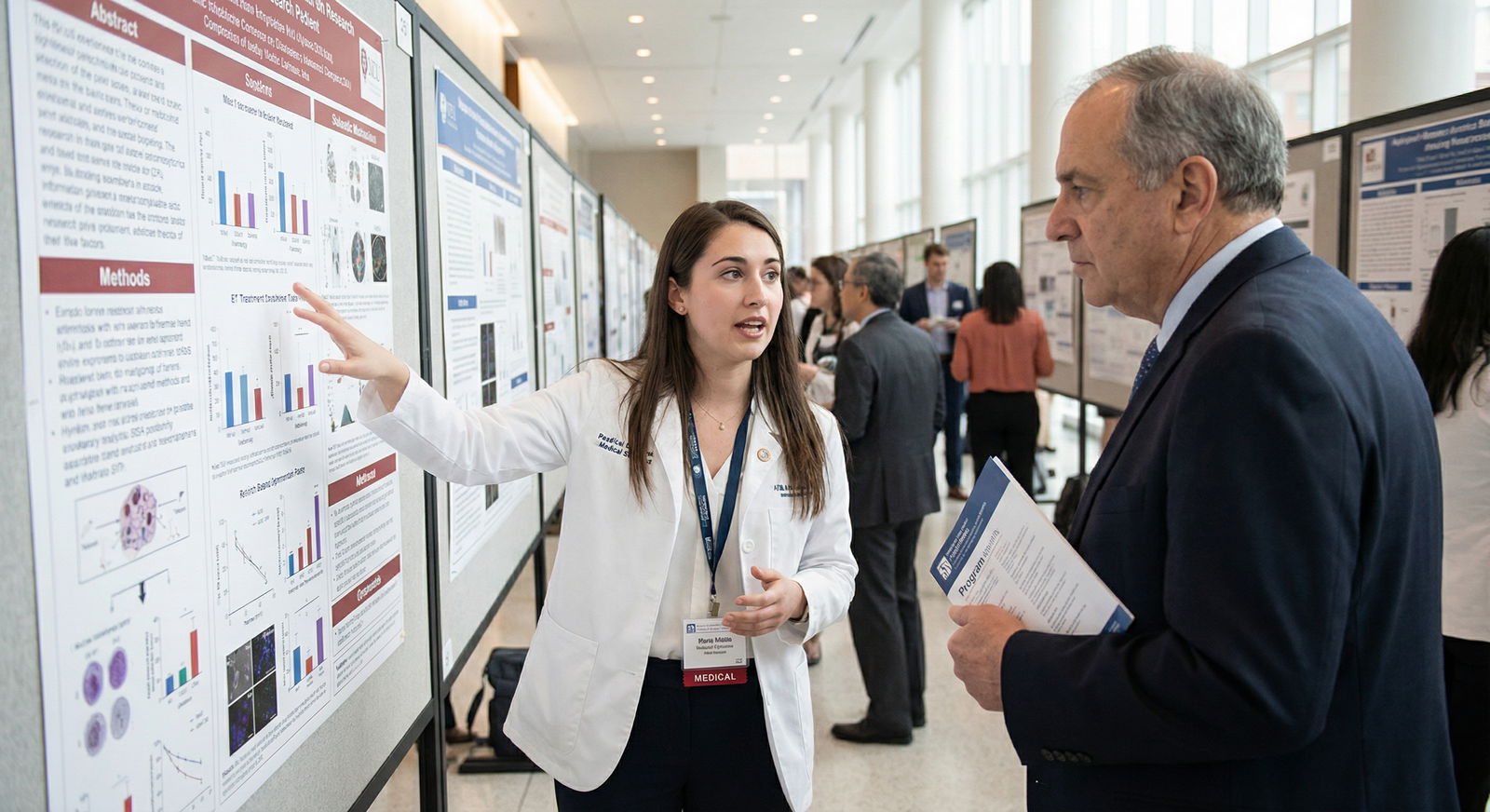
Who Needs a Dedicated Gap Year?
Be honest with yourself. You should strongly consider a research year if you meet any of these criteria:
- The Home-Department Void: Your medical school lacks a home residency program in your target specialty (e.g., Urology, Plastic Surgery, ENT).
- The Step 2 Deficit: Your practice exam scores indicate you are trailing 10+ points below the mean Step 2 score for your desired field, requiring extra time to build a massive academic cushion.
- The Top-Tier Pursuit: You are targeting hyper-competitive academic powerhouse programs (e.g., Harvard, Johns Hopkins, UCSF) that explicitly favor candidates with a dedicated research fellowship on their CV.
Month-by-Month Gap Year Blueprint
If you choose to pivot to a dedicated gap year between M3 and M4, your clock starts immediately. Do not drift through the year without micro-milestones.
GAP YEAR TIMELINE BLUEPRINT
[Month 01-02] Onboarding & IRB Clearances | Secure 3-5 Core Projects
[Month 03-06] Peak Data Collection & Drafting | Submit 5+ Conference Abstracts
[Month 07-09] National Conferences | Away Rotation Networking | Draft Papers
[Month 10-12] ERAS Line Item Optimization | Finalize Submissions | Secure LORs
- Months 1-2 (June-July): Onboarding & Setup. Clear all IRB protocols within the first 30 days. Inherit existing, unfinished datasets from outgoing fellows. Do not start a prospective trial that will take two years to complete; focus on high-yield retrospective cohorts and registry analyses.
- Months 3-6 (August-November): The Output Surge. This is your primary writing window. Aim to draft and submit at least one full manuscript every three weeks. Submit abstract entries to major spring specialty conferences.
- Months 7-9 (December-February): Networking & Away Planning. Present your findings at national meetings. Use poster sessions to introduce yourself to program directors and department chairs where you plan to do away rotations (audition electives).
- Months 10-12 (March-May): Finalization & Transition. Wrap up manuscript revisions. Secure a glowing, detailed letter of recommendation from your Principal Investigator (PI) that explicitly vouches for your work ethic and clinical acumen.
At this point, you should be drafting a formal research proposal and securing a signed mentorship agreement with a high-volume PI before committing your time and tuition status to a gap year.
Key Strategic Rules
Before you lock in your trajectory, anchor your decision on these three practical facts:
- Research volume is just a proxy for commitment. Program directors don't care about a high publication count if you can't explain your exact role in the methodology during an interview. Choose the path that gives you deep, articulate ownership over your work rather than a list of low-tier middle-author citations.
- Clinical grades and board scores reign supreme. Integrated research requires disciplined time management. If your shelf exam scores are falling below target averages, pause your research projects immediately. A 260 on Step 2 CK will clear filters that ten case reports cannot overcome.
- A gap year is a networking investment, not just a publishing sprint. If you take a research year, spend equal effort building relationships with faculty, attending department grand rounds, and showing up in the operating room or clinic. The letter of recommendation from a well-connected PI is often worth far more than the papers you write for them.
Your Action Steps for This Week
- Audit your target specialty stats. Check the latest NRMP match data for your intended field and record the median number of research experiences and publication line items for matched applicants.
- Calculate your current research trajectory. Count your existing pubmed-indexed articles, posters, and in-progress manuscripts. Determine your honest numerical gap.
- Schedule a mentor meeting. Sit down with your research mentor or specialty advisor this week to ask a direct question: "Can I reach a competitive research profile at this institution through an integrated approach, or do I need a dedicated research fellowship?"