

The biggest lie about research in your gap year is that “it will help your application” just because you are doing it. It will not. Only publications in hand or clearly accepted/in-press papers move the needle. And those take longer than you think.
You cannot afford to “see how it goes.” You have to backward-plan from Match Day.
Below is a concrete, time-anchored guide: from Match Day backward to the month you start your gap year. At each point you will know exactly what you should be aiming to have on your CV, and what you should be doing that week to get there.
Big Picture: Your Research Timeline in Reverse
Before we drill into months and weeks, you need the end-point constraints.
For residency applications, the key dates in a typical cycle (adjust ±2 weeks depending on the year) are:
| Milestone | Typical Timing (PGY1 Start Year - 1) |
|---|---|
| ERAS Opens for Applicants | Early June |
| Programs Can View Applications | Mid–Late September |
| Interviews Peak | November–January |
| Rank List Deadline | Late February |
| Match Day | Mid March |
Your publications matter at three distinct points:
- When programs first see your ERAS (late September)
- When you interview (Nov–Jan)
- When you rank / they rank you (Feb–Mar)
At each stage, “submitted” and “under review” help only marginally. “Accepted,” “in press,” and “published” matter.
Here is the harsh but accurate estimate for a standard clinical manuscript:
- Data collection and cleaning: 2–4 months
- Analysis, drafting, internal revisions: 1–3 months
- Peer review cycle (submission → decision → revision → acceptance): 4–9 months
So you are looking at 7–16 months from “we should write this up” to “accepted.”
This is why you backward-plan. You pick how many solid publications you want by the time ERAS opens, then work backward month by month to see what must already be in progress.
To visualize the pressure curve:
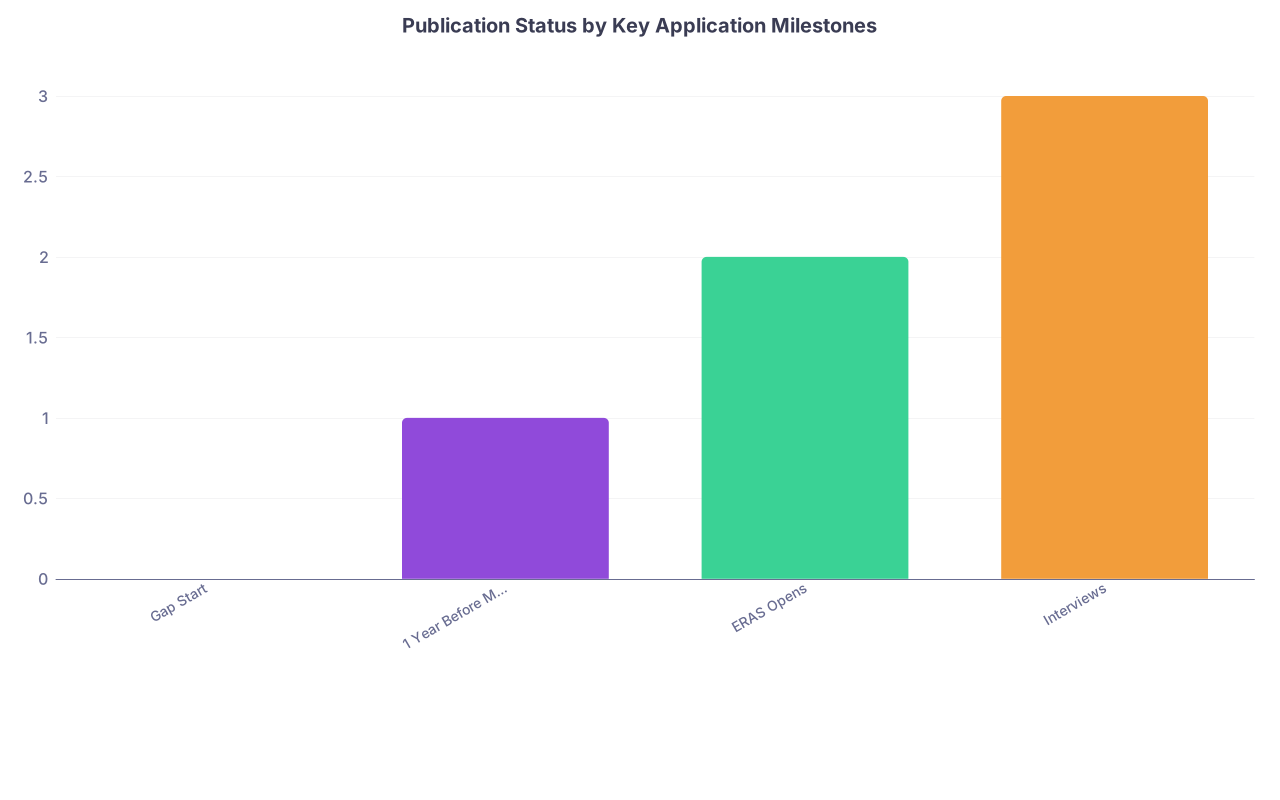
| Category | Value |
|---|---|
| Gap Start | 0 |
| 1 Year Before Match | 1 |
| ERAS Opens | 2 |
| Interviews | 3 |
That “3” near interviews is not aspirational. For competitive specialties, that is close to baseline.
From Match Day Backward: Month-by-Month Targets
Assume Match Day is March of Year 0, and you start your gap year July of Year -2 (i.e., 20 months before ERAS opens, 32 months before Match).
We will walk backward from Match, then forward in more detail.
Match Day (March, Year 0)
At this point you cannot change your application. Publications that appear now are good for your ego and future fellowships, but they do not move your residency Match.
What should be true by Match Day:
- You have:
- 2–4 first- or co-first-author manuscripts accepted or published
- Several middle-author papers and/or abstracts/posters
- You are:
- Possibly finishing minor revisions on late-cycle papers
- Not starting anything new “for residency applications”
Backward-planning implication: everything for your residency CV had to be accepted before about January of Year 0, when rank lists lock in.
Rank List Deadline (Late February, Year 0)
Reality check: Program directors skim updates, but they already have their impression of you.
Your goal by now:
- Any “submitted” / “under review” in September ideally flipped to:
- “Accepted” or “In press” by December–January
- Your ERAS update email (if your specialty allows meaningful updates) in Dec/Jan:
- Announces new acceptances, not that you “submitted another paper”
If you still have major manuscripts at the “we’re almost done” stage in January, those are functionally for future benefit, not the Match.
Peak Interview Season (Nov–Jan, Year -1 to Year 0)
This is where your gap-year planning really shows.
At this point you should be able to say, honestly:
- “I am first author on X accepted/in-press manuscripts related to [field].”
- “I am co-author on Y accepted manuscripts.”
- “I have Z projects under review with [specific journals], expected decisions in [rough month].”
On your CV / ERAS:
- Accepted / in press / published: clearly labeled, with PMIDs or DOIs when available.
- Under review / submitted: a short, sane list. Not a graveyard of desperation.
Backward-planning implication:
Anything you want to talk about in interviews as accepted likely had to be:
- Submitted: by March–June of Year -1
- Data frozen: by January–April of Year -1
That is almost one full year before interviews.
ERAS Opening to Program Review: The Critical Publication Snapshot
Now we get to the hard checkpoint: late September of Year -1 when programs first download your file.
At that point, program leadership sees a static snapshot:
- Published / in press
- Accepted (you may list as such)
- Submitted / under review
- “In preparation” (these usually do not impress anyone)
What You Want on ERAS by Late September (Year -1)
For moderately competitive specialties:
- Ideal:
- 2+ first-author manuscripts (at least one accepted or in press)
- 2–5 middle-author clinical papers
- A couple of conference abstracts/posters
For very competitive specialties (derm, ortho, plastics, ENT, neurosurg, rad onc):
- Realistic target if you are serious:
- 3–5 first- or co-first-author manuscripts (some may still be under review, but at least 1–2 accepted)
- 5–10 total PubMed-indexed works including middle-author pieces and abstracts
Not everyone hits these numbers. But this is what the strong applicants you will compete with look like.
Backward-planning implication:
To have manuscripts accepted or in-press by September:
- Manuscripts need to be submitted by:
- January–April of Year -1 (for quicker-turnaround journals)
- Data need to be frozen by:
- October–January of Year -1
So if you are starting your gap year July of Year -2, you have roughly 9–12 months from gap year start to “data frozen” for your main projects.
From Gap Year Start Forward: Quarter-by-Quarter Plan
Now we flip the direction and walk forward from gap year start, but every action is tied to those future ERAS / Match constraints you just saw.
Quarter 1 (Months 0–3 from Gap Start: July–September, Year -2)
At this point you must not drift. The first 90 days decide whether you will have anything publishable in time.
By the end of Month 1 (July):
- You have:
- Chosen your primary mentor(s) with a track record of publishing trainees
- Clarified your specialty target (or top 2 if undecided)
- You have in writing:
- A list of 2–4 projects where you are clearly first author
- Realistic timelines for data collection and submission
- “We have a lot of ideas, let’s see what you’re interested in” → translation: no concrete pipeline.
- “You can help with this big RCT” → translation: you will be data janitor, no first-author paper in time.
By the end of Month 3 (September):
- At least 1 project:
- IRB approved
- Data source confirmed and accessible
- Variables and outcomes predefined
- For at least one other project:
- Protocol drafted
- IRB submitted or about to be
At this point you should already be blocking time in your week like a real job. For example:

Quarter 2 (Months 4–6: October–December, Year -2)
Objective for this quarter: Complete data collection for at least one manuscript.
Month 4–5 (October–November):
- Weekly goals:
- X charts abstracted or Y patients’ data cleaned each week
- One standing meeting with mentor or fellow to keep you honest
- By end of Month 5:
- Dataset for your first project is essentially complete
- You have met with a statistician (or competent fellow) to finalize your analysis plan
Month 6 (December):
- Analysis for Project 1:
- Run primary analyses
- Generate preliminary tables and figures
- Writing:
- Draft Introduction and Methods (these are straightforward if you did the protocol correctly)
- Start Results as soon as tables are stable
Backward link:
You want Project 1 submitted by around March–April of Year -1 to have a shot at “accepted” by September. That means the draft needs to be in solid shape by January.
Quarter 3 (Months 7–9: January–March, Year -1)
This quarter is where serious applicants separate from “I did a research year” tourists.
Month 7 (January):
- For Project 1:
- Complete full first draft (Intro, Methods, Results, Discussion)
- Send to mentor with an explicit revision timeline (e.g., “I will incorporate your edits and submit by March 1”)
- For Project 2:
- Data collection at least halfway complete
- For small side projects:
- Case report? Brief communication? Systematic review? These can be your “padding” but do not let them replace the main papers.
Month 8 (February):
- Revisions for Project 1:
- Turnaround: 1–2 weeks per revision cycle. Not 6.
- Schedule weekly writing blocks purely for responding to comments.
- Data for Project 2:
- Push to completion; aim to have a clean dataset by end of Month 8.
Month 9 (March):
- Submit Project 1 to a realistic, appropriate journal by the end of March. No endless upward-journal fantasies.
- Begin analysis and drafting for Project 2.
- For fast-turnaround items (case reports, letters), push at least 1–2 to submission this month.
At this point (end of Quarter 3), you should have:
- 1 first-author manuscript submitted
- 1 first-author manuscript with data frozen and analysis underway
- 1–2 minor manuscripts (case series, reviews, letters) in draft or submitted
If you are not there yet, you are behind for competitive specialties. Not doomed, but behind.
Quarter 4 (Months 10–12: April–June, Year -1)
This quarter is your last true window to create content that might be accepted in time for ERAS.
Month 10 (April):
- Project 1:
- Expect either:
- Initial editorial decision (reject / revise) from first journal, or
- At least confirmation that it is in review
- If rejected early: resubmit within 1–2 weeks. No sulking.
- Expect either:
- Project 2:
- Complete full draft by end of April
Month 11 (May):
- Submit Project 2 by mid–late May.
- Push at least one smaller, faster project (case report, letter, brief report) across the finish line and submitted.
Month 12 (June):
- ERAS opens. You are drafting your application while:
- Monitoring status of Project 1 and 2
- Nudging coauthors on smaller pieces
By end of June (1 year before Match), your scoreboard should look something like:
| Project Type | Status Goal by June (Year -1) |
|---|---|
| First-author Project 1 | Submitted, possibly in review |
| First-author Project 2 | Submitted or nearly submitted |
| Minor Project(s) | 1–3 submitted |
| Extra Big Project 3 | Data collection well underway |
Summer and Early Fall of Application Year: Locking in ERAS
July–August (Months 13–14: Year -1)
Objective now: convert “submitted” into “accepted” before programs download ERAS.
- Project 1:
- If you got “revise and resubmit,” turn it around in < 2 weeks.
- Keep analysis changes minimal; big redesigns at this stage rarely work in your favor.
- Project 2:
- Same logic. Aggressive revision timelines.
- Minor projects:
- Submit any stragglers. If something is still “in preparation” now, it will probably be listed as such (low yield).
You should be in near-constant, low-level communication with your mentors now. I have literally written, “If we can get this resubmitted by Aug 15, there is a good chance it will be accepted before ERAS downloads,” and it changed behavior. Spell out the stakes.
September (Month 15: Year -1)
This is snapshot month.
By the time programs can see your application (mid–late September), your CV should show:
- A cluster of accepted / in-press papers whose timelines trace back to:
- Data collection in your first 6–9 months of gap year
- Submission in the spring
- A few “under review” items that you can credibly discuss
If you are still submitting new manuscripts in September just to list them as “submitted,” fine. But do not expect those to be accepted in time to influence most interview invites.
Late Application Year: Managing Revisions and Interviews
Once ERAS is out, your research work shifts from generation to maintenance and signaling value.
October–December (Months 16–18: Year -1 to Year 0)
Your priorities:
- Rapidly handle any:
- Minor revisions → get them accepted before interview season peaks
- Moderate revisions → target acceptance by January at the latest
- During interviews:
- Talk about your work like a near-expert in that subfield, not like a tourist
- Emphasize the gap-year story: “I started this project in August of my research year; by March we had data, and it was accepted this September.”
January–March (Months 19–21: Year 0)
At this point:
- Any new acceptance is nice but will rarely change your rank.
- Your goal is:
- Do not drop any balls (answer journal queries promptly, handle proofs, etc.)
- Capture PMIDs / DOIs and be prepared to send an update if your specialty/program allows.
Any brand-new research idea now is for future fellowship or your own intellectual curiosity, not the Match.
Micro-Level: What You Should Do This Week and Today
You probably want something very concrete by now. Here is what I tell gap-year students and preliminary residents who realize they need publications.
Weekly Non-Negotiables
Every week during your first 12–15 months, you should have:
- 2–3 half-days blocked for:
- Data abstraction / cleaning
- Writing (not reading about writing)
- 1 scheduled meeting for:
- Project check-in with mentor or fellow
- 1 stats or methods meeting per active project at key decision points
Use a simple visual to stay honest about output, not just effort:
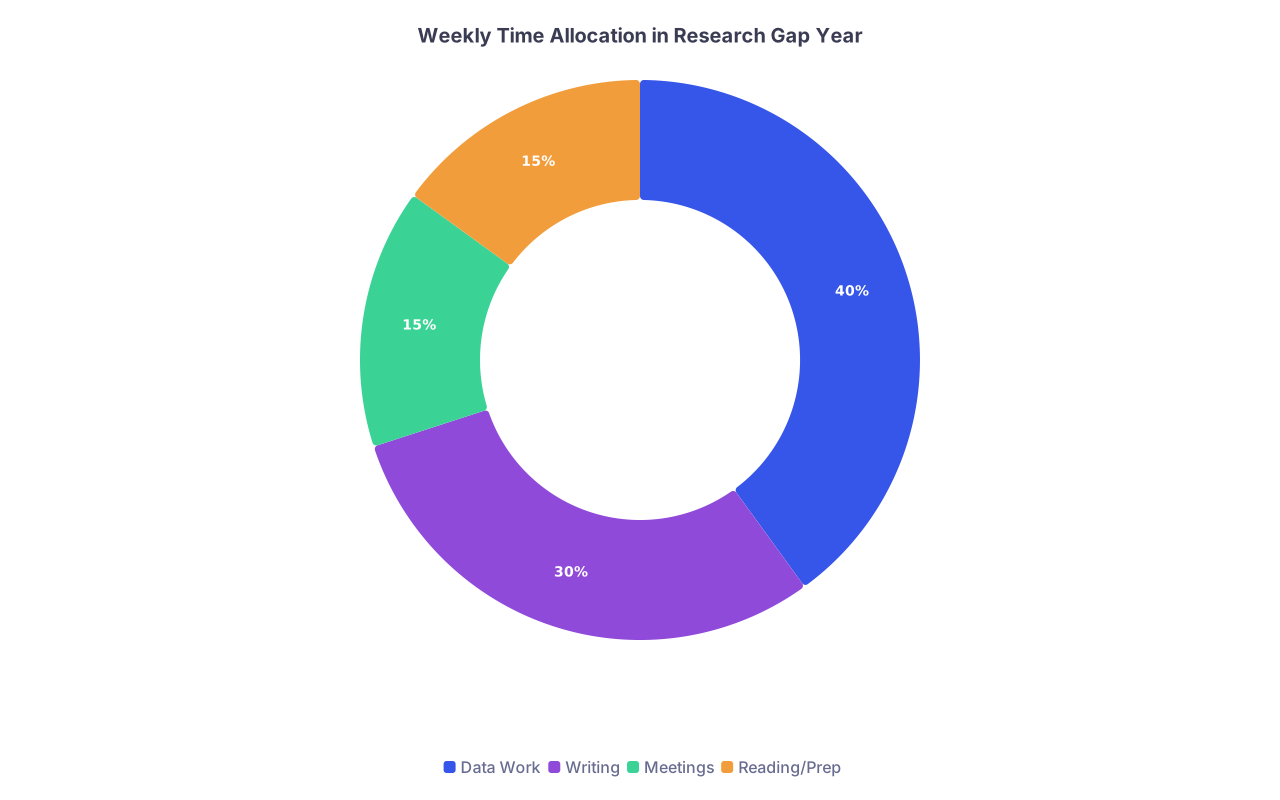
| Category | Value |
|---|---|
| Data Work | 40 |
| Writing | 30 |
| Meetings | 15 |
| Reading/Prep | 15 |
If your weeks are 60–70% “reading background literature” and “brainstorming,” you will not submit anything in time.
Today: Your Immediate Action
You took the time to read this. Good. Now convert it.
Today, do this:
- Open a blank page and write “ERAS Snapshot – September [Year]” at the top.
- List exactly how many:
- First-author manuscripts you want accepted/in press by then
- Co-authored manuscripts you want visible
- For each, sketch backward:
- Submission month
- Data-frozen month
- IRB approval month
You will instantly see whether your current pace and project mix can possibly get you there.
If it cannot, you have your answer: you need fewer, more focused projects with aggressive, pre-committed deadlines.
Start that exercise right now and do not stop until each desired publication has a backward-planned data-freeze and submission date written next to it.


