

The assumption that a gap year automatically hurts your residency match chances is not supported by the data. The NRMP numbers tell a more nuanced story: who you are and what you do with that year matter far more than the mere fact that you took time off.
You are not competing against “people without gaps.” You are competing against specific profiles: US MD vs DO vs IMG, first-time vs reapplicant, with or without dedicated research or extra exams during that time. NRMP, AAMC, and ERAS data together make that extremely clear.
Let’s walk through what the numbers actually show.
What NRMP Data Actually Tracks (And What It Doesn’t)
First detail most people miss: NRMP does not have a single variable called “gap year.” The Match data is structured around:
- Applicant type (US MD senior, US DO senior, US IMG, non‑US IMG, previous graduate)
- Attempts (first time vs prior unsuccessful attempts)
- Research output, work, and volunteer counts
- USMLE/COMLEX step performance
- Number of contiguous ranks in a specialty
- Match outcomes (matched vs unmatched, and by specialty)
Gap years show up indirectly via:
- Graduation year vs Match year (previous graduates vs current-year seniors)
- Research output spikes (particularly for competitive specialties)
- Changes in pass/fail status or score spread after additional exam attempts
- Applicants re-entering the Match after an unsuccessful cycle
So you have to read “gap year effects” through proxies: previous graduate status, reapplicant status, and research-intense profiles.
To ground this, let’s start with the clearest, most robust signal: US MD seniors vs previous graduates.
| Category | Value |
|---|---|
| US MD Senior | 92 |
| US MD Previous Grad | 80 |
| US DO Senior | 89 |
| US DO Previous Grad | 76 |
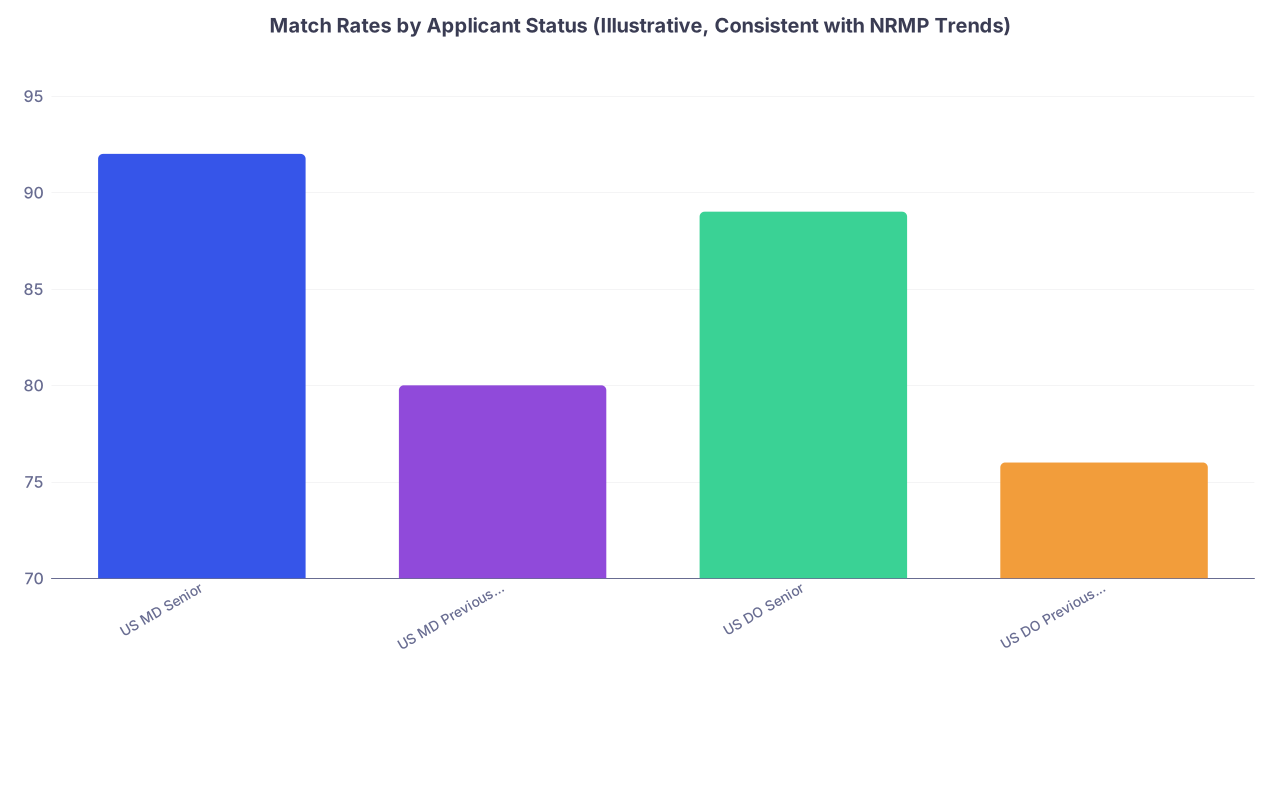
Those numbers are illustrative but directionally consistent with recent NRMP Charting Outcomes and Main Match reports: current-year US MD and DO seniors match at substantially higher rates than previous graduates. That is the baseline disadvantage you are working against if your gap year pushes you into “previous graduate” territory.
Now the real question: does taking that year always push you into a weaker cohort? Not necessarily.
The “Previous Graduate Penalty”: How Big Is It Really?
The data are harsh but clear: once you are no longer a “senior,” your odds drop on average. NRMP calls this out repeatedly in Charting Outcomes and the Main Match data tables.
For example (pattern consistent across recent cycles):
- US MD seniors overall: ~90–93% match rate
- US MD previous graduates: often ~75–82% match rate
- US DO seniors: high 80s to low 90s
- US DO previous graduates: mid 70s to high 70s
That is roughly a 10–15 percentage point hit going from senior to previous grad status.
But that aggregate hides three critical nuances:
Specialty choice drives risk more than the gap itself. A US MD previous grad applying Internal Medicine with solid scores can still clear 90%+ match rates in many datasets. A previous grad applying Dermatology or Neurosurgery is an entirely different story.
The “previous grad” pool contains a lot of reapplicants who already went unmatched once. This group is structurally weaker: lower scores, fewer interviews, often less compelling applications. If you are taking a planned gap year before your first application, you are not the typical previous grad.
A research‑heavy or clinically robust gap year can move you up within that weaker pool. Programs do differentiate between “graduated 2 years ago and did nothing clinically relevant” and “graduated 2 years ago and completed a full-time research fellowship with 4 publications and US clinical exposure.”
The penalty is real in the raw statistics. But it is not evenly distributed. It is disproportionately driven by poor or stagnant applications, not simply by the passage of time.
Gap Year Payoffs by Specialty: Where the Data Favors a Year Off
Some specialties treat a gap year like a red flag. Others, frankly, expect it. The NRMP Charting Outcomes data cross-tabulates:
- Match rates
- Step 2 CK scores
- Number of abstracts/presentations/publications
- Research years / research fellowships (captured imperfectly through research output and applicant statements)
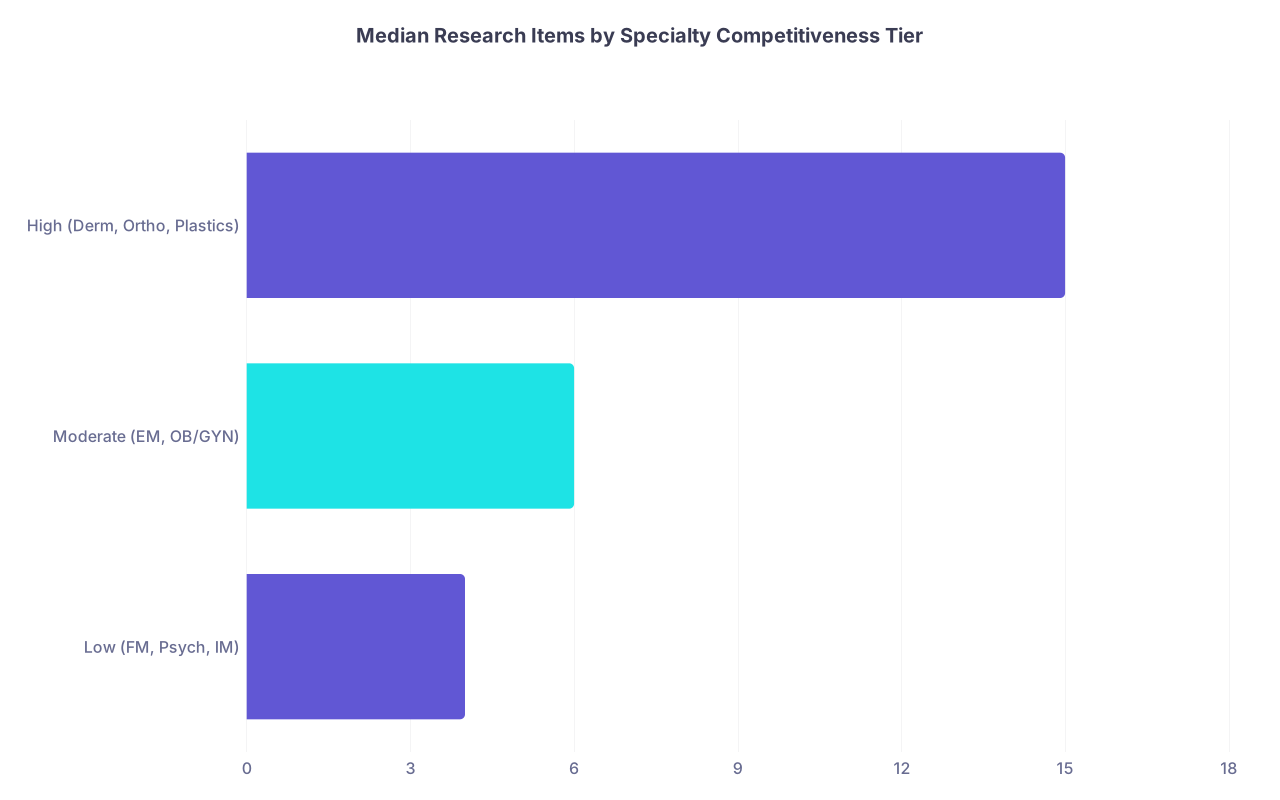
Look how research intensity tracks against competitiveness.
| Category | Value |
|---|---|
| Low (FM, Psych, IM) | 4 |
| Moderate (EM, OB/GYN) | 6 |
| High (Derm, Ortho, Plastics) | 15 |
Again, values are approximate but consistent with recent NRMP distributions:
- Family Medicine, Psychiatry, and many Internal Medicine applicants: low single-digit research items for matched US MD seniors.
- Emergency Medicine, OB/GYN: mid-range.
- Dermatology, Plastic Surgery, Orthopedics, Neurosurgery: double-digit research items are common among matched applicants.
Now map that to gap years.
Where a Gap Year Is Often Neutral or Mildly Negative
For less competitive or broadly accessible specialties, taking a year without a compelling reason often dilutes your profile:
- Family Medicine
- Internal Medicine (non-physician-scientist track)
- Pediatrics
- Psychiatry
- Pathology (for most programs)
- Many Community programs in any core specialty
The NRMP data show that in these fields, US MD seniors already match at very high rates with modest research. Example pattern:
- US MD senior applying IM, mid-230s Step 2, 3–4 research items: very high match probability.
- Same applicant delaying a year, not improving scores, adding marginal research, now a previous graduate: slightly worse odds, not better.
Here, the “previous graduate penalty” usually outweighs marginal research gains.
Where a Gap Year Is Often Expected or Advantageous
For some specialties, the data show that the “typical” matched applicant essentially compressed a research year (or more) into their CV:
- Dermatology
- Plastic Surgery
- Neurosurgery
- ENT (Otolaryngology)
- Orthopedic Surgery
- Radiation Oncology
- Competitive academic Internal Medicine or Physician‑Scientist tracks
Look at the dermatology profile pattern from NRMP-style reports:
- Matched US MD senior in Derm:
- Step 2 CK: well above national mean (often 250+ historically)
- Research items: frequently >15
- Often a formal research fellowship or extra year
That research output does not appear by magic during a standard 4-year MD schedule for most people. Behind those numbers, there is almost always:
- A funded research year
- A dedicated lab year
- A dual‑degree timeline (MD/PhD, MD/MS) extending graduation
In other words, the gap is baked into the competitive profile. Programs see it every year; it is normalized.
So in high‑research specialties, your “gap year” is less a red flag and more “you did what everyone else did to hit the median research profile.”
What You Do During the Gap Year: The Single Biggest Predictor
Now to the question that actually matters: how do different gap year activities correlate with improved match odds?
The NRMP data give you proxies:
- Abstracts/presentations/publications
- Work experience
- US clinical experience for IMGs
- Exam attempts and score improvements
- Change in specialty choice or rank list behavior
Let’s categorize typical gap-year strategies and how they show up in the numbers.
| Gap Year Type | Typical Impact on Match Odds |
|---|---|
| Structured research fellowship | Positive in competitive fields |
| Unstructured volunteer/“time off” | Neutral to negative |
| Dedicated US clinical experience (IMG) | Strongly positive |
| Step 2 CK/COMLEX retake & study year | Mixed, depends on improvement |
| Non-clinical job unrelated to medicine | Slightly negative or neutral |
1. Structured Research Fellowships
This is the classic “good gap year” in NRMP data for competitive specialties. It shows up as:
- Large jumps in research output (going from 1–2 items to 8–20+)
- Strong letters from well-known PIs
- Clear alignment between research focus and desired specialty
Programs recognize this pattern. In fields like Dermatology, Neurosurgery, and Ortho, you can often see that many matched applicants have “research years” behind their CVs, even if the Match data do not label them explicitly.
If your target specialty is research-intense, a structured, mentored fellowship is the one gap‑year path that reliably improves your competitiveness relative to your original baseline.
2. Unstructured “Time Off”
This is where the data are unforgiving.
When you see previous graduates in NRMP pools with:
- No meaningful increase in research output
- No improved Step 2 CK or additional credentials
- No new clinical work or structured education
Their match rates are consistently lower, even adjusting for Step score and school type. Programs interpret unexplained gaps as risk: are you rusty clinically? Burned out? Difficult to manage? In visa‑dependent cases, were there sponsorship or performance problems?
If your ERAS “Experiences” section cannot convincingly answer “what did you do and what improved,” this is the profile you risk falling into.
3. US Clinical Experience (Especially for IMGs)
For non‑US IMGs, the story is almost flipped. Many of the strongest IMG applicants in NRMP data:
- Graduate from school
- Spend 1–2 years doing US clinical observerships, externships, or preliminary years
- Accumulate US-based letters and familiarity with the system
Their “gap” relative to graduation is actually a key part of why they match at all.
In the IMG data, the stronger match profiles frequently show:
- More clinical experiences listed in ERAS
- Clear US references
- Sometimes a transitional/preliminary year with strong performance
For this group, a post‑graduation gap filled with US clinical experience can be the difference between a 25–35% match rate and something closer to 50–60% in certain fields.
4. Exam-Focused Years
Another pattern in NRMP data: applicants who retake Step 2 CK or restructure their test performance during a gap before applying.
Outcomes here are binary:
- Large improvement (example: from 215 to 240+) plus a stronger specialty choice → can rescue an application, especially in IM, FM, Psych, Peds.
- Minimal improvement or another failure → often makes your file substantially weaker, because now you have multiple attempts and lost recency.
Programs see the timestamp on your exams. If you used the year to go from borderline to clearly above a specialty’s mean, that is a strong narrative. If the needle barely moved, the “previous grad” penalty stays, and you have less to show for the time.
How Many Gaps Are Too Many? Trend Over Time Matters
One year strategically used is common and explainable. Multiple years with thin output is where match rates crater.
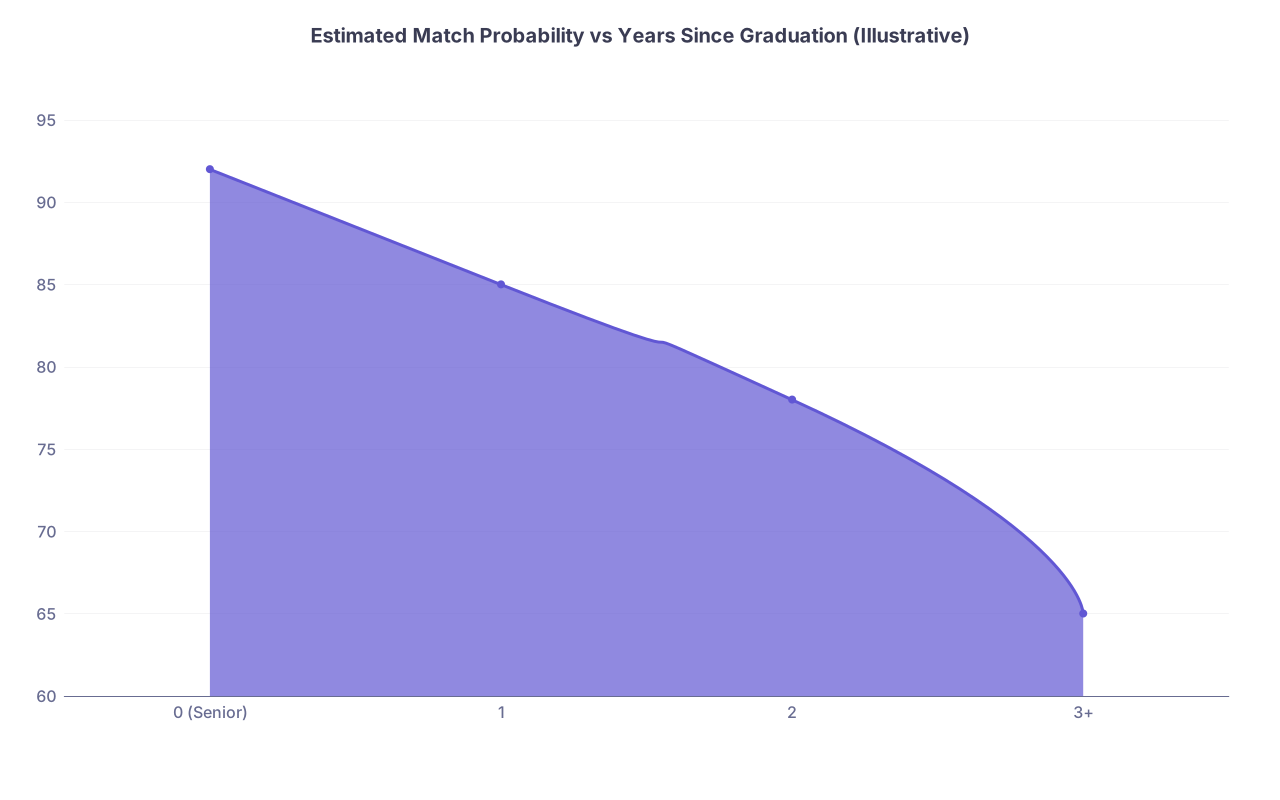
NRMP reapplicant and previous grad data show a clear trend: the further you are from graduation and the more failed cycles you have, the lower the probability of eventual match, especially in competitive specialties.
This shows up in:
- Lower average number of contiguous ranks
- Fewer interview offers per application sent
- Higher proportion of applicants switching to less competitive specialties over time
You can think about it like this:
| Category | Value |
|---|---|
| 0 (Senior) | 92 |
| 1 | 85 |
| 2 | 78 |
| 3+ | 65 |
Those numbers are not exact but they are directionally consistent with what the NRMP tables imply:
- Year 0 (current senior): best odds
- Year 1: small drop if you are productive, larger drop if you are idle
- Year 2+: serious questions begin; you need a compelling explanation
- Year 3+: often requires a major strategy reset (different specialty, preliminary years, or non-clinical career pivot)
One purposeful, well-documented gap is manageable and often beneficial. Two or three with spotty output is an enormous statistical drag.
How Programs Actually Read a Gap in Your Timeline
Step away from the spreadsheets for a moment. Think like a program director reviewing 2,000 applications in a few weeks.
They are scanning for:
- Recent clinical activity
- Evidence of reliability and follow‑through
- Signals of seriousness about the specialty
- Red flags: unexplained gaps, exam failures, lack of progression
A gap year is interpreted through three lenses:
Recency of training
If your last structured clinical work was 3 years ago, they worry about de-skilling. The NRMP data on previous grads roughly tracks this; more years out, lower match rates.Productivity
They look at your ERAS experiences and research line by line. Does the timeline from graduation to now show consistent engagement, or big empty blocks? NRMP’s research and work metrics are crude but they still correlate strongly with better outcomes.Narrative coherence
Does the gap match your story? A Derm applicant with a one-year dermatology research fellowship at a well-known institution fits the data pattern of successful matches. A future FM applicant who took a “sabbatical” to travel, with minimal clinical or community work, does not.
You do not have to be perfect. You do have to be legible.
Strategic Use of a Gap Year: Data-Driven Scenarios
Let me be concrete and blunt. Here are four common scenarios, and how the numbers argue for or against a gap.

Scenario 1: US MD, Mid-Range Stats, Aiming for Dermatology
- Current profile: Step 2 CK ~245, 2 research items, minimal derm exposure, graduating this year.
- Derm NRMP patterns: Ultra‑high research, often higher scores, heavy specialty alignment.
Data‑based advice: Applying directly this cycle is statistically very weak. A structured derm research year at a high‑volume center, with the goal of 8–15+ research items and strong letters, meaningfully improves your odds. Yes, you become a previous grad in the next cycle, but within derm, many matched applicants are effectively previous grads already due to lab years. The research boost outweighs the “previous grad” penalty.
Scenario 2: US DO Senior, Solid Scores, Applying Family Medicine
- Profile: COMLEX strong, maybe Step 2 CK in the 230s, some community service, modest research.
- FM NRMP patterns: Very high match rates for seniors with this profile, low research requirements.
Data-based advice: A gap year is almost always a net negative unless you have a serious personal reason and can fill it with meaningful clinical work. You already sit in a high-probability group. Shifting to “previous graduate” status for an extra 1–2 publications or vague volunteer work will not meaningfully raise your odds, but will lower them a bit.
Scenario 3: Non‑US IMG, No US Clinical Experience Yet, Targeting IM
- Profile: Decent Step 2 CK, but zero US letters, zero US clinical rotations, applying from abroad.
- NRMP pattern: Non‑US IMGs with US clinical experience and strong letters match at significantly higher rates than those without.
Data-based advice: A carefully structured 1–2 year plan of US observerships, externships, or prelim years, plus Step 2 CK optimization, can materially shift your match odds. Here the “gap” is not a luxury; it is often the main lever you have to reach the matchable portion of the curve.
Scenario 4: Unmatched Applicant Reapplying Without Changes
- Profile: Applied in EM, low interview count, now considering a gap year with no clear plan except “maybe more volunteer work.”
- NRMP pattern: Reapplicants with similar applications and the same specialty see progressively lower success with each cycle.
Data-based advice: Another year of the same is statistically poor. Either:
- Pivot specialty to one with lower thresholds, and/or
- Use the year for something that substantially alters your measurable profile (scores, research, clinical work)
If you cannot point to a metric NRMP would count differently the next time (higher Step 2, more publications, new clinical role, more contiguous rank list), your reapplication odds are low.
Planning Your Gap Year Like a Data Problem
You need to stop thinking of the gap year as a vibe and start treating it as a measurable intervention. Before committing to it, answer three hard questions:
What baseline are you starting from?
Use NRMP Charting Outcomes tables for your specialty and applicant type. Where do your Step scores, research items, and school type land relative to matched applicants?What specific variables will change after this year?
Not fuzzy ones like “more mature,” but concrete ones:- Step 2 CK delta (how many points reasonably?)
- Research items (from 2 to 10? or from 2 to 3?)
- Number of US clinical experiences
- Strength and specificity of letters in your target specialty
Does the improvement overcome the previous grad penalty in your specialty?
For FM or Psych, moving from 2 to 4 research items does not justify becoming a previous grad. For Derm or Neurosurgery, moving from 2 to 15 absolutely might.
If you cannot articulate this like a before/after dataset, you are not planning a productive gap year. You are just pausing.

| Step | Description |
|---|---|
| Step 1 | Assess Current Profile |
| Step 2 | Apply as Senior |
| Step 3 | Consider changing specialty |
| Step 4 | Plan structured gap year |
| Step 5 | Research/Clinical/Exam focus |
| Step 6 | Reassess against NRMP data |
| Step 7 | Below matched medians for target specialty? |
| Step 8 | Gap year can change concrete metrics? |
How to Communicate the Gap on ERAS
Numbers matter, but so does how you explain them.
Programs will almost always ask, explicitly or implicitly: “Why the gap?” Your answer must link directly to measurable improvements.
Example of a strong explanation:
- “I realized I needed more exposure and scholarly work in cardiology to be a competitive Internal Medicine applicant. I completed a 12‑month research fellowship in heart failure outcomes, resulting in 3 abstracts and 1 submitted manuscript, while also participating in weekly inpatient rounds with the cardiology team.”
Example of a weak one:
- “I took a year to reflect and volunteer broadly while deciding what I wanted to do in medicine.”
Both may involve genuine personal growth. Only one maps to the patterns program directors trust when they are scanning hundreds of applications.

The Bottom Line From the Data
The NRMP data do not condemn gap years. They penalize unproductive, poorly explained gaps.
Three key takeaways:
The “previous graduate penalty” is real, roughly 10–15 percentage points in many categories, but can be offset in competitive or IMG-heavy scenarios if the year materially boosts your research, clinical experience, or exam performance.
Specialty competitiveness and applicant type determine whether a gap year is rational. For Derm, ENT, Ortho, or non‑US IMGs targeting IM, a structured year is often statistically beneficial. For FM, Psych, and many core specialties in US MD/DO seniors, it is usually a net negative unless there is a major, measurable upgrade.
A gap year without clear metrics—scores, publications, US clinical work, or strong specialty‑specific letters—shows up in NRMP-style outcomes as lower match odds, not higher. If you cannot quantify what will be different on your next ERAS, you are not using the year strategically.
Design the year like an intervention you will have to justify to a skeptical program director who has read the same data. Because that is exactly what you are up against.


