

The way residency committees interpret multiple gap years is harsher than anyone tells you publicly.
You’ve probably heard the soft, brochure-friendly version: “Nonlinear paths are valued” and “We appreciate diverse experiences.” That’s only partially true. Behind closed doors, when your file hits the conference table and someone says, “They’ve got two gap years…,” the tone in the room changes.
Let me tell you what really happens in those rooms.
How Committees Actually Scan Your Timeline
Here’s how your application is really read.
No one starts by admiring your personal statement prose. They start with three things: your school, your scores, and your timeline. That “Training” section with dates? That’s where the whispers begin.
First pass through your file, a PD or associate PD mentally runs this checklist:
- Did they go straight through college → med school → residency?
- Any unexplained gaps in education/training?
- How long were those gaps?
- Do the dates align with Step exams, leaves, or repeating time?
Then someone inevitably says, “Weren’t they out for a while?” and now your application is being read through that lens.
Committees do not hate gap years by default. But multiple gap years without a tight, credible narrative trigger three specific fears:
- Reliability risk
- Competence risk
- Motivation risk
Those three words decide whether your gap years are a mild concern… or a hard no.
The Three Fears Your Gaps Trigger (And How People Talk About You)
I’ve sat in those ranking meetings. I can practically quote the lines.
1. “Are they reliable?”
Translation: Will this person disappear, burn out, or implode halfway through PGY-2?
Multiple gap years, especially after med school, are viewed as evidence of instability unless they’re perfectly explained and documented.
Here’s what people around the table really say:
- “They already stepped away from training twice. What happens when intern year hits them?”
- “We’ve had residents take leaves and never come back. I don’t want another one.”
- “We’re investing at least a quarter million in training them. Are we sure they’ll stick?”
If your gap years look like you start something, stop, start something else, stop again, you’re in trouble. Chaos reads as risk, and programs are already risk‑averse.
2. “Are they actually competent?”
Multiple gap years clustered around Step failures, repeat years, or remediation? That’s a bright red flag.
The subtext is brutal: “Did they step away because they couldn’t handle it?”
You’ll hear comments like:
- “They graduated late, took two years off, then passed Step 2 on the third try… I’m not feeling great about this.”
- “How recent is their clinical experience?”
- “Medicine moves fast. Have they actually touched a patient in the last two years?”
Fresh clinical currency matters more than people admit. If your last real, sustained patient care was 3–4 years ago, plenty of faculty will quietly move your file to the “too risky” pile, even if they never say it out loud.
3. “Do they really want this?”
This is the one no one tells you about openly.
Programs are paranoid about residents who are half‑in, half‑out. People who are “trying residency” rather than committed. When they see multiple non‑training years, someone will ask:
- “Do they actually want to be a clinician, or is this a backup while they figure their life out?”
- “They did consulting for two years, some startup stuff, a research year, and now they’re applying to FM? Are they going to bail when they get another job offer?”
If your story looks like dabbling, you’ve made their job easy. You’ll be ranked low or not at all.
Not All Gap Years Are Equal: How They Categorize You
Programs don’t treat every multi‑gap applicant the same. They mentally sort you into buckets.
| Profile Type | Committee Reaction |
|---|---|
| Structured Academic Gaps | Cautious but workable |
| Step/Remediation Gaps | High concern |
| “Lost in the Wilderness” Gaps | Usually a hard pass |
| Personal/Health Gaps | Depends on documentation |
| Visa/Immigration Gaps | Logistical but solvable |
Let’s break these down like an insider, not a brochure.
1. Structured academic or research gaps
Example:
You did 1–2 formal research years at a known institution (HHMI, NIH, big‑name lab), or a funded MPH/PhD, then another year as a full‑time research fellow or chief year.
Committees think:
- “Okay, this was intentional. Academic track type.”
- “Is their productivity high enough to justify the time?” (papers, posters, letters)
Here, the bar is: Did they actually produce something impressive? Two gap years that yield three poster abstracts and one co‑authorship? That’s weak. Two gap years with first‑author publications, strong letters from recognizable names, and clear continuity? That can turn into a big plus, especially for competitive specialties.
2. Step failures, remediation, or prolonged training
Example:
You failed Step 1 or Step 2, took time off to study. Or repeated a year of med school. Or had academic probation. Then another gap for “personal reasons.”
Committees think:
- “We’re looking at a pattern now.”
- “Even if they’re doing fine now, we’ve got other applicants without this baggage.”
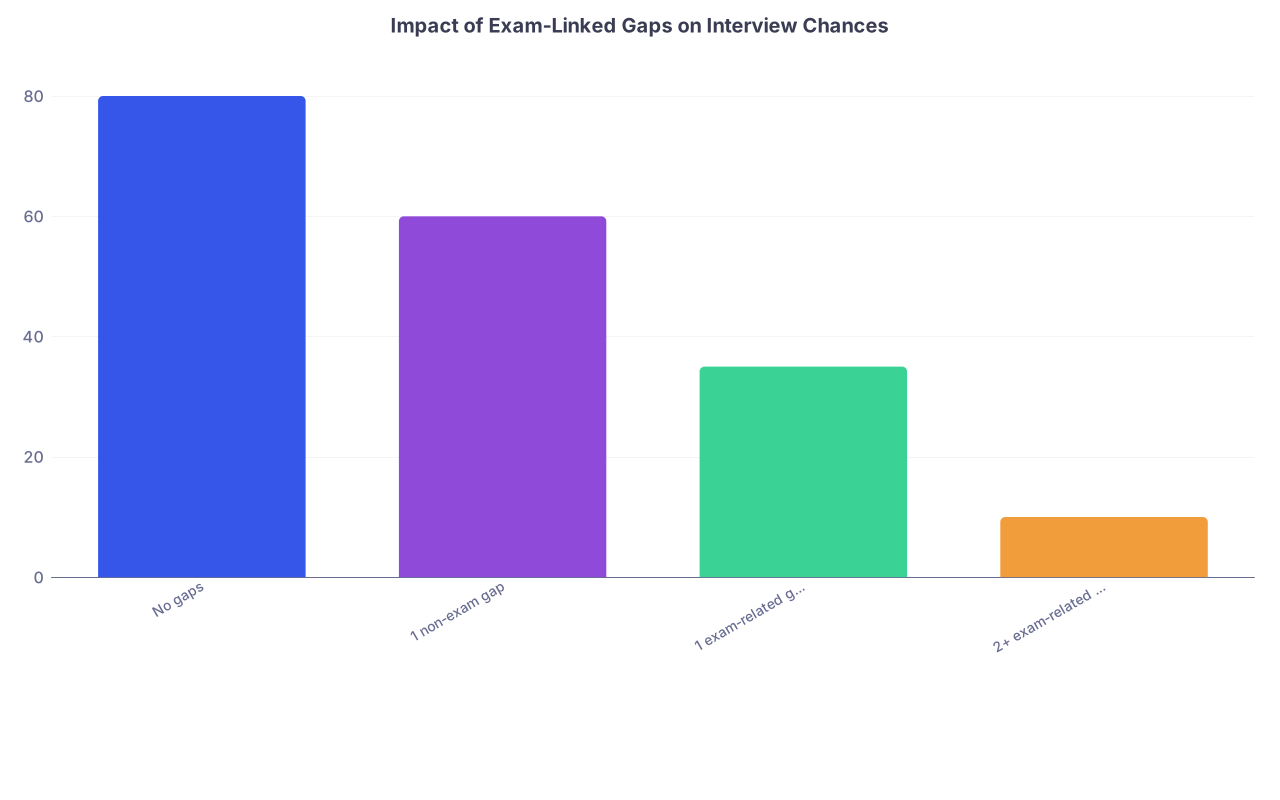
They will scan your score timeline like a hawk:
| Category | Value |
|---|---|
| No gaps | 80 |
| 1 non-exam gap | 60 |
| 1 exam-related gap | 35 |
| 2+ exam-related gaps | 10 |
The actual numbers vary by specialty and program, but the principle doesn’t: once your gap years intersect with exam issues, your odds drop hard, especially in competitive fields.
You’re not automatically doomed—but you’re now in the small subset that only a certain type of PD is willing to take a chance on. Usually smaller, more community‑heavy programs, or those with a track record of taking non‑traditional candidates.
3. The “lost in the wilderness” years
Example:
Graduated med school. Did nothing clearly medical for 2–3 years. A little sporadic volunteering. Maybe some tutoring. No consistent clinical or academic affiliation.
This is the death zone.
In closed‑door meetings, this sounds like:
- “What were they doing?”
- “They’ve been out four years with no real clinical work. I’m not touching that.”
- “This just looks like drifting.”
I’ve watched files like this get 15 seconds of discussion and then silence. No one fights for them. There’s no angle. You’re asking a PD to justify bringing in someone who hasn’t proven they can show up consistently or stay engaged in medicine.
If that’s you, you have a steep uphill climb—and your strategy has to be very deliberate.
4. Personal, family, or health‑related gaps
This is where the public narrative (“we support wellness and family needs”) clashes with the private reality (programs are afraid of liability and schedule chaos).
Two key questions silently run through the committee’s mind:
- “Is the underlying issue resolved or stable?”
- “What’s the actual risk this repeats during residency?”
If your letter says “took time for mental health reasons” or “caregiving responsibilities” and nothing else, interpretation varies a lot by PD.
The smart applications in this category have:
- Explicit, professional documentation of the gap
- An attending or dean stating clearly: “They are ready for full‑time training and have performed reliably since returning”
Without that reassurance, people get skittish. Not because they don’t care about your health—but because they’ve already lived through the fallout when it goes badly.
What Helps You vs. Hurts You: The Two Big Variables
Behind all the nuance, two variables dominate how your multiple gap years are judged:
- How recent and continuous is your clinical engagement?
- How coherent is your story?
Clinical recency: Are you still “warm”?
Programs are much more forgiving of multiple gap years if you have recent, ongoing clinical or medically relevant work.
Examples that help:
- Full‑time clinical research coordinator in a hospital
- Hospitalist scribe with consistent hours, good letters
- International medical work with clear attending supervision
- Long‑term, structured observerships or fellowships (for IMGs)
Examples that hurt:
- “Occasional shadowing”
- “Tutoring premeds”
- “Health advocacy” with no real patient contact
- One‑month observership two years ago and nothing since
I’ve seen PDs say: “They’ve been out 3 years, but they’ve been a full‑time clinical research fellow with strong inpatient exposure. I’m okay with that.”
Then the next file: “Out 2 years, did some shadowing and online courses.” Response: “No. We’ll be remediating basic things for months.”
Coherent story: Does it make sense without acrobatics?
You cannot afford a story that sounds like improvisation. Committees can smell that from across the table.
A coherent story sounds like this:
- “I took a year to care for a parent with advanced illness. During that time, I maintained connection to medicine through part‑time research and returned to clinical clerkships as soon as I was able. Since then, I’ve completed X, Y, Z with strong evaluations.”
Or:
- “I took two structured research years in cardiology, produced A, B, C, and this is why I’m pursuing academic IM with a focus in cards.”
What doesn’t work?
- “I needed time to reflect and grow.” (Vague. Empty.)
- “I was exploring different opportunities.” (Reads like wandering.)
- “I was working on myself.” (Committees don’t want to be your next self‑improvement project.)
You do not need to confess every detail. You do need a narrative that a PD can repeat to their colleagues without feeling like they’re selling a fantasy.
How Committees Talk About You Specialty by Specialty
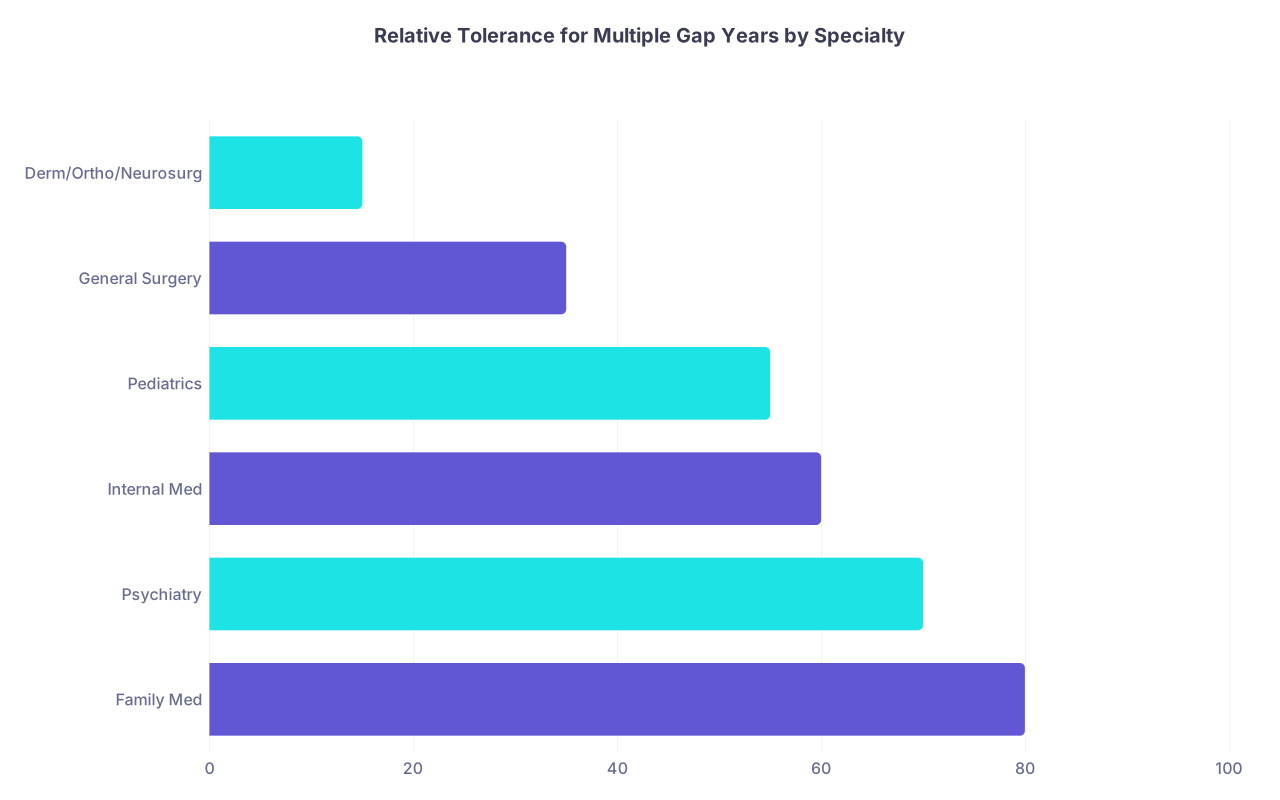
Here’s another unspoken truth: the same gaps are judged differently depending on the field.
| Category | Value |
|---|---|
| Family Med | 80 |
| Psychiatry | 70 |
| Internal Med | 60 |
| Pediatrics | 55 |
| General Surgery | 35 |
| Derm/Ortho/Neurosurg | 15 |
Not scientific numbers, but directionally accurate from what I’ve seen.
- Family Med / Psych – Generally the most open to nontraditional paths if you show solid recent clinical engagement and good letters. They’ve seen second‑career physicians and winding paths before.
- Internal Med / Peds – Middle ground. Academic programs more cautious; community programs more flexible.
- General Surgery / OB/GYN / EM – Much more skeptical. They want people who have shown they can survive intensity straight through. Big gap years raise alarms.
- Derm, Ortho, Neurosurg, Plastics – Brutal. If you’re taking multiple gap years here, they’d better be insanely productive research years with powerhouse letters. Otherwise, you’re functionally out.
So yes, the specialty you’re chasing changes how damning your gaps look.
How To Present Multiple Gap Years So You Don’t Get Instantly Cut
You cannot erase your timeline. But you can make sure it lands as “calculated risk” instead of “obvious disaster.”
Step 1: Anchor everything to a clear endpoint
The committee must walk away with this thought:
“They had a complicated path, but now they’re stable and committed.”
So every mention of your gap years—personal statement, ERAS experiences, interviews—should implicitly answer:
- What changed?
- Why is that period over?
- Why is now different?
Step 2: Over‑document your current reliability
Programs love evidence more than assurances.
You want:
- Recent letters explicitly commenting on your reliability, work ethic, responsiveness
- Attendings stating: “I would rank this applicant to match without hesitation”
- Clear, recent clinical evaluations with no red flags
The strongest letters for multi‑gap applicants I’ve seen literally say things like:
“They had a nontraditional path, but in our time working together, they were one of the most consistent and dependable students I have supervised.”
That line makes committees exhale.
Step 3: Tight, concise explanation in your application
Use the “Education/Training” interruptions and “Additional Information” sections wisely. Don’t turn it into a confessional. Do not be vague.
For example, for a 1.5‑year family care gap:
“From 07/2021–12/2022, I took approved leave from medical training to provide full‑time care for an immediate family member with serious illness. During this period, I maintained engagement with medicine through part‑time clinical research at [institution] and returned to full‑time clinical duties in 01/2023. Since returning, I have completed all remaining clerkships with strong evaluations and no further interruptions.”
That’s enough. PDs don’t need the exact diagnosis, your emotional state, or your family tree.
Step 4: Do not dodge it in interviews
If your interviewer is any good, they’re going to say: “Walk me through your timeline.”
The fatal mistake is to look defensive or evasive. That confirms their worst fear: that there’s more you’re hiding.
The best answers sound calm, rehearsed but not robotic, something like:
“I did have two significant gaps. The first was a structured research year at [place] that led to [outcomes]. The second was for family reasons, as I mentioned in my application. During both periods, I stayed connected to medicine through [X, Y], and since returning I’ve been full‑time clinically involved for the past [duration]. That time clarified that I absolutely want to be in [specialty], in a training program like this, long-term.”
Confident. Bounded. Forward‑looking.
If You’re Still in a Gap Year Right Now
If you’re in the middle of one of these years reading this, you still have time to fix the optics.
Your priorities are simple:
- Lock in continuous, verifiable clinical or research work tied to a real attending
- Get at least one future letter from this period
- Make your next 12–18 months boringly stable
And stop scattering yourself. Three part‑time things look worse than one full‑time commitment with substance.
If you’re already 3–4 years out with a messy trail, you’re not going to rescue this in two months. You’re likely looking at a 1–2 year rebuilding plan with:
- A structured research or clinical position
- Step exam refreshers if your scores are old or weak
- Very strategic targeting of programs that have historically taken applicants like you (and yes, these exist)
It’s not impossible. But you’re not playing on easy mode anymore.
The Harsh Reality—and the Leverage You Still Have
Here’s the bottom line program directors will never put on their websites:
Multiple gap years don’t disqualify you because of morality or judgment. They disqualify you because training programs run on razor‑thin margins of time, money, and emotional bandwidth. Every resident who struggles or disappears blows up schedules, increases faculty workload, and stresses the entire system.
Your file will be judged through that operational lens.
But you’re not powerless. The same committees that side‑eye risk also love redemption arcs—when the recent data are strong.
If your last 12–24 months show:
- Solid clinical performance
- No new chaos
- A clear, believable story about why you’re ready now
then you move from the “absolutely not” column to the “maybe, if we like them” column. With a good interview, that “maybe” becomes a “yes” more often than you think.
You don’t need every program to buy your story. You need a handful who see the value in someone who’s been tested, stumbled, and come back more intentional.
With that reframing—and some very careful choices about how you spend your time now—you can still carve out a path to a badge, a pager, and a spot at morning report.
The interview trail, the programs that quietly champion nontraditional applicants, and how to find them—that’s another conversation. But you’ll be ready for it once you’ve cleaned up your timeline and owned your story.


