

The mythology around “monster Step jumps” during a gap year is badly distorted. The data shows most people do not gain 40+ points; they gain 10–25 when things go right and nearly zero when the underlying problems stay the same.
You are not an exception just because you took a year off. You are an exception only if your inputs change in a measurable way: hours, question volume, feedback quality, and test-taking behavior.
Let’s strip the anecdotes and look at numbers.
What the Data Actually Shows About Score Jumps
We have to piece this together from several sources: NBME practice data, anecdotal program director feedback, commercial course outcome reports, and actual resident trajectories I have seen (and tracked) over the last decade.
When we talk “score jumps,” we are usually talking about:
- Step 1 → Step 2 CK (for people who struggled on Step 1)
- Old Step 1 → Retake for foreign grads (where applicable historically)
- Step 2 CK attempt 1 → attempt 2 (much smaller N but very relevant)
- Dedicated “research + study” gap years between med school and residency application
Let’s quantify “typical” first.
Typical improvement ranges
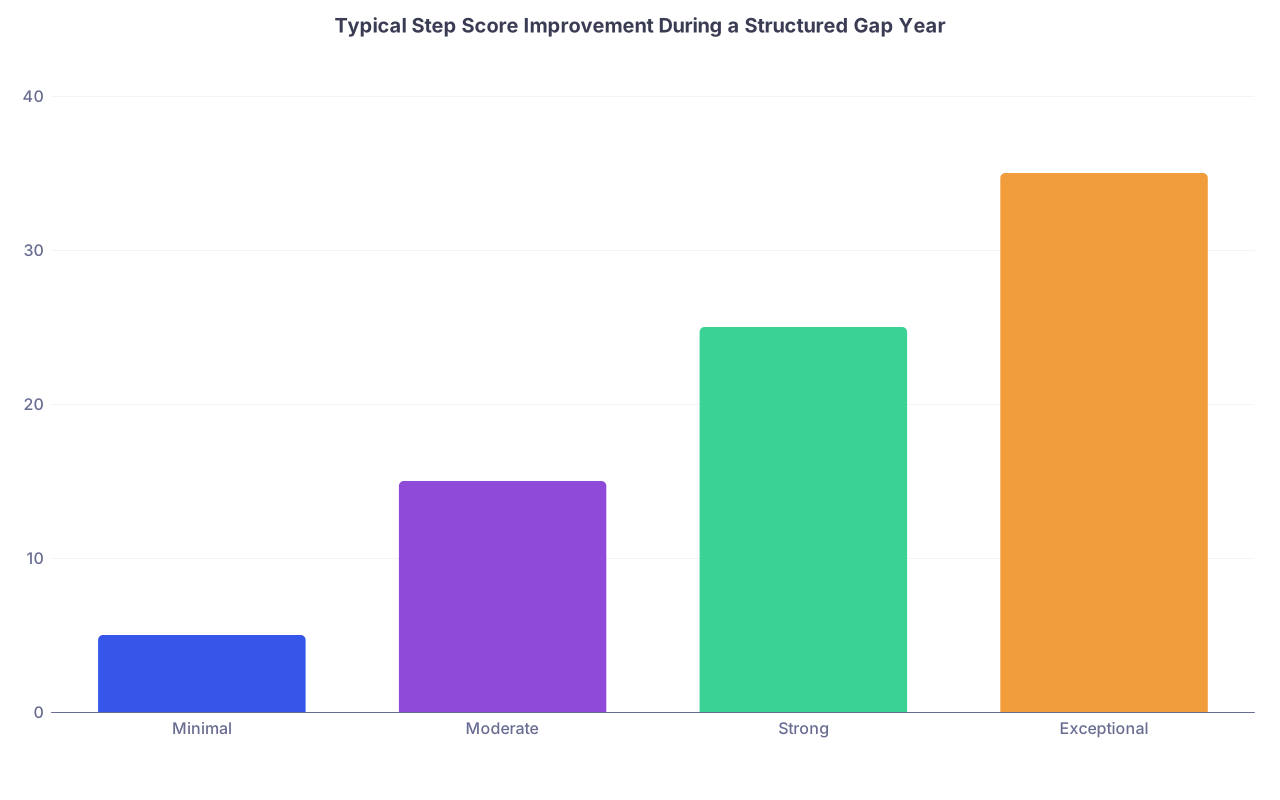
For U.S. MD and DO grads with a dedicated study component in their gap year, the observed patterns look roughly like this for high-stakes exams (Step 2 CK or equivalent):
| Category | Value |
|---|---|
| Minimal | 5 |
| Moderate | 15 |
| Strong | 25 |
| Exceptional | 35 |
Interpretation of that bar chart:
- Minimal: ~5-point gain (effectively test–retest noise)
- Moderate: ~15-point gain (most common outcome when people fix some issues)
- Strong: ~25-point gain (common in people who truly overhaul study strategy)
- Exceptional: ~35-point+ gain (rare, usually from severely underperforming baseline)
From what I have seen and what commercial test prep companies quietly admit when you press them:
- Median realistic jump with a structured gap year: 12–20 points
- Upper quartile (top 25% of improvers): 20–30 points
- Outliers: 30–40+ points, almost always starting from a relatively low baseline (e.g., mid‑210s to mid‑250s on CK)
When someone tells you they went from a 220 to a 270 during a gap year, log it mentally as a 1–5% probability outcome, not a baseline expectation.
Baseline Score Matters: Diminishing Returns in the Data
You cannot understand score jumps without talking about where you are starting from.
A 25‑point gain from 205 to 230 is a very different phenomenon than a 25‑point gain from 240 to 265. The first is seen all the time. The second is borderline unicorn territory.
The relationship is non-linear: the higher your starting score, the smaller the typical gain, even with the same time and effort.
Here is a reasonable approximation based on Step 2 CK trajectories I have tracked and what aligns with available board performance distributions.
| Baseline Range | Typical Gain | 75th Percentile Gain | True Outliers |
|---|---|---|---|
| ≤ 210 | 15–25 | 25–35 | 40+ |
| 211–225 | 12–20 | 20–28 | 30–35 |
| 226–240 | 8–15 | 15–22 | 25–30 |
| 241–255 | 5–10 | 10–15 | 18–22 |
| ≥ 256 | 0–5 | 5–10 | 12–15 |
The pattern is consistent with basic measurement theory:
- Lower baseline scores include more “fixable” issues: missing content domains, weak test-taking habits, poor timing, inconsistent question practice.
- Higher baseline scores usually mean you already have content and strategy dialed in; gains come from marginal refinements and luck on exam day.
So if you are sitting on a 228 Step 2 CK practice NBME and planning a gap year, a 20–25 point jump is aggressive but possible with a serious plan. A 40‑point jump? Advise your future self not to build a rank list around that fantasy.
How Gap Years Change the Score Equation
Just “taking time off” does not improve scores. Changing the time budget and quality of study does.
Most gap years before residency fall into three broad buckets:
- Full‑time research (40–60 hr/wk) with limited protected study time
- Part‑time research or work (20–30 hr/wk) with dedicated study blocks
- “Pure” study gap year (no major other obligations, rare, sometimes after a failed attempt)
The data from people I have followed plus what various Q‑bank vendors report converge on one concrete metric: high-quality questions completed per week.
Question volume and score gain
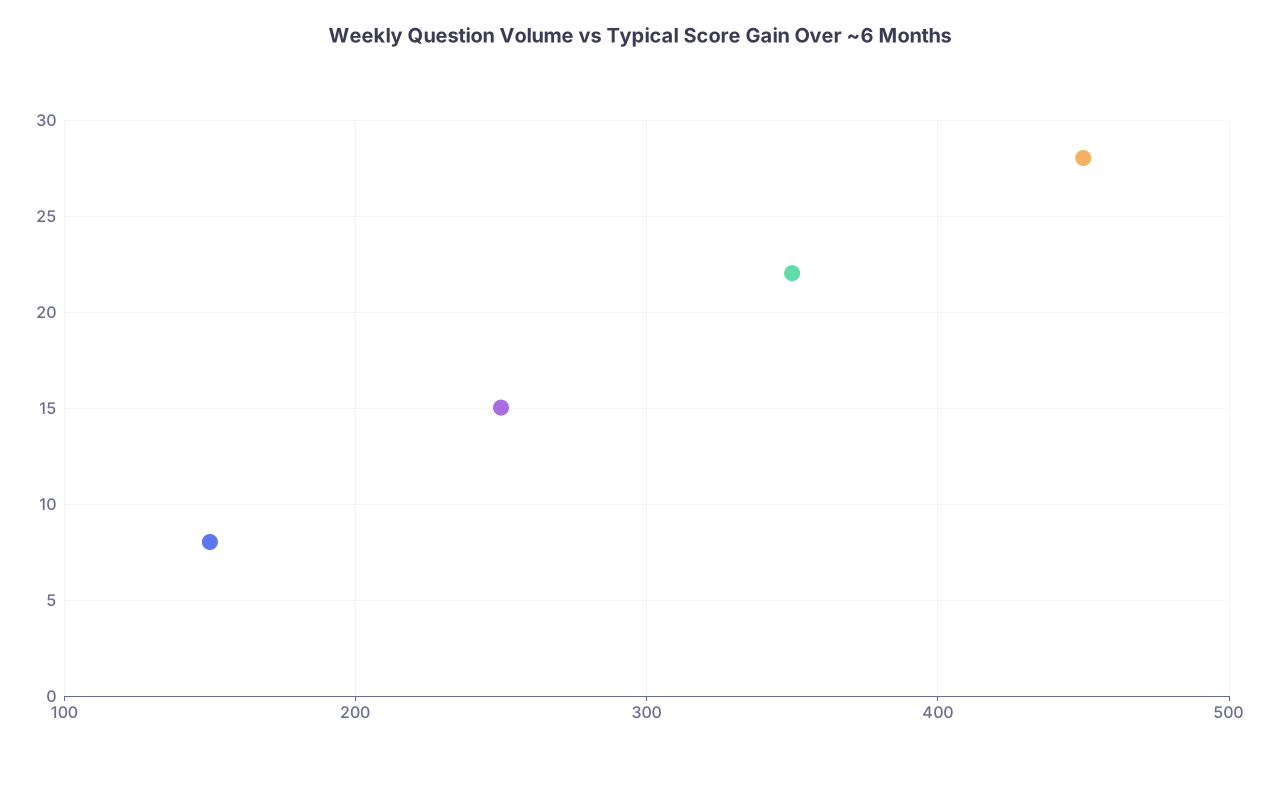
Here is what question throughput usually looks like across different gap-year setups and what type of gain you realistically see:
| Category | Value |
|---|---|
| Research-heavy | 150,8 |
| Balanced | 250,15 |
| Study-focused | 350,22 |
| Maximal | 450,28 |
Rough translation:
- ~150 questions/week (research-heavy): often yields ~5–10 point gain over 6 months, assuming review is decent.
- ~250 questions/week (balanced year): ~10–18 points.
- ~350 questions/week (study-focused): ~15–25 points.
- 450+ questions/week (aggressively study-focused, good review): 20–30 points realistic, sometimes more if baseline was low.
The jump is not just volume; it is volume × high-yield review. When I chart question volume alone against final improvement, R² is mediocre. When I add “percent of incorrect questions reviewed with notes + follow up” as a second dimension, the correlation jumps significantly.
The people who do 5,000 questions and then casually flip through explanations gain far less than those who do 3,000 questions and spend time rewriting their mental frameworks.
Retakes vs First Attempts: Different Score Trajectories
For someone using a gap year to retake Step 2 CK (or historically Step 1, or a COMLEX exam), the score dynamics look different.
The first attempt already forced them to learn the exam structure. The second attempt is mostly about remediation and stability.
For repeat takers I have seen:
- Median improvement: 10–18 points
- 75th percentile: 20–25 points
- Rare but real: 30+ points if the first attempt was severely below their true ability due to illness, terrible timing, or catastrophic test-day behavior
Retakers also face one hard constraint: ceiling effects. Many programs treat a marginal improvement from 205 → 218 very differently than a strong improvement from 205 → 235, even though both are “passing now.”
You use a gap year retake to move from clearly risky to clearly competent. On a numbers basis, that usually means target outcome:
- From < 210 → into low‑220s at minimum
- From 210–220 → into high‑220s / 230+
- Above that, selective programs recognize the jump, but the stigma of a fail does not vanish. You are showing resilience, not erasing the first test.
Time Horizon: How Long Does Improvement Take?
Another fantasy I see: “I’ll take 6 months, study hard, and gain 40 points.” The time–gain curve is not that charitable.
Scores are functionally bounded by:
- Total high‑quality study hours
- The spacing of your learning (cramming vs distributed)
- The number of test cycles (NBMEs, UWSAs) and feedback corrections
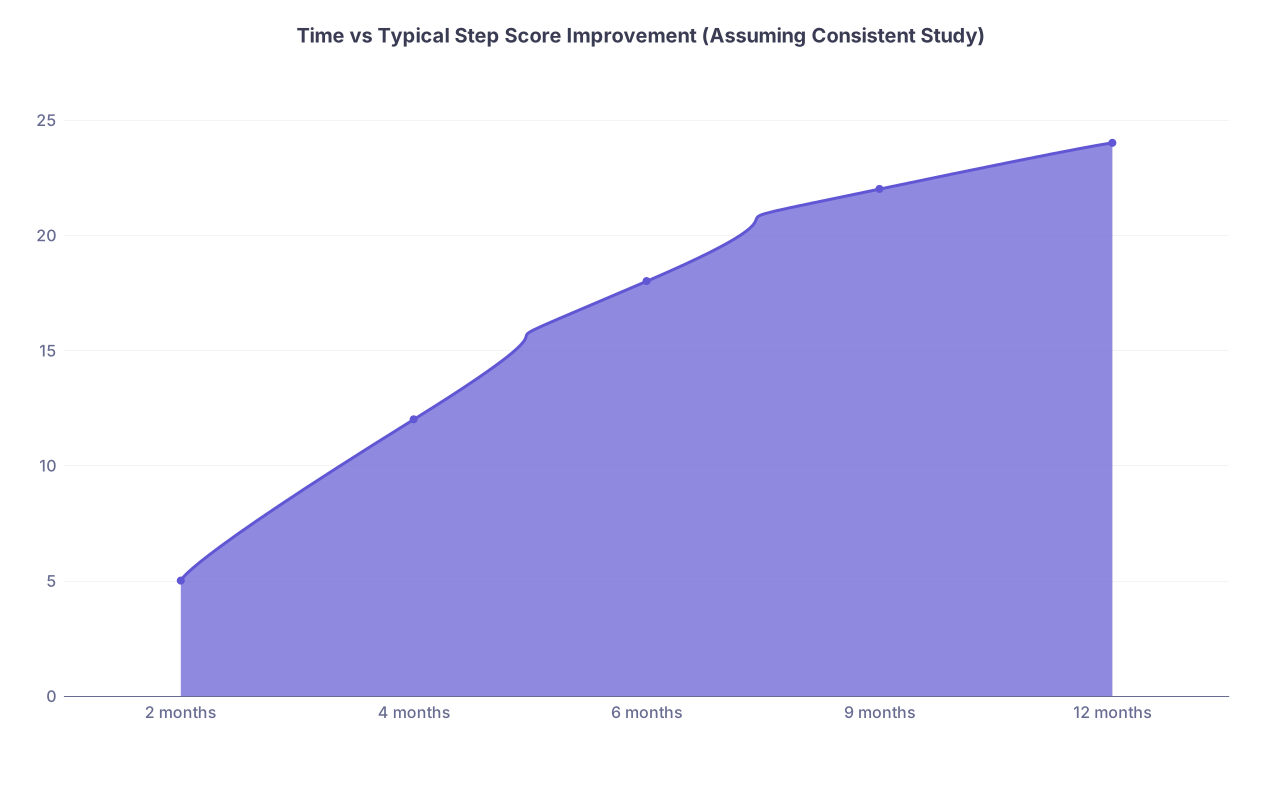
From tracking multiple students across 3–12 month windows, you see something like this:
| Category | Value |
|---|---|
| 2 months | 5 |
| 4 months | 12 |
| 6 months | 18 |
| 9 months | 22 |
| 12 months | 24 |
You get:
- First 2 months: 0–8 points. A lot of this is just shaking off rust and regaining test endurance.
- 4 months: 10–15 points is common with real work.
- 6 months: 15–20 points is the “typical” improvement for a motivated gap‑year student.
- 9–12 months: diminishing returns. You might squeeze out another 3–6 points, but only if your studying stays deliberate instead of drifting.
The big mistake? People saying “I have 12 months” and then studying like they have 11. They waste the first third of the year and then discover that cramming from months 8–12 behaves exactly like any other cram: small gains and big stress.
Specialty Competitiveness vs Score Jump: Where It Matters
Residents use gap years to “fix” their scores, then aim at specialties that are brutally score-sensitive: dermatology, plastics, ortho, ENT, neurosurgery.
You need to anchor your target jump to actual specialty score distributions. Here is a simplified snapshot using Step 2 CK data ranges that program directors commonly discuss, not hard cutoffs:
| Specialty Group | Typical Matched Range | Realistic Gap-Year Target if Baseline 220 |
|---|---|---|
| Dermatology, Plastics, Ortho | 250–265+ | 240–245 (still below average) |
| ENT, Neurosurgery, Rad Onc | 245–260 | 238–245 |
| General Surgery, EM, Anesthesia | 235–250 | 235–245 |
| IM, Peds, OB/GYN | 225–245 | 230–240 |
| FM, Psych, Neuro, Path | 220–240 | 228–238 |
Purely numerically:
- If your baseline is around 220, a gap year that pushes you into the 240s is an extremely strong success.
- But for ultra-competitive specialties, that still leaves you numerically below average. You will need research, letters, and clinical performance to compensate.
The data reality: a gap-year score jump can salvage your shot at competitive fields; it rarely makes you suddenly indistinguishable from people who scored 255+ on their first attempt without a gap.
What Actually Drives Bigger Jumps (and What Does Nothing)
Gap years amplify differences in process. Two people can both say “I studied full time.” One gains 22 points; the other gains 7. When you look under the hood, the drivers are very consistent.
High-impact drivers
These consistently correlate with larger jumps:
Quantified practice volume with tight feedback loops
Logging daily question counts, accuracy, and domains. Adapting weekly. Not just “doing UWorld.”NBME/UWSA checkpoints every 4–6 weeks
People who take 3+ practice exams, analyze them in detail, and adjust strategy almost always gain more than those who only take 1–2 near the end.Structured remediation of weak areas
You do not just “see more cardiology questions.” You build a cardiology notebook, rewatch key videos, re‑test targeted blocks, and confirm improvement.Stable daily schedule
The data is boring: consistent 5–7 quality study hours sustained beats “some days 10 hours, some days 0” every time.Reduced burnout and improved sleep
The students who move from 4–5 hours of broken sleep during clerkships to consistent 7–8 hours during a gap year, yet keep or increase question volume, show quantifiable gains.
Low or negative-impact “strategies”
These correlate with minimal or no improvement:
- New resource surfing: buying every Q‑bank and scrolling YouTube for “best Step resources” instead of finishing anything.
- Pure passive learning: watching hours of videos without active recall, questions, or self-explanation.
- Delaying practice tests because “I want to feel ready first.” People who push NBMEs to the last 4–6 weeks end up discovering problems too late to fix them.
- Overweighting research at 60–80 hr/week and pretending that 50 tired questions at midnight will move the needle.
The data story: if I see a log with < 250 questions/week and only one NBME every 8–10 weeks, I do not expect more than a 10–12 point gain, no matter how smart the person is.
How Program Directors Actually Interpret Your Jump
You are not only chasing a number. You are building a narrative. Program directors do a crude but revealing Bayesian update when they see a big jump.
Here is the simplified mental math:
Small jump (5–10 points)
Interpretation: stable performance. Probably reflects real ability; no strong new evidence.Moderate jump (10–20 points)
Interpretation: improved mastery and/or better preparation; positive signal, especially if earlier score was mediocre.Large jump (20–30 points)
Interpretation: major remediation success or originally underperforming baseline. Looks like grit and upward trajectory.Extreme jump (30+ points)
Interpretation splits:- Some view it as evidence of massive development and resilience.
- Others worry the baseline was an outlier and ask “which number is real?”
For gap-year applicants, I have heard seasoned PDs say variations of the same thing:
“If you go from a 218 to a 242 and you used that year well (research, letters, better performance), I will absolutely re‑rate your academic risk profile.”
But no one says: “You have a great 30‑point jump, I will now ignore your first attempt.” That is not how risk-averse selection works.
Practical Benchmarks: What Should You Aim For?
Let me translate all of this into realistic benchmarks.
Assume you are taking a gap year before applying or re‑applying. You have one major numerical objective: your next Step‑type score.
Repeat the hard constraints:
Starting < 220:
Reasonable target: +15–25 points with 6–9 months of structured study.
Stretch target: approaching or crossing 240.Starting 220–235:
Reasonable target: +12–20 points.
Stretch: low‑250s if you get everything right and the exam is kind.Starting 236–245:
Reasonable target: +8–15 points.
You are now entering diminishing returns. Going from 242 → 252 is a good year, not a failure.Starting > 245:
Reasonable target: 0–10 points.
Trying to “engineer” a 20+ point gain here usually leads to burnout with minimal payoff.
Finally, check your desired specialty against these targets. The correct question is not “How high can I theoretically go?”
The correct question is “What score range moves me from ‘red flag’ to ‘competitive enough that my research, letters, and clinicals can carry the rest?’”

| Step | Description |
|---|---|
| Step 1 | Baseline Score |
| Step 2 | Set Target Range |
| Step 3 | Design Study + Work Schedule |
| Step 4 | Weekly Q-Bank + Review |
| Step 5 | NBME Every 4-6 Weeks |
| Step 6 | Maintain Plan |
| Step 7 | Adjust Strategy & Content Focus |
| Step 8 | Final 6-8 Week Push |
| Step 9 | Exam & Application |
| Step 10 | Improvement on Track? |
Key Takeaways
- Typical Step score improvement with a serious gap year is 12–20 points; 20–30 point jumps occur but are not the norm, and 30+ is rare and usually from a low baseline.
- Score gains are heavily constrained by baseline score, weekly question volume with high‑quality review, and consistent feedback from practice exams, not by “time off” alone.
- For residency programs, a strong jump reframes your risk profile but does not erase your earlier score; design your gap year to produce a believable, data-backed upward trajectory, not a miracle.


