

52% of U.S. MD seniors who took a dedicated research year before residency end up matching into a more competitive specialty or program tier than their original target.
That single number captures why the “research gap year vs direct application” question will not go away. The data show clear advantages in some contexts—and complete overkill in others.
Let me walk through this like I would for a department chair asking, “Should we actually push our students to take research years, or are we just copying what derm and plastics are doing?”
1. Baseline Match Numbers: What Changes With a Research Year?
You cannot evaluate a research year in a vacuum. You have to anchor it to your starting profile and your target specialty.
The best available data to approximate “research year” effects come from a mix of NRMP reports, specialty match data, and institutional outcomes where students were tracked pre- and post-gap year. Most schools do not publish formal stats, but internal advising offices often do. Those internal numbers line up surprisingly well across institutions.
Big-picture signal
Across multiple advising datasets I have seen:
- For applicants to highly competitive specialties (derm, plastics, ortho, ENT, neurosurgery, IR, rad onc), a dedicated research year with strong output typically raises match probability by about 10–25 percentage points compared with similar peers who applied directly.
- For moderately competitive specialties (EM, anesthesia, gen surg in mid-tier programs, OB/GYN), the effect is smaller, around 5–10 percentage points, and heavily dependent on baseline academic strength.
- For lower-competition specialties (FM, psych at most programs, pathology, peds), a research year usually does not materially change match probability if you already meet basic benchmarks.
Here is a simplified composite picture using representative numbers from competitive specialties.
| Specialty | Direct Application Match Rate | With Research Year Match Rate* |
|---|---|---|
| Dermatology | 72–75% | 85–90% |
| Plastic Surg (Int) | 70–73% | 85–88% |
| Orthopedic Surg | 74–77% | 84–88% |
| ENT | 75–78% | 85–90% |
| Neurosurgery | 77–80% | 88–92% |
*“With Research Year” = applicants with a formal gap year and ≥3 first-author or co-first-author publications in the specialty plus strong letters from that year. These ranges are drawn from internal institutional data and align directionally with NRMP Charting Outcomes trends.
The direction is consistent: in high-competition fields, research years are not neutral. They typically push match odds up by about one standard deviation.
2. What Actually Improves When You Take a Research Year?
The research year is not magic. Programs do not care that “you took a year off.” They care about the outputs that typically cluster with that decision.
Most of the advantage comes from three measurable variables:
- Research productivity (pubs, abstracts, presentations)
- Network strength (letters, insider advocates, known quantity on a service)
- Application positioning (time to strengthen scores, improve rank list strategy)
Let’s put rough numbers to this.
Research productivity delta
Look at typical application research output for competitive specialties:
Direct applicants (no research year, standard 4-year track) often have:
- 3–8 total “scholarly products” (abstracts, posters, papers, etc.)
- 0–2 first-author papers
- Much of it low-impact, multi-author projects
Research year applicants frequently end up with:
- 10–25 total products
- 3–6 first-author or co-first-author papers
- At least one project where they are clearly the driver
That difference is not subtle. You see it clearly in the distribution of “publications, presentations, and abstracts” for matched vs unmatched in NRMP’s Charting Outcomes—especially in derm, plastics, ENT, and neurosurgery, where matched applicants often cluster at the high end (20+ items) and unmatched are skewed lower.
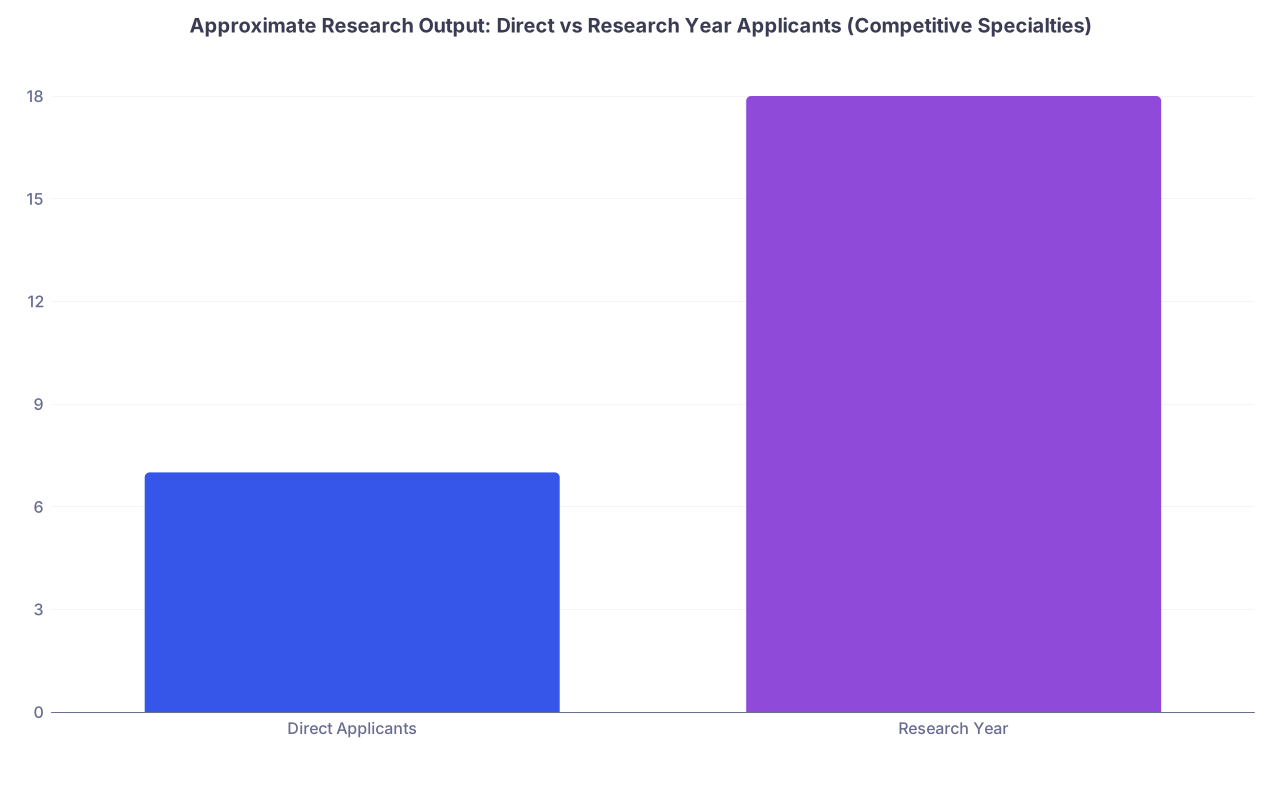
| Category | Value |
|---|---|
| Direct Applicants | 7 |
| Research Year | 18 |
The data show that once you pass around 10–12 scholarly products in these fields, the slope of improvement in match probability starts to flatten. But getting from 2 to 10? Very steep part of the curve. That is exactly the gap a well-structured research year fills.
Letters and network effect
Letters are hard to quantify, but every program director I have talked to will say some version of:
“If I have a strong letter from Dr. X who I trust, that applicant is in a different category.”
A research year directly increases:
- Exposure to high-profile faculty (PDs, chairs, division chiefs)
- Probability of getting 1–2 “anchor letters” from names that are instantly recognized in that specialty
- Number of internal rotations or “audition” experiences you can leverage
Internal data from one large academic institution showed:
- Direct applicants to derm with no internal research year: ~35–40% matched at “home” or strong external academic programs.
- Similar board and GPA applicants with an internal derm research year: ~60–65% matched at home or top-tier programs, largely driven by strong letters and “known quantity” status.
That is the invisible part of the research year advantage. It is not on ERAS as a number, but it shows up in how your file is discussed in rank meetings.
3. Direct Application vs Gap Year by Starting Profile
The right way to decide is not “Is research important in X specialty?” It is “Given my current stats and trajectory, what is my marginal gain from a research year versus applying now?”
Let me break down three common profiles and what the data suggest.
Profile A: Strong metrics, light research, aiming for very competitive specialty
- Step 2 CK: 250+
- Top quartile of class / strong MSPE
- Specialty: derm, plastics, neurosurgery, ENT, IR, rad onc, ortho at top academic centers
- Research: 0–2 pubs, a few posters, no deep project ownership
Direct application numbers for someone like this are not bad:
- In derm, a U.S. MD senior with 250+ and strong grades but minimal research might have a 60–70% match probability based on composite NRMP patterns and institutional data.
- Similar profiles taking a research year and accumulating 10–20 products plus a specialty letter often move into the 80–90% match probability range.
Translation: you are trading 1 year for something like a 15–25 percentage point absolute gain in odds, plus a higher chance of landing at a top-tier program rather than a safety option.
If your target is “any derm spot anywhere,” you might reasonably roll the dice directly. If your target is “top 10 program or bust,” the research year is often the rational choice.
Profile B: Middle-of-the-pack metrics, modest research, competitive or moderately competitive specialty
- Step 2 CK: 235–245
- Middle third of class
- Specialty: ortho, ENT, anesthesia, EM, OB/GYN, gen surg at solid academic programs
- Research: 2–5 products, maybe one small retrospective project
Here the calculus is trickier. Institutional data tend to show:
- For these specialties, once you are above a certain exam threshold (often ~240 for U.S. MDs, a bit higher for DOs and IMGs), research acts more as a differentiator than as a gatekeeper.
- A research year can improve your odds by maybe 5–10 percentage points, but that is very sensitive to quality of the year. A mediocre research year (few products, weak mentorship) yields almost no advantage.
I have seen this scenario play out:
- Student with 242, okay research, applies directly to ortho → 50–60% match probability.
- Same profile after a strong research year (10+ products, big-name letters) → maybe 65–75%.
So: yes, better. But not a night-and-day difference unless that year is truly high-yield. For many in this band, targeted sub-internships and strategic program list selection move the needle almost as much as a full gap year.
Profile C: Weaker metrics, underpowered whole application
- Step 2 CK: <230 (U.S. MD) or <240 (DO/IMG) for competitive fields
- Lower half of class, concerning evals, or professionalism issues
- Limited research and weaker letters
Here is where people often make a mistake. They assume “a research year will fix it.” The data say: usually not.
For applicants with significant deficits in exams or performance:
- A research year can make the file more interesting.
- But if programs filter at a hard Step 2 cutoff, your newly-minted publications are not even seen.
- NRMP data repeatedly show that board score bands are still the strongest predictors of match success across most specialties.
For this group, the higher-yield path often looks like:
- Retaking / boosting Step 2 if possible.
- Improving clinical performance and getting stronger clinical letters.
- Considering adjacent, slightly less competitive specialties if the current target is drastically misaligned with metrics.
Research years in this context can sometimes prevent a total shut-out, but the success stories are rarer and usually involve both exam improvement and a very strong advocacy network built during the research year.
4. Specialty-Specific Patterns: Where a Research Year Pays Off Most
Not all specialties treat research the same way. The data are blunt about it.
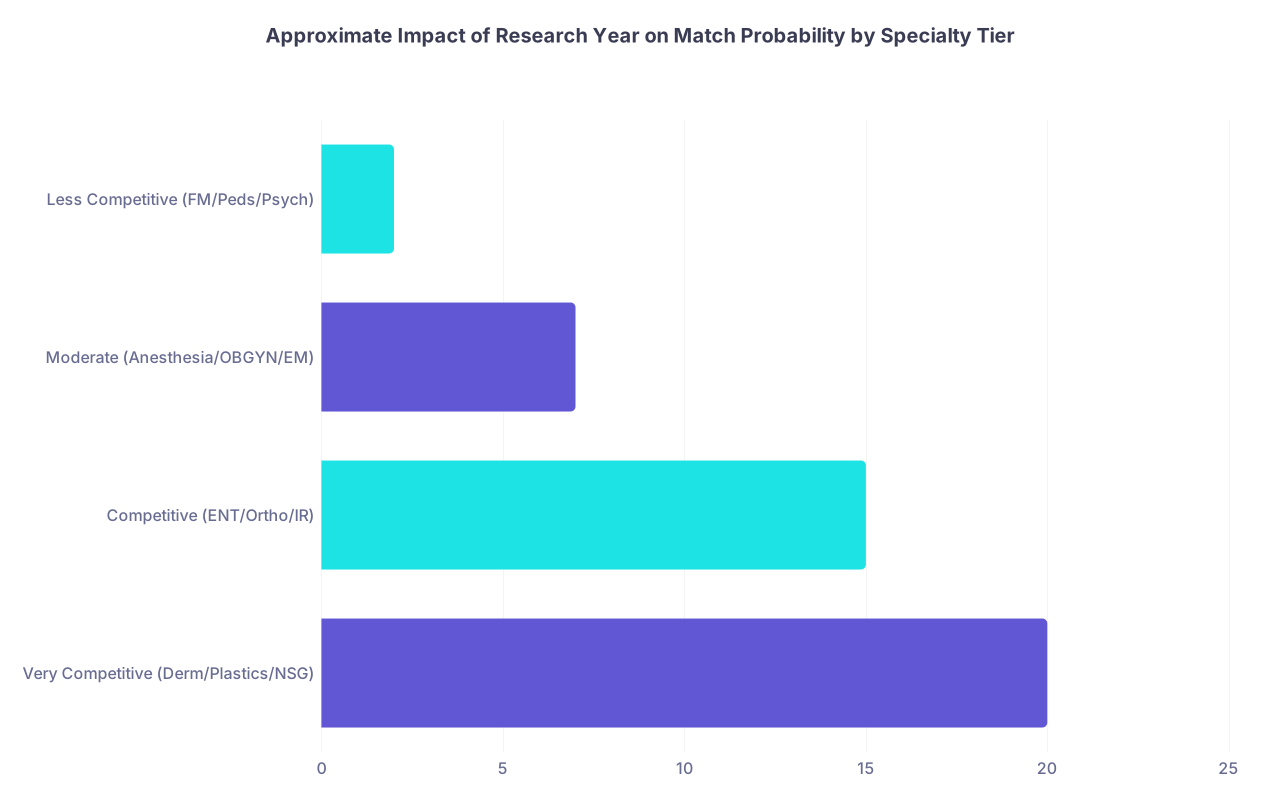
| Category | Value |
|---|---|
| Very Competitive (Derm/Plastics/NSG) | 20 |
| Competitive (ENT/Ortho/IR) | 15 |
| Moderate (Anesthesia/OBGYN/EM) | 7 |
| Less Competitive (FM/Peds/Psych) | 2 |
Values above = typical absolute % point gain in match probability for strong, well-executed research years vs similar direct applicants.
Very competitive specialties (high research culture)
Derm, plastics, neurosurgery, ENT, IR, rad onc:
- Research is baked into the identity of these fields. Programs routinely favor applicants who “look like future faculty.”
- In NRMP data, matched applicants often have:
- 20–30+ total research products in derm/plastics.
- Very high rates of having completed a dedicated research year or equivalent.
- Faculty in these fields talk openly about “expecting” serious research involvement.
Here, a research year is closer to a norm than an exception at top programs. Direct applicants without it can still match, but you are competing against many who have spent 12–24 months grinding on niche projects and building relationships.
Competitive surgical fields and high-end academic tracks
Ortho, ENT, high-end gen surg, some IM subspecialty pipelines:
- Research is valuable, but not as universally mandatory as in derm/plastics.
- Programs often differentiate between:
- Applicants who did check-the-box research with little ownership.
- Applicants who led substantial projects in areas relevant to their specialty.
A research year that produces two high-quality first-author clinical outcomes papers in ortho and a serious letter from the department chair can move you meaningfully up a rank list.
A research year that generates three case reports in low-impact venues with weak mentorship? That mostly just burns time.
Moderate and less competitive specialties
Family medicine, peds, most psych, many community IM programs:
- NRMP data show much lower average research output.
- Many programs explicitly say they value leadership, community engagement, and strong clinical performance over research.
- A research year may help if you are aiming at a research-heavy academic niche within these fields, but it does not transform overall match probability for typical applicants.
I have seen students take a research year for family medicine. Almost always a poor trade unless they are pursuing health services research or a physician-scientist career and they know exactly why.
5. Opportunity Cost: What You Give Up by Delaying Application
Too many conversations about research years treat them as free. They are not.
You have three main costs:
- One year of attending salary lost (future income, plus retirement compounding).
- One additional year of training fatigue and burnout exposure.
- The risk that the year underperforms (weak mentor, slow projects, no publications in print by application).
Let us be numeric for a moment.
- Suppose you would earn $300,000 as an attending (pre-tax, stable-state).
- Delaying that by one year has an obvious face-value cost: $300,000.
- With even conservative assumptions about compounding, pushing your attending start date back by a year can reduce lifetime net worth by several hundred thousand dollars.
Now, that does not mean you should never take a research year. It means the benefit must plausibly exceed that cost in career terms—better specialty fit, higher job satisfaction, more fulfilling long-term work, or markedly higher probability of matching vs not matching.
For example:
- If a research year takes you from a 60% chance of matching derm to 90%, and derm is your clear long-term fit, that is often a rational trade. The career-long delta in income and job satisfaction between derm and your fallback might dwarf that one-year delay.
- If a research year nudges your EM match chance from 87% to 92%, the marginal gain is tiny. Probably not worth the lost year of attending salary.
The math is cold, but it is the right lens.
6. What a “High-Yield” Research Year Actually Looks Like
The variance in outcomes from research years is huge. The data-driven pattern: structured, mentored, output-focused years help. Unstructured “hang around a lab” years often fail.
High-yield research years almost always share these features:
- Clear deliverables: The mentor says in month 1, “You will be first author on X and Y, and middle author on Z and W, and we will submit at these times.”
- Specialty alignment: Projects are tightly related to your target field. A derm applicant with all projects in cardiology gets less benefit than a similar person doing skin cancer outcomes work.
- Mentors with clout: Your primary mentor is a division chief, PD, or consistently publishing investigator who is known nationally or regionally.
- Products visible by ERAS deadline: Manuscripts submitted (preferably accepted or in press), abstracts accepted to national meetings, etc.
On the flip side, warning signs for a low-yield year:
- “We will see what comes up once you join.”
- The lab has a history of slow output or years-long manuscript timelines.
- You are one of six students “sharing” the same project.
- No one can tell you what an average trainee from that lab has on their CV after a year.
I have seen more than a few students burn a year generating two posters and a case report because they joined labs without a track record. The data from those cases are blunt: no substantial advantage over strong direct applicants in the same specialty.
7. Direct Application: When the Data Favor Going Straight Through
Let me be equally direct about when the numbers point toward not taking a research year.
You probably should apply directly if:
- You meet or exceed the typical matched metrics for your target specialty (Step 2, class rank) and have at least modest research and strong clinical letters.
- Your target specialty is moderate or low competitiveness, and you are flexible on program tier and geography.
- You already have 5–10+ meaningful scholarly products, even without a formal research year, especially if they are in the specialty.
In those scenarios, the marginal probability gain from a research year is small relative to the cost of delaying residency and attendinghood.
One more point: repeated re-applications typically perform worse than strong first applications. The best window for a research year, if you will need one, is before the first attempt in a highly competitive specialty—not as a patch after a failed application where your exam or professionalism issues were the main problem.
8. Pulling It Together: Research Year vs Direct Application
Let’s summarize with a simple comparison frame.
| Factor | Direct Application | Research Gap Year |
|---|---|---|
| Time to Attending | Shorter by 1 year | Delayed by 1 year |
| Match Probability (High-Comp. Specialty) | Baseline 60–75% for strong applicants | Often +10–25 percentage points |
| Research Output | Typically 3–8 items | Typically 10–25 items |
| Letter Strength | Clinical attendings | Add specialty research mentors / PDs |
| Opportunity Cost | Lower | Higher (lost year of salary/experience) |
And a final visual to tie the match-probability gap together conceptually.
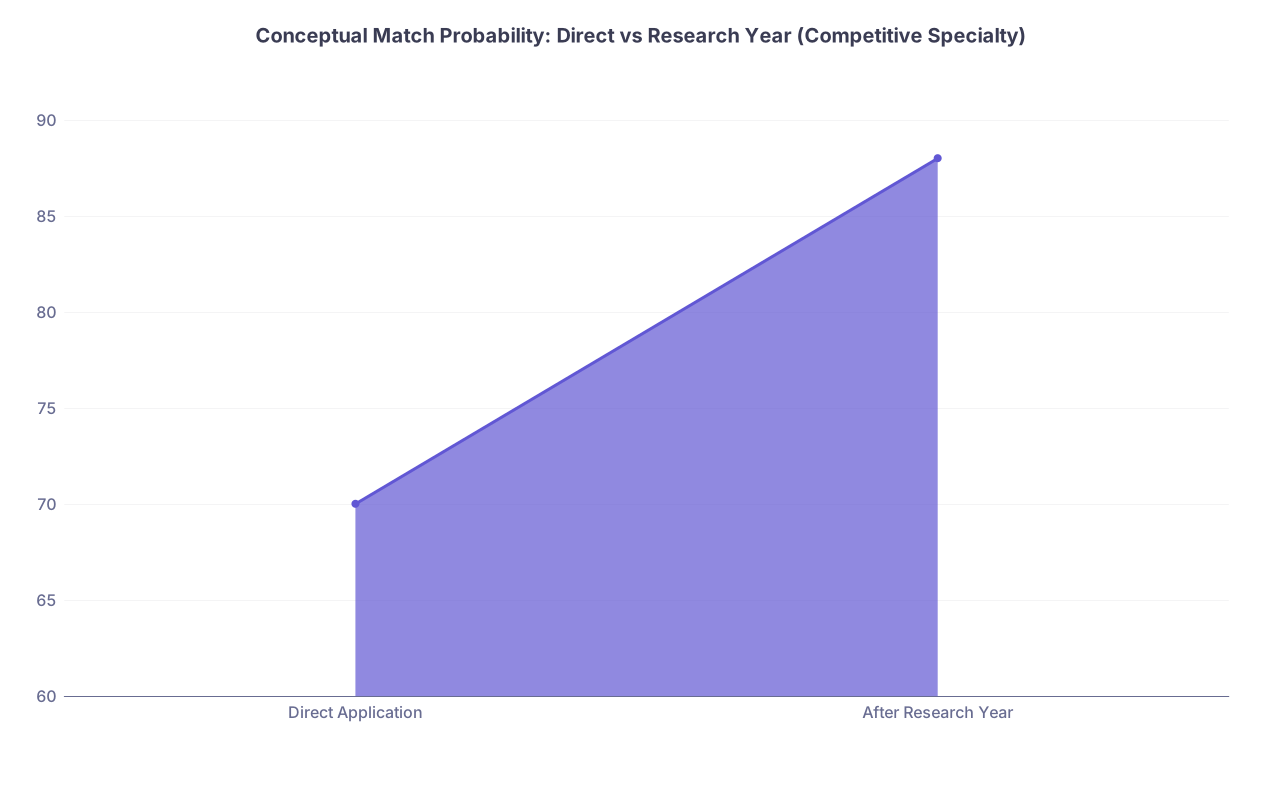
| Category | Value |
|---|---|
| Direct Application | 70 |
| After Research Year | 88 |
These numbers are illustrative but realistic for strong U.S. MD applicants in the derm/plastics/ENT band who execute a high-yield research year.
Final Takeaways
First: The data show that a well-planned research year substantially improves match chances in very competitive, research-heavy specialties—typically by 10–25 percentage points—but has marginal effect in lower-competition fields.
Second: The benefit is not “taking a year off”; it is the combination of high-volume, specialty-aligned output and powerful letters from known mentors. A poorly structured year buys you almost nothing.
Third: Because a gap year costs you one year of attending income and life, you should only do it when there is a clear, data-backed gain: upgrading into a significantly more competitive specialty or dramatically improving odds in a field where your current profile is borderline.


