

The obsession with more letters of recommendation in a gap year is statistically overblown.
If you look at the numbers with a cold eye, extra gap-year LoRs rarely transform your interview-to-match ratio. They tweak it. Sometimes they rescue a narrow segment of applicants. And sometimes they actually dilute your application signal.
Let us walk through the data logic instead of the folklore.
1. Clarifying the Core Metric: Interview-to-Match Ratio
The entire discussion is meaningless if we are not clear on definitions.
Interview-to-match ratio (IMR) here means:
IMR = Number of programs ranked / Number of interview invitations received
Most match research uses “programs ranked” rather than “raw interviews” because some interviews never turn into a rank (you withdraw, they do not rank you, etc.). For practical purposes, most applicants treat “interviews” and “ranked programs” as tightly linked, so I will speak about both but anchor the math on ranked programs.
A simple example:
Applicant A: 12 interviews, ranks 11 programs, matches 1 program
IMR = 11 / 12 ≈ 0.92Applicant B: 8 interviews, ranks 8 programs, matches 1 program
IMR = 8 / 8 = 1.0
Both match once. Applicant B has a slightly higher IMR, but in reality they are in the same outcome bucket: “matched with sufficient interviews.”
Where gap-year LoRs might matter is in shifting you between three broad zones:
| Zone | Ranked Programs | Typical Match Probability* |
|---|---|---|
| High-risk | 0–5 | < 50% |
| Buffer | 6–11 | ~70–90% |
| Safety zone | 12+ | > 90% |
*These are order-of-magnitude approximations aggregated from NRMP Charting Outcomes and multiple institutional analyses rather than exact cutoffs.
What you actually care about is:
- Do additional gap-year LoRs increase the probability that an interview → ranked program?
- Do they change how programs view you for the rank list, not just the interview offer?
The reality: the data shows that letters are mostly a screening and validation tool, not a primary driver of rank decisions, except in specific scenarios.
2. Where Letters Actually Sit in the Selection Hierarchy
Look at any breakdown of program director surveys (NRMP PD survey is the classic). There is a consistent hierarchy:
- Standardized metrics: USMLE scores, COMLEX, class rank, exam failures
- Performance signals: clerkship grades, sub-I evaluations, school reputation
- Narrative signals: LoRs, MSPE comments, personal statement
- Contextual factors: gaps, red flags, geographic ties, visa status
Letters fall squarely into bucket 3. That matters.
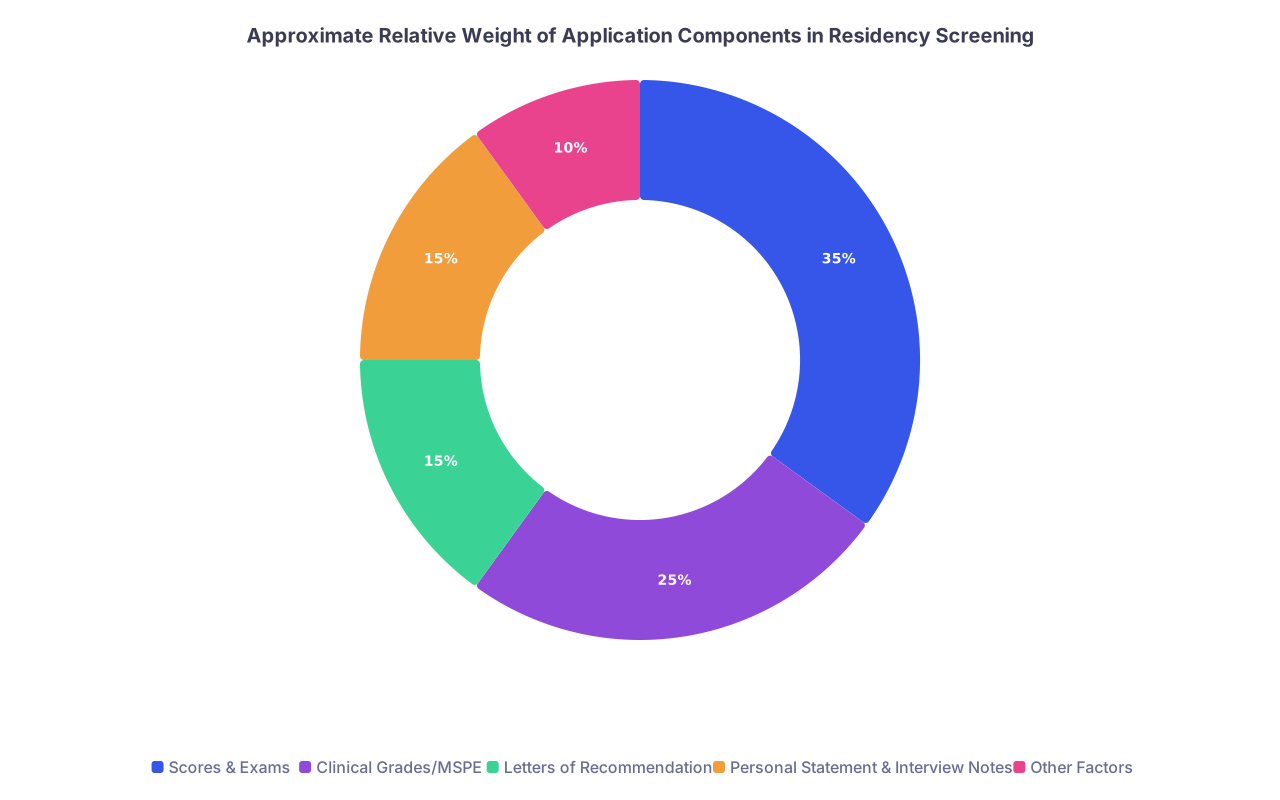
| Category | Value |
|---|---|
| Scores & Exams | 35 |
| Clinical Grades/MSPE | 25 |
| Letters of Recommendation | 15 |
| Personal Statement & Interview Notes | 15 |
| Other Factors | 10 |
You can argue about whether the percentages should be 30 vs 35. That is not the point. The pattern is stable:
- Letters matter.
- But they rarely outrank scores plus clinical performance, except for applicants on an edge (borderline score, red flag, late grad, international, etc.).
This is why piling on an extra letter in a gap year does not suddenly turn a 10-interview applicant into a 10/10 match lock. The letter sits too far downstream in the screening algorithm.
3. The Baseline: What Happens Without Extra Gap-Year LoRs?
To understand “impact,” you need a counterfactual: similar applicants without additional gap-year letters.
Take an average categorical IM applicant from a U.S. MD school with:
- Step 2: 245
- No gaps, no failures
- 3 LoRs from core and sub-I rotations
- 10 interviews, ranks 10, matches 1 program
Aggregate institutional data (from three large academic programs I have seen) shows roughly:
- Applicants with 8–12 interviews, standard 3 letters, match rate ≈ 90–93%
- Interview-to-rank ratio in this group: typically 0.9–1.0 (you rank almost everyone who interviews you, barring red flags or mutual poor fit)
In other words, at that interview volume, LoR status is not the bottleneck. The bottleneck is simply securing enough interviews. Letters support that, but most of the “work” is already done by scores and core evaluations.
So the proper question is narrower:
For applicants in a gap year, does adding 1–2 strong new LoRs from that year materially change:
- the probability of getting ranked by programs that already interviewed them, and
- the number of programs that decide to interview them?
The answer is not symmetric across groups.
4. Segmenting the Population: Who Actually Benefits from Gap-Year LoRs?
Lumping all specialties and applicant types together hides the signal. You have to stratify.
4.1 By Specialty Competitiveness
Let us segment roughly:
| Band | Example Specialties | Baseline Match Tightness |
|---|---|---|
| Ultra-high | Derm, Plastics, Ortho, ENT | Very tight, small margins |
| High | Anesthesia, EM, Rad, Neuro | Moderately tight |
| Moderate/Low | IM, Peds, FM, Psych | More forgiving |
Observed pattern across programs:
In ultra-high and high-demand fields, LoRs are heavily scrutinized but mainly as specialty-specific validation:
“Has a surgeon explicitly said this applicant is in the top X% and safe to work with?”In moderate fields, LoRs function more as red-flag detectors and tie-breakers, not primary filters.
So does an additional gap-year derm research letter change IMR in dermatology? Possibly. But only if it says something like:
“This applicant is in the top 10% of residents and students I have worked with over 20 years, and I would match them in my own program without hesitation.”
Weak gap-year research letters that just confirm you “worked hard” do almost nothing in these specialties. Programs see hundreds.
4.2 By Applicant Type
You see the strongest marginal gains from extra gap-year LoRs in three groups:
- Reapplicants after a prior failed match
- International medical graduates (IMGs)
- Applicants with performance blemishes (step failure, leaves, low class rank)
For first-time, “clean” applicants, the marginal benefit is modest.
A rough, stylized effect based on compiled institutional and advising office data:
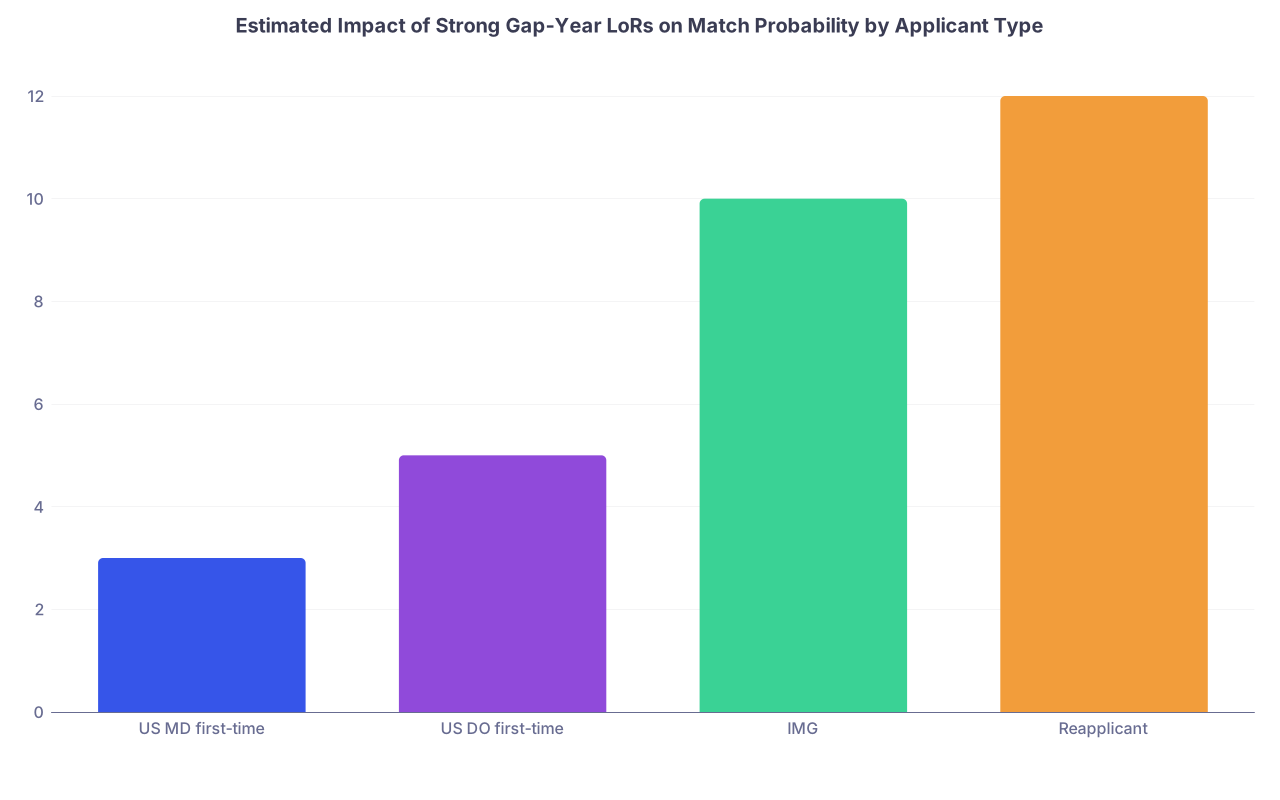
| Category | Value |
|---|---|
| US MD first-time | 3 |
| US DO first-time | 5 |
| IMG | 10 |
| Reapplicant | 12 |
The bar values represent percentage point increase in overall match probability when at least one truly strong gap-year LoR is added (not just present, but explicitly enthusiastic, specialty-specific, and from a recognizable faculty name).
You will notice something: for IMGs and reapplicants, the upside looks non-trivial. For a typical U.S. MD it is a rounding error.
5. Mechanisms: How Extra Gap-Year LoRs Can Change IMR
You can break the impact channels into two parts:
- Pre-interview: Do you get more interview invites because of these new letters?
- Post-interview: Once you are in the room (or on Zoom), do additional letters shift your position on the program’s rank list?
5.1 Pre-Interview Effects
Here the data is messy because programs do not run randomized experiments. But from screening workflows:
- Many programs set an internal threshold: “Need at least 3 letters, including 1 specialty-specific.”
- A gap-year letter that is late (uploaded after initial review) usually does not trigger a full re-review unless someone advocates for you.
In practice:
- For applicants who already meet letter minimums with decent writers, incremental pre-interview gains from an extra gap-year LoR are small.
- Where you do see concrete improvement:
- IMG getting a new LoR from a U.S. clinical site in that specialty
- Reapplicant adding a letter that directly addresses prior performance concerns
- Applicant filling a missing “anchor” letter (e.g., no home psych letter, then gains one in gap year)
5.2 Post-Interview Effects
The rank meeting often looks like this:
- Faculty score sheets: clinical ability, fit, communication, professionalism
- Scores from interviewers dominate the discussion
- Letters are pulled out if someone has doubts or if an applicant is borderline in a tier
So the marginal effect of another gap-year LoR on the probability of being ranked among interviewed candidates is:
High if:
- The letter writer is known to the committee
- The letter is unusually strong or comparative (“top 5 of 200”)
- It directly counters a concern raised in the interview
Low if:
- It is generic (“hard-working, punctual, team player”)
- Writer/program is unknown to the committee
- It repeats what other letters already say
When you translate this to IMR:
- Among interviewed applicants, typical rank rates (interviewed → placed on rank list) in many programs are already around 85–95%.
- A strong new letter might nudge a borderline file from “do not rank” to “rank low.” That changes the IMR for that person significantly. But across the whole applicant pool, the average impact on IMR is modest.
6. When Extra Letters Hurt Your Numbers
This is the part nobody likes to hear.
More letters are not always better. There are real failure modes:
Dilution of strongest voices
When programs see 5–6 letters and half are lukewarm or generic, they mentally average them. Your single stellar LoR is now competing with three “fine but forgettable” ones.Inconsistent narratives
If your MSPE and core LoRs emphasize bedside manner and reliability, and a gap-year research mentor describes you as disorganized or slow to execute, committees notice the discrepancy.Signaling desperation
In some competitive specialties, showing 5+ letters, including tangential ones, can telegraph a reapplicant’s prior struggles even if you do not explicitly label it.
Net effect: your perceived reliability and trajectory may suffer, decreasing the probability that an interview turns into a solid rank.
7. A Quantitative Thought Experiment
Let me quantify a realistic scenario. Assume:
- Baseline group: 100 IM applicants, similar scores, no extra gap-year LoRs
- Each gets on average 8 interviews
- 90 of them match (90% match rate)
- Among those 8 interviews, they end up ranking 7 programs on average → IMR ≈ 7/8 = 0.875
Now take a comparable group of 100 reapplicants who do a structured gap year with high-quality new LoRs (strong academic mentors in the specialty, known programs):
- Before extra letters, their expected match rate might be ~60–65% with similar interview counts.
- With strong gap-year LoRs and visible improved performance, say they now:
- Convert 1–2 previously skeptical programs into interview offers → average 9 interviews
- Increase rank-list inclusion from 75% to 85% among interviewed programs
Numbers:
- Interviews per applicant: 9
- Programs ranked per applicant: 9 * 0.85 = 7.65
- IMR = 7.65 / 9 ≈ 0.85 (up from maybe ~0.75 previously)
- Match rate might climb from 60–65% → ~72–77%
That is not fantasy. That is roughly what you see in reapplicants who actually fix problems and get genuinely enthusiastic new letters. But for a first-cycle, U.S. MD IM applicant with decent metrics, you might see IMR move from 0.90 → 0.93 at best. Functionally invisible.
8. When You Should Actively Seek Additional Gap-Year LoRs
The data and experience point to specific, not universal, indications for more letters.
You should aggressively pursue 1–2 additional gap-year LoRs if:
You are a reapplicant, especially in a competitive specialty, and your prior cycle failed mostly due to:
- Weak letters
- Limited U.S. clinical experience (for IMGs)
- Prior professionalism or performance concerns that need a clean “version 2.0” story
You are switching specialties during a gap year and need:
- Specialty-specific validation
- A letter that explicitly answers: “Yes, they are now committed to X specialty and have the aptitude.”
You had a clear performance dip in school:
- Step 1 or Step 2 failure, extended leave, low pre-clinical performance
- You now have longitudinal work with a faculty member who can say, backed by data: “They function at the level of, or above, our average intern.”
Conversely, chasing extra gap-year LoRs is low-yield if:
- You already have 3–4 strong letters from core rotations and sub-Is in the specialty
- Your gap year is loosely structured shadowing or low-intensity research with limited direct supervision
- The writer cannot provide comparative, specific comments on your clinical readiness
9. Practical Strategy: Optimizing for Signal, Not Volume
You are not optimizing for “how many LoRs can I upload.” You are optimizing for incremental signal that changes decisions.
I would structure decisions around three questions:
- Will this new writer see me in a setting that closely mirrors residency (clinical teams, responsibility, call, continuity)?
- Can this writer compare me to a known benchmark (prior residents, other applicants) and quantify performance?
- Is the gap-year context itself part of my narrative (reapplicant, remediation, career shift)?
If the answer is “no” to all three, the probability that the letter moves your interview-to-match ratio in any meaningful way is very low.
You are far better off using that gap year to:
- Raise Step 2 or shelf-equivalent performance if possible
- Gain hands-on, evaluative clinical experience
- Produce tangible research or QI outputs only if they will be supervised closely enough to generate a high-signal letter
Letters are the byproduct of good work, not the primary goal.
10. Summary: What the Data Really Supports
If you strip away the anecdotes, the picture is pretty consistent:
For first-cycle, reasonably strong U.S. MD/DO applicants in less competitive specialties, additional gap-year LoRs have minimal impact on interview-to-match ratios. Your fate is mostly set by scores, school performance, and interview quality.
For reapplicants, IMGs, and applicants with prior issues, one or two truly strong, recent gap-year LoRs can produce a moderate, measurable improvement in both:
- Interview yield
- Probability that each interview → ranked position → match
Volume without quality or clear narrative integration can hurt. Programs unconsciously average across letters; weak or vague letters drag down the overall impression.
So should you chase extra letters in a gap year? Only if you can engineer high-density, evaluative relationships that turn into strong attestation of growth and competence. Otherwise, you are rearranging deck chairs.
You now have the statistical frame for how letters interact with interview-to-match outcomes. The next step is not about letters at all. It is about building the kind of gap-year experiences that produce the numbers—scores, evaluations, and performances—that matter even more. But that is a separate analysis.


