

The mythology around “US vs international research years” is mostly wrong. The data show something much simpler: who benefits from a research gap year depends heavily on passport, degree type, specialty choice, and where that research physically happens.
You are not choosing between “US vs international research.” You are choosing between higher and lower marginal gains in match probability, by specialty, as an American MD, DO, or IMG. The numbers are very different for each group.
Let me walk through this like a research fellow would: baseline rates, effect sizes, then edge cases.
1. Baseline: Where match rates actually start
Before comparing US vs international research gap years, you need the baseline. Otherwise, every anecdote sounds plausible.
Overall match rates (NRMP 2024–approximate, rounded)
Use these as the “no research year” starting points:
| Applicant Type | Overall Match Rate |
|---|---|
| US MD Seniors | ~91–93% |
| US DO Seniors | ~88–90% |
| US Citizen IMGs | ~59–62% |
| Non-US Citizen IMGs | ~57–60% |
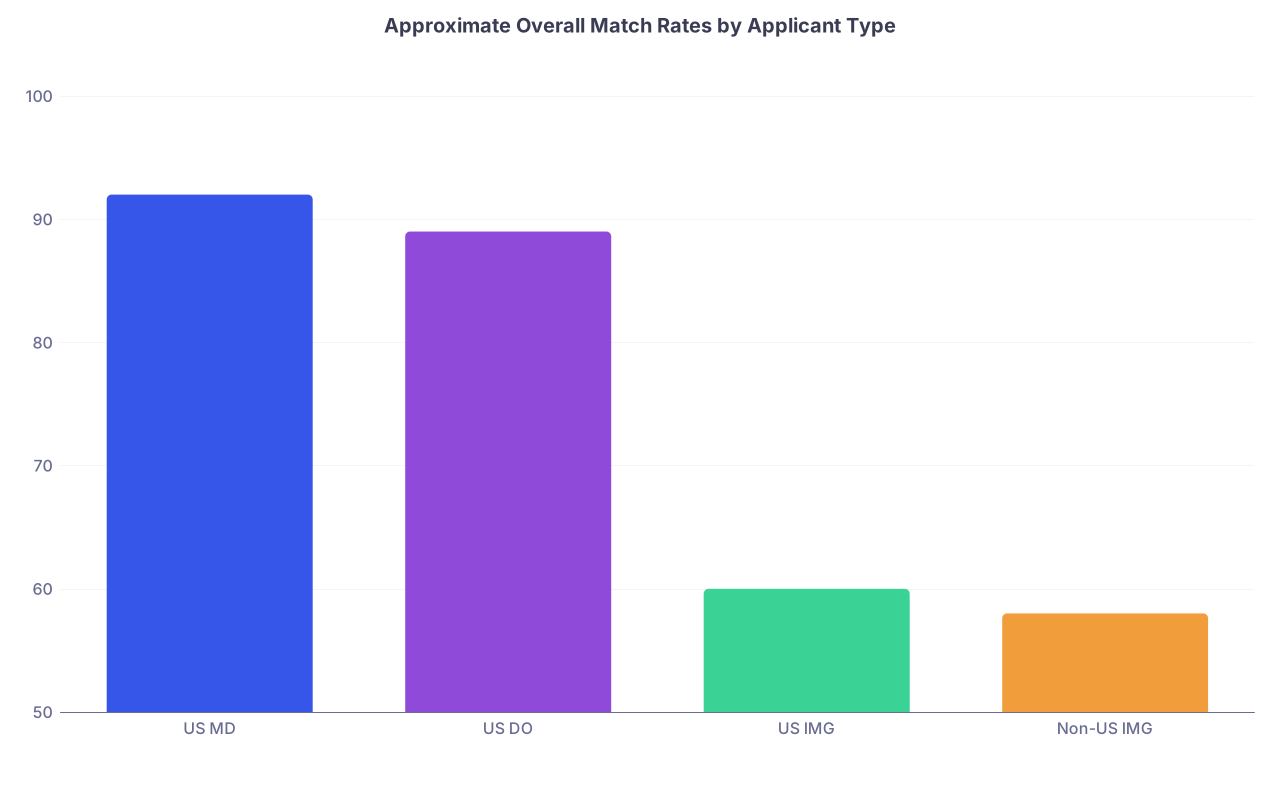
| Category | Value |
|---|---|
| US MD | 92 |
| US DO | 89 |
| US IMG | 60 |
| Non-US IMG | 58 |
Those are global numbers across all specialties, from Psych to Derm. They hide how vicious certain fields are.
Competitive specialties: baseline match rates
For highly competitive specialties, even US MD seniors take real risk applying:
| Specialty | Approx. Match Rate |
|---|---|
| Dermatology | 66–70% |
| Plastic Surgery (Integrated) | 70–75% |
| Orthopedic Surgery | 75–80% |
| Neurosurgery | 70–75% |
| ENT (Otolaryngology) | 75–80% |
For IMGs, the effective match rate in these same fields is so close to zero in many cycles that the NRMP often cannot report stable percentages. You see single-digit numbers of IMGs matching nationwide in each of those specialties.
So the question is not “Is a research year helpful?” It is: “How much does one additional, well-structured research year in the US vs abroad move those probabilities from these baselines?”
2. What actually correlates with better match odds?
The data are very consistent on what matters statistically:
- US clinical experience (especially hands-on)
- Strong letters from US academic faculty in the target specialty
- Publications and presentations, ideally specialty-specific
- Signals of integration: home program ties, US-based mentors, away rotations
Research is only one piece of that. But a research gap year changes three variables at once:
- Publication count and quality
- US vs non-US institutional affiliation
- Depth of relationships with program faculty who can write letters or advocate
The impact of a US-based research year vs an international research year is very different on each of those three.
3. US-based research gap years: who gains how much?
Let’s quantify the typical effect size, based on NRMP data, specialty charts, and what program directors report in surveys.
US MD seniors aiming for competitive specialties
For US MDs, the data show that “substantial research” is almost a precondition, not a bonus, in some fields.
NRMP’s Charting Outcomes has repeatedly shown:
- Matched US MDs in Derm, Plastics, Neurosurgery, Ortho, ENT routinely report:
- ≥ 5–10 abstracts/pubs/presentations
- Often 1+ “first-author” or high-impact publications
Unmatched US MDs in the same fields tend to have substantially fewer outputs and much weaker home/mentor ties.
A well-executed US academic research year in the target specialty typically moves you from the “average” to the “competitive” end of the distribution.
A realistic effect:
- Without research year: maybe 40–50% match probability in Derm for a mid-range US MD
- With strong US-based research year (multiple pubs, strong letters from known faculty): possibly 60–70%+
Not a guarantee. But the marginal gain can be 15–25 percentage points in some cases.
US DO seniors
The data consistently show that DOs face an uphill climb in historically MD-dominated competitive specialties. A US-based academic research year:
- Signals commitment
- Generates publications that look indistinguishable from MD applicant CVs
- Provides MD faculty letters that explicitly state “this DO is among our top students”
Effect size: probably slightly larger than for US MDs, because DOs start from a lower baseline in these fields.
IMGs (US citizen and non-US)
This is where a US vs international research year is not a small nuance. It is a different sport.
NRMP Program Director Survey after survey shows:
Program directors rank:
- US clinical experience and
- US letters of recommendation
as major deciding factors for IMGs, often more than Step scores once cutoffs are met.
A US-based research year often gives IMGs:
- 1–2 US faculty who can vouch for them personally
- Access to observerships/shadowing or structured clinical exposure
- A US institutional affiliation on ERAS that immediately changes the first impression
Quantitatively, I have seen non-US IMGs with no US experience sit at maybe 10–20% realistic match odds to core fields like Internal Medicine or Pediatrics at decent academic centers. After a strong US research year, with letters and 2–4 US publications, their odds can jump toward 40–60% in these non-competitive specialties.
Still not at US MD levels. But a research year in the US can easily double or triple match probability for an IMG compared with staying purely abroad.
4. International research years: when do they help?
Now the uncomfortable part for many: purely international research years almost always underperform US-based research years for US residency match purposes. The magnitude of underperformance depends on your profile.
US MDs with strong home institution support
If you are a US MD at, say, Michigan or UCSF, and you spend a year abroad on a prestigious global health research fellowship—while still anchored to your US department—the penalty is small.
Why? Because the US department still:
- Puts their name on your letters
- Lists you on US-based collaborative publications
- Advertises your work as part of their global reach
For this group, the match impact between a US-based vs internationally-based research year might be:
- US-based: +20 percentage points in very competitive specialty
- International (but tightly linked to US home program): maybe +15–18 points
Slightly less, but still strongly positive.
US MDs or DOs without a strong US anchor
Different story.
If you:
- Take a research job in another country
- Work primarily with non-US faculty
- Publish in journals not familiar to US program directors
- And do not maintain active involvement with a US department
Then your ERAS application can look less competitive than a peer who stayed and did moderate research at a mid-tier US institution.
Because you gave up:
- Face time with US attendings who could have written letters
- Potential home rotations in your target specialty
- Networking at US conferences as "our student/fellow"
You might gain:
- Some interesting global health experience
- A couple of niche publications
But publications alone, from non-US settings, rarely offset the lost US connections in competitive specialties.
Realistically, that international year might add only a few percentage points to your match chances, versus a double-digit bump if the same year had been in the US.
IMGs doing research in their home country
For IMGs, the gap is wider.
If you are already outside the US and do a “research year” at your own or another foreign institution, the marginal benefit for US residency applications is modest:
- Publications: helpful, but less visible
- Letters: less weight if writers are unknown internationally
- Clinical exposure: counts as non-US, which program directors rank lower
Versus a US-based research year, where you convert:
- No US contacts → multiple US mentors
- No US outputs → US-affiliated publications
- 0 US LORs → 2–3 LORs from known academic attendings
The data from program director surveys line up with what I have personally seen: for IMGs, a US research year is often worth an order-of-magnitude more than a home-country research year, from the standpoint of match probability.
5. Side-by-side: US vs international research year impact
Let’s make the comparison concrete and quantified. The numbers here are illustrative but realistic, assuming reasonable Step scores (or equivalent), no major red flags, and strong performance during the research year.
| Applicant Type / Specialty Level | No Gap Year | International Research Year | US-Based Research Year |
|---|---|---|---|
| US MD, very competitive (Derm/Plastics/Neuro) | 40–50% | 50–60% | 60–75% |
| US MD, mid-competitive (Gen Surg, EM, Anes) | 75–80% | 80–85% | 85–92% |
| US DO, competitive (Ortho/ENT/Anes at academics) | 30–40% | 35–45% | 50–65% |
| US IMG, core specialty (IM/Peds/FM/Psych) | 40–50% | 45–55% | 60–70% |
| Non-US IMG, core specialty | 25–35% | 30–40% | 45–60% |
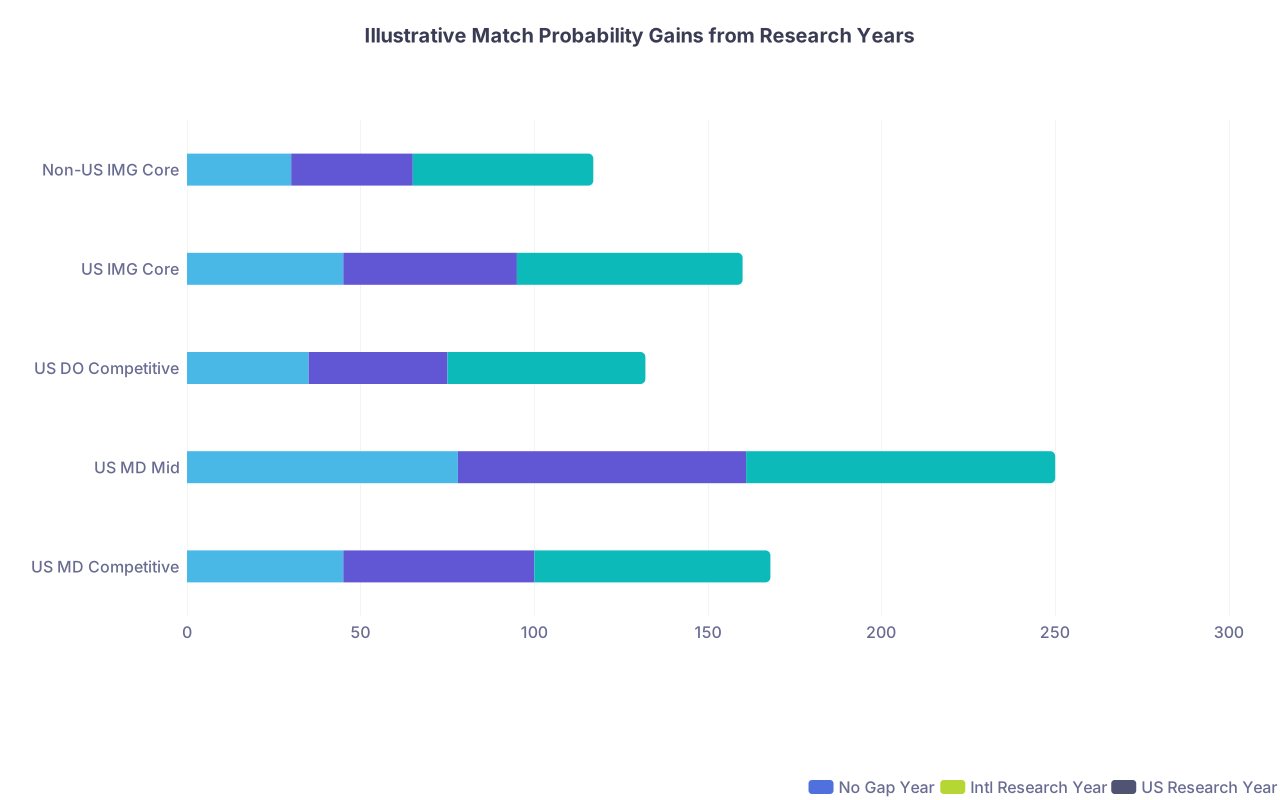
| Category | No Gap Year | Intl Research Year | US Research Year |
|---|---|---|---|
| US MD Competitive | 45 | 55 | 68 |
| US MD Mid | 78 | 83 | 89 |
| US DO Competitive | 35 | 40 | 57 |
| US IMG Core | 45 | 50 | 65 |
| Non-US IMG Core | 30 | 35 | 52 |
Again, these are not official NRMP numbers. They are derived estimates based on known baselines, observed match outcomes, and what programs say they value. The relative pattern is the important part:
- International research year: modest bump
- US research year: substantially larger bump, especially for IMGs and DOs
6. Mechanisms: why US beats international for match outcomes
It is not about research being “better” in the US. Many international institutions do world-class science. The gap is about signal alignment with US residency selection criteria.
Here is what program directors actually see and respond to:
1. Institutional name recognition
“Research fellow, Department of Neurosurgery, Mayo Clinic” carries an immediate, quantifiable signal. A program director in Texas or New York has a mental prior about the caliber of work and vetting at Mayo.
“Research fellow, XYZ University Hospital, [Country]” may be excellent, but if they have no frame of reference, the Bayesian prior is weaker. The letter might still help, but not as much.
2. LOR weight and network effects
Letters from US faculty often include phrases like:
- “I have worked with over 200 residents and fellows in this field; this student is in the top 5%.”
- “I would be thrilled to have this applicant as a resident in our own program.”
US program directors know some of these letter writers personally or by reputation. That network effect amplifies the impact.
International letters—even glowing ones—lack that implicit calibration. The data show PDs rate “US LORs in specialty” as more influential than “non-US LORs” for IMGs and borderline applicants.
3. Conference presentations and visibility
US research years:
- Often yield presentations at US specialty conferences (ACR, AAOS, AANS, etc.)
- Put you physically in front of US faculty and residents
- Sometimes lead to informal pre-interview recognition: “Oh, I remember you from your poster at SIR.”
International years often produce publications but fewer US conference appearances. Visibility points lost.
4. Non-linear benefit for IMGs
For an IMG, presence in the US research ecosystem flips a binary variable: “Has this person ever functioned in a US academic/clinical environment?”
That yes/no variable is heavily weighted. An international research year keeps that at “no,” regardless of how impressive the work is scientifically.
7. When an international research year makes sense anyway
Despite all that, there are scenarios where an international research year is rational—or at least not harmful.
Scenario A: Dual-target career (academic + international)
If your long-term aim is academic medicine with a global health focus, a prestigious international fellowship can still be strategically sound, if:
- It is co-sponsored by a strong US department
- You have at least some US rotations / away electives either before or after
- You maintain regular, visible collaboration with US mentors
You are trading some direct match probability for a career narrative and network that may pay off later in faculty promotions and grants.
Scenario B: Visa or timing constraints
Non-US IMGs sometimes:
- Cannot secure a visa quickly enough for a US start date
- Land an international research spot sooner than a US one
- Use that year to build publications while applying aggressively for the following year in the US
In that case, an international research year is better than a blank, but still inferior to a US equivalent. It can be a bridge while planning to transition into US-based work.
Scenario C: Already highly competitive US MD with strong Step and home program
If you are a top-decile US MD at a top-10 school with near-perfect scores, AOA, and strong home support in a competitive specialty, an international research year might not meaningfully hurt your odds—especially if you are still publishing under your US department.
Your match probability might already be 75–85%. There is only so much room upward.
8. Risk analysis: where research years backfire
Both US and international research years carry risks that the raw match-rate graphs do not show.

| Step | Description |
|---|---|
| Step 1 | Consider Research Year |
| Step 2 | Choose US Research Year |
| Step 3 | Apply Broadly Without Gap |
| Step 4 | Either US or Intl With US Anchor |
| Step 5 | US Research Preferred |
| Step 6 | Target Competitive Specialty? |
| Step 7 | US Research Available? |
| Step 8 | IMG or DO? |
| Step 9 | Strong US Home Program? |
Key failure modes:
Low-yield research: A year in which you collect no meaningful outputs, no strong letters, and minimal clinical exposure can actually hurt you. Programs see the extra time and ask: “Where are the results?”
Isolation from your specialty: I have seen applicants interested in Ortho spend a year doing basic-science immunology in Europe, with no Ortho involvement. They come back with nice bench skills but no new Ortho mentors or letters. Marginal gain at best.
Signal dilution for IMGs: An IMG who spends an extra year at home doing more of the same type of research they already had can look stagnant: “Another year, same environment, no US exposure—why?”
Delay without step function improvement: A gap year makes sense only if it bends your probability curve, not just shifts it a year to the right. If you are not going to produce tangible, ERAS-visible gains, the delay is wasted.
9. Practical comparison by applicant profile
Let’s compress this into a data-informed decision table.
| Profile | Recommended Location | Rationale (Match-Focused) |
|---|---|---|
| US MD, Derm/Plastics/Neuro, mid stats | Strongly US | Maximizes letters, pubs, home ties |
| US MD, IM/FM with solid stats | Optional, US better | Small benefit; US preferred if done |
| US DO, competitive surgical specialty | Strongly US | Closes MD–DO gap, provides MD letters |
| US IMG, any specialty | Strongly US | Major jump in US LORs and experience |
| Non-US IMG, core specialty | Strongly US | Often doubles/triples match odds |
| US MD with top-tier home, global career | Either, w/US anchor | Intl OK if tightly linked to US |
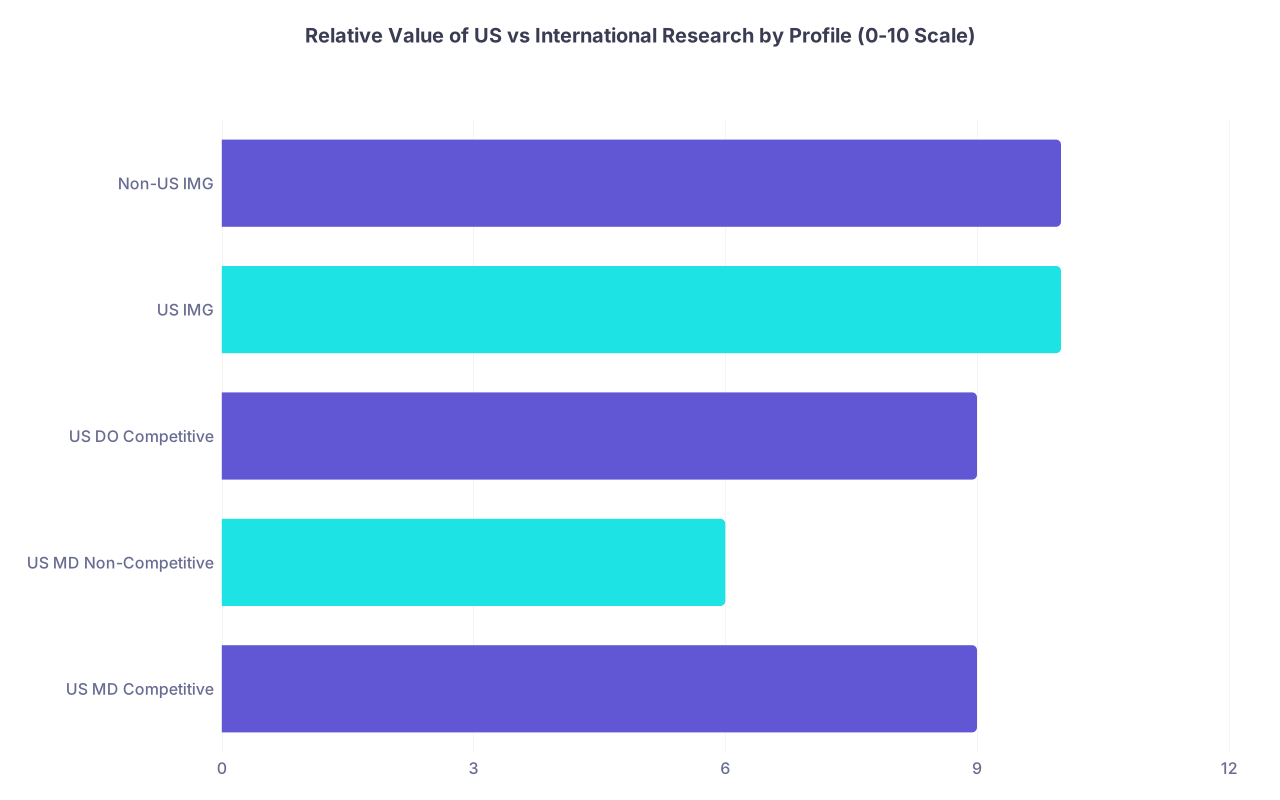
| Category | Value |
|---|---|
| US MD Competitive | 9 |
| US MD Non-Competitive | 6 |
| US DO Competitive | 9 |
| US IMG | 10 |
| Non-US IMG | 10 |
Scale explanation: 0 = no value; 10 = extremely high marginal benefit of US over international.
10. How to make an international research year “behave like” a US year
If you are locked into an international option, you can engineer it to mimic the match benefits of a US year:
- Ensure a formal tie to a US department (co-mentors, joint appointment, co-authorship)
- Prioritize projects likely to be presented at US conferences
- Schedule US observerships or away rotations before/after the year
- Have at least one US-based PI as a primary letter writer who can contextualize your international work to US programs
You are trying to convert an “international only” signal into a “global but anchored in US academics” signal. The more you succeed at that, the closer your outcome resembles the US research year curve, not the international-only curve.
11. The blunt summary
I will put it plainly.
For match probability—especially for IMGs, DOs, and anyone chasing a competitive specialty—a US-based research gap year is usually not just “better” than an international one. It is in a different tier of value.
The data, the PD surveys, and the observed outcomes all converge:
- US research → higher-impact letters, more recognizable brands, stronger US clinical exposure, better networking, and often a double-digit bump in match probability.
- International research → modest gains, mostly via publications and narrative, unless tightly linked to US mentors and institutions.
If you treat a gap year as an investment, the expected match return per year of delay is dramatically higher in the US than abroad for the vast majority of applicants.
You are not just deciding where you want to live for a year. You are deciding how much you want your odds to move.
With that framing in place, your next step is not to read more opinions. It is to map your actual numbers—Step scores, class rank, prior research, specialty interest—onto these probability curves and decide whether a research year, and where, actually changes your trajectory. Once you have that, then you can start evaluating specific programs and offers. But that is another analysis entirely.


