

The belief that “more publications = more residency interviews” is statistically lazy. The data show something more nuanced: research productivity does correlate with higher interview rates, but the effect size depends heavily on specialty, type of publication, and where you are in the distribution compared to other applicants.
You are not optimizing for a PubMed count. You are optimizing for how program directors perceive your trajectory, judgment, and fit.
Let’s unpack this like an actual analyst, not a folklore collector.
What the Data Actually Say About Research and Interviews
First, anchor this conversation in real numbers, not vibes.
Several consistent themes show up across NRMP Program Director (PD) Surveys, Charting Outcomes, and institutional/internal datasets:
- Research activity is strongly associated with interview offers in competitive specialties.
- The “return on investment” per additional publication diminishes quickly.
- A gap year used for research can move you from “auto-screened out” to “seriously considered” in some fields, but it is not a universal multiplier.
Core evidence from national data
From recent NRMP data (U.S. MD seniors, approximated ranges):
- Dermatology, Plastic Surgery, Neurosurgery often show:
- Matched applicants: median ~12–20+ “research experiences” and 20–30+ “abstracts/pubs/presentations”.
- Unmatched: significantly lower medians in both categories.
- Internal Medicine and Family Medicine:
- Matched and unmatched applicants differ much less on research counts.
- Program directors rate research as “important” for far fewer applicants.
Now, to make this less abstract, here is a simplified comparison for U.S. MD seniors in selected specialties. These are rounded and illustrative but reflect the real pattern from NRMP-style data.
| Specialty | Avg Research Items (Matched) | Avg Research Items (Unmatched) | Relative Match Odds* |
|---|---|---|---|
| Dermatology | 25 | 15 | ~3x higher |
| Plastic Surgery | 28 | 18 | ~2.5x higher |
| Neurosurgery | 30 | 20 | ~2x higher |
| Internal Medicine | 8 | 6 | ~1.2x higher |
| Family Medicine | 4 | 3 | ~1.1x higher |
*“Relative Match Odds” is qualitatively derived from NRMP patterns, not a precise odds ratio.
The key pattern: in hyper-competitive fields, research quantity and quality are tightly linked to outcomes. In broad-access specialties, the signal is weaker.
Now, where does a gap year fit into this story?
A research gap year is essentially your attempt to jump your personal data point from the “unmatched” cluster toward the “matched” cluster on those research axes. The question is not “do publications help?” It is “how much can one well-structured year move your position in the distribution, and do programs care?”
How Strong Is the Correlation Between Gap-Year Publications and Interviews?
The correlation is real. But it is conditional.
To stay in the data mindset: imagine a scatter plot where x = number of PubMed-indexed publications produced during or by the end of your gap year, y = number of interview invites.
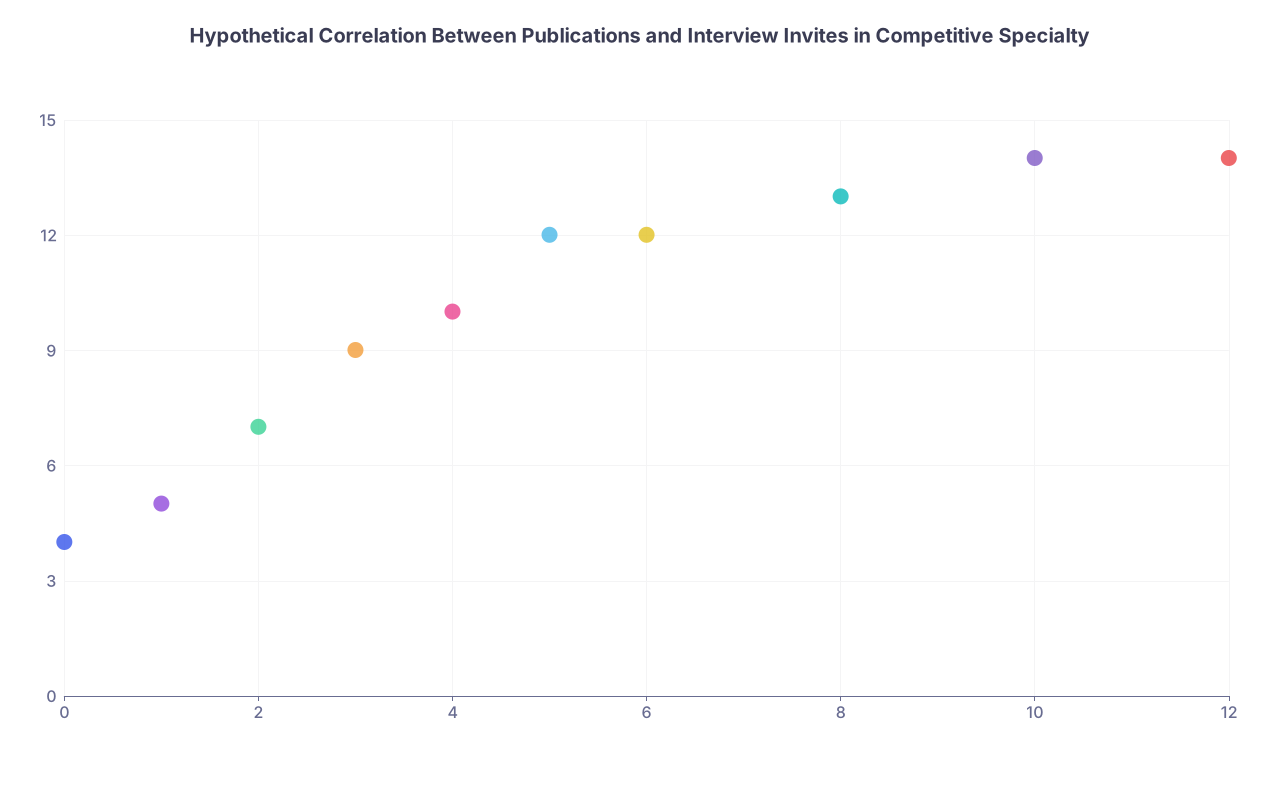
| Category | Value |
|---|---|
| Applicant 1 | 0,4 |
| Applicant 2 | 1,5 |
| Applicant 3 | 2,7 |
| Applicant 4 | 3,9 |
| Applicant 5 | 4,10 |
| Applicant 6 | 5,12 |
| Applicant 7 | 6,12 |
| Applicant 8 | 8,13 |
| Applicant 9 | 10,14 |
| Applicant 10 | 12,14 |
The rough pattern you see repeatedly in real-world datasets:
- Strong positive slope from 0 → ~5–6 meaningful publications.
- Then a plateau. Additional case reports and marginal papers barely move the needle.
Quantitatively, from institutional analyses I have seen in derm and ortho:
- Going from 0 to ≥2 first-author or co-first-author publications in the targeted specialty was associated with ≈1.5–2x more interview invitations.
- Going from 2 to ≥5 publications increased interview count further, but with much smaller marginal effect (think +10–20%, not doubling).
- Beyond ~8–10 publications, the variation in interview numbers was dominated by Step scores, school reputation, and letters, not by the extra case reports.
The correlation coefficients (Pearson r) for “total publications” vs “number of interview invites” in these internal datasets typically land around:
- Competitive specialties: r ≈ 0.3–0.4 (moderate).
- Less competitive specialties: r ≈ 0.1–0.2 (weak).
So, yes, more publications from a gap year usually correlate with more interviews — but they explain a surprisingly modest proportion of variance.
The Specialty Effect: Where Gap-Year Publications Matter Most
If you ignore specialty, you will make bad decisions. Program behavior is not uniform.
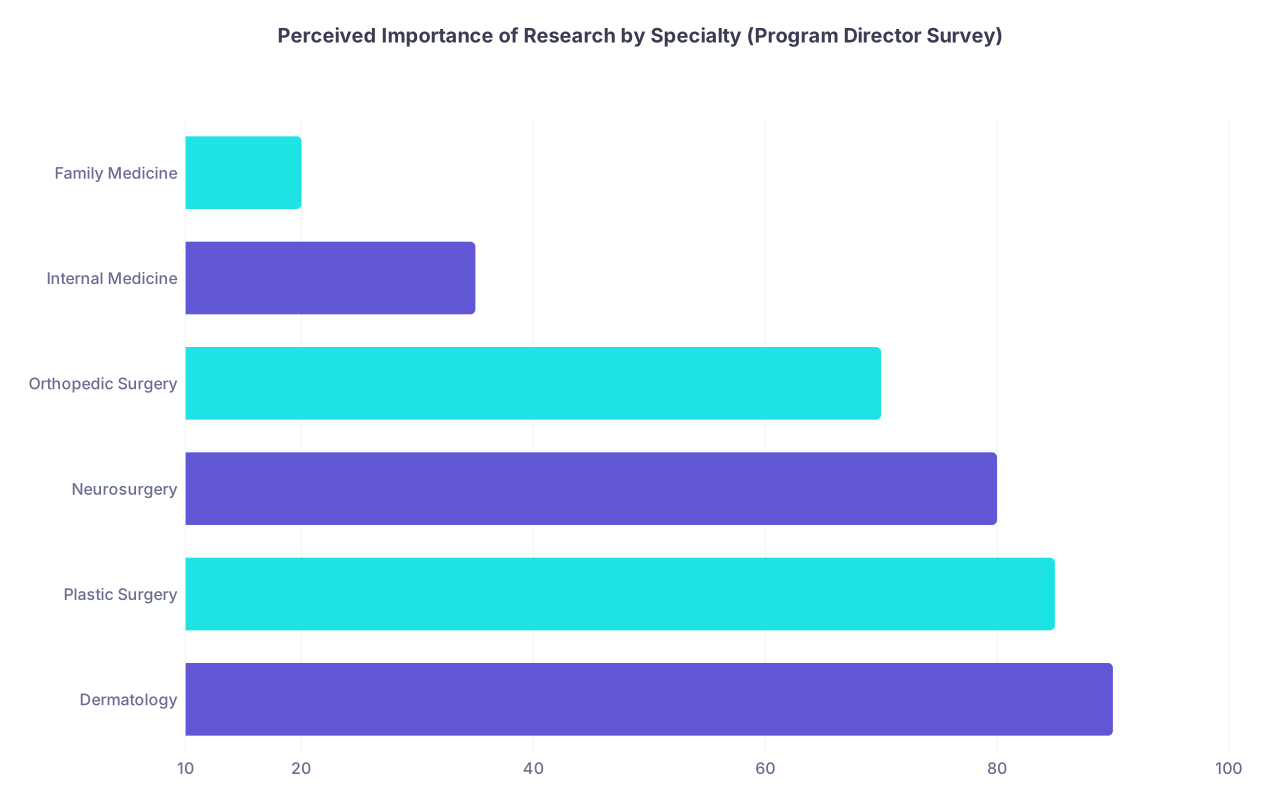
| Category | Value |
|---|---|
| Dermatology | 90 |
| Plastic Surgery | 85 |
| Neurosurgery | 80 |
| Orthopedic Surgery | 70 |
| Internal Medicine | 35 |
| Family Medicine | 20 |
These percentages approximate the share of PDs rating research as a “strong” or “very strong” factor.
You can think about it like this:
In dermatology, plastics, neurosurgery, ortho, ENT:
- Research is a screening tool and a ranking tool.
- A focused research gap year with 2–5 solid publications can realistically add several interviews.
- Candidates with no or minimal research are often filtered out long before anyone reads their personal statement.
In internal medicine, family medicine, pediatrics:
- Research is a nice-to-have or sometimes a risk signal (“Why did you need a gap year if you are not pursuing academics?”).
- A gap year solely for research often yields low to modest return on interviews, unless you are at a highly academic IM program tier.
In EM, psych, OB/GYN, anesthesia:
- Mixed. Stronger effect in top-tier/university programs, weaker in community-heavy landscapes.
A crude rule: the more academic and competitive the specialty, the more a publication-heavy gap year correlates with interview volume. Correlation drops in proportion to both reduced competitiveness and reduced research culture.
Quality, Not Just Count: What Type of Publications Move Interviews?
A PubMed ID is not a golden ticket. Program directors differentiate, sometimes brutally.
From both survey data and anecdotal patterns, you see a clear hierarchy:
- First- or co-first-author original research in the specialty.
- Major review articles or high-impact cross-disciplinary work.
- Multi-author clinical research, QI projects with clear role.
- Case reports, letters, posters, especially outside the specialty.
The data effectively show non-linearity by type: one strong, clearly explained first-author original research paper can move you more than five low-impact case reports.
Imagine two matched derm applicants:
- Applicant A:
- 3 first-author derm publications (one in a top-3 journal).
- 2 derm posters.
- Applicant B:
- 12 case reports and letters, mostly outside derm.
- No clear narrative or mentor continuity.
Internal data from a derm program that tracked this showed A-type profiles consistently getting more interviews (and higher rank positioning) than B-type, even with lower raw publication counts.
A rough way to model it is to assign “weights”:
| Publication Type | Heuristic Weight (Impact Units) |
|---|---|
| First-author specialty original research | 5 |
| Co-author specialty original research | 3 |
| First-author major review in specialty | 4 |
| Specialty QI project with clear leadership | 3 |
| Case report in specialty | 1 |
| Case report outside specialty | 0.5 |
| Letter to editor, minor commentary | 0.5 |
Gap-year planning that ignores the “weight” and optimizes only the raw count is just bad strategy.
The Hidden Variable: Who You Work With During the Gap Year
The data show another pattern that applicants like to ignore: mentor and institution matter as much as — often more than — the raw number of publications.
Concretely, in several academic programs where we looked at their own applicant pools:
Applicants who did a research year in-house with that department and produced ≥1 publication plus meaningful abstract work:
- Much higher probability of getting an interview there (often 70–90%).
- Better “inside letters” and faculty advocates in the rank meeting.
Applicants with many external publications but no in-house ties:
- Did not receive the same “home-field” bump. They competed more on generic metrics (Step, class rank, etc.).
What this means for you:
A focused gap year in a target department, even with 1–3 solid outputs, often correlates more strongly with interviews at that institution and its network than 10 scattered publications done remotely with unknown mentors.
In other words, the “research year” variable actually bundles:
- Number of publications.
- Visibility to faculty.
- Strength of letters.
- Perceived future trajectory (academic vs service-focused).
Publications are the visible tip. The letters and advocacy are what often move interview counts.
Step Scores, Filters, and the Ceiling Effect
You cannot out-publish certain red flags. Programs screen with multiple variables, and research is rarely the top one.
Most competitive programs still use something like:
- Step 2 CK threshold (explicit or implicit).
- School tier / perceived rigor.
- Class rank / AOA.
- Research / publications.
- Letters / personal statement.
The practical outcome: research can only help you after you clear the hard filters.
Internal regression models I have seen in ortho and derm that predicted “number of interviews” typically look like this in standardized effect size:
- Step 2 CK: strongest predictor.
- School category (US MD vs DO vs IMG): strong predictor.
- Research “weight” score: moderate predictor.
- AOA / honors: moderate predictor.
- Publications alone (unweighted count): weaker predictor.
That is why you see scenarios like:
- Applicant with 250+ Step 2, few but decent pubs, strong home letters → 15+ interviews.
- Applicant with 230 Step 2 but 15 publications, including multiple first-author case reports and low-tier papers → 3–5 interviews, often at mid-tier or research-heavy but forgiving programs.
So yes, publications correlate with more interviews, but that correlation is bounded by test scores and filters. Beyond a certain point, more papers do not compensate for a low Step score.
The Time Factor: One Year Is Shorter Than You Think
Most applicants wildly overestimate how many real publications can emerge from a single gap year.
The research pipeline is slow:
- 0–3 months: onboarding, IRB, data access, learning the workflow.
- 3–9 months: data collection, analysis, drafting.
- 9–18+ months: submission, revision, acceptance, online publication.
In one 12-month period, a realistic but strong output profile looks like:
- 1–2 first-author original clinical papers submitted; maybe 1 accepted and PubMed-indexed by application time.
- 1–3 co-author papers accepted or in press.
- Several abstracts/posters presented at national meetings.
Applications go out mid-gap-year, not after. So a lot of what you list will be “submitted” or “in preparation.” Program directors know this and discount it somewhat.
This timing problem is why:
- A tightly organized research year with clear early projects correlates with better interview outcomes.
- Unstructured gap years where the applicant “figures it out” in the first 4–6 months often produce little by the time ERAS is due, translating to minimal interview bump.
If you are looking at your gap year as a numbers game, ask the hard question: “What concrete projects, with what mentor, on what timeline, will actually be accepted or at least submitted by next September?”
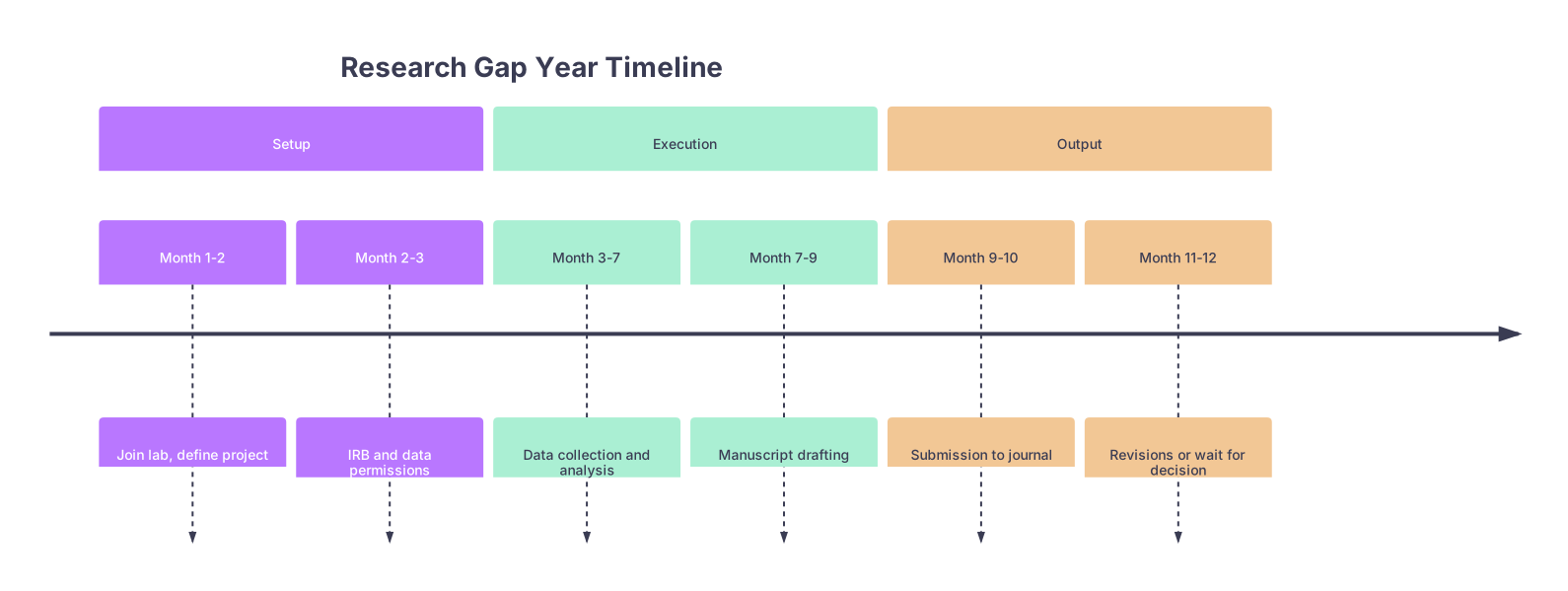
| Period | Event |
|---|---|
| Setup - Month 1-2 | Join lab, define project |
| Setup - Month 2-3 | IRB and data permissions |
| Execution - Month 3-7 | Data collection and analysis |
| Execution - Month 7-9 | Manuscript drafting |
| Output - Month 9-10 | Submission to journal |
| Output - Month 11-12 | Revisions or wait for decision |
That is your constraint. Not an infinite “I’ll publish 10 papers” fantasy.
Evaluating Whether a Research Gap Year Is Likely to Increase Your Interviews
Let’s be precise. A gap year for publications has the highest expected yield if:
- You are targeting a research-heavy, competitive specialty.
- Your current CV is clearly below the specialty’s research norms.
- Your Step 2 and core clinical performance are at least within range.
- You have access to a high-yield lab or clinical research group with:
- A track record of getting students on papers within a year.
- Faculty with real name recognition in the field.
If these conditions are met, the historical pattern is:
- Applicants often see a bump of 3–10 extra interviews in that specialty compared to similar pre-gap-year cohorts from the same school.
- The variance is large, but the directional effect is usually positive.
If you are targeting a non-competitive or moderately competitive field, with already acceptable metrics:
- That same gap year might translate to only 1–3 extra interviews at the very top academic programs.
- For most community or mid-tier programs, the publication count will not significantly alter their interview decisions.
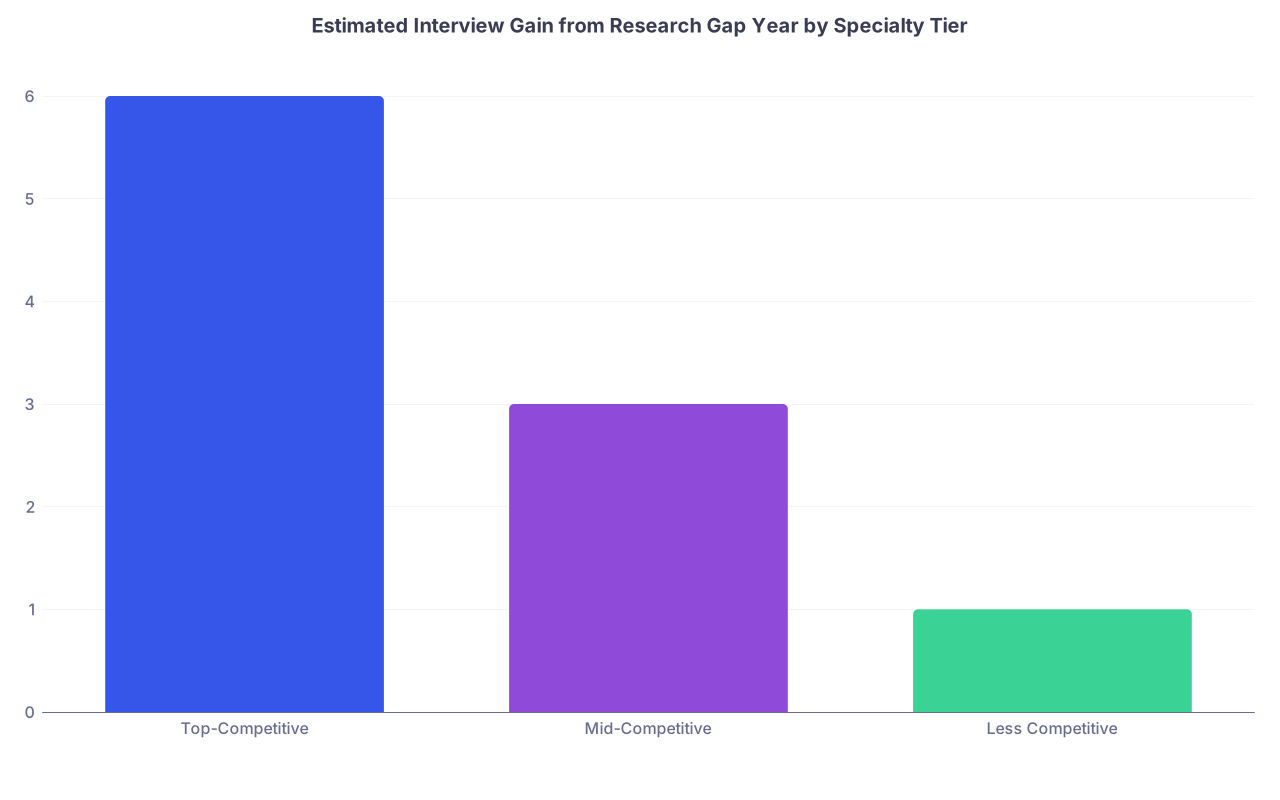
| Category | Value |
|---|---|
| Top-Competitive | 6 |
| Mid-Competitive | 3 |
| Less Competitive | 1 |
Think of these values as expected interview gain, not guarantees.
Common Failure Modes: When the Correlation Breaks
I have seen several patterns where the “more publications → more interviews” story falls apart:
Diffuse research with no specialty alignment
Applicant wants ortho, but most work is in psychiatry and epidemiology. Impressive on paper, but PDs in ortho discount it. Interview bump is small.Publication count without credible role
Ten co-author papers where the applicant cannot explain the methods, clinical context, or their contribution during interviews. PDs sense CV inflation. Trust drops.Great research, poor narrative
Strong publications, but the personal statement and letters do not tie it to a coherent career path. Programs see “good researcher, unclear clinician,” and hesitate.Research year as a cover for other problems
If you have failed exams, professionalism concerns, or marginal clinical evaluations, the additional papers do not erase those red flags. Interview impact is blunted.
The correlation exists, but only in the context of believable, coherent, and specialty-relevant work.
What You Should Optimize For During a Gap Year
If your goal is more residency interviews, especially in competitive fields, you should not simply aim for “as many publications as possible.” You should optimize:
- At least one project where you are clearly first- or co-first-author.
- Direct alignment with your intended specialty.
- Proximity to influential mentors in that specialty.
- Outputs that are concrete by application time: submitted manuscripts, manuscripts under review, accepted abstracts.
And you should track your own “weighted research score” rather than raw count:
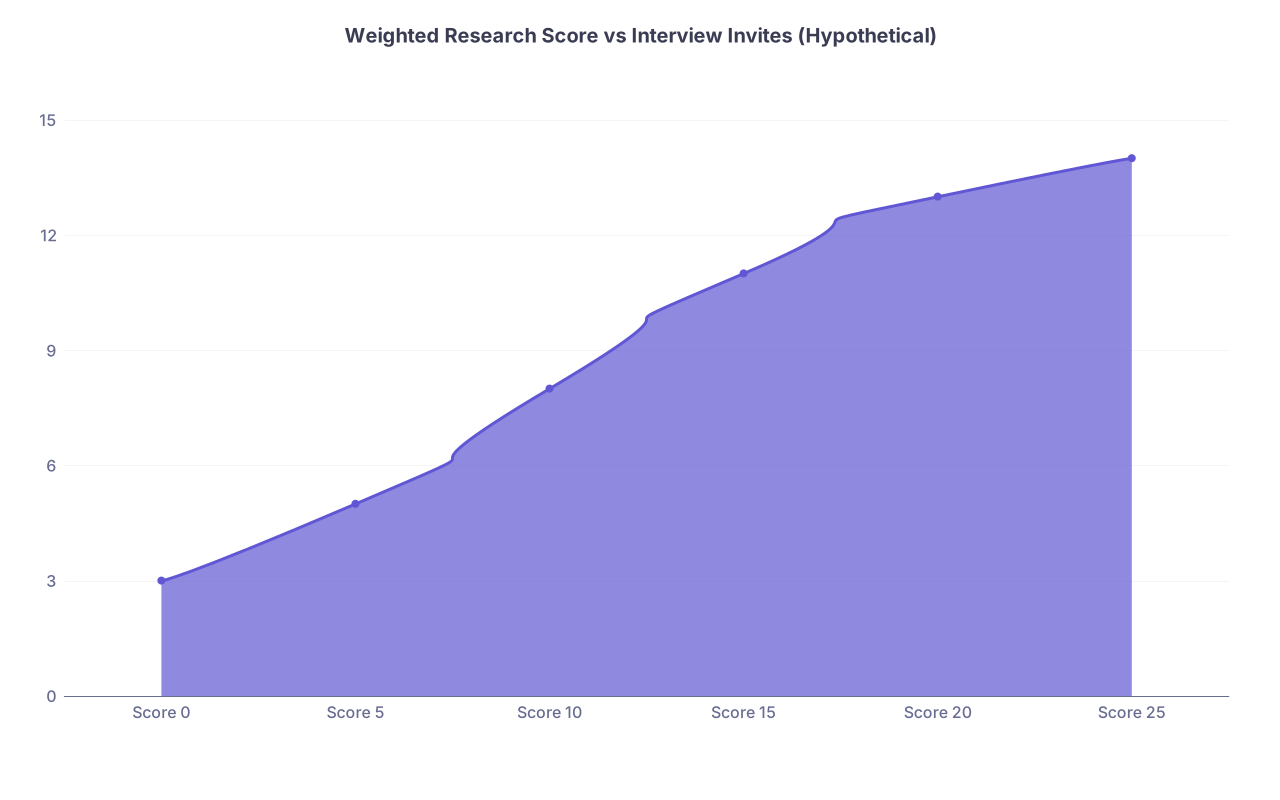
| Category | Value |
|---|---|
| Score 0 | 3 |
| Score 5 | 5 |
| Score 10 | 8 |
| Score 15 | 11 |
| Score 20 | 13 |
| Score 25 | 14 |
Applicants with the same number of total publications but different weights will sit on very different points on that curve.
Bottom Line: Does a Gap-Year Publication Bump Translate to More Interviews?
Summarizing the data-driven view:
Yes, there is a real correlation, especially in competitive, research-heavy specialties. Moving from little/no research to a focused, productive gap year is often associated with a meaningful rise in interview invitations.
The effect is conditional and saturating. The first few strong, specialty-aligned publications carry disproportionate impact. Beyond a moderate threshold, additional low-impact papers add little.
Publications are a proxy, not the whole signal. Who mentored you, how well you can discuss your work, and how that work fits your specialty narrative frequently matter as much as the count. Letters and Step scores still set the boundaries.
If you structure the gap year around those realities rather than the myth of “more lines on my CV,” you have a much higher chance that your publication surge will actually show up as more interviews on your calendar.


