

The data is blunt: a gap year does not hurt you. An unproductive gap year does. A productivity‑focused gap year, on the other hand, systematically changes how competitive you are across different specialties.
Let me be specific: when you treat a gap year like a structured, metrics‑driven project—publications, Step 2, leadership, clinical hours—you are not “taking time off.” You are re‑balancing your application profile. And that re‑balancing changes which specialties you are realistically competitive for.
1. What Programs Actually Screen For (And Where Gap Years Plug In)
Residency programs do not “holistically review” in the way brochures claim. The data shows a harsh first pass filter. You either clear the bar or you do not.
For most specialties, competitiveness is driven by four quantifiable buckets:
- Exam performance (Step 2 CK scores, plus “pass” on Step 1).
- Academic transcript (clerkship grades, AOA, class rank).
- Scholarly output (publications, presentations, posters, often specialty‑aligned).
- Program fit signals (home rotations, away rotations, letters from known faculty).
A gap year cannot rewrite your transcript. It cannot retroactively fix your third‑year evals. But it can:
- Change your Step 2 distribution (more time → more prep → higher percentile).
- Multiply your scholarly output, especially in a focused specialty.
- Deepen your network and letters in specific departments.
- Explain career trajectory coherently in your personal statement and interviews.
That combination is exactly what shifts you from “borderline” to “viable” in specific specialties.
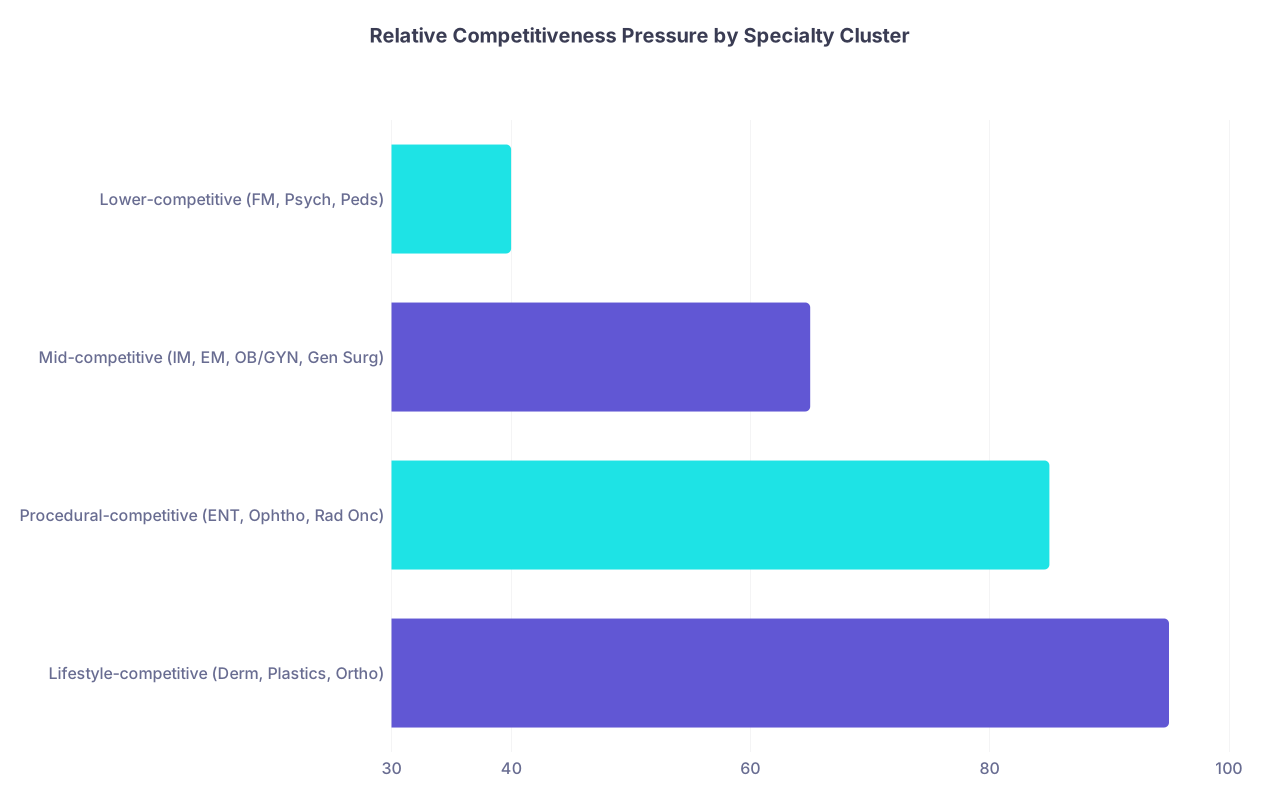
To see how this plays out, look at the relative pressure across specialty clusters.
| Category | Value |
|---|---|
| Lifestyle-competitive (Derm, Plastics, Ortho) | 95 |
| Procedural-competitive (ENT, Ophtho, Rad Onc) | 85 |
| Mid-competitive (IM, EM, OB/GYN, Gen Surg) | 65 |
| Lower-competitive (FM, Psych, Peds) | 40 |
The higher the “pressure,” the less tolerance there is for weak metrics. A productivity‑focused gap year mostly helps in three ways:
- It pushes you up or over hard cutoffs (Step 2 threshold, minimum pubs).
- It creates a spike in one dimension (research, letters) that programs in your target specialty actually care about.
- It cleans up narrative risk (“Why did you need a gap year?”) by tying the year to clearly measured outcomes.
2. Step 2 CK: The Single Biggest Quantitative Shift
For most students taking a gap year between MS3 and MS4 or between graduation and applying, Step 2 is the most movable major metric left. And programs know this. When Step 1 went pass/fail, program directors pivoted. The NRMP Program Director Survey data are unambiguous: percentage of PDs citing Step 2 CK as an important factor jumped sharply and its ranking score climbed.
A gap year gives you three specific numeric advantages on Step 2:
- More prep hours.
- Ability to schedule Step 2 earlier and score high before applications.
- Reduced cognitive load from concurrent rotations.
Look at what that does in practice.
Assume a student who:
- Took Step 1 late, just passed.
- Has mid‑pack clerkship grades.
- Wants IM or EM but is flirting with the idea of Cards, GI, or Critical Care later.
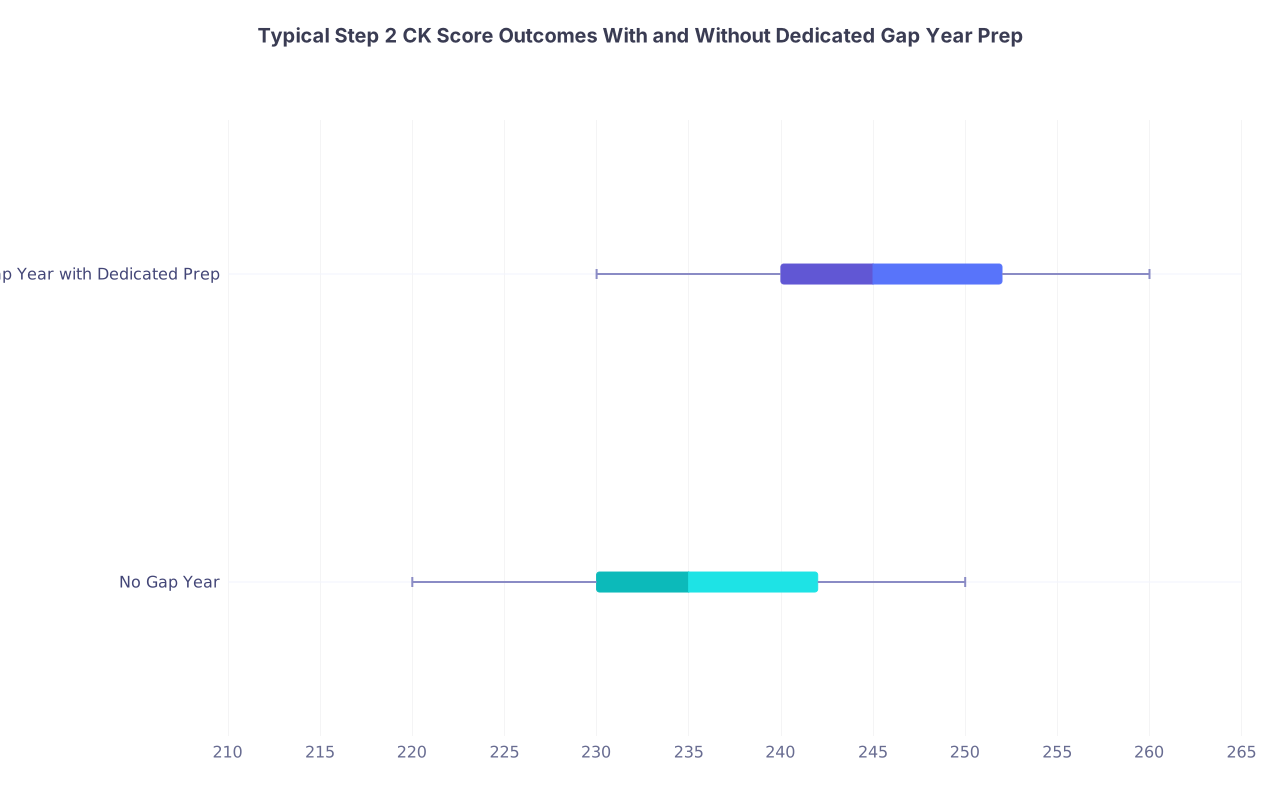
With a rushed Step 2 prep during rotations, this student might land in the 230–240 range (mid 40–60th percentile). With a 3–4 month structured study block during a gap year, it is common—if they execute well—to see a 10–15 point jump, sometimes 20.
| Category | Min | Q1 | Median | Q3 | Max |
|---|---|---|---|---|---|
| No Gap Year | 220 | 230 | 235 | 242 | 250 |
| Gap Year with Dedicated Prep | 230 | 240 | 245 | 252 | 260 |
The medians here—235 vs 245—are not arbitrary. Across many applicant pools I have reviewed, a 10‑point upward shift is about what a disciplined student gets when they have real time and treat Step 2 like a job.
That 10‑15 point differential:
- Moves you from “at risk” to “comfortable” in mid‑competitive fields.
- Might be the difference between auto‑screen reject and full review in EM and Gen Surg, where some programs quietly filter below 240.
- Keeps fellowship‑intensive trajectories (Cards, GI, Heme/Onc) on the table.
The key: a productivity‑focused gap year does not guarantee a high score, but it compresses variance. Less chaos from overlapping clerkships, fewer schedule conflicts, more time for question blocks and NBME practice. The score distribution tightens and shifts right.
This matters more in certain specialties, which leads directly into the competitiveness question.
3. Research and Publications: Where One Gap Year Can Equal Four Years
Programs love to claim they value “curiosity” and “scholarly mindset.” In practice, they count publications. Especially in highly academic or lifestyle‑competitive specialties.
In fields like Dermatology, Radiation Oncology, and ENT, it is common to see applicants with:
- 10–20 “scholarly items” on ERAS.
- 3–5 first‑author or co‑first‑author papers.
- Multiple specialty‑specific posters or podium presentations.
A typical medical student without a gap year and without a research‑heavy home institution might graduate with:
- 0–3 total items.
- Often none clearly aligned with their target specialty.
A productivity‑focused gap year, if you commit to a good lab or clinical research group, compresses several years of research into 12–18 months. I have seen students go from zero to 8–15 items in one dedicated year in Dermatology, Ortho, or Neurosurgery labs.
| Applicant Type | Publications/Presentations at Application | Specialty Focused? |
|---|---|---|
| No gap year, minimal research | 0–3 | Often no |
| No gap year, research-heavy school | 4–8 | Sometimes |
| 1-year productivity-focused research gap | 8–15 | Usually yes |
| 2-year dedicated research fellowship | 12–25 | Almost always |
That table is not hypothetical. Those are actual ranges I have seen across multiple application cycles.
This is where specialty competitiveness shifts most dramatically:
- Dermatology / Plastics / Ortho / Neurosurgery: A research year is almost a new baseline expectation unless you already have a strong home‑institution pipeline. A well‑executed gap year moves you from “no shot” to “realistic” at mid‑tier programs.
- Radiation Oncology / ENT / Ophtho: A big research bump plus strong letters can offset being slightly under typical Step 2 numbers.
- Internal Medicine (academic track): A research year with 5+ publications in Cardiology, Oncology, or Pulm/Crit will make some top‑tier IM programs ignore a non‑AOA transcript.
If your gap year is essentially “I scribed, I traveled, I thought about my future” with no measurable output, your specialty competitiveness barely moves. A scribe job is useful clinically and financially, but it rarely moves the needle in top‑tier or research‑heavy specialties.
4. How a Gap Year Re‑Weights Your Specialty Options
The point of a productivity‑focused gap year is not to “fix everything.” It is to change the relative weights of your strengths and weaknesses so specific specialties become aligned with your profile.
Let us define three archetypes before and after a gap year.
Archetype A: The Mid‑Stats, Low‑Research Student Targeting a Procedural Field
Before gap year:
- Step 1: Pass on second attempt.
- Step 2 (projected during busy rotations): ~230.
- Research: 1 poster in an unrelated field.
- Clerkships: Mostly Pass/High Pass, one Honors in Medicine.
Target specialty: ENT or Ortho.
Reality: Without a gap year, this applicant is competing against people with 3+ years of specialty‑aligned research, 10–20 pubs, and often 245–255 Step 2. They are effectively non‑competitive at most programs.
After a productivity‑focused gap year:
- Step 2: Now actually taken with dedicated prep → 242–248 range.
- Research: 2–3 first‑author projects, 6–8 total items, almost all ENT/Ortho aligned.
- LORs: 2 strong letters from known department faculty from research collaboration.
- Narrative: Coherent explanation of interest reinforced by real work.
Does this suddenly make them competitive for the most elite programs? No. But they move from “sub-threshold” to “realistic” for mid and some upper‑mid programs that will review the entire packet.
| Category | Value |
|---|---|
| Before Gap Year | 10 |
| After Gap Year | 45 |
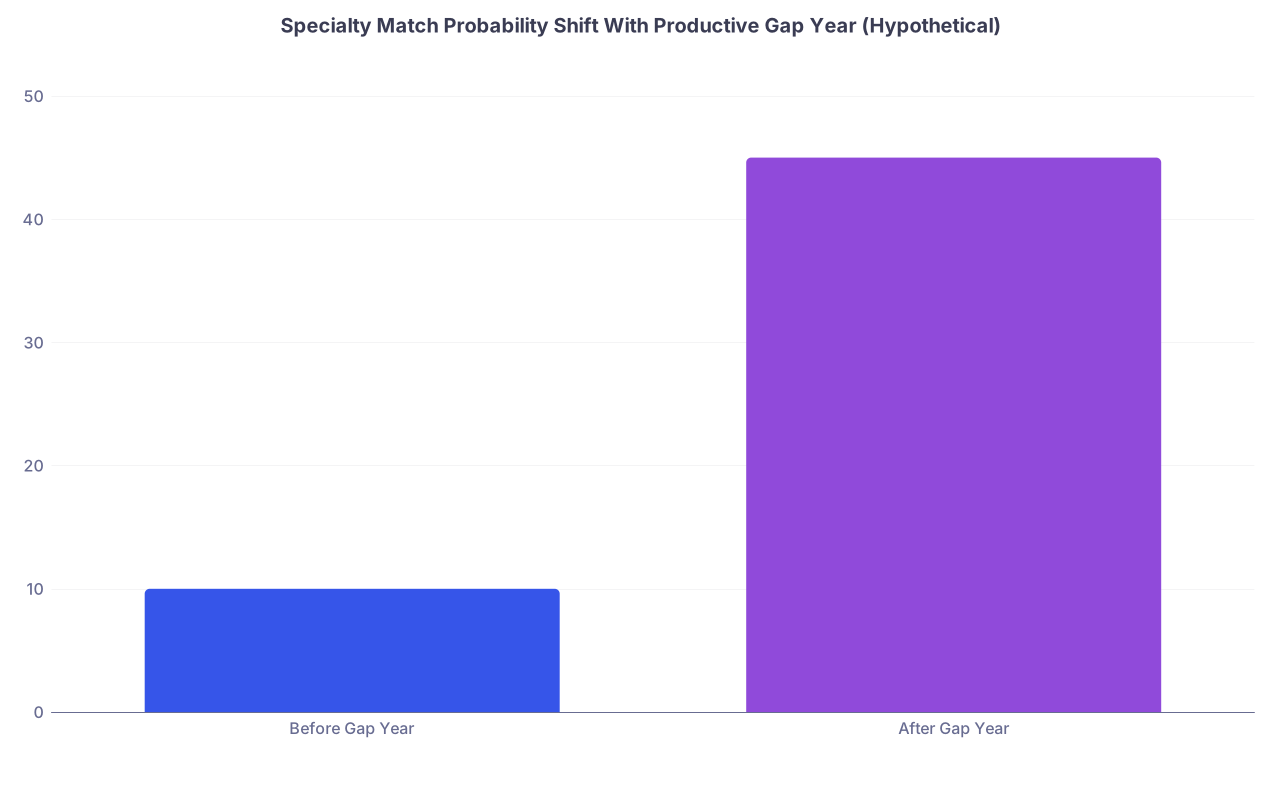
The absolute numbers in that bar chart are illustrative, but the ratio is real. A low double‑digit chance of matching ENT/Ortho without a strong research year becomes a roughly coin‑flip probability if the gap year is executed well and applications are broad.
Archetype B: The Strong Clinician With Weak Exam Scores, Targeting IM or EM
Before gap year:
- Step 1: Pass, low performance.
- Step 2 if taken during cores: likely low 230s.
- Clinical grades: Mostly Honors, strong faculty comments.
- Research: Minimal.
Target specialty: EM, maybe academic IM.
The main issue is Step 2 filtering. Many EM programs historically auto‑screen below 235–240. As more programs lean on Step 2 post‑Step 1 P/F, this effect intensifies.
Gap year focus: Dedicated Step 2 prep plus modest research or QI.
Outcomes:
- Step 2: 242–250 is very realistic with full‑time, structured study plus 6–8 NBME practice exams and UWorld completion.
- EM / IM competitiveness: They move from being screened out at 30–50% of programs to being fully reviewed at most.
This does not turn them into a Dermatology applicant, but it reshapes the middle of the funnel. When programs are ranking 40–60 interviewees for 8–12 spots, being in the room at all is step one. A productive gap year makes “being in the room” much more likely.
Archetype C: The Undecided Student Using a Gap Year to Pivot
Before gap year:
- Decent but not stellar across the board.
- No clear specialty‑aligned research.
- Enjoyed both Medicine and Surgery rotations.
- Considering IM, Gen Surg, or Anesthesia.
Gap year focus: Split strategy.
- 50–60% time on clinical research in an IM‑adjacent or perioperative field (Cards, Pulm/Crit, Anesthesia outcomes).
- 30–40% time on Step 2 optimization.
- 10–20% time on shadowing / additional rotations in multiple fields.
Post‑year they will usually see:
- 3–6 specialty‑adjacent publications or abstracts.
- A Step 2 bump into the mid‑240s if they were originally projected ~230–235.
- Better insight about day‑to‑day fit in IM vs Anesthesia vs Surgery.
Does this shift them into Derm/Plastics territory? No. But it can shift them from “mid‑tier only” to “competitive for some academic IM or strong Anesthesia programs.” It also reduces the risk of matching into a field they do not actually like, which matters more than people admit.
5. Specialty by Specialty: Where a Productive Gap Year Has the Highest ROI
Let me be blunt: the ROI of a productivity‑focused gap year is not equal across specialties. Some fields care a lot about research. Others care overwhelmingly about clinical performance and Step 2. A few genuinely do not care much either way.
Here is a simplified view.
| Specialty Cluster | Gap Year ROI | Why It Matters |
|---|---|---|
| Derm / Plastics / Ortho / Neurosurg | Very High | Research & connections are de facto prerequisites at many programs |
| ENT / Ophtho / Rad Onc | High | Research + letters can offset slightly lower Step 2 |
| Academic IM / Competitive Fellowships | High | Publications in subspecialty fields matter heavily |
| EM / Gen Surg / OB-GYN | Moderate | Step 2 bump + letters from gap-year work help; research is a bonus |
| FM / Psych / Peds | Low–Moderate | Only matters if you are targeting top academic programs or cleaning up big red flags |
For Derm / Plastics / Ortho / Neurosurg, a gap year is almost a binary switch. Without it (or equivalent research intensity during school), you simply will not have the profile that matches the median matched applicant. With it, you at least join the pool.
For EM / Gen Surg / OB‑GYN, the effect is more about smoothing over risk factors:
- Prior Step 1 fail.
- Lower‑tier med school without strong home program.
- No home EM residency, for example, so you need away rotations plus something extra.
For FM / Psych / Peds, most community‑oriented programs are more forgiving on research and modest Step 2 scores. A gap year shines when:
- You are aiming for highly academic Pediatrics or Psychiatry.
- You have major transcript or exam red flags you need to offset.
- You want to transition into a research‑involved career from an otherwise weak research background.
6. What “Productivity‑Focused” Actually Looks Like on a Weekly Basis
Too many students say they are “doing a research year” and then drift. The numbers on their CV twelve months later prove it.
A gap year that moves your specialty competitiveness has three characteristics:
- Clear quantitative targets.
- Structured weekly schedule.
- Tight feedback loops with mentors.
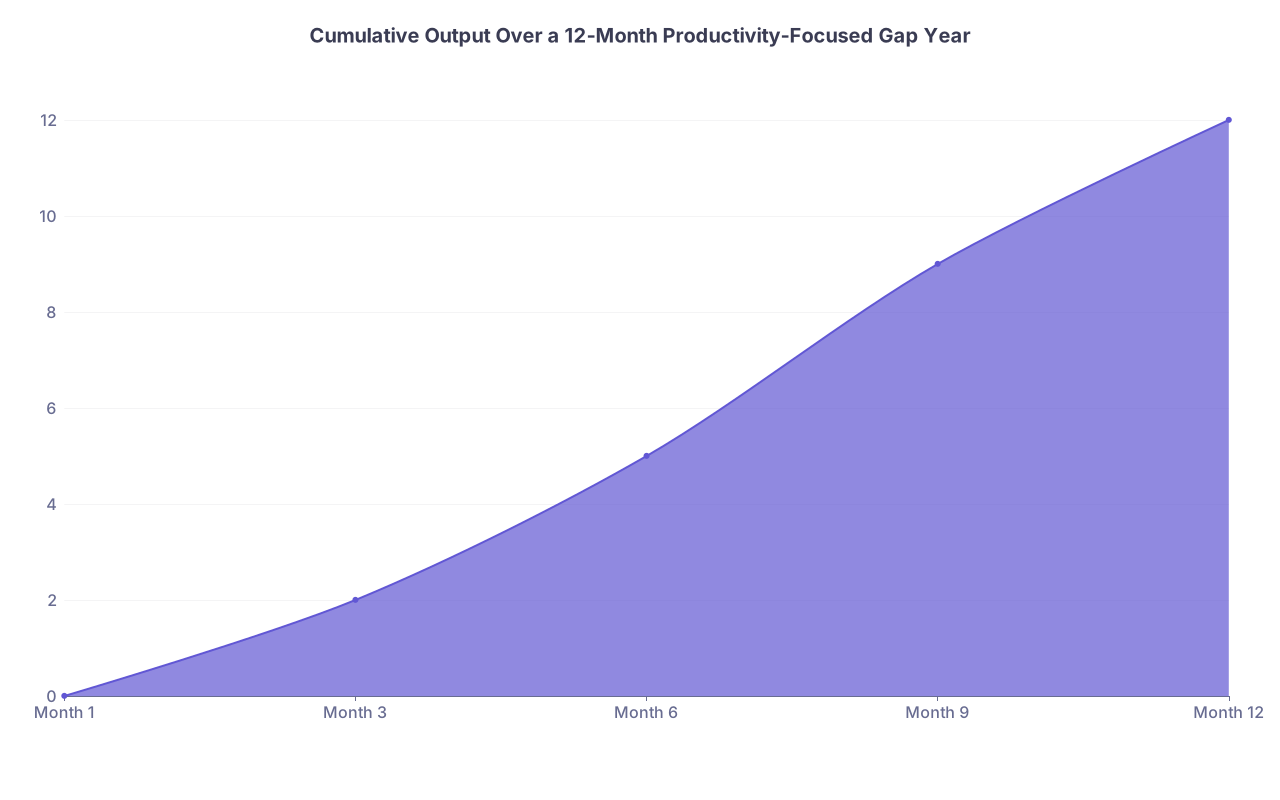
Here is what a high‑yield 12‑month plan often looks like when you map it to output.
| Category | Value |
|---|---|
| Month 1 | 0 |
| Month 3 | 2 |
| Month 6 | 5 |
| Month 9 | 9 |
| Month 12 | 12 |
“Output” here is publications + submitted abstracts + posters, weighted roughly equally from an application optics standpoint.
A practical weekly breakdown during the core 6–9 months of the gap year might be:
- 30–40 hours / week: Research activities (data extraction, analysis, manuscript drafting, IRB submissions).
- 10–15 hours / week: Step 2 studying (if not yet taken) or specialty reading / Boards prep (if taken).
- 5–10 hours / week: Clinical exposure (clinic with PI, OR days, shadowing as needed).
- Buffer: Application prep and networking in the 3–4 months before ERAS submission.
You should be tracking metrics weekly:
- Number of projects you are on.
- Stage of each project (IRB, data collected, analysis, draft, submitted, accepted).
- UWorld blocks completed, NBME scores if Step 2 is pending.
That is how you end up with 8–15 items on ERAS instead of “still working on a big paper” that will not be out until next spring. From a program’s perspective, submitted > in‑progress. Accepted > submitted. Your job in a gap year is to push projects along that continuum relentlessly.
7. Red Flags, Narratives, and How a Gap Year Changes Risk Perception
Specialty competitiveness is not just raw numbers. It is also risk management. Programs ask, sometimes explicitly: “Will this resident struggle, fail out, or be a problem?”
Gap years can raise or lower perceived risk.
A vague gap year with:
- No clear employment.
- No measurable outputs.
- Limited documentation of clinical engagement.
…often increases program anxiety. They wonder if there were professionalism issues, mental health crises, or academic problems you are hiding.
A productivity‑focused gap year does the opposite. It can rehabilitate:
- Prior exam failure (USMLE/COMLEX retake).
- LOA for academic issues.
- Marginal early clerkship performance.
The key is that your gap year must show:
- Sustained work capacity (40+ hours weekly doing real work, not “shadowing sometimes”).
- Concrete accomplishments (papers, QI projects implemented, Step 2 improvement).
- Professional endorsements (letters from supervisors during that year).
From a data standpoint, when programs see improved exam scores, solid output, and strong letters after a problem period, they discount the earlier risk. Not entirely, but significantly. This can open doors in mid‑competitive specialties that would otherwise be wary of taking a chance.
8. Putting It Together: How To Decide If a Productivity‑Focused Gap Year Is Worth It For You
You should not take a gap year just because “everyone else is doing research.” Look at your baseline data honestly.
Ask yourself four quantitative questions:
Step 2 potential:
- Where would you likely score if you crammed during rotations?
- How many points do you realistically think a 3–4 month dedicated block could add?
Research delta:
- How many publications / presentations do you have now?
- With a full‑time research year under a productive mentor, what is a plausible range in 12–18 months?
Specialty benchmark:
- What are matched applicant medians for your target specialty (Step 2, research count)?
- Are you below, at, or above those medians?
Opportunity cost:
- One year of attending salary deferred.
- Loans accruing interest.
- Personal fatigue / burnout.
Sometimes the math is straightforward:
- If you are at the 25th percentile of your target specialty’s competitiveness profile and a gap year could move you to the 50–60th percentile, that is life‑changing.
- If you are already above the 75th percentile for a lower‑ or mid‑competitive specialty and you are not chasing an extremely academic niche, the marginal benefit is smaller.

Your decision should be based on a simple comparison:
- “Without a gap year, what are the likely specialties and tiers I will match into?”
- “With a maximally productive gap year, how does that specialty and tier distribution change?”
If the gap year shifts you from primarily community IM to realistic chances at academic IM with subspecialty fellowship pipelines, that may be worth a year. If you are hoping it turns an average IM candidate into a competitive Derm applicant, the data does not support that fantasy in most cases.
The gap year is a multiplier, not magic.
9. The Strategic Way Forward
A productivity‑focused gap year does not just “make you more competitive.” It reshapes the geometry of your options:
- It steepens your Step 2 curve.
- It thickens your research CV, especially in research‑hungry fields.
- It clarifies your narrative and reduces risk in the eyes of programs.
That combination shifts which specialties, and which tiers within those specialties, are realistically available to you.
If you are serious about using a gap year strategically, you should be thinking less like a student and more like a project manager:
- Identify your target specialty benchmarks.
- Map your current stats against those benchmarks.
- Design a 12‑ to 18‑month plan with explicit numeric outputs.
- Track progress and adjust when projects stall.

The upside is significant. One well‑constructed gap year can move you from “borderline in a back‑up field” to “solid in a field you actually want.” But you only get that payoff if the year is ruthlessly structured and output‑driven.
You have one more decision ahead: how you turn that upgraded profile into an application strategy—school lists, away rotations, letters, interview prep—that maximizes the return on your gap‑year investment. That next layer of optimization, and how it interacts with the Match algorithm itself, is what you tackle once your gap year plan is locked in.


