

The assumption that “any match is better than a gap year” is mathematically wrong for a significant slice of unmatched applicants.
The Core Question: SOAP Now or Gap Year Then Reapply?
You are staring at two bad options:
- Scramble into a program during SOAP that you did not plan for and may not want.
- Take a post‑match gap year, strengthen your application, and re-enter the match next cycle.
The data show this is not a coin flip. The probabilities, long-term outcomes, and risk profiles of these paths are very different.
The problem: NRMP, ECFMG, and state boards do not publish a clean RCT of “SOAP vs gap year.” You will not find a neat table labeled “Effect of gap year on SOAP success.” But you can get very close by triangulating:
- SOAP fill rates and specialty patterns
- Re‑applicant match rates vs first‑time applicants
- Impact of added research, U.S. clinical experience (USCE), and exam improvements
- Unemployment / underemployment risk for those locking into poor‑fit SOAP positions
Let me walk through this like an analyst, not a motivational speaker.
Baseline Numbers: What Actually Happens to Unmatched Applicants?
Start with scale. In recent cycles:
- Roughly 44,000 applicants compete for about 40,000 PGY‑1 positions.
- About 3,000–4,000 U.S. MD/DO seniors go unmatched each year.
- A larger number of IMGs (US and non-US) miss on the first try.
SOAP exists to mop up. But it is not a safety net for everyone.
SOAP Reality Check
Across recent years, SOAP has:
- Started with roughly 10,000–12,000 unfilled positions right after the main match.
- Filled >95% of those positions by the end of SOAP.
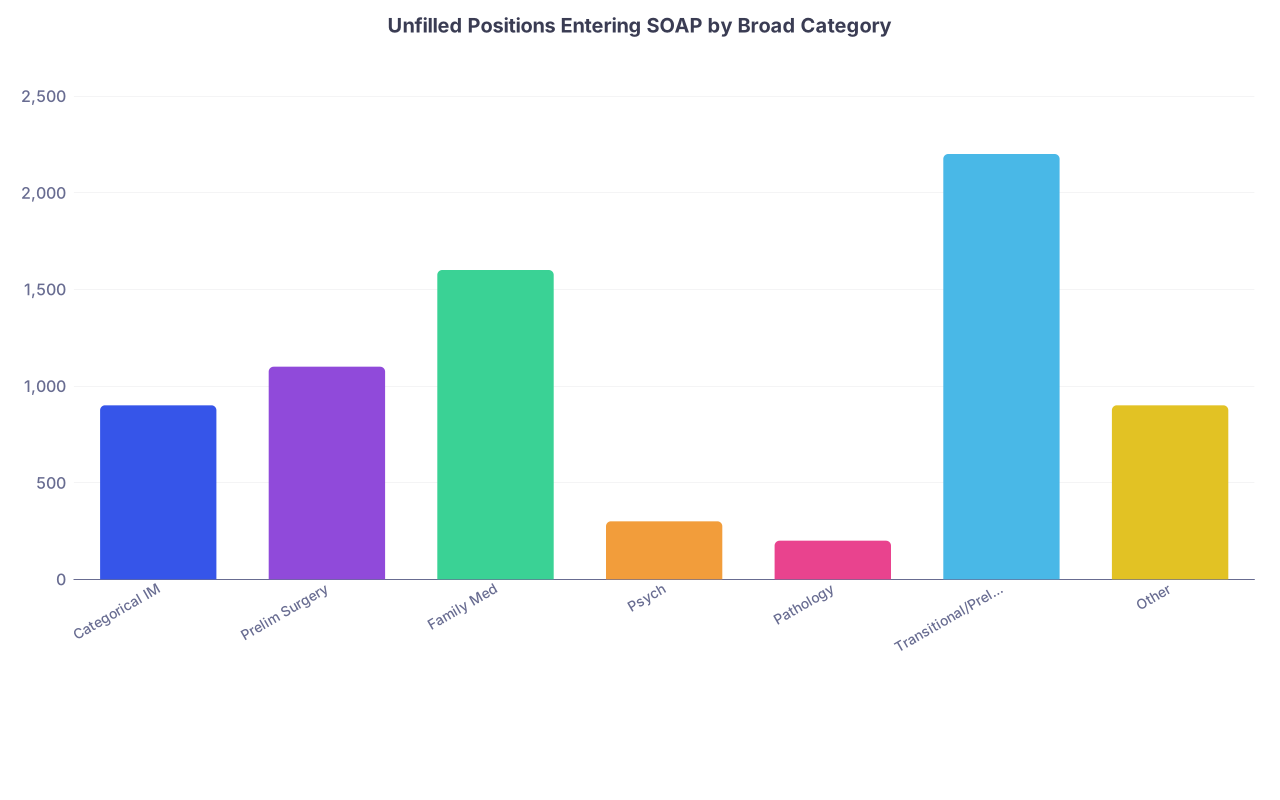
That sounds good until you see where those positions are.
| Category | Value |
|---|---|
| Categorical IM | 900 |
| Prelim Surgery | 1100 |
| Family Med | 1600 |
| Psych | 300 |
| Pathology | 200 |
| Transitional/Prelim IM | 2200 |
| Other | 900 |
Rough pattern:
- Heavy in prelim surgery, transitional year, prelim internal medicine.
- A big chunk in family medicine and community internal medicine.
- Almost none in dermatology, ortho, plastic surgery, ENT, ophthalmology, or radiology.
- Very few in competitive academic internal medicine or categorical surgery tracks.
So for a candidate who missed in neurosurgery, derm, ortho, ENT, or even strong academic internal medicine, SOAP will not give a “slightly worse version” of the same dream. It is a different career trajectory.
What Happens to Re‑Applicants?
The NRMP’s “Charting Outcomes” and “Data for Re‑Applicants” consistently show:
- First‑time US MD seniors match at ~92–95% overall.
- Re‑applicant US MD seniors match at ~75–85% depending on specialty and improvements.
- DO and IMGs have lower absolute rates but similar relative patterns: re‑applicants do worse unless something substantial changes.
The key phrase is “unless something substantial changes.” That is where the gap year comes in.
SOAP vs Gap Year: Two Very Different Probability Trees
Think like a statistician running two scenarios.
Scenario A: You Go All‑In on SOAP
Assumptions based on NRMP SOAP data and what I’ve seen in actual applicant pools:
- You are unmatched after the main match.
- Your scores, experiences, and specialty choices have already been tested against the market and failed once.
- During SOAP, you will be competing with:
- Other unmatched seniors
- Previous‑year grads
- Some IMGs with strong clinical and research portfolios
Actual SOAP outcomes cluster into a few buckets:
- Matched into an undesired but accredited categorical position (e.g., FM in a location you never considered, community IM with limited subspecialty exposure).
- Matched into a prelim/transitional year with no guaranteed PGY‑2 spot.
- Unmatched after SOAP.
For US MD/DO seniors, SOAP match probability into something (prelim/categorical) is reasonably high—often >60–70% depending on flexibility. But:
- Categorical in your original specialty via SOAP is rare outside primary care, psych, and community IM.
- Competitive specialty SOAP matches are statistically negligible.
Now compare with a simple decision table.
| Pathway | Best Likely Outcome | Moderate Outcome | Worst Outcome |
|---|---|---|---|
| SOAP this year | Categorical in less desired field | Prelim TY/prelim surgery/IM | Unmatched after SOAP |
| Gap year + reapply | Categorical in target or close | Categorical alternate but planned | Unmatched again / out of pipeline |
SOAP maximizes the probability of “some job now,” not “best specialty fit over 30‑year career.” That distinction matters financially and professionally.
Scenario B: You Take a Gap Year and Re‑Enter Next Cycle
Now assume you:
- Use the gap year for high-yield activities: research with publications, USCE with letters, exam improvements (CK, English exams, possibly retake OET/IELTS for some IMGs), maybe completion of a master’s or MPH with demonstrable output.
- Re‑target specialties and programs based on data, not wishful thinking.
The NRMP data show a gap:
- Re‑applicants with demonstrable improvements have match rates approaching first‑time applicants in several primary care specialties.
- Re‑applicants with no meaningful change have significantly lower match rates, often <50% in competitive specialties.
The gap year is not magic. It is an input. The effect size depends on what you do.
What Actually Moves the Needle in a Gap Year?
The data show that “time passed” by itself does nothing. Programs are explicit about this when I talk to PDs and APDs. They look for 4 quantifiable signal categories.
1. USMLE/COMLEX Performance Gains
- Step 1 is now pass/fail, but a failure is still a major flag.
- Step 2 CK remains a hard numerical filter.
Patterns from PD survey data and matching outcomes:
- Step 2 CK < 220 (or COMLEX Level 2 < ~480) severely restricts options for US grads and is close to fatal for non‑US IMGs in competitive markets.
- Raising Step 2 from ~220 to 240+ changes the size of your realistic program pool dramatically, especially in IM, FM, psych, peds, and anesthesia.
If your current Step 2 is weak and you still have a window to retake or to add a strong COMLEX 2, a gap year focused on exam remediation has large effect size. I have seen candidates jump from no interviews to 10–15 interviews purely by getting CK into the mid‑240s plus fresh letters.
2. Research Productivity
Programs do not care if you “did research.” They care if you produced something.
Correlation is clear:
- For competitive specialties (derm, ortho, ENT, neurosurgery, IR, rad onc), matched applicants typically report 10–20+ abstracts, posters, or publications.
- For IM, anesthesia, radiology, EM, psych: the median is lower, but applicants with at least a few real products and one strong research letter have a distinct interview advantage, especially at academic centers.
A gap year with:
- 1–2 first‑author manuscripts accepted or in late‑stage review
- 2–5 posters/abstracts
- Strong letters from known faculty in the specialty
has measurable impact. The effect is “non‑linear”: going from 0 to 3 outputs is far more powerful than going from 10 to 13.
3. U.S. Clinical Experience (USCE) and Letters
For IMGs in particular, the data are unambiguous:
- Programs rank “strong letters from US faculty in the specialty” in the top 3 selection factors almost every survey cycle.
- Hands‑on USCE (sub‑internships, observerships with real responsibility, inpatient electives) strongly correlates with interview likelihood.
A gap year generating:
- 3–6 months of solid USCE in the exact specialty you are targeting
- 2–3 letters from people who actually know you, not just template writers
often moves candidates from “no interviews” to “enough interviews to be in the game.”
4. Specialty and Program Strategy Shift
This is the unsexy but brutally effective lever.
You see this pattern over and over:
- First cycle: Student chases ortho, derm, plastics, etc. with a mediocre competitiveness profile.
- Goes unmatched or ends up in SOAP prelim.
- Gap year: switches focus to anesthesia, radiology, or internal medicine with a realistic program list and a broader geographic spread.
- Match rate skyrockets the second time.
If you use your gap year to:
- Abandon truly unrealistic targets based on data (Step 2 below average for derm? The numbers do not care about your passion).
- Build a “tiered” list: reach, realistic, and safety programs based on historical match lists, score ranges, and IMG friendliness.
You transform the second cycle from “long‑shot specialty re‑try” into “targeted, probability‑optimized campaign.”
Quantifying Comparative Risk: SOAP vs Gap Year
Let’s put rough numbers to this. The exact values vary by year and profile, but directional trends hold.
Assume you are:
- A US MD senior, no red‑flag professionalism issues.
- Step 1 pass, Step 2 = 228.
- Applied to categorical internal medicine and anesthesia, got a few interviews but did not match.
Path 1: Aggressive SOAP into Anything
Reasonable estimates based on NRMP + what PDs report:
- 70–80% chance of getting some SOAP offer if you are willing to go into:
- Family medicine
- Community IM
- Prelim IM or prelim surgery
- Transitional year
- 20–30% chance of ending SOAP with nothing.
Conditional on accepting a SOAP spot:
- ~50–60% chance that you are in a categorical position you can live with.
- ~40–50% chance you are in a prelim/transitional position with no guaranteed PGY‑2.
Second‑cycle outcomes from a prelim:
- Many prelims do not convert to categorical spots.
- You are reapplying while working 60–80 hours/week, with limited capacity to change research, exams, or strategy.
- Match rate for “reapplying from a prelim” is lower than for “reapplying after a structured gap year” in specialties like anesthesia, rads, and competitive IM tracks, simply because there is less change in your portfolio.
Path 2: Deliberate Gap Year and Reapply
If you:
- Raise Step 2 CK to ~240+
- Add 1–2 publications and a few abstracts
- Secure 2–3 strong specialty‑specific letters
- Expand your program list to include more community and IMG‑friendly sites
Typical outcome bands (for IM / anesthesia‑targeting US grads):
- 60–80% chance of matching into internal medicine (wide range depending on geography flexibility).
- 30–50% chance of matching into anesthesia or another moderately competitive specialty if your new profile hits median ranges.
For IMGs with weaker initial profiles, the absolute percentages shift down, but the relative value of the gap year is often larger because improvements (USCE, letters, English fluency, exam retakes) move them from “auto‑screened out” to “considered.”
Where SOAP Makes Sense—and Where Gap Year Wins
SOAP is statistically defensible in a few scenarios.
SOAP is Reasonable If…
- You are perfectly happy with primary care or broad‑based internal medicine and only care about “being a resident somewhere in the U.S. this year.”
- Your risk tolerance is low, and the idea of spending a year in limbo is worse than 30 years in a less‑than‑ideal specialty.
- Your chances of materially improving your application in a gap year are objectively small:
- Exams are already strong (Step 2 > 250).
- You already have several publications and good letters.
- The main problem was pure bad luck or narrow geography constraints.
In these cases, the expected utility of SOAP (immediate income + training start) can exceed the probabilistic upside of a delayed, marginally better match.
Gap Year is Statistically Superior If…
- You aimed for a competitive specialty and have almost zero SOAP options in that field.
- Your scores, research, or USCE are clearly below median and fixable.
- You are not willing to commit long‑term to the fields that actually have SOAP availability.
For example:
- You missed in ortho with Step 2 = 240, little research.
- SOAP will offer you prelim surgery in a high‑workload, low‑support environment.
- A focused gap year adding 1–2 ortho or MSK‑oriented publications, relevant USCE, and maybe an improved Step 2/COMLEX portfolio pushes you closer to the competitive band—or helps you pivot intelligently to anesthesia or radiology with much better odds than from a prelim surgery job.
Or:
- You are a non‑US IMG with Step 2 = 225, no USCE, no publications.
- SOAP options will be minimal and often in programs hostile to visa issues.
- A well‑planned gap year acquiring 6–12 months of USCE, a couple of publications, and cleaner English exam results can move match probability from near‑zero to meaningfully >25–40% in IM/FM/psych, depending on geography.
Structuring a High‑Yield Gap Year (Not a “Lost Year”)
The data pattern is clear: “floating” for a year torpedoes your application. A structured gap year can rescue it.
Think of it as designing a portfolio with measurable outputs:

| Step | Description |
|---|---|
| Step 1 | Unmatched After Match |
| Step 2 | Exam Retake/Improve CK |
| Step 3 | Research Fellowship |
| Step 4 | US Clinical Rotations |
| Step 5 | Reassess Targets |
| Step 6 | New Scores |
| Step 7 | Publications/Posters |
| Step 8 | New Letters |
| Step 9 | Broader Program List |
| Step 10 | Reapply Next Cycle |
| Step 11 | Key Weakness? |
You want quantifiable deliverables by the time ERAS opens again:
- New score report with higher CK or COMLEX 2.
- CV entries that include accepted manuscripts, not “submitted” vaporware.
- At least 2–3 US‑based letters dated in the application year.
- Explicit specialty pivot documented through rotations and experiences, not just “I changed my mind.”
The programs that actually read your file will notice.
The Psych Trap: Overvaluing Immediate Match
There is a strong psychological bias here:
- You and your peers have spent 4+ years believing “not matching = failure.”
- SOAP feels like a last chance to avoid that failure.
From a purely data‑driven perspective, that framing is flawed.
A gap year:
- Delays income by one year.
- Costs some opportunity cost and, for some, visa or debt‑related stress.
But if it moves you from:
- 60% chance of a lifetime in a field you dislike
to - 60% chance of a field you prefer + 30% chance of a more acceptable backup + 10% chance of ultimately leaving medicine
the expected lifetime satisfaction and earning potential strongly favor the second option.
You are not deciding between “match vs never match.” You are deciding between “match fast into anything” and “optimize the probability distribution of lifelong career outcomes.”
A Quick Look at Financial Implications
One more layer. Numbers again.
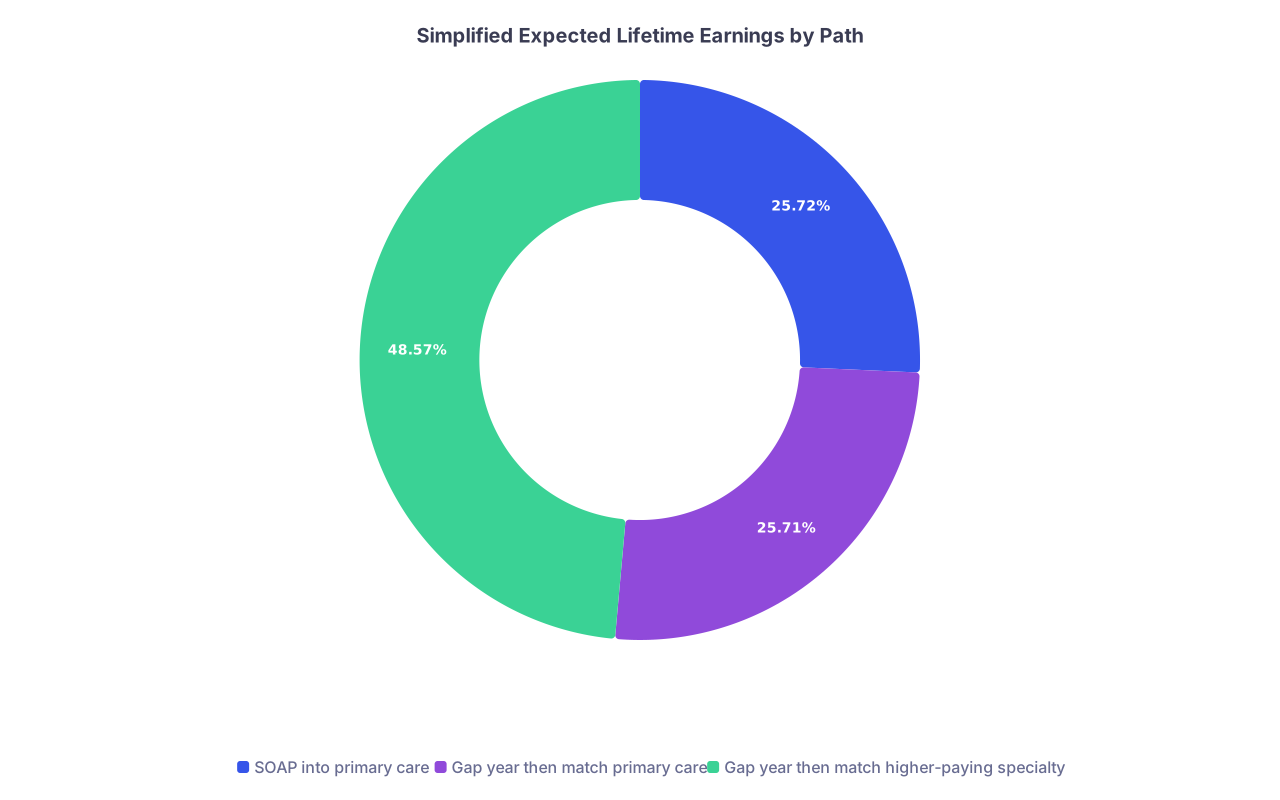
Rough lifetime income differences (over 30–35 years, US averages, ignoring discount rates):
- Family medicine vs anesthesiology: often a gap of $4–6 million in gross earnings.
- Low‑paying primary care vs high‑end subspecialists (ortho, derm, IR): gap can exceed $8–10 million.
If a well‑structured gap year:
- Decreases your probability of “undesired STEM primary care” from 80% to 30–40%.
- Increases your probability of “moderately or highly competitive specialty” from 10% to 40–50%.
Then the expected value difference dwarfs one year of lost PGY‑1 salary. The math is ugly and unforgiving here.
| Category | Value |
|---|---|
| SOAP into primary care | 4.5 |
| Gap year then match primary care | 4.5 |
| Gap year then match higher-paying specialty | 8.5 |
(Values here are illustrative in millions, not precise, but the ratio is realistic.)
Again, that does not mean everyone should chase derm at all costs. It does mean you should not trade 30 years of suboptimal fit and earnings for one year of psychological relief unless the data argue you truly have no realistic path to improvement.
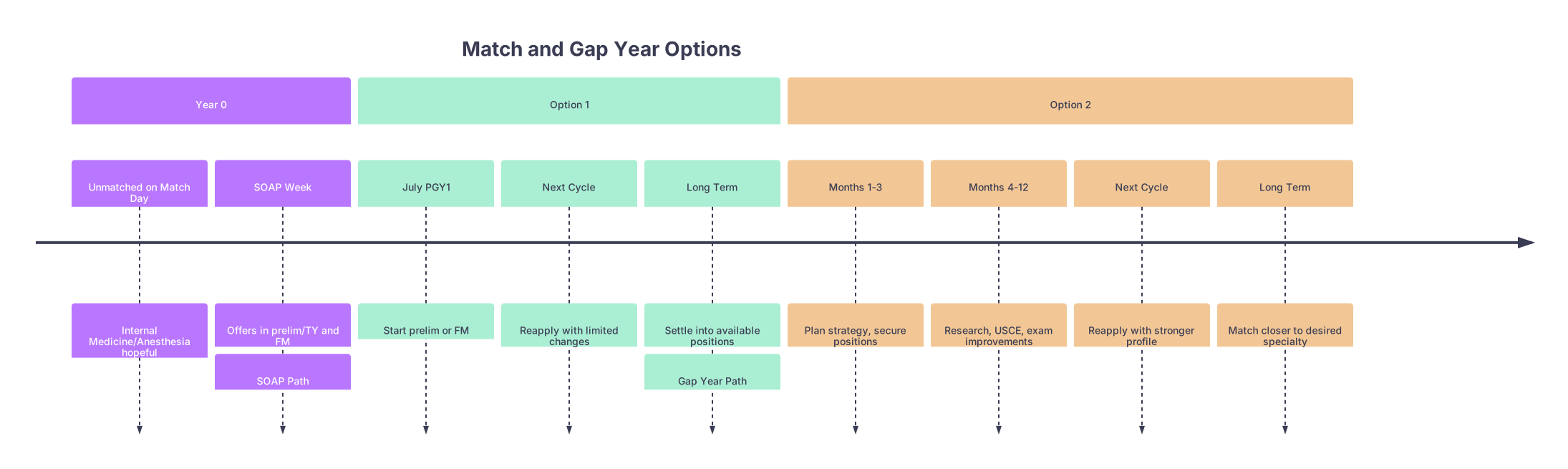
Visualizing the Match Trajectory
It helps to see this as a multi‑cycle process, not a single do‑or‑die moment.
| Period | Event |
|---|---|
| Year 0 - Unmatched on Match Day | Internal Medicine/Anesthesia hopeful |
| Year 0 - SOAP Week | Offers in prelim/TY and FM |
| Option 1: SOAP Path - July PGY1 | Start prelim or FM |
| Option 1: SOAP Path - Next Cycle | Reapply with limited changes |
| Option 1: SOAP Path - Long Term | Settle into available positions |
| Option 2: Gap Year Path - Months 1-3 | Plan strategy, secure positions |
| Option 2: Gap Year Path - Months 4-12 | Research, USCE, exam improvements |
| Option 2: Gap Year Path - Next Cycle | Reapply with stronger profile |
| Option 2: Gap Year Path - Long Term | Match closer to desired specialty |
The “cycle” model matches what actually happens in the data: plenty of residents matched on the second or even third attempt have objectively better end states than peers who scrambled into the first available SOAP slot.
Final Takeaways
SOAP maximizes your odds of “any job now,” not your odds of “right specialty for 30 years.” For many unmatched applicants, that is a bad trade statistically and financially.
A structured gap year with exam improvement, real research output, strong USCE, and strategy correction can move your match odds and specialty options substantially—especially if your first attempt was misaligned with your competitiveness.
The worst choice is an unplanned gap year that changes nothing. If you are going to step off the match treadmill, treat it like a data‑driven project with measurable outputs, not a vague “time to figure things out.”


