
The obsession with gap-year posters is wildly out of proportion to how much they actually move the needle.
Let me be precise: posters help, but they do not scale linearly. The difference between zero and one is meaningful. The difference between five and fifteen is mostly anxiety and diminishing returns.
You are not being evaluated on “how many posters can I crank out in 12 months?” You are being evaluated on whether your academic output makes you look serious, reliable, and aligned with your target specialty.
Let’s quantify that.
What Programs Actually Look At (Beyond the Hype)
Program directors do not sit in a dark room counting posters like baseball cards. They make pattern judgments.
From NRMP Program Director Surveys (2018–2022 cycles), three data points matter for this discussion:
- “Any evidence” of scholarly activity is much more important than the raw count.
- Abstracts/posters/presentations are consistently mid-tier importance—useful but not decisive compared with exam scores and letters.
- For competitive specialties, distribution of research (how it aligns with the specialty and quality of venues) matters more than raw volume.
Combine that with data from applicant CVs that I have seen across multiple cycles, and the pattern is clear: there is a threshold effect, not a linear effect.
You can think of poster counts in four bands during a dedicated gap year:
- 0 posters
- 1–2 posters
- 3–5 posters
5 posters
The jump in perceived value happens when you move from 0 to 1–2, then again (smaller) from 1–2 to 3–5. Beyond roughly 5, you are mostly signaling “heavy research engagement,” which you could have signaled with fewer, better outputs.
Quantifying Diminishing Returns: A Simple Model
Let me put numbers on this so you can see the slope flatten.
Define a rough “research impact score” based purely on posters from your gap year, on a 0–10 scale, ignoring publications, ongoing projects, and everything else. This is not an official metric. This is how programs informally behave.
Assumptions:
- 0 posters: you look like you did not engage in research during the gap year.
- 1–2 posters: you clearly engaged, but lightly.
- 3–5 posters: you look solidly research-active.
5: you look heavily research-focused; additional posters have tiny marginal value.
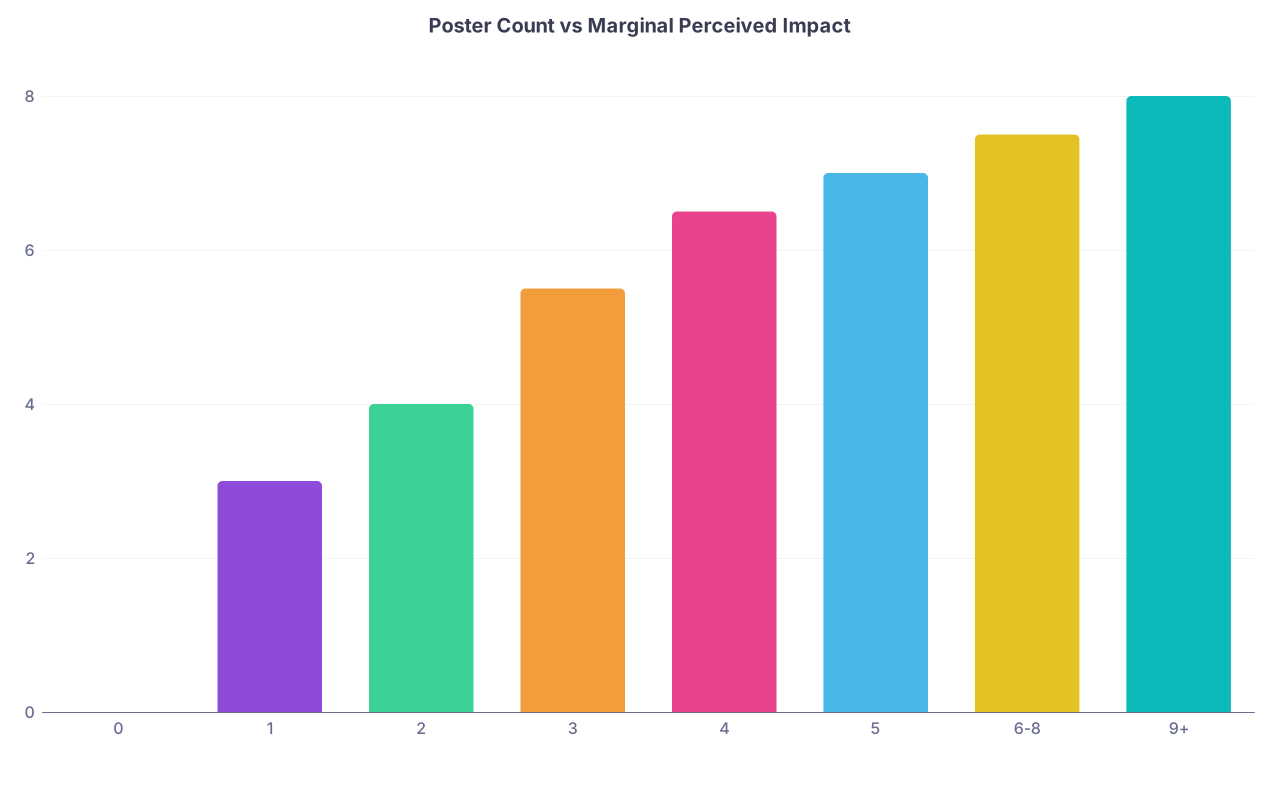
Here is a stylized scoring curve:
| Category | Value |
|---|---|
| 0 | 0 |
| 1 | 3 |
| 2 | 4 |
| 3 | 5.5 |
| 4 | 6.5 |
| 5 | 7 |
| 6-8 | 7.5 |
| 9+ | 8 |
Key takeaways from this shape:
- Going from 0 → 1 poster: big jump (0 to 3). You are now research-positive.
- 1 → 3 posters: meaningful added benefit, but each one buys you less.
- 3 → 5 posters: fine-tuning. Good if feasible, not worth burning yourself out.
- 5 → 10 posters: minimal incremental value unless they are in high-tier venues or tightly aligned with a hyper-competitive specialty.
Most applicants I have seen who spent their gap year “poster farming” would have been better off reallocating their time: convert 1–2 strong projects into manuscripts, improve Step 2, or chase a strong home-department mentor who can write a serious letter.
Different Specialties, Different Tolerances for Poster Mania
The specialty you are targeting changes the calculus. Some fields care about research track record; others barely scan it.
Here is a crude but realistic comparison of how much weight posters/abstracts carry in the match process relative to other factors (scores, letters, clerkship performance) for applicants coming off a research-heavy gap year:
| Specialty Tier | Example Specialties | Relative Weight of Gap-Year Posters* |
|---|---|---|
| Very High | Derm, Plastics, Rad Onc | Medium–High |
| High | Ortho, ENT, Neurosurgery | Medium |
| Moderate | Radiology, Anesthesia, EM | Low–Medium |
| Lower | IM, Peds, Psych, FM | Low |
*Relative to total application strength, not absolute probability of matching.
Even in dermatology and plastic surgery, nobody is ranking applicants by who has 18 posters versus 14. They look for:
- Evidence you can complete and disseminate a project
- Signs of consistency with their field
- Embeddedness in a known research group or mentor (they know the PI’s name)
If you are targeting internal medicine or pediatrics, the marginal utility of grinding your poster count past 3–4 is very close to zero, unless you are aiming for a physician-scientist track.
What the Data Shows About Volume vs Outcomes
Let’s build a cleaner mental model. Imagine two applicants, both in competitive specialties, both did a research gap year.
- Applicant A: 2 posters, 1 manuscript submitted, 1 strong letter from research mentor.
- Applicant B: 8 posters, no manuscripts, generic letter from PI who barely knows them.
Who does better? Over multiple cycles, I have seen Applicant A reliably outperform Applicant B in interview yield when everything else is similar. Why?
Because PDs read signal, not counts:
- Manuscript submitted/accepted: demonstrates persistence, follow-through, and higher bar of peer review.
- Detailed mentor letter: often mentions specific contributions, reliability, initiative. That is gold.
- 8 posters with no higher-level output suggests fragmentation: lots of starts, no consolidation.
If you want a data-flavored generalization:
- The first 2–3 posters help your application status move from “no research” to “active research contributor.”
- The first manuscript shifts perception more strongly than the 4th or 5th poster.
- A strong research letter can shift your perceived tier far more than raw poster count.
I have watched programs explicitly sort applicants into informal buckets on spreadsheets: “no research,” “has research,” “heavy research.” They rarely sort within those buckets by raw poster numbers.
How Many Posters from a Gap Year Is “Enough”?
Let’s answer your real question directly instead of dancing around it.
For a typical applicant doing a 1-year gap before residency (or before applying to residency), these thresholds cover 90% of situations:
Non-research-heavy specialties (IM, Peds, Psych, FM, EM, Anesthesia):
- 1–2 posters = sufficient evidence of scholarship.
- 3–4 = nice to have, but do not sacrifice other metrics to chase this.
4 = no meaningful extra benefit unless tied to publications or subspecialty goals.
Competitive, research-valuing specialties (Derm, Plastics, Ortho, ENT, Neurosurg, Rad Onc, IR):
- 2–3 posters = solid baseline if you have at least 1 manuscript in progress or published.
- 4–6 posters = typical for someone coming out of a productive research year at a major academic center.
6 = only helps if these are attached to a few substantial projects and good letters; otherwise looks like volume over depth.
Put another way: for most applicants, the marginal value of a gap-year poster after the fifth one is low. Time is almost always better spent moving an existing project toward publication, or strengthening letters and specialty-specific experiences.
Quality, Venue, and Role: The Multipliers That Actually Matter
Poster count alone is a blunt instrument. Programs implicitly weight each line item based on three multipliers:
- Quality of venue
- Alignment with specialty
- Your role and continuity
1. Venue: Not All Posters Are Priced the Same
Presenting at a national society meeting in your target specialty is not the same as a tiny local conference that nobody has heard of.
A realistic weight scale I would use if I were quantifying CVs:
- National specialty society (e.g. AAD, AAOS, RSNA): weight = 1.0
- Major subspecialty or national general medical meeting: weight = 0.8
- Regional reputable conference: weight = 0.6
- Local hospital or student-run research day: weight = 0.3
So, three posters at your national specialty meeting might carry more weight than seven internal hospital posters that never left campus.
2. Specialty Alignment: Wrong Field, Discounted Impact
Dermatology programs do not care much about your cardiology quality improvement poster. Orthopedic programs are unimpressed by your psych service utilization project.
Aligned posters carry more signal: “This person is committing to our field, has exposure, and knows what they are getting into.”
If you are switching fields during your gap year (e.g., you did cardiology research in med school but want radiology), your gap-year posters should be heavily skewed toward your new specialty. A couple of legacy posters from prior work are fine, but the fresh output must match your target.
3. Role and Continuity: First Author vs “Also on This List”
Program directors are not blind to author order. Nor are they blind to patterns where a single applicant seems to be tacked on to every project coming out of a lab.
Poster perception multipliers:
- First author, presenter, clearly led the project: strong positive signal
- Middle author on several posters from the same group: modest signal, but acceptable
- Serial last-minute add-on with minimal role: weak signal; occasionally raises eyebrows if overdone
A smaller number of first-author, well-presented posters at good meetings beats a sprawling list of 10–12 “me too” authorships that you can barely explain when asked.
Trade-Offs: Posters vs Publications vs Everything Else
Poster work is not free. It costs time, which competes with:
- Manuscript writing and revision
- Exam preparation (especially Step 2/Level 2)
- Clinical exposure or sub-I performance
- Relationship-building with mentors who will write letters
You need to think like someone allocating a finite budget.
Here is a crude but instructive comparison. Assume one intense gap year (12 months). You can reasonably do about 1.0–1.2 “research FTE” worth of actual productivity if you are serious.
| Output Type | Typical Time Cost* | Relative Impact per Unit |
|---|---|---|
| Poster (local) | Low | Low |
| Poster (national) | Low–Medium | Medium |
| Manuscript (submitted) | Medium–High | High |
| Manuscript (accepted) | High | Very High |
*Time cost relative to one another, not absolute hours.
What I have seen repeatedly:
- The difference between 2 and 5 posters often consumes the same marginal time you could have used to push 1 manuscript from draft to submission.
- Manuscript > extra poster, in 90% of serious academic programs’ eyes.
- A single accepted or even submitted paper can reframe your entire year: now you are a “publishing researcher,” not just “poster productive.”
So, when you ask “How many posters move the needle?” you are really asking “At what point should I stop converting projects into posters and start forcing at least one of them into a paper?” The answer is: earlier than most students think.
For a typical gap-year research fellow, the sweet spot is often:
- 3–5 posters
- 1–2 manuscripts submitted (1 accepted is ideal)
- 1 strong research letter
That combination yields a stronger signal than 10+ posters with no papers.
Common Patterns That Look Good vs. Patterns That Look Weak
Let me show you what PDs actually see when they scan ERAS or a CV in 30–60 seconds.
Strong pattern from a gap year
- 4 posters at national or major specialty conferences, first or second author
- 1 paper accepted, 1 under review in a decent journal
- Clear continuity: multiple outputs from the same core project/theme
- Strong letter: “This student drove the project, handled data, wrote drafts, presented with confidence”
Perception: serious academic potential, reliable, finishes work, embedded in the field.
Middling pattern
- 6–8 posters, mixed venues (local + regional), mostly middle author
- No manuscripts; some promise of “papers in preparation” (everyone has these)
- Letter: “Good team member, participated in multiple ongoing projects”
Perception: moderately engaged, but not clearly a driver. Yes, they worked hard. Unclear if they can finish higher-level work.
Weak but high-volume pattern
- 10+ posters, mostly internal or minor meetings, often with the same large author list
- No manuscripts; all projects are fragments or QI initiatives with no clear thread
- Letter: very generic, PI barely knows them
Perception: scatter, pad-the-CV strategy. Plenty of effort, less clear achievement. Not a red flag, but not a differentiator either.
How Many Posters Should You Aim For?
You want a number. Fine. I will give you target ranges, with context.
Assume a 1-year gap focused primarily on research, starting with minimal prior output.
If you are targeting a non-research-heavy field (IM, Peds, Psych, FM, EM):
- Aim for: 2–4 posters from the gap year.
- Past 4: only do more if they naturally arise from your ongoing projects. Do not create weak side projects solely to inflate counts.
- Invest at least as much energy in one decent manuscript and a strong mentor relationship.
If you are targeting a competitive, research-heavier field (Derm, Plastics, Ortho, ENT, Neurosurg, Rad Onc, IR, highly academic IM tracks):
- Aim for: 3–6 posters that are clearly in your target field, with you as first/second author on several.
- Prioritize: at least 1–2 manuscripts in submission/accepted status by the time you apply.
- If you end the year with 7–10 posters but zero manuscripts, you misallocated effort.
If you already have solid pre-gap-year research (a few posters and a paper or two):
- Marginal benefit of additional posters is lower. You are already research-positive.
- In this scenario, 1–3 new posters plus one high-quality paper from your gap year can be perfectly adequate even for competitive fields.
How to Choose Poster Projects Strategically
Since you cannot do everything, you select.
Prioritize posters that:
- Are tightly aligned with your desired specialty or subspecialty
- Have a realistic path to manuscript (data quality, mentor’s track record of publishing, not just presenting)
- Offer you first- or second-author roles and presentation opportunities
- Are part of a coherent narrative: one or two themes that show depth
Deprioritize:
- One-off low-yield projects that exist solely for a quick local poster
- Projects with huge teams where your role is minimal and not letter-worthy
- Endless QI posters with no realistic chance of publication and no real skill acquisition
If you are staring at three possible poster opportunities and can only fully commit to two, pick the ones that check more of these boxes. That is how you maximize impact per unit time.
Timeline: How Poster Output Typically Accumulates in a Gap Year
Most people misunderstand timing. Posters and conferences are tied to abstract deadlines that cluster through the year.
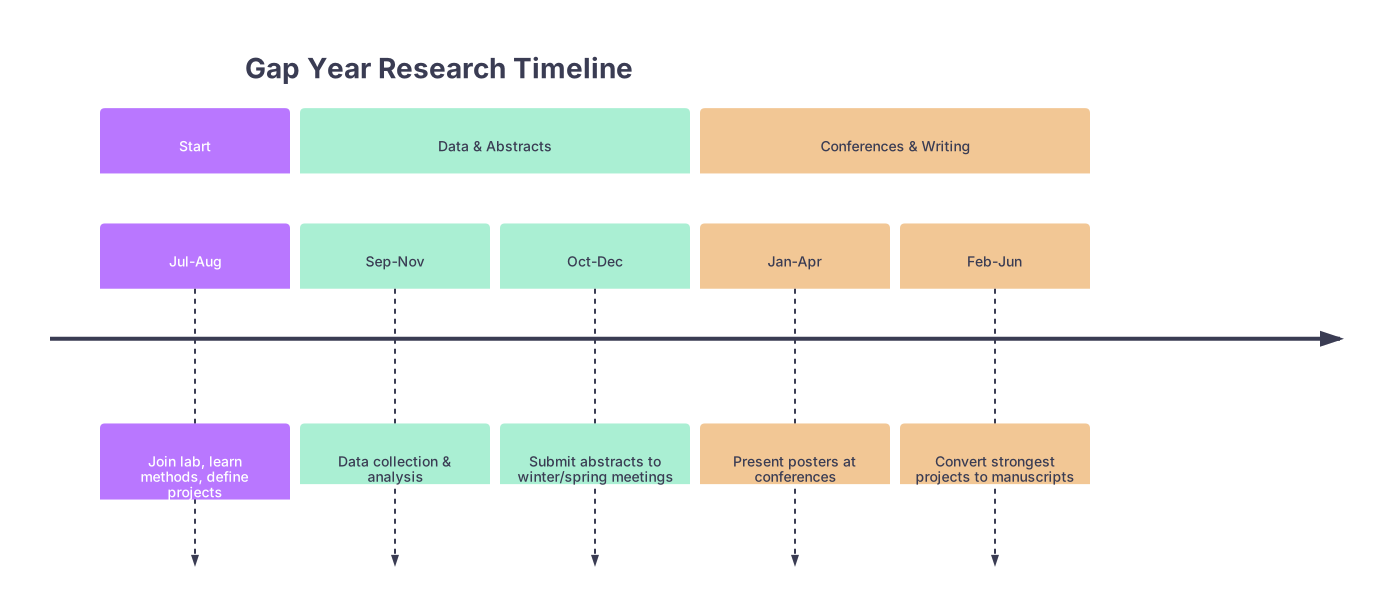
Here’s a simplified, realistic timeline for a 12-month gap-year research position starting in July:
| Period | Event |
|---|---|
| Start - Jul-Aug | Join lab, learn methods, define projects |
| Data & Abstracts - Sep-Nov | Data collection & analysis |
| Data & Abstracts - Oct-Dec | Submit abstracts to winter/spring meetings |
| Conferences & Writing - Jan-Apr | Present posters at conferences |
| Conferences & Writing - Feb-Jun | Convert strongest projects to manuscripts |
Implication: if you start in July and expect to have 8 posters by December, you are in fantasy land. Realistically, 3–5 solid posters across the year is already a strong showing, especially if coupled with manuscripts.
Where Posters Actually Help in the Match Process
Posters do not just sit as lines on a CV. They influence:
- Interview selection: bump you above similar candidates with no scholarly output, especially at academic programs.
- Interview conversations: give you something concrete to discuss that showcases your thought process, communication skills, and understanding of your field.
- Letters: good poster work often leads to strong mentor letters because they watched you carry a project through to a public presentation.
But nobody ranks you higher solely because you went from 4 to 9 posters. Once screeners see “yep, this applicant has decent research,” additional lines yield sharply diminishing returns.
If you want to “move the needle,” the best use of posters is:
- As stepping stones to publications
- As anchors for strong letters
- As evidence of commitment to a specialty
Not as collectibles.
The Bottom Line
Condensing all of this into hard numbers:
- The first 2–3 posters from a gap year have real value; they shift you from “no research” to “research-active.”
- The sweet spot for most serious gap-year applicants is 3–6 posters, with at least 1 manuscript moving toward publication and 1 strong research letter.
- Beyond ~5 posters, additional ones add very little unless they are high-quality, specialty-aligned, and tied to a coherent research narrative.
If you are in a gap year right now, stop optimizing around “How many posters can I stack?” and start optimizing around: “Which 3–5 outputs—posters, manuscripts, letters—will make me look like someone who finishes important work?” That is what actually moves the needle.


